Rhythm & Meter
Duple Meter
Duple meter groups the beats in twos, strong-weak, strong-weak. 2/4 and 2/2 (cut time) are simple duple meters, and 6/8 is compound duple.
Duple meter groups the beats in twos: STRONG-weak, STRONG-weak. It is the meter of walking and marching, left-right, left-right, and you hear it in marches, polkas, many folk dances and children's songs.
Simple and compound duple
There are two families of duple meter, depending on how each beat divides:
- Simple duple: each beat splits into two. 2/4 (two quarter-note beats) and 2/2, or cut time (two half-note beats), are the usual signatures.
- Compound duple: each beat splits into three. 6/8 (two dotted-quarter beats) is the usual signature, and 6/4 also appears.
Both have two beats per bar. What changes is the motion inside each beat: even pairs in simple duple, rocking groups of three in compound duple.
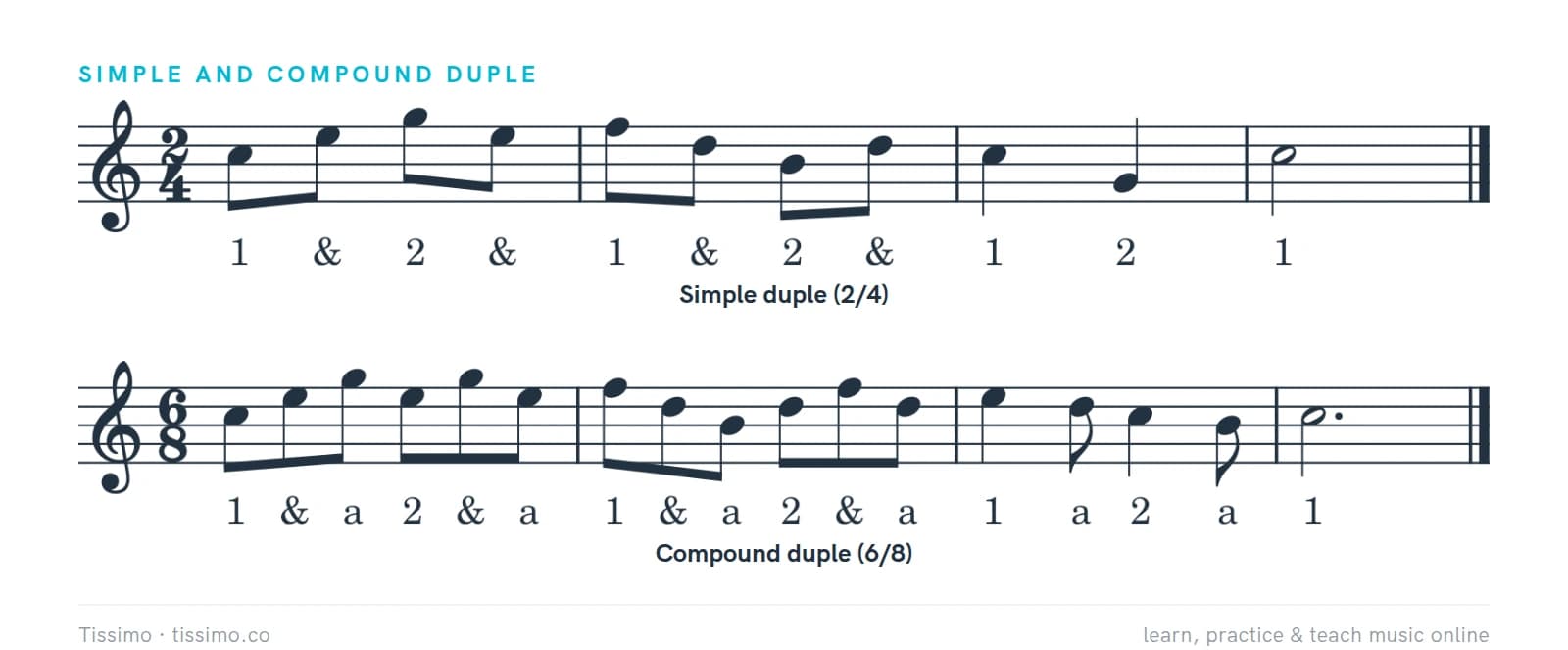
Counting and conducting in two
Count "1, 2" on the beats, and "1 & 2 &" or "1 & a 2 & a" for their divisions. A conductor beats duple meter with a simple down-up pattern: down on 1, the downbeat, and up on 2, the upbeat.
Duple or quadruple?
By ear, duple and quadruple meters can be hard to tell apart, since a bar of 4/4 can sound like two bars of 2/4. Listen to how often the strongest accents and the chord changes come. If every other beat feels equally strong, the music is probably duple. If beat 1 clearly outweighs beat 3, it is probably quadruple. Often both readings work, and the composer's choice of time signature mainly affects how the music looks and how you count it.
Feel the difference between 2/4 and cut time in Two Beats in a Bar: 2/4 & Cut Time and Count in Two, and meet 6/8 in Time Signatures II: Compound Time.
Common questions
Is 6/8 duple or triple meter?
Duple. 6/8 has two beats per bar, each a dotted quarter divided into three eighth notes, so it is compound duple. The "three" you feel lives inside each beat; it is not the number of beats.
Practice it: free worksheets
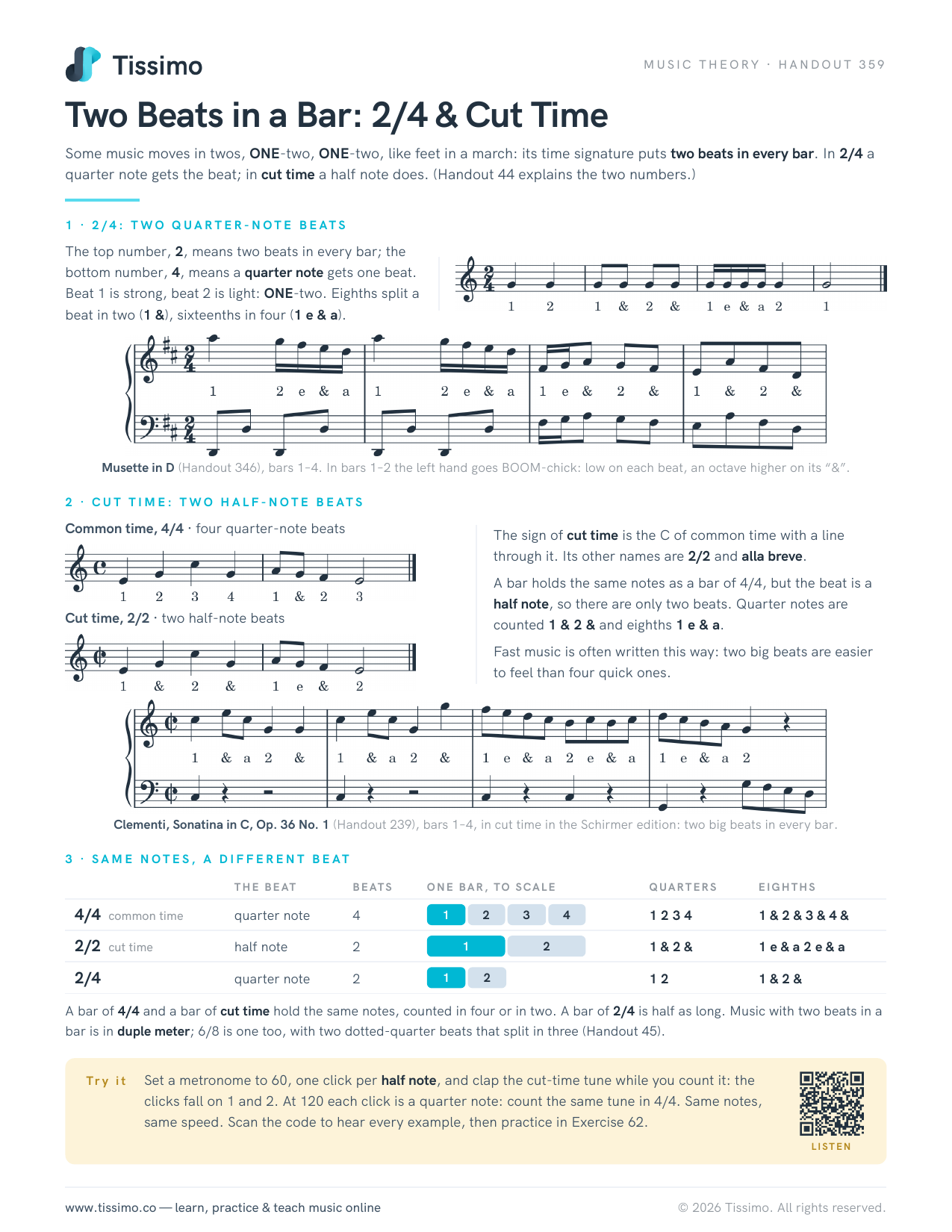 Two Beats in a Bar: 2/4 & Cut TimeSome music moves in twos, ONE-two, ONE-two, like feet in a march: its time signature puts two beats in every bar. In 2/4 a quarter note gets the beat; in cut time a half note does. (Handout 44 explains the two numbers.)
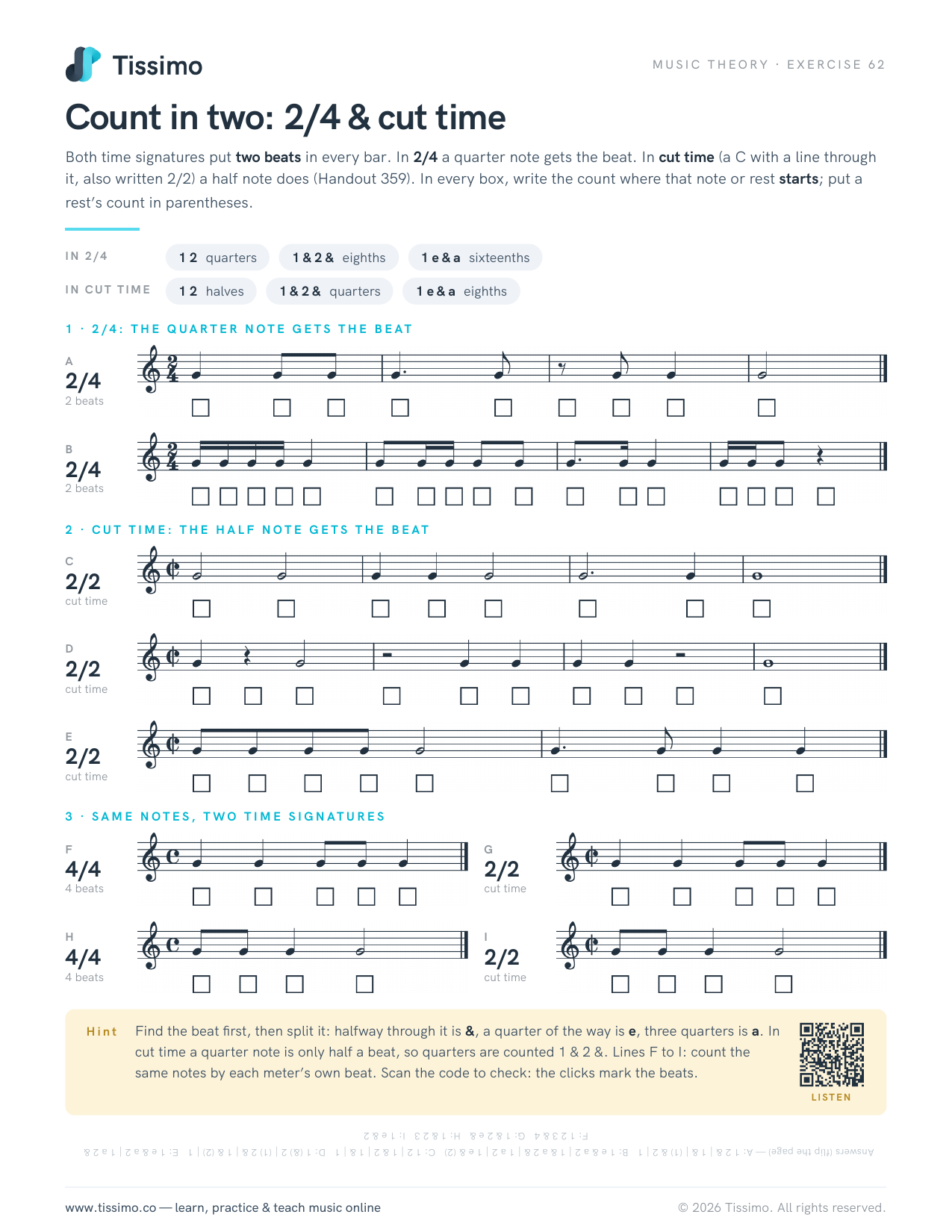 Count in two: 2/4 & cut timeBoth time signatures put two beats in every bar. In 2/4 a quarter note gets the beat. In cut time (a C with a line through it, also written 2/2) a half note does (Handout 359). In every box, write the count where that note or rest starts; put a rest’s count in parentheses.
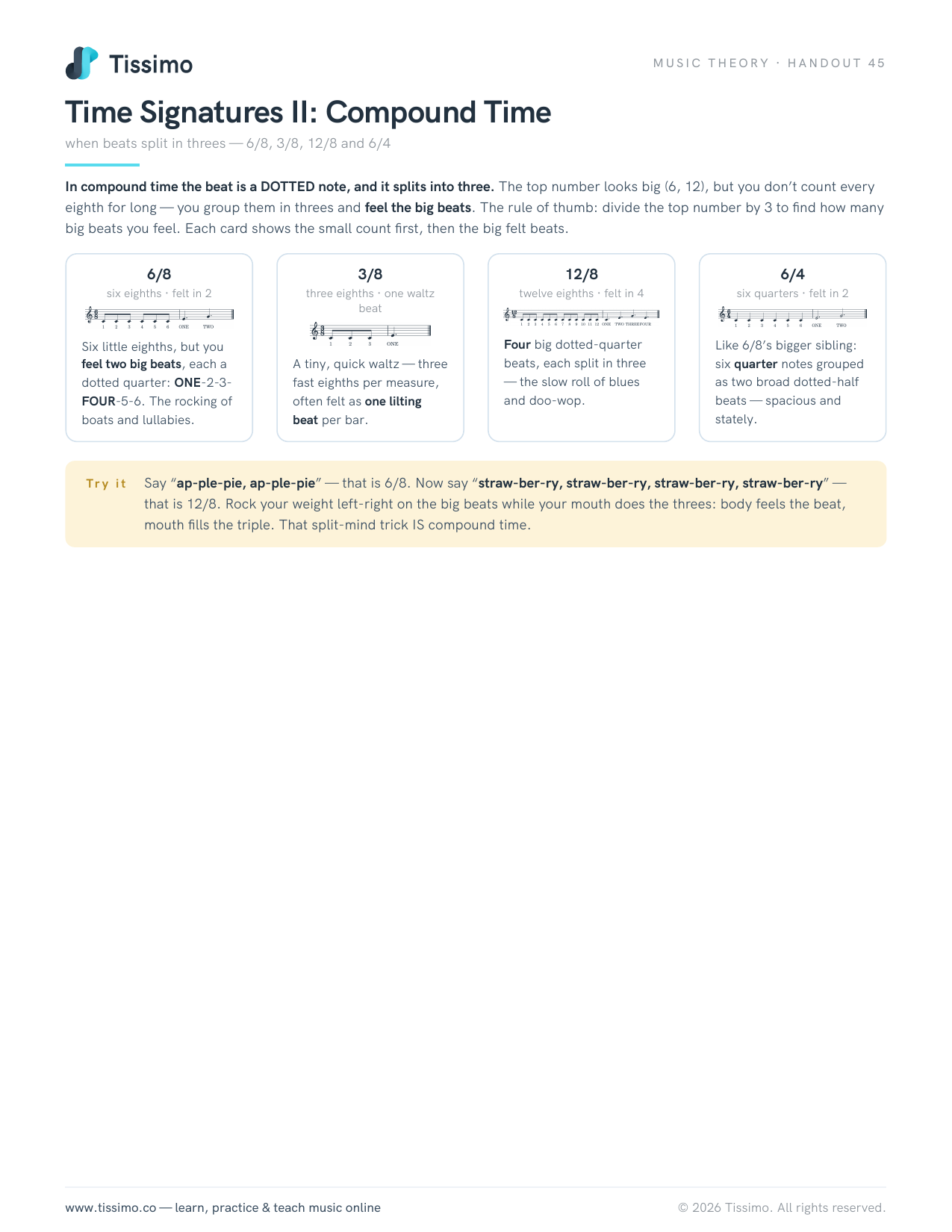 Time Signatures II: Compound Timewhen beats split in threes — 6/8, 9/8, 12/8 and 6/4