Technique & Performance
Duet
A duet is a piece for two performers, or a performance by two musicians together, such as two singers, two instruments, or two pianists sharing one piano (piano four hands).
Any two performers can play a duet: two singers in an opera, a violin and a piano, two guitars, two flutes. In piano music the word usually means piano four hands, two players sharing one keyboard. The player on the right takes the upper part, the primo; the player on the left takes the lower part, the secondo, and usually works the sustain pedal as well. Music for two pianists at two pianos is usually called a piano duo instead.
In printed four-hand music, the secondo part is often on the left-hand page and the primo on the right, so each player reads their own part.
Playing together
The skills of duet playing are the skills of all chamber music:
- Agree on the tempo before you start, and count in together. One player gives a small nod or breath as the signal.
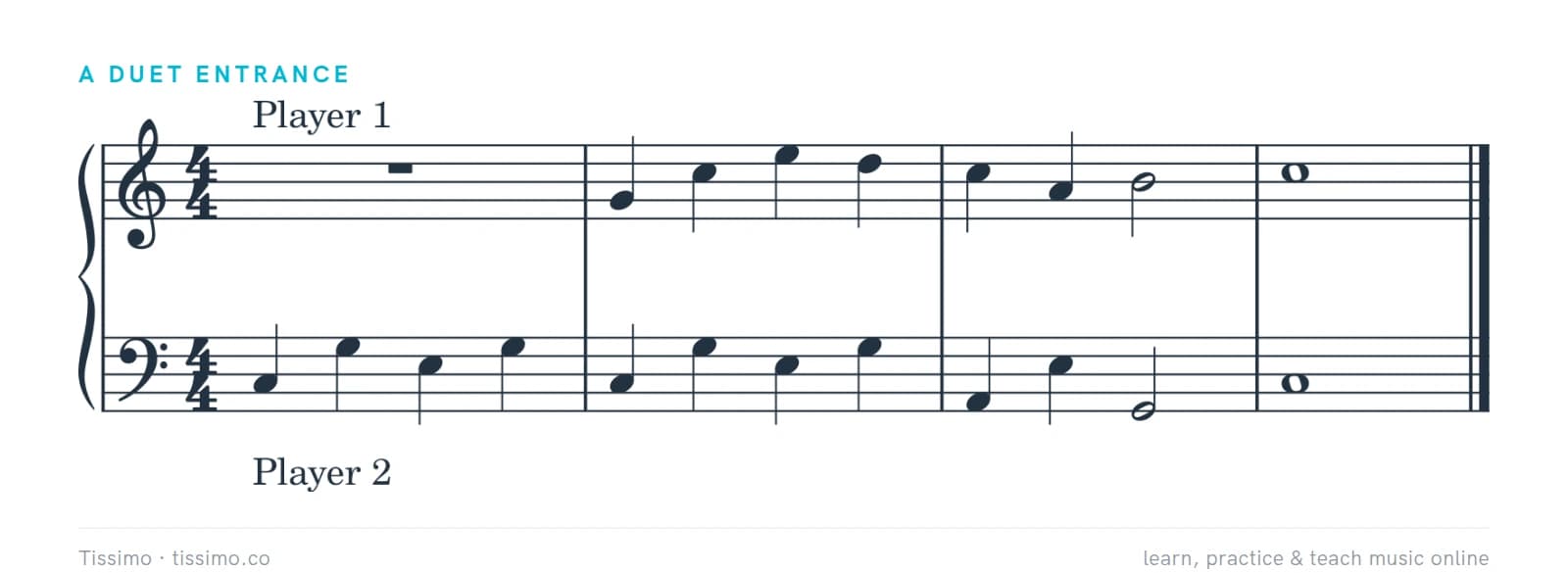
- Count your rests. When your part is silent, keep counting and listen for your entrance, as Player 1 does in the example.
- Listen more than you look. Balance your part against your partner's: whoever has the melody should be heard clearly.
- Keep going. If one player slips, the other keeps the beat, and the lost player comes back in at the next downbeat. Practice this on purpose.
- Rehearse the start and the end. Beginning together and releasing the last chord together are the moments listeners notice most.
Why duets are good for students
Duets build skills solo practice can't: keeping a steady beat because someone else depends on it, listening while playing, and following a partner. Teacher-and-student duets let a beginner make a full, rich sound from the first weeks. Piano Duet: Ready, Count, Play and Duet Cue Detective are written for two players.
Common questions
What is the difference between a duet and a duo?
A duet is the piece or the performance for two; a duo is the pair of performers. In piano music, a duet usually means two players at one piano, and a piano duo two players at two pianos.
What are primo and secondo?
In piano four-hand music, primo is the upper part, played by the person sitting on the right, and secondo the lower part, played by the person on the left.