Technique & Performance
Five-Finger Position
A five-finger position is a hand position with one finger over each of five neighboring notes, such as C, D, E, F and G, so you can play a melody without moving your hand.
In a five-finger position, each finger rests over its own key and stays there. In C position the right thumb sits on middle C and fingers 2, 3, 4 and 5 cover D, E, F and G. The left hand mirrors it: its little finger plays the C below middle C and its thumb sits on G. Because the hand doesn't move, a beginner can read a tune note by note and know that each step up the staff is the next finger.
Major and minor positions
Five neighboring notes starting on any key make a position. For a major five-finger position, the steps from the bottom are whole, whole, half, whole: C D E F G. For a minor position, lower the middle note: C D E♭ F G (whole, half, whole, whole). You can feel the difference under your hand, because finger 3 moves to a black key.
Other keys put black keys under other fingers. G position (G A B C D) is all white keys. D position (D E F♯ G A) and A position (A B C♯ D E) put the right hand's finger 3 on a black key. The 5-Finger Positions in Every Key chart shows all twelve major positions.
Why teachers start here
- You learn to read by step and skip: a step on the staff is the next finger, a skip jumps over one.
- Each finger learns its own job, which builds even, independent fingers.
- Many first pieces stay in one position, then move to a new one during a rest, which leads to your first real fingering decisions.
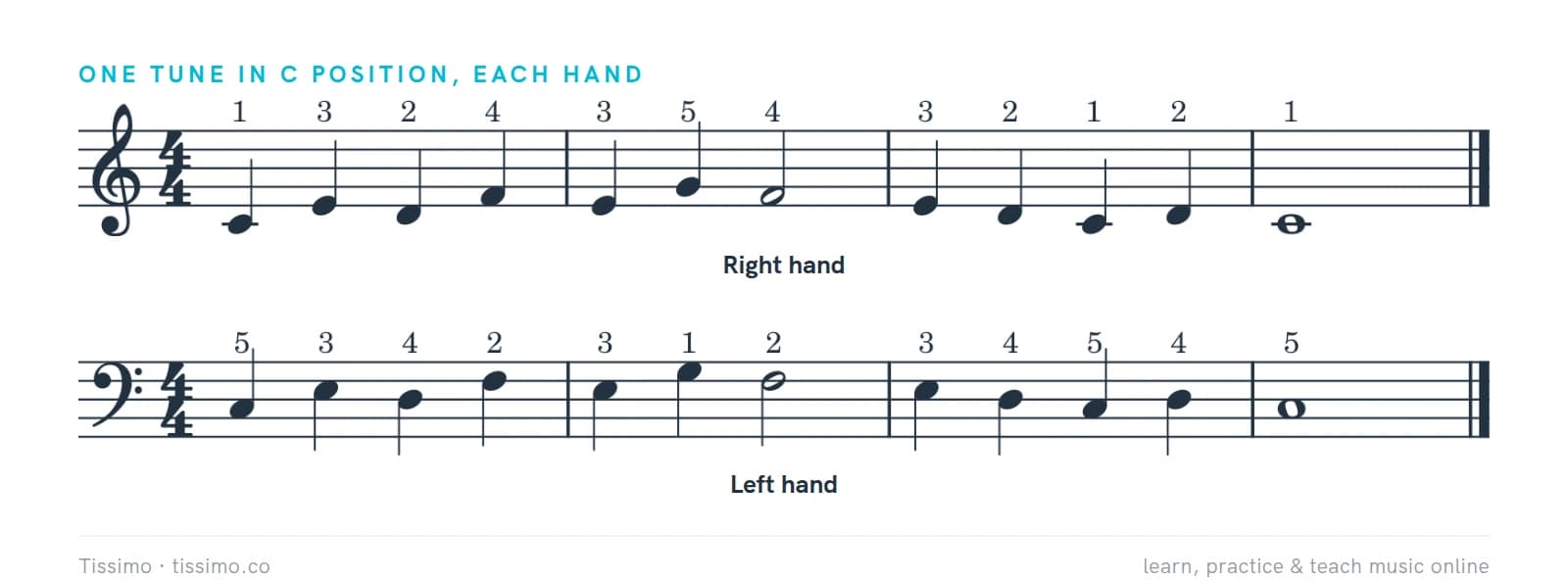
A practice routine for today
- Place your right hand in C position, fingers curved, each fingertip resting on its key. Play C D E F G F E D C slowly and legato.
- Do the same with your left hand, an octave lower.
- Move the pattern to G, then to D, and listen for the same major sound.
- Play the C minor position and compare the two colors.
Five-finger patterns are a common warm-up, and they lead straight to thumb under scale playing, where the hand learns to leave its position smoothly. The C 5-Finger Scale and its left-hand version are a good first step, and the virtual piano lets you try the positions without an instrument.
Common questions
What is C position on the piano?
Right thumb on middle C with fingers 2 to 5 on D, E, F and G; left little finger on the C below middle C with fingers 4 to 1 on D, E, F and G.
How do you make a minor five-finger position?
Start from the major position and lower the middle note, under finger 3, by a half step. C D E F G becomes C D E♭ F G.
Practice it: free worksheets
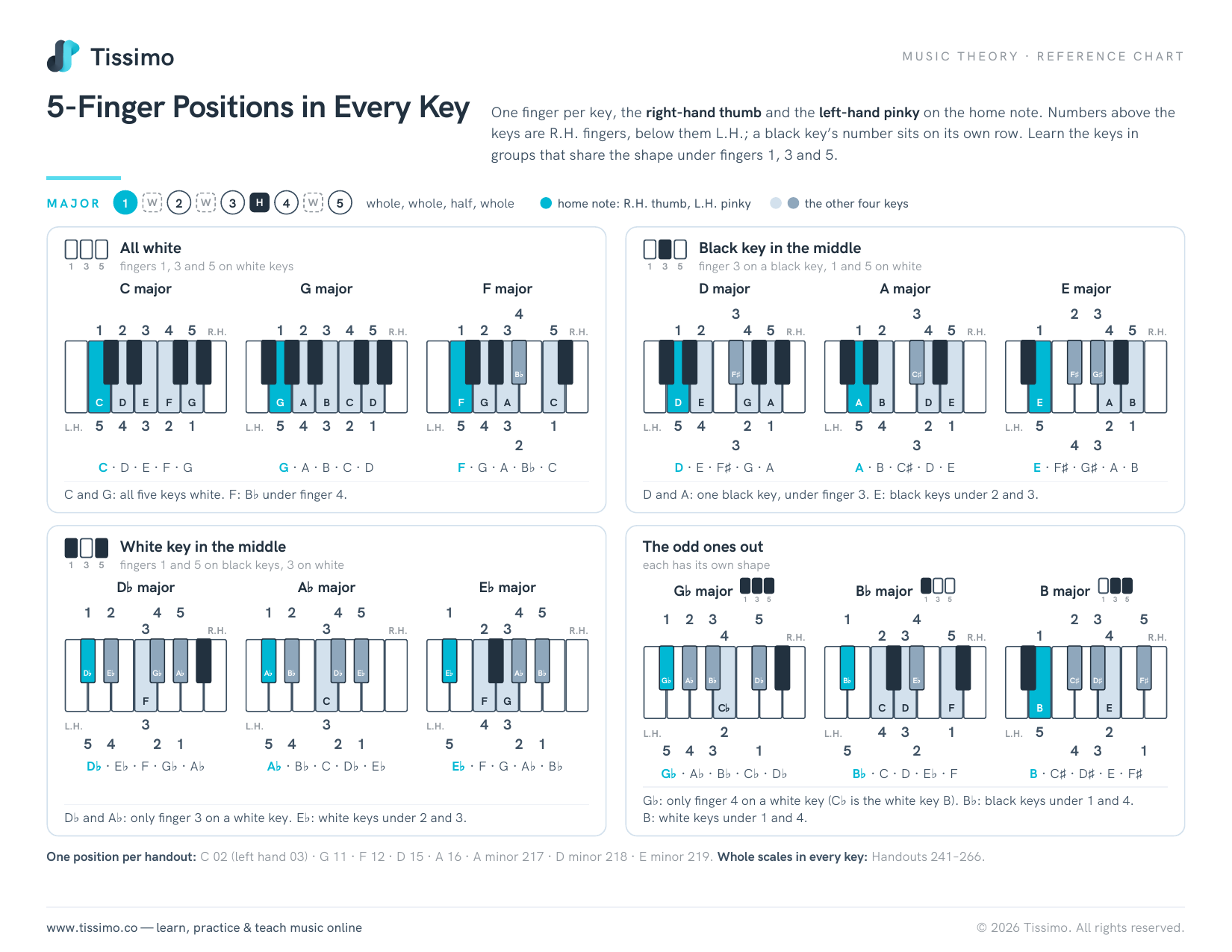 5-Finger Positions in Every KeyOne finger per key, the right-hand thumb and the left-hand pinky on the home note. Numbers above the keys are R.H. fingers, below them L.H.; a black key’s number sits on its own row. Learn the keys in groups that share the shape under fingers 1, 3 and 5.
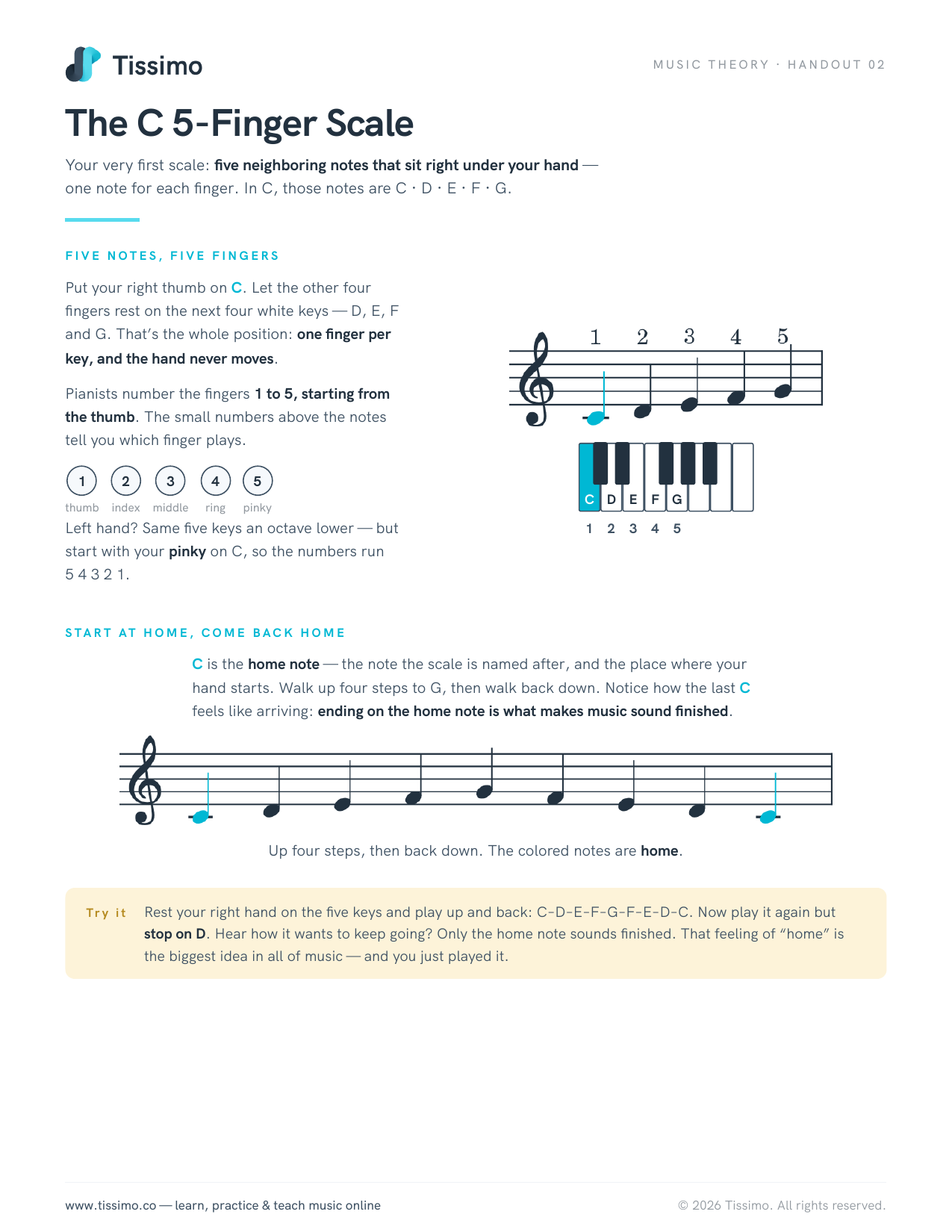 The C 5-Finger ScaleYour very first scale: five neighboring notes that sit right under your hand — one note for each finger. In C, those notes are C · D · E · F · G.
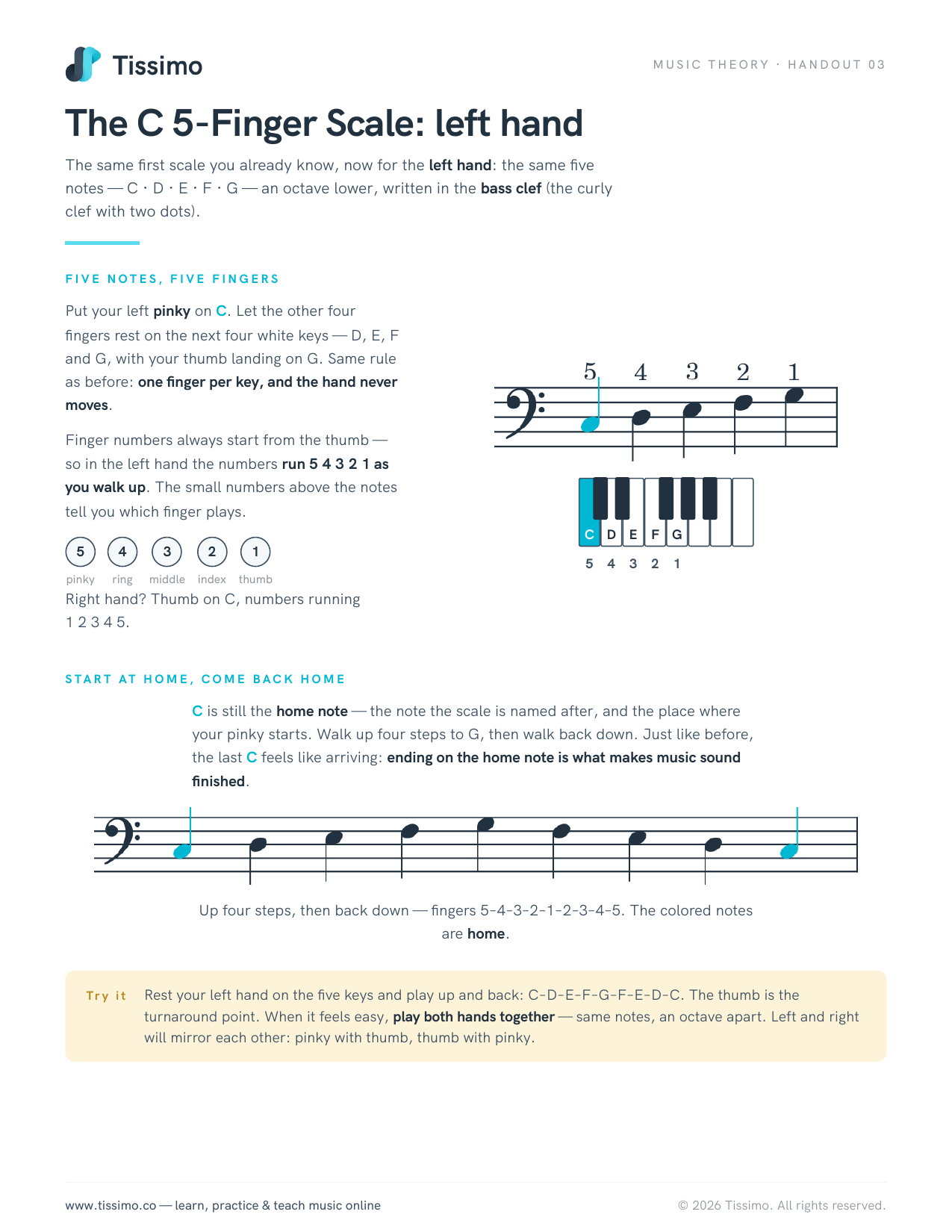 The C 5-Finger Scale: left handThe same first scale you already know, now for the left hand: the same five notes — C · D · E · F · G — an octave lower, written in the bass clef (the curly clef with two dots, Handout 352).
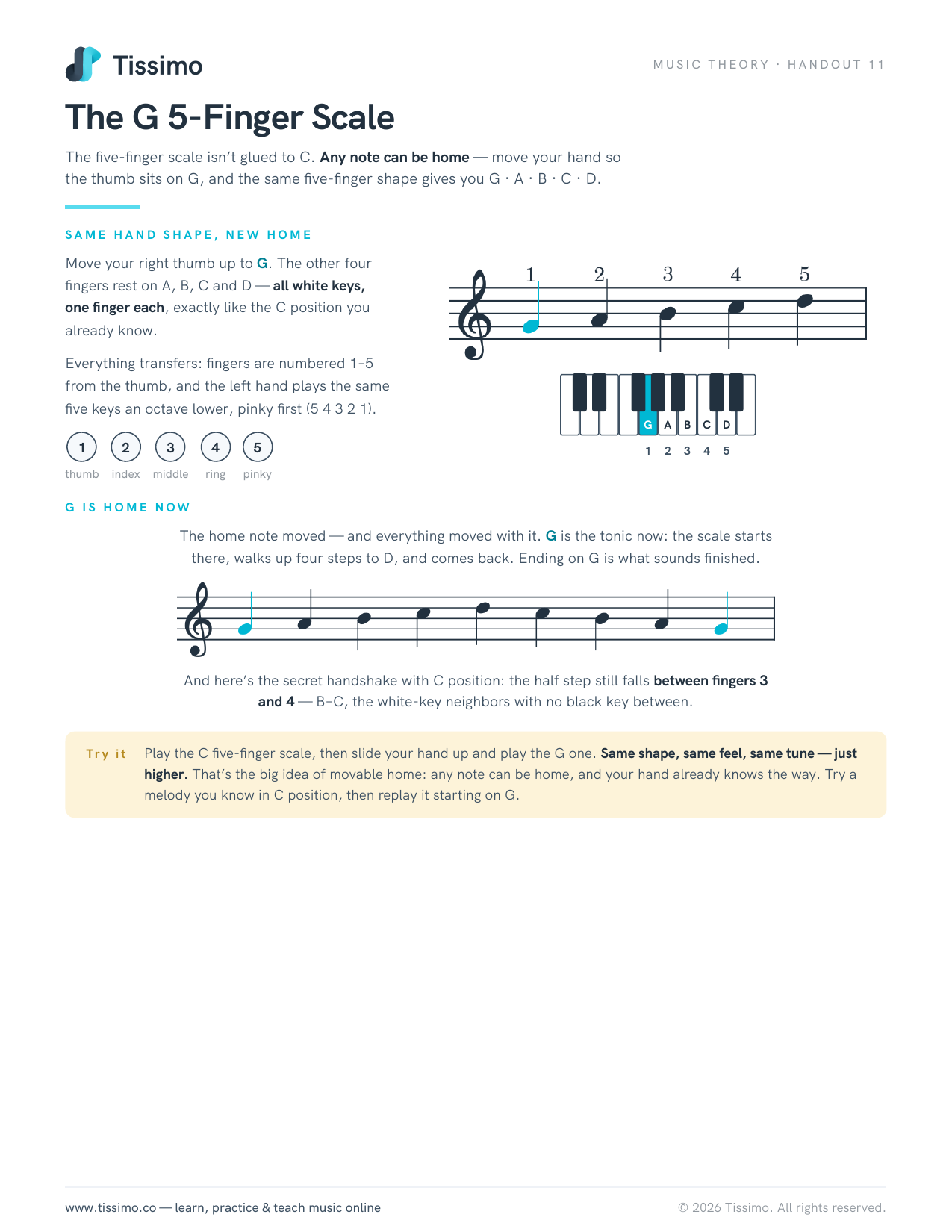 The G 5-Finger ScaleThe five-finger scale isn’t glued to C. Any note can be home — move your hand so the thumb sits on G, and the same five-finger shape gives you G · A · B · C · D.
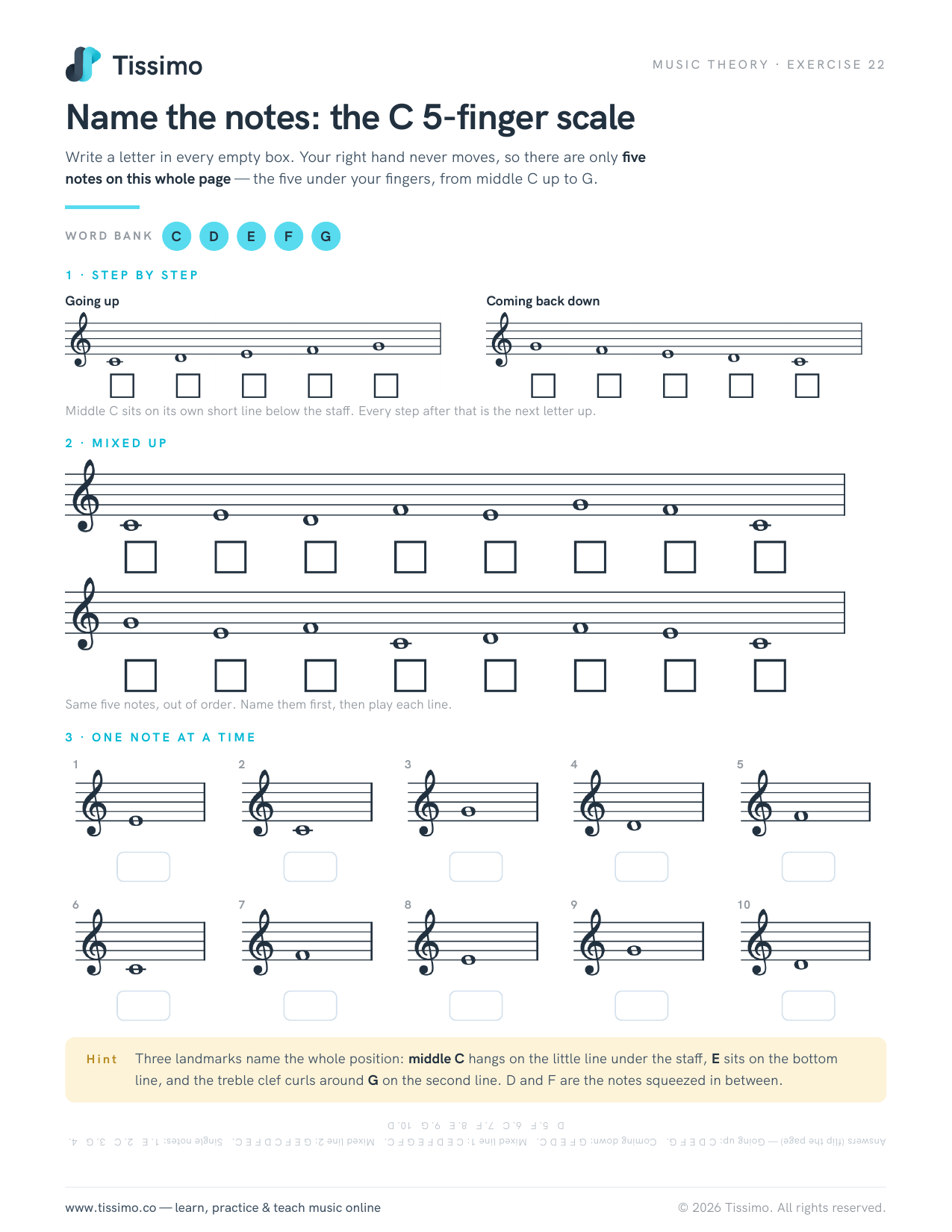 Name the notes: the C 5-finger scaleWrite a letter in every empty box. Your right hand never moves, so there are only five notes on this whole page — the five under your fingers, from middle C up to G.