Notation & Symbols
First and Second Endings
First and second endings are numbered brackets over the last bars of a repeated passage. Play the first ending the first time and repeat; the second time, skip it and play the second ending instead.
Many repeated passages finish differently the second time: the first time they lead back to the start, the second time they lead on, or end the piece. Instead of writing the whole passage out twice, the composer writes it once, with numbered brackets over the bars that change. These are first and second endings, also called volta brackets, from the Italian volta, "time": prima volta (first time), seconda volta (second time).
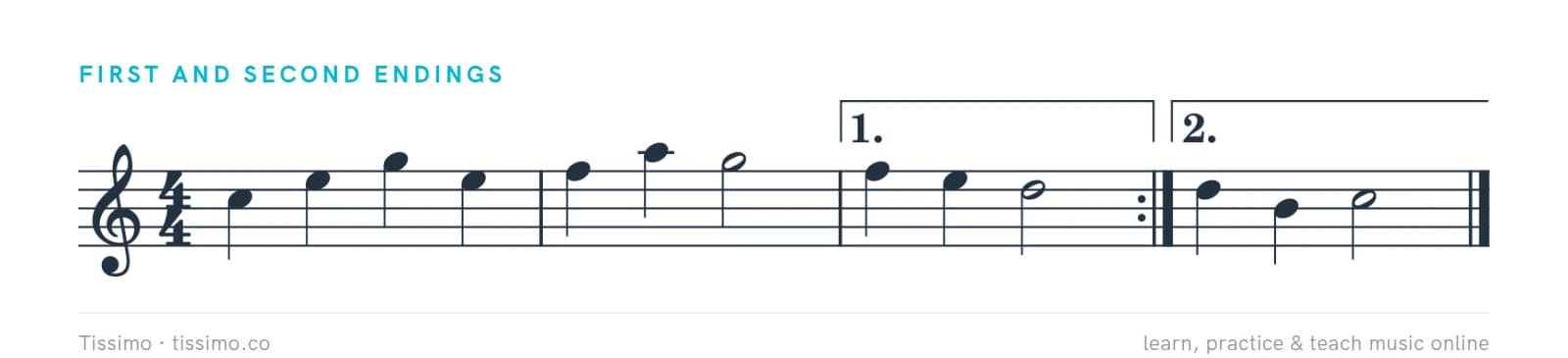
How to read them
- Play from the start of the passage through the 1st ending, the bracket marked "1."
- At the repeat sign at the end of the first ending, go back to the start-repeat sign, or to the beginning if there is none.
- Play the passage again, but this time skip the bars under the first bracket and go straight to the 2nd ending, marked "2."
- Carry on from the second ending.
The first ending normally ends with a repeat sign; the second does not. The second bracket is often left open on its right side, because the music simply continues from there.
More than two endings
A passage played three times may have three endings, or a bracket marked "1., 2." over the bars played the first two times and "3." over the bars played last. Always follow the numbers: they say which time through each ending belongs to.
Endings after D.C. and D.S.
If a D.C. or D.S. sends you back into a passage that has endings, the usual convention is to play straight through to the last ending, without taking the repeat again.
You will meet endings everywhere: in folk tunes, hymns and marches, in dance movements in binary form, and in songs whose verses finish differently from one another.
Practice them in Navigation Signs and Trace the road map.
Common questions
How do first and second endings work?
Play the first ending the first time through, then repeat. The second time, skip the first ending and play the second ending instead.
What does volta mean in music?
Volta is Italian for "time", as in prima volta (first time) and seconda volta (second time). Volta brackets is another name for first and second endings.
Practice it: free worksheets
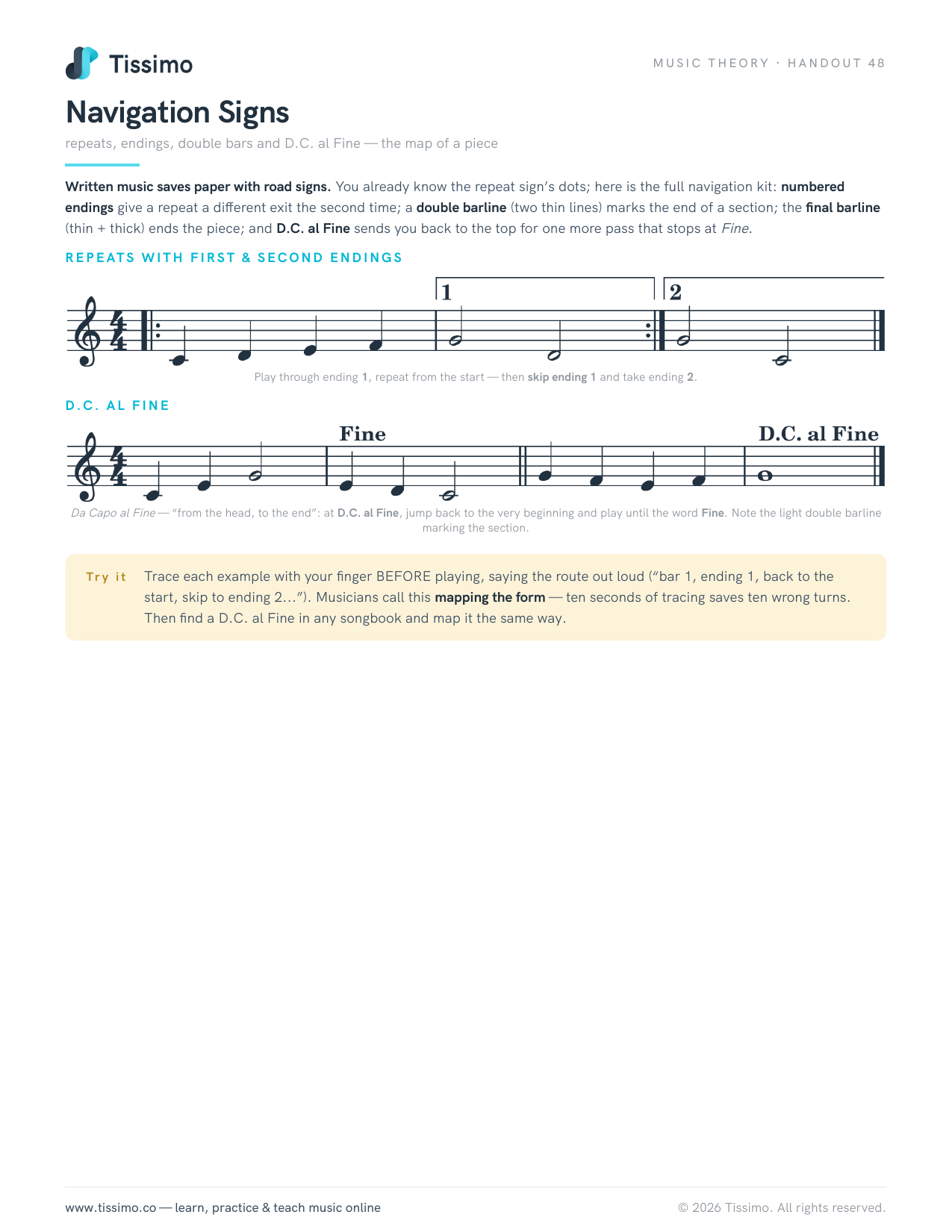 Navigation Signsrepeats, endings, double bars and D.C. al Fine — the map of a piece
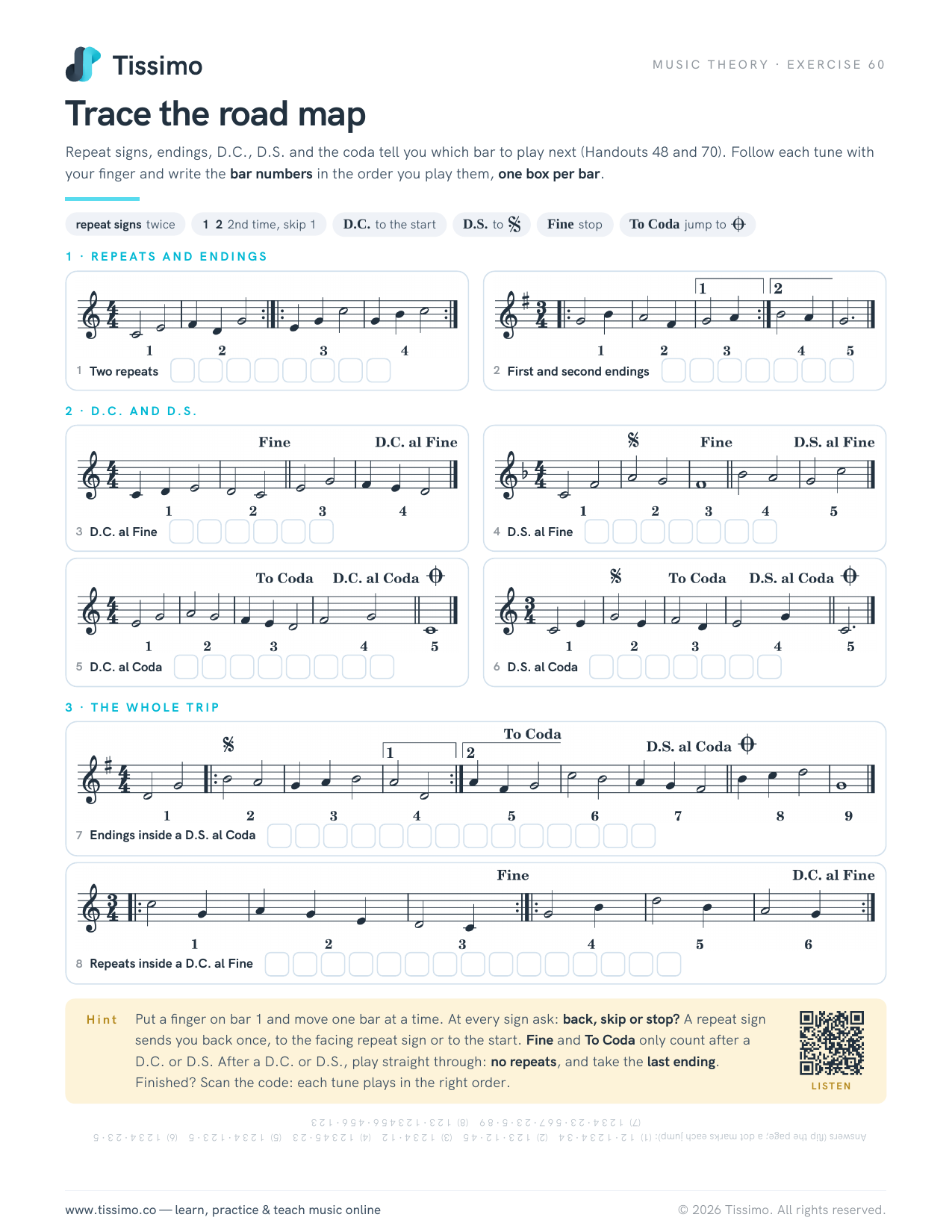 Trace the road mapRepeat signs, endings, D.C., D.S. and the coda tell you which bar to play next (Handouts 48 and 70). Follow each tune with your finger and write the bar numbers in the order you play them, one box per bar.