Notation & Symbols
Coda
Pronounced KOH-dah
A coda is the closing section of a piece, added after its main structure to bring it to an end. In notation, the coda sign, a circle crossed by two lines, marks the jump to that ending in a D.C. or D.S. al Coda.
Coda is Italian for "tail". In music it has two closely related meanings: a closing section that rounds off a piece, and the sign that tells you when to jump to it.
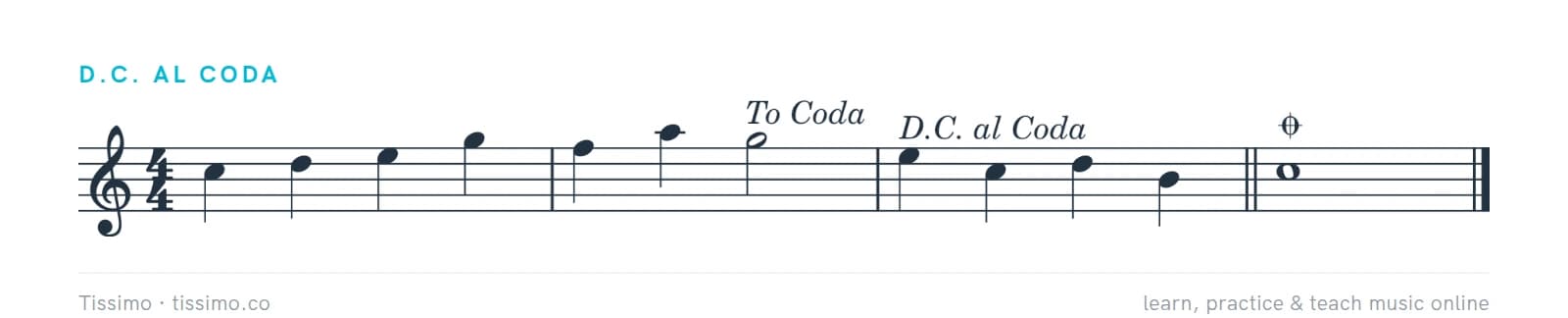
The coda sign and "To Coda"
The coda sign is a circle or oval crossed by a vertical and a horizontal line, like crosshairs. It usually appears twice:
- At the jump point, often with the words "To Coda": the place where, on your second time through, you leave the main music.
- At the start of the coda itself, usually labeled "Coda" and often set apart by a double bar line or a gap on the page.
The jump happens only after a D.C. or D.S. has sent you back. The first time through, you ignore "To Coda" and keep playing.
Reading D.C. al Coda and D.S. al Coda
- Play until you reach D.C. al Coda (or D.S. al Coda).
- Go back to the beginning (D.C.) or to the segno (D.S.).
- Play until "To Coda" or the first coda sign.
- Jump to the coda and play it to the end.
The coda as a section of the form
As part of the form, a coda comes after the music has finished its main business: after the recapitulation in sonata form, or after the last chorus of a song, where pop musicians usually call it the outro. A coda can be a few closing chords or a long passage that brings back earlier themes one last time. A short closing passage, at the end of a piece or of a section within it, is often called a codetta, "little coda".
Learn the signs in D.S. & the Coda and follow complete routes in Trace the road map.
Common questions
What does D.C. al Coda mean?
Go back to the beginning, play until "To Coda" (or the coda sign), then jump to the coda at the end and play it.
What does the coda symbol look like?
A circle or oval crossed by a vertical and a horizontal line, like crosshairs.
Practice it: free worksheets
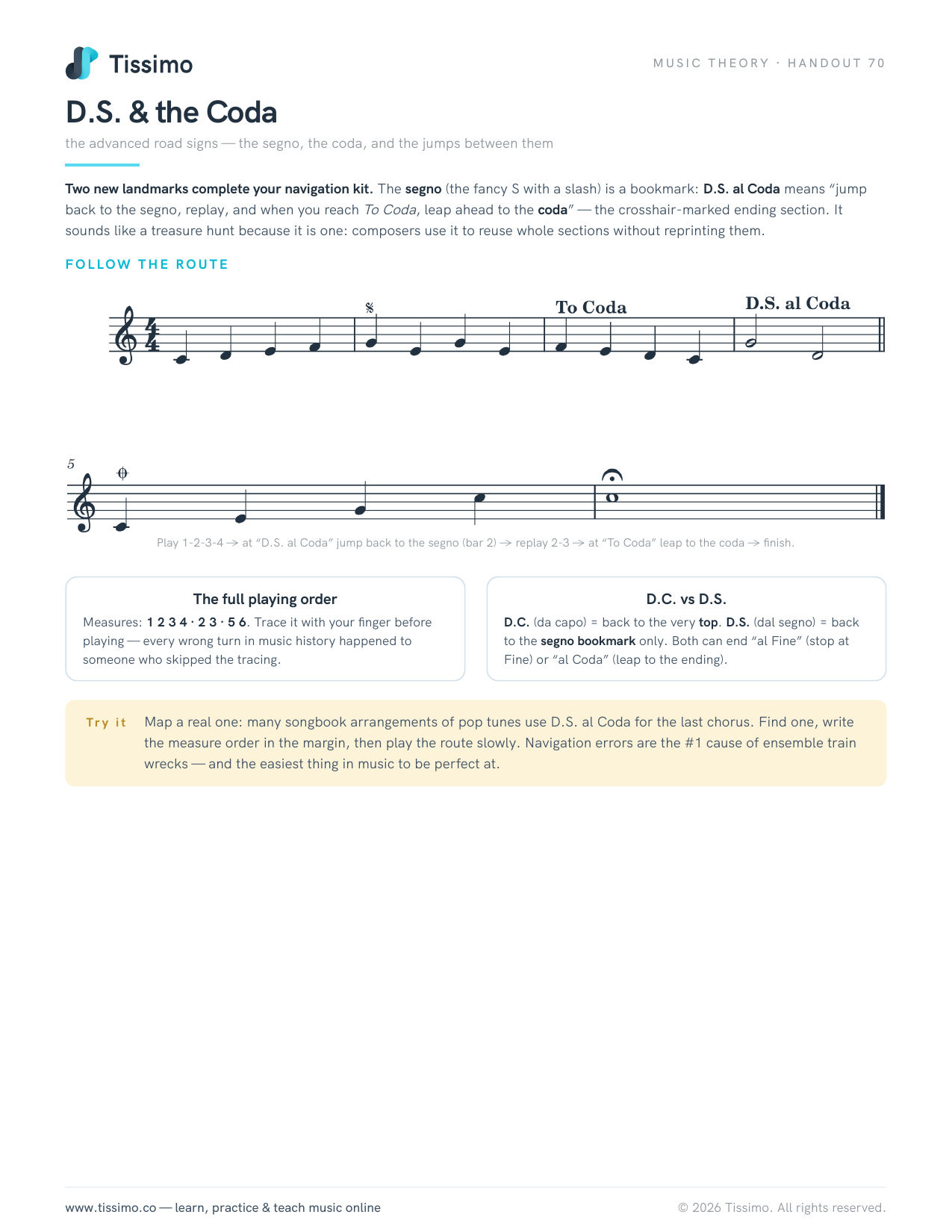 D.S. & the Codathe advanced road signs — the segno, the coda, and the jumps between them
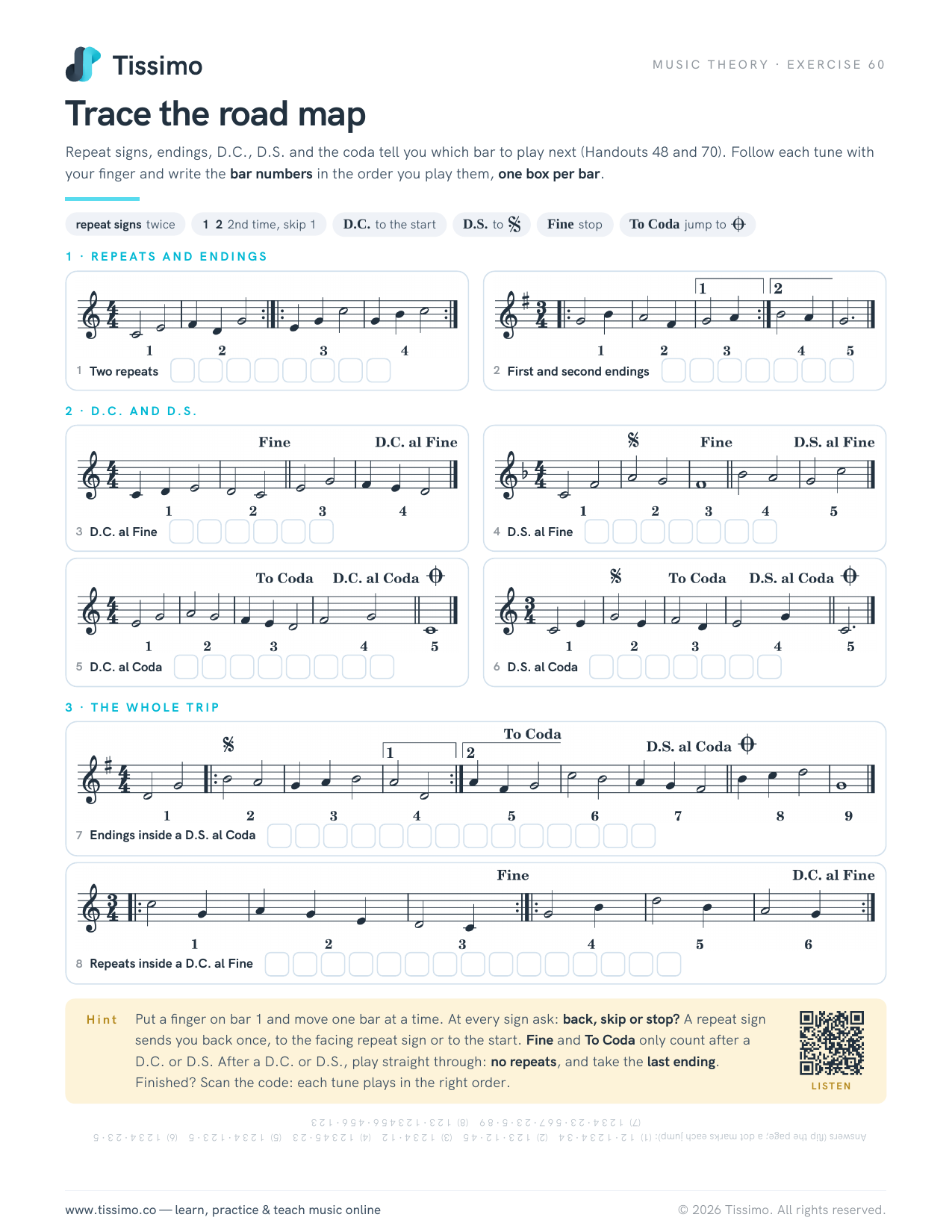 Trace the road mapRepeat signs, endings, D.C., D.S. and the coda tell you which bar to play next (Handouts 48 and 70). Follow each tune with your finger and write the bar numbers in the order you play them, one box per bar.
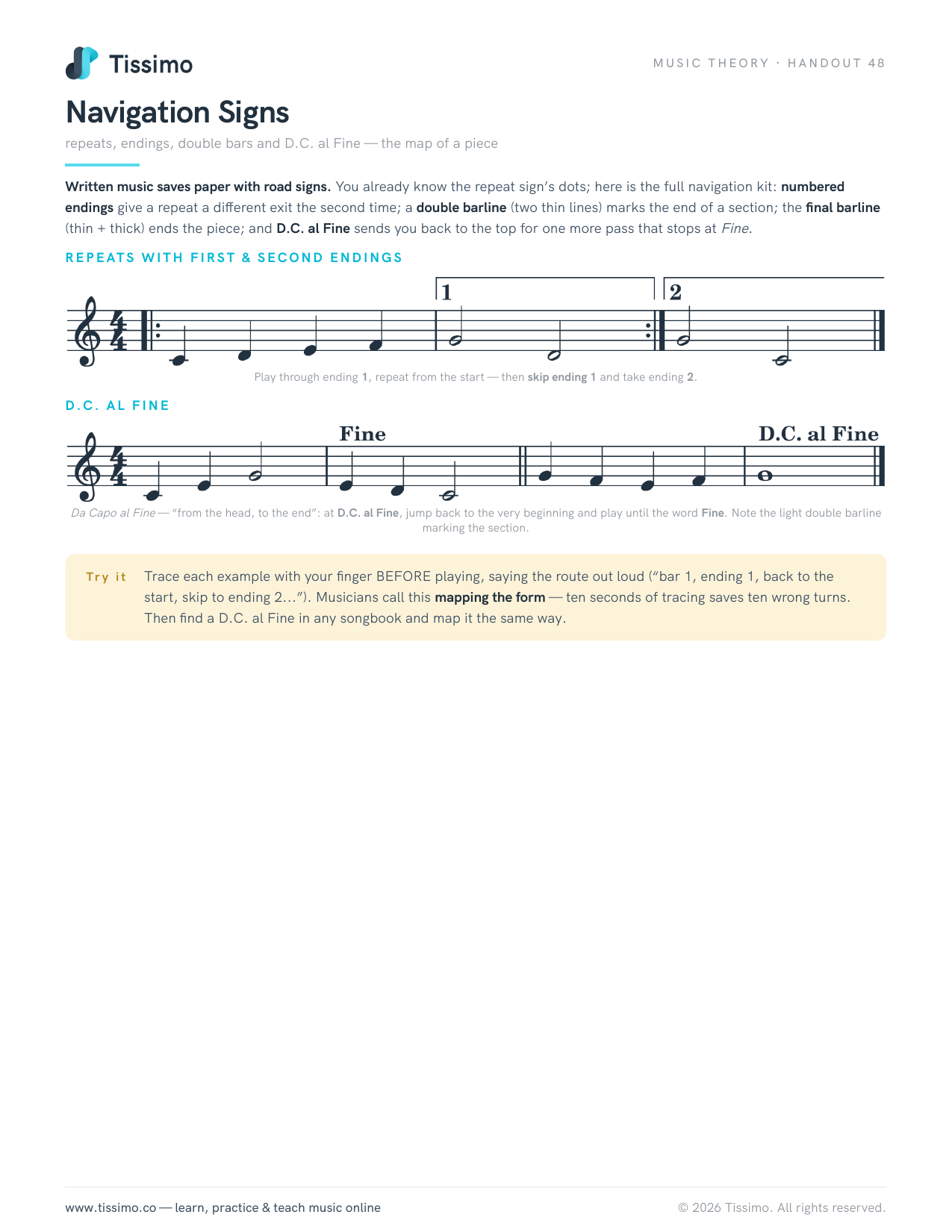 Navigation Signsrepeats, endings, double bars and D.C. al Fine — the map of a piece
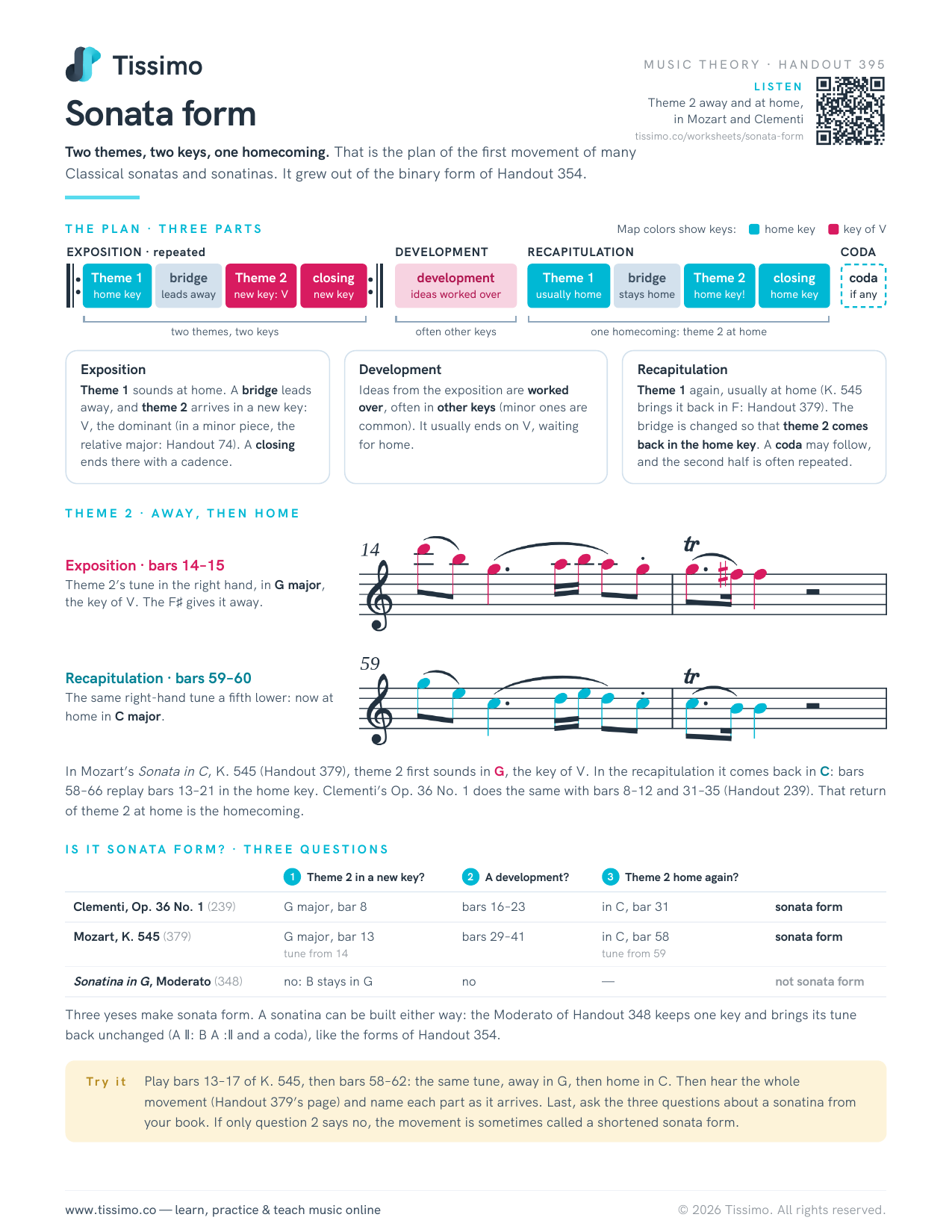 Sonata formTwo themes, two keys, one homecoming. That is the plan of the first movement of many Classical sonatas and sonatinas. It grew out of the binary form of Handout 354.