Notation & Symbols
Grand Staff
The grand staff is two staves joined by a brace, usually a treble staff above a bass staff. Piano and harp music is written on it, with middle C sitting between the two staves.
The grand staff (also called the great staff, or the grand stave in Britain) is a pair of staves read at the same time: a treble clef staff on top and a bass clef staff below, joined at the left by a curly brace and a vertical line. Bar lines usually run straight through both staves, so you can see at a glance which notes fall in the same beat.
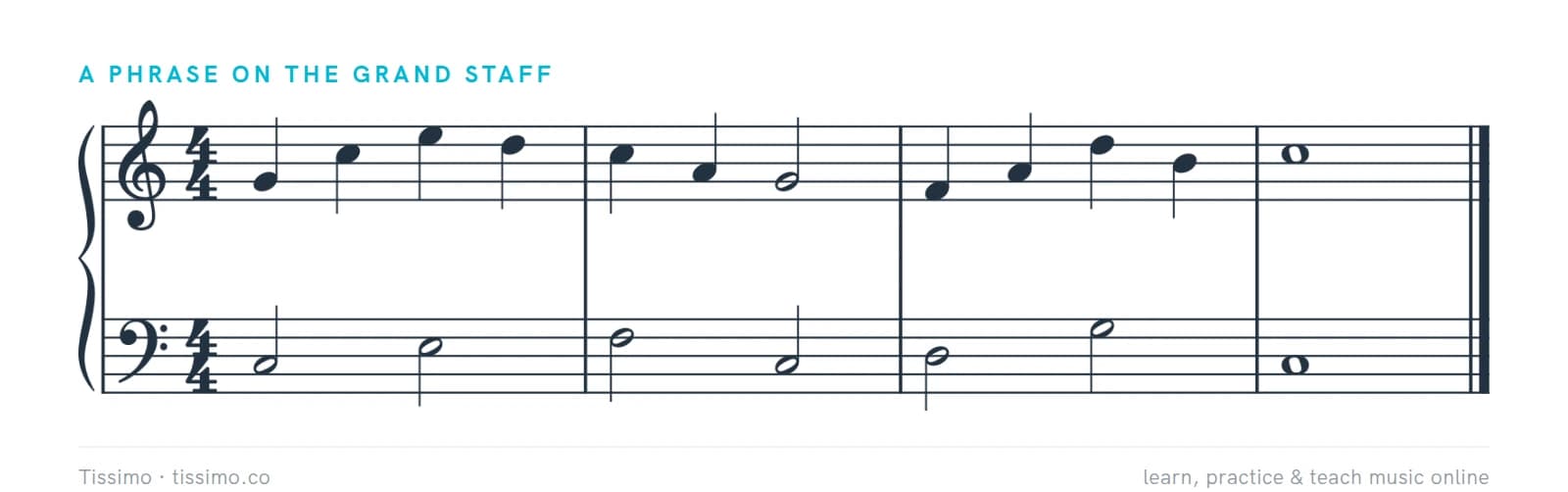
Who reads the grand staff?
The piano is the best-known example: the top staff is usually played by the right hand and the bottom staff by the left. The harp and harpsichord use it too, and so do mallet instruments such as the marimba. Organ music normally adds a third staff below for the pedals.
The hands do not have to stay on "their" staff. When the left hand plays high or the right hand plays low, the music may change clef or write the notes on the other staff. Small markings such as "r.h." and "l.h." (or the Italian "m.d." and "m.s.") say which hand to use.
Middle C sits between the staves
The two staves are closer than they look. Middle C is written on a ledger line just below the treble staff, and the very same note can be written on a ledger line just above the bass staff. If you imagine that middle-C line drawn in, the grand staff becomes one tall staff of eleven lines, with the treble clef naming the top five and the bass clef the bottom five. That picture helps when a melody crosses from one staff into the other.
- Treble staff, bottom to top: lines E G B D F, spaces F A C E.
- Bass staff, bottom to top: lines G B D F A, spaces A C E G.
Reading both staves at once
Read the grand staff vertically as well as left to right. Notes that line up above each other are played together, so at each beat glance down through both staves before you play. Many students learn a new piece one hand at a time; when you put the hands together, go slowly enough that you can see every vertical line-up.
Practice with The Bass Clef & the Grand Staff and Name the notes: grand staff.
Common questions
Which hand plays which staff on the grand staff?
Usually the right hand plays the top (treble) staff and the left hand the bottom (bass) staff. Composers sometimes write one hand on the other staff, so follow the notes and any r.h. or l.h. markings.
Is middle C in the treble clef or the bass clef?
It can be written in either: on a ledger line below the treble staff or on a ledger line above the bass staff. Both mean the same key on the piano.
Practice it: free worksheets
 The Bass Clef & the Grand StaffThe bass staff holds the lower notes, usually played by the left hand. It works just like the treble staff (Handout 351), but its clef names a different line.
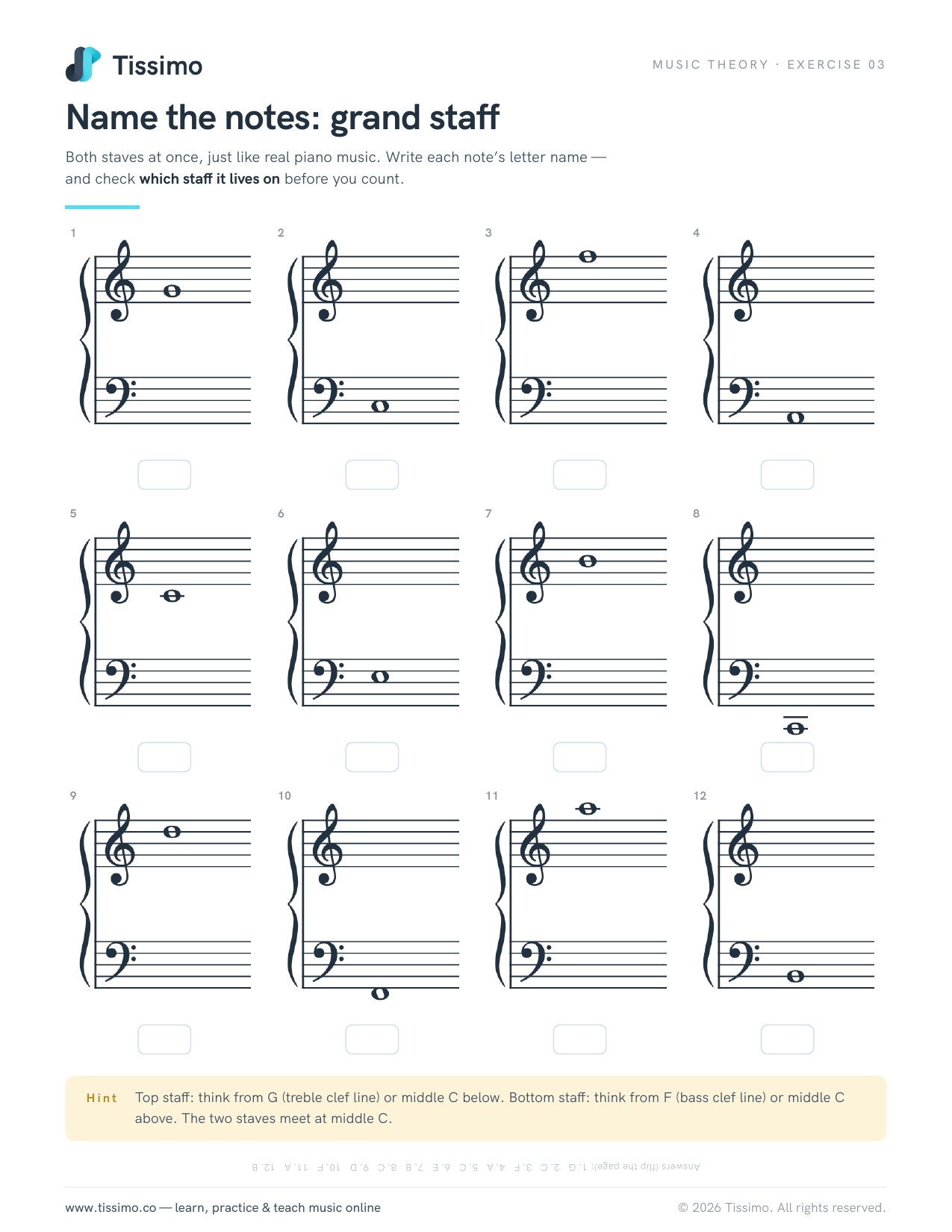 Name the notes: grand staffBoth staves at once, just like real piano music. Write each note’s letter name — and check which staff it lives on before you count.
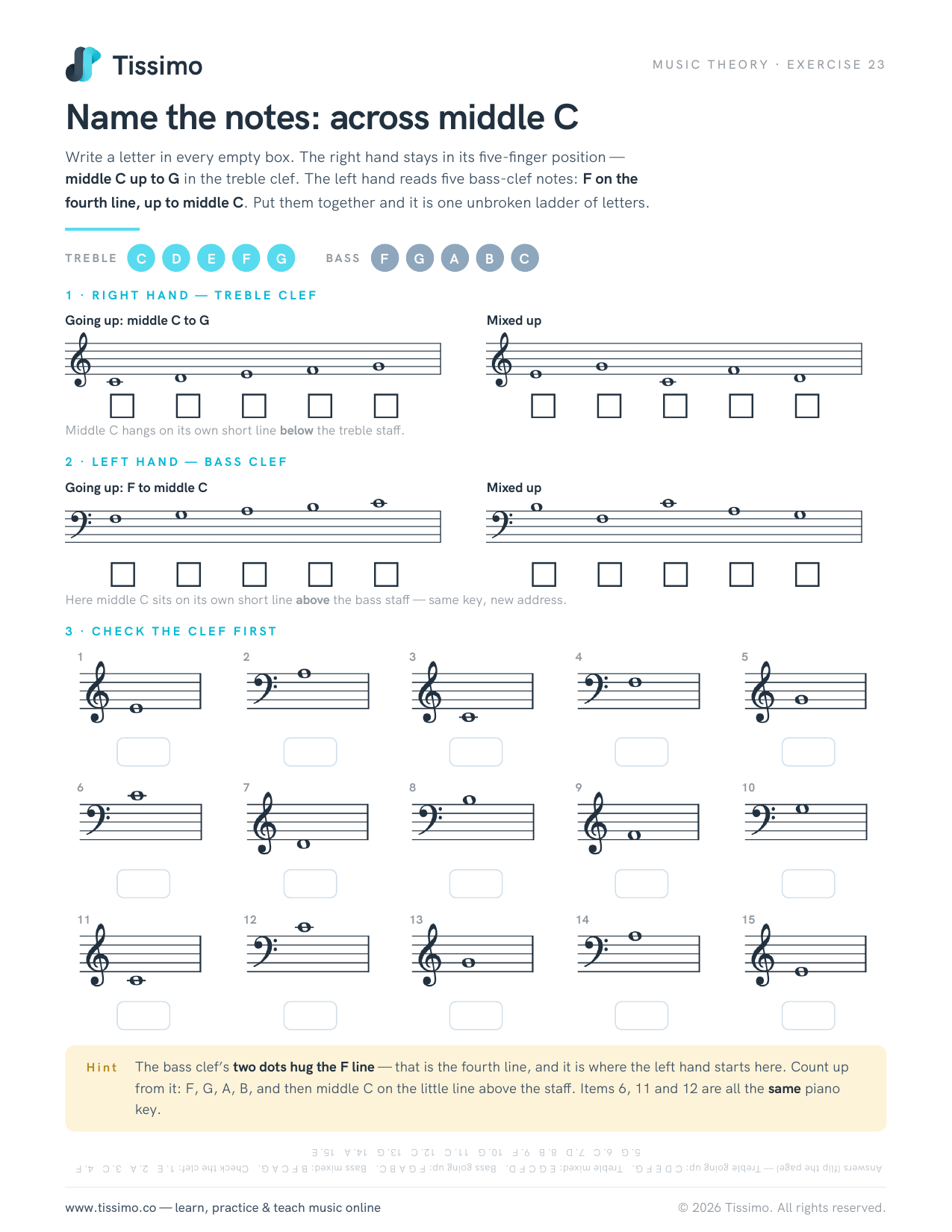 Name the notes: across middle CWrite a letter in every empty box. The right hand stays in its five-finger position — middle C up to G in the treble clef. The left hand reads five bass-clef notes: F on the fourth line, up to middle C. Put them together and it is one unbroken ladder of letters.
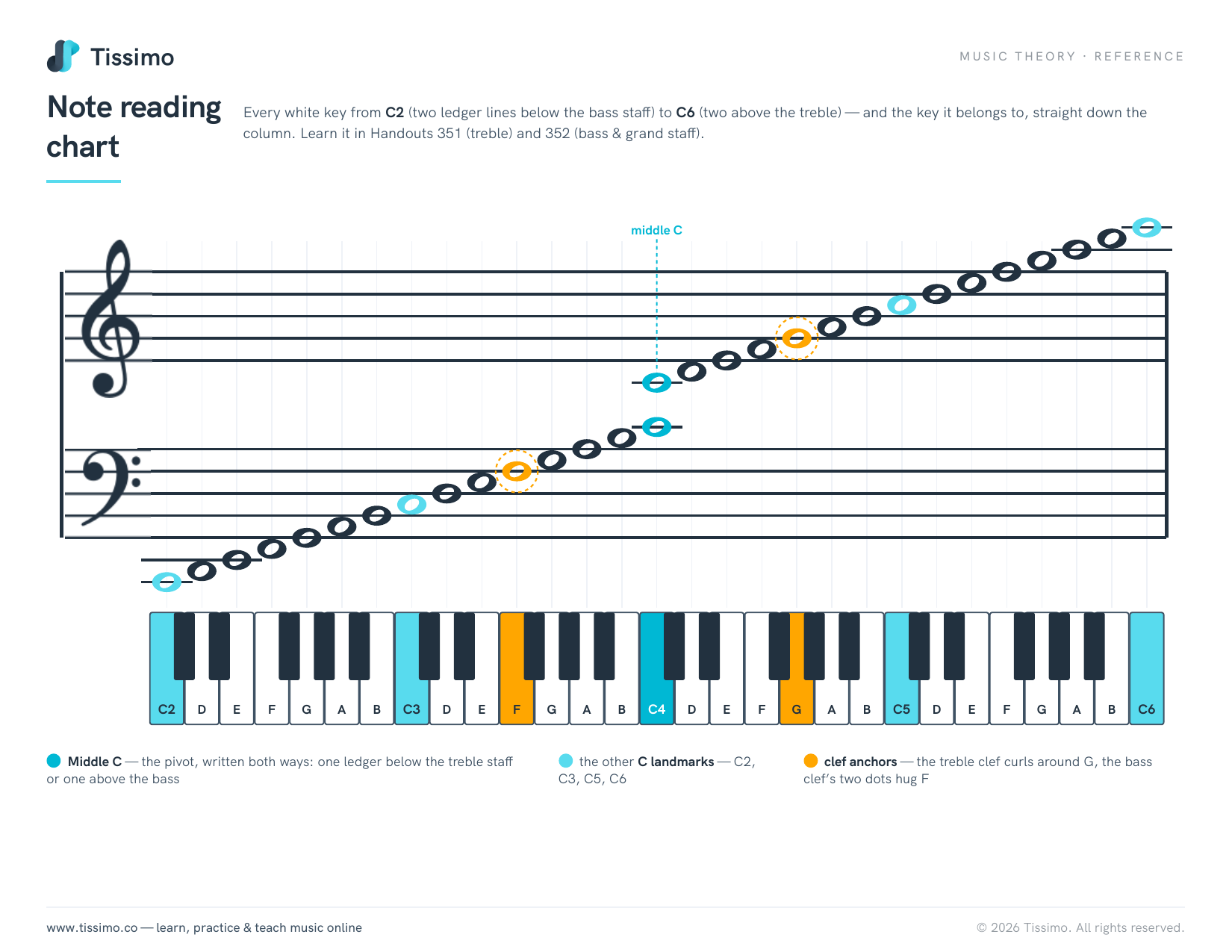 Note reading chartEvery white key from C2 (two ledger lines below the bass staff) to C6 (two above the treble) — and the key it belongs to, straight down the column. Learn it in Handouts 351 (treble) and 352 (bass & grand staff).