Instruments & Voices
Harp
The harp is a plucked string instrument whose strings run vertically inside a triangular frame. The concert pedal harp has 47 strings, from C1 to G7, and seven pedals that make each note name flat, natural or sharp.
The harp is one of the oldest string instruments, found in many cultures. Its strings run from a soundboard at the bottom up to a curved neck, inside a triangular frame, and you pluck them with the pads of your fingers. Its sound is clear and ringing, and the sweep of a glissando across the strings is one of the most recognizable sounds in the orchestra.
How the harp makes its sound
You play with the thumb and first three fingers of each hand; harpists normally do not use the little finger. Plucked strings ring on until they die away or you stop them with your palm, so damping is part of the technique. The left hand usually plays the lower strings and the right hand the higher ones. To help you find your way, the C strings are colored red and the F strings black or dark blue.
Pedal harp and lever harp
The concert (pedal) harp has seven strings per octave, one for each note name, so it has no strings for the sharps and flats. Instead, seven pedals at its base each control strings of one note name across the instrument, except for strings without pedal mechanisms, notably the lowest C and D, which must be tuned separately. Each pedal has three positions: up for flat, middle for natural and down for sharp. The left foot works the D, C and B pedals, the right foot the E, F, G and A pedals. Setting the pedals before and during a piece is how harpists change key.
The smaller lever harp (often called a Celtic or folk harp) has a small lever at the top of each string that raises that one string by a half step. Lever harps are lighter, cheaper and a common first instrument.
Range
A full concert harp has 47 strings and spans about six and a half octaves, from C1 to G7, almost as much as the piano. Smaller pedal harps and lever harps have fewer strings.
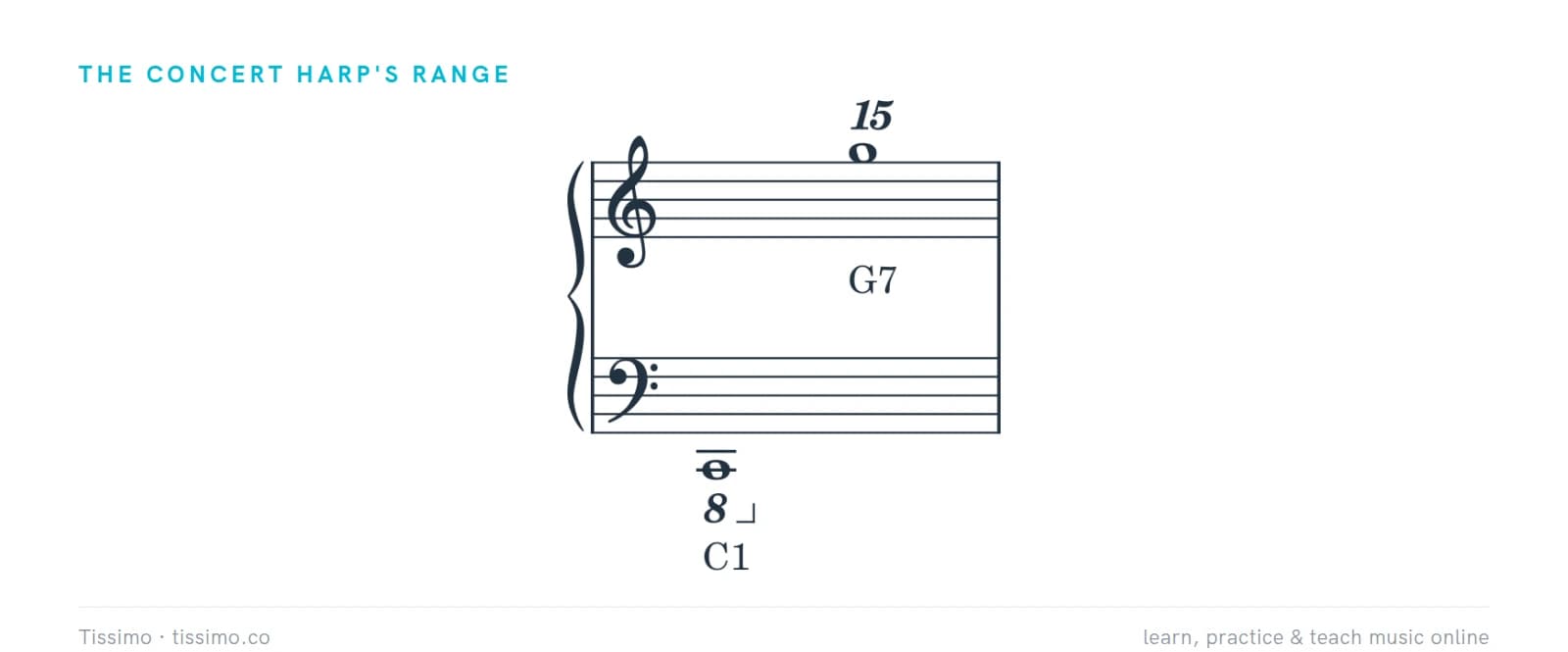
How harp music is written
Harp music is written on the grand staff, like piano music, at the pitch it sounds. Pedal settings are often shown as a small diagram or as note names under the staff, and harpists pencil in their own pedal changes. Special effects include harmonics (a bell-like tone an octave higher, played by touching the middle of the string), glissandos and playing near the soundboard for a dry, guitar-like sound.
Its role
In the orchestra the harp adds color: arpeggios, glissandos and shimmering chords, especially in music from the nineteenth century onward. It has a large solo repertoire, chamber music (for example with flute), and strong traditions in Irish, Welsh, Paraguayan and many other kinds of folk music.
Tips for beginners
- Many harpists start on a lever harp, then move to a pedal harp.
- Place your fingers on the strings before you play, so every note is prepared.
- Pluck with the pads of the fingers and close each finger into the palm after the pluck; that motion makes a full, round tone.
Common questions
How many strings does a harp have?
A full-size concert pedal harp has 47 strings, from C1 to G7. Smaller pedal harps have fewer, and lever harps commonly have somewhere between about 20 and 40.
How does a harp play sharps and flats?
On a pedal harp, each of seven pedals changes the connected strings of one note name: up is flat, middle is natural and down is sharp. The lowest C and D normally have no pedal mechanism and are tuned separately. On a lever harp, a lever on each string raises that string by a half step.
Practice it: free worksheets
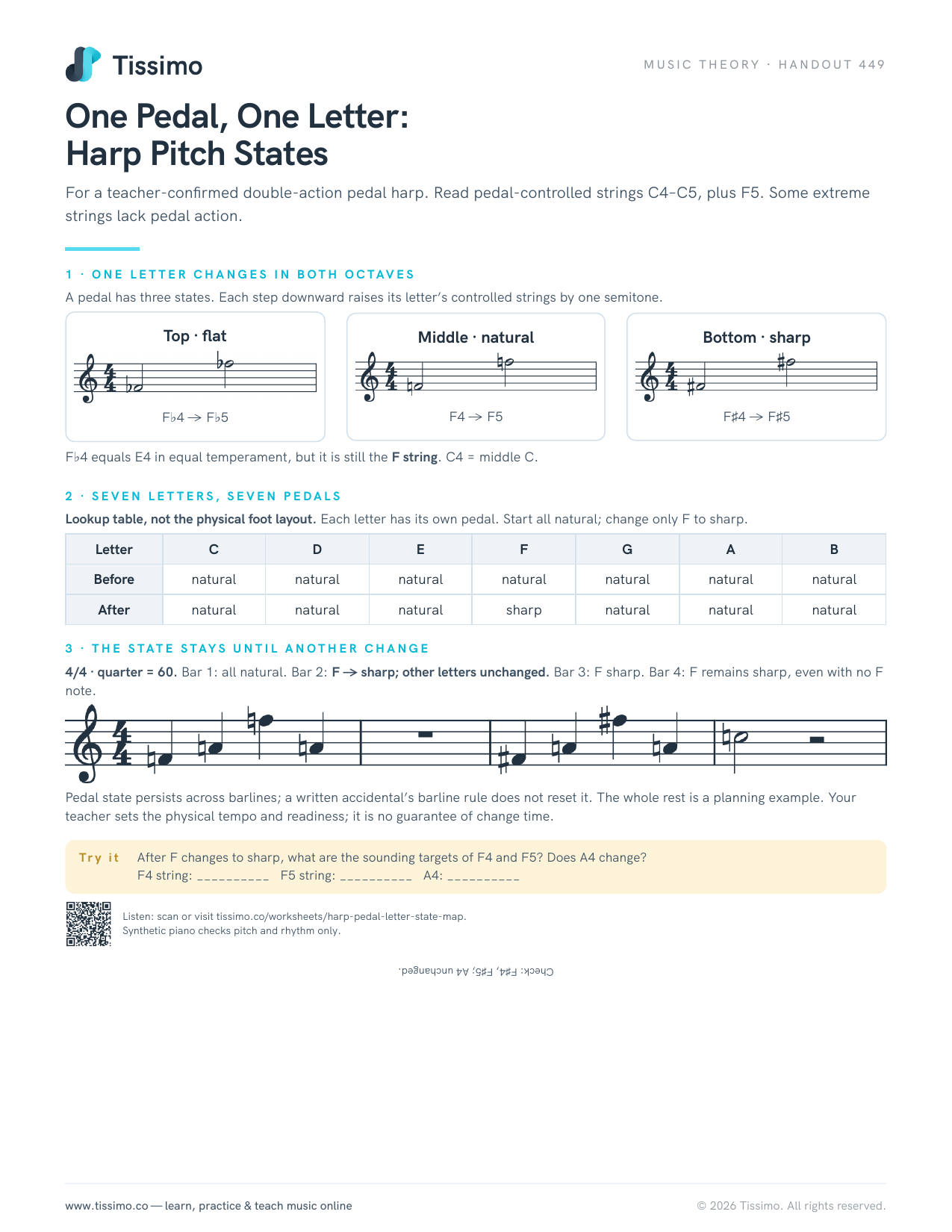 One Pedal, One Letter: Harp Pitch StatesFor a teacher-confirmed double-action pedal harp. Read pedal-controlled strings C4–C5, plus F5. Some extreme strings lack pedal action.
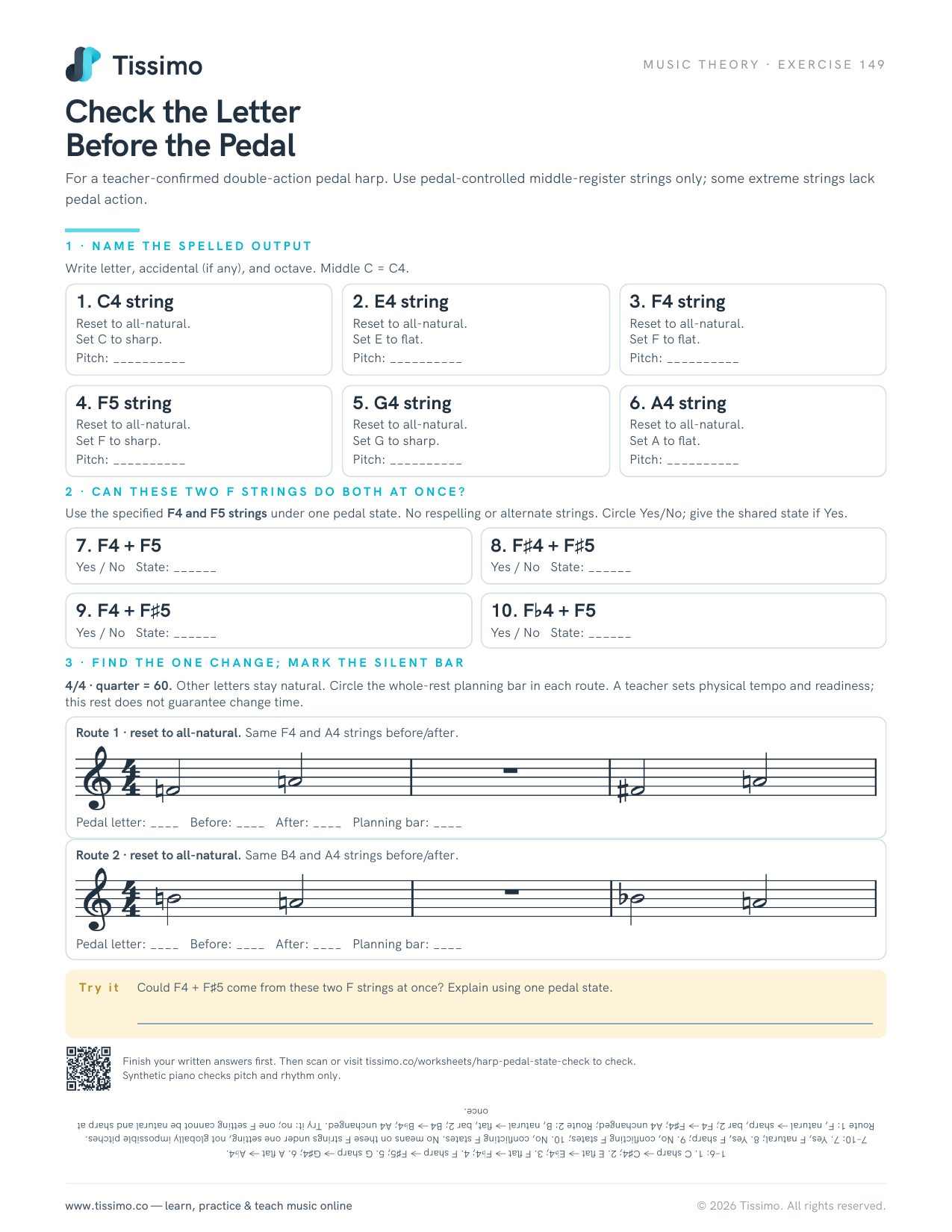 Check the Letter Before the PedalFor a teacher-confirmed double-action pedal harp. Use pedal-controlled middle-register strings only; some extreme strings lack pedal action.
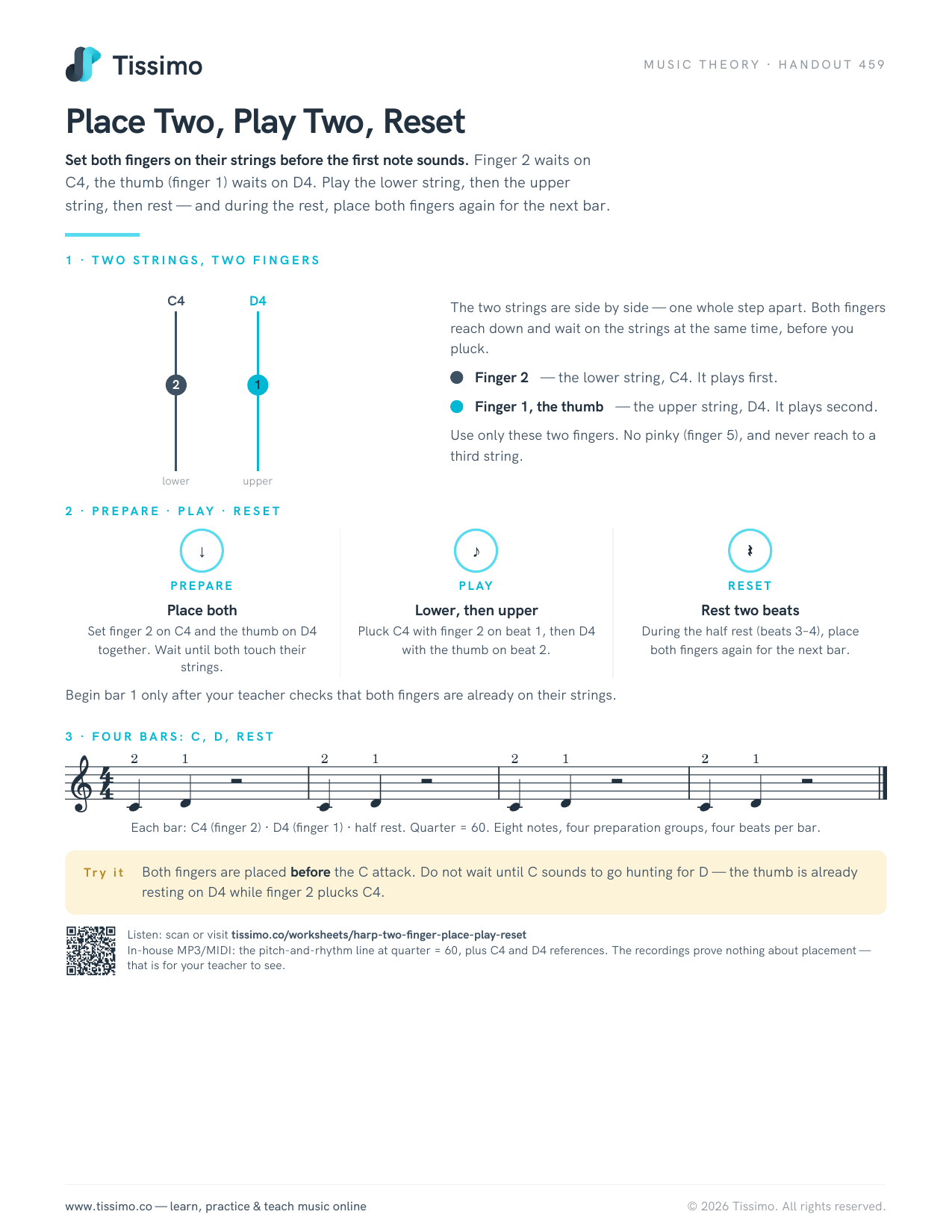 Place Two, Play Two, ResetSet both fingers on their strings before the first note sounds. Finger 2 waits on C4, the thumb (finger 1) waits on D4. Play the lower string, then the upper string, then rest — and during the rest, place both fingers again for the next bar.
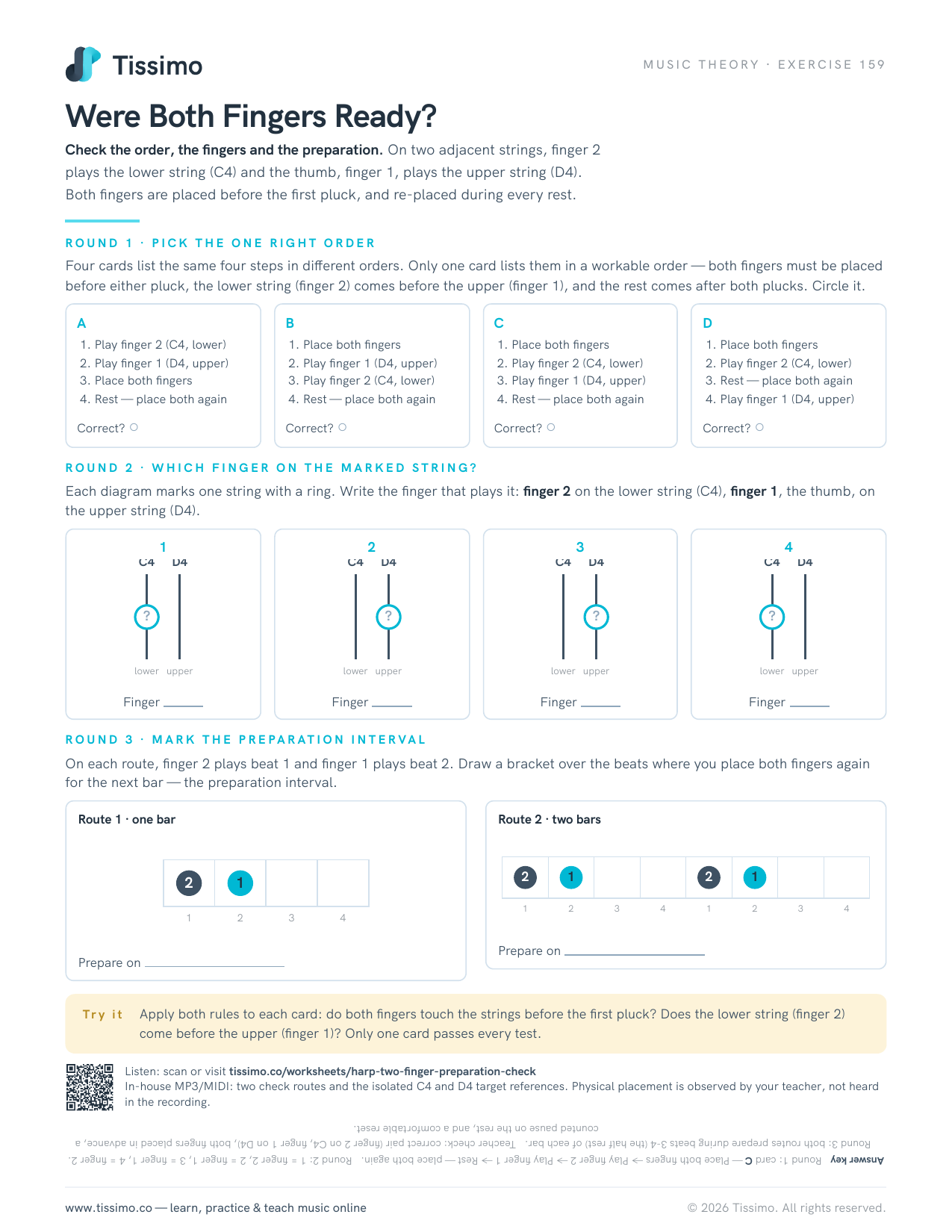 Were Both Fingers Ready?Check the order, the fingers and the preparation. On two adjacent strings, finger 2 plays the lower string (C4) and the thumb, finger 1, plays the upper string (D4). Both fingers are placed before the first pluck, and re-placed during every rest.