Pitch & Intervals
Half Step (Semitone)
A half step, or semitone, is the smallest interval on a piano: the distance from any key to the very next key, black or white. Two half steps make a whole step.
A half step is the smallest distance between two notes in most Western music. On the piano it is the move from one key to the very next key, with nothing in between: white to black, black to white, or, in two places, white to white. British musicians call it a semitone.
Finding half steps on the keyboard
Most half steps involve a black key: C to C♯, F♯ to G, B♭ to B. But look at E–F and B–C. There is no black key between them, so those white keys are already a half step apart. These two "natural half steps" give the major scale its pattern of whole and half steps.
On a guitar, a half step is one fret. On the staff, a sharp raises a note a half step and a flat lowers it a half step; a natural cancels either one.
Two spellings of a half step
The same distance can be written in two ways, and theory books name them differently:
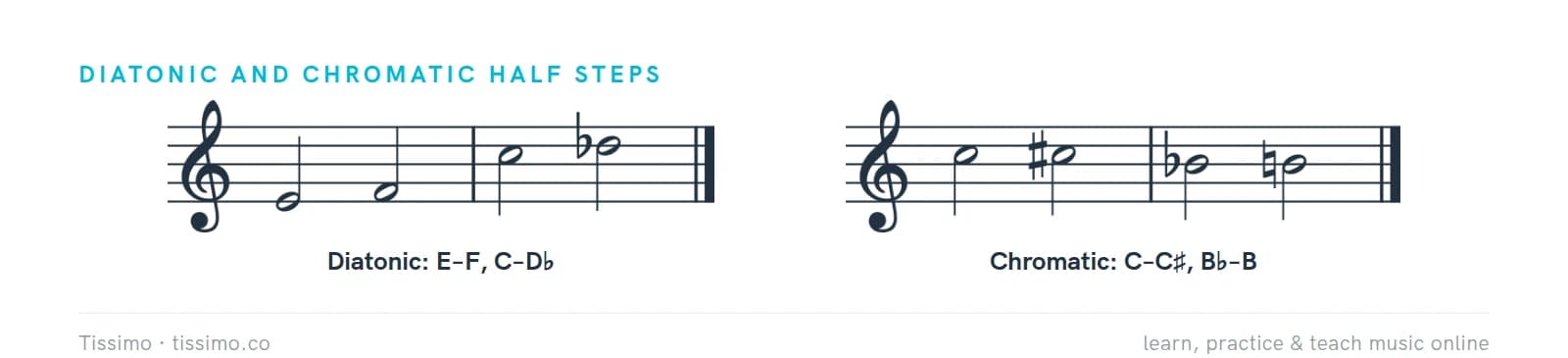
- A diatonic half step moves to the next letter name: E–F, B–C, C–D♭. As an interval it is a minor second.
- A chromatic half step keeps the letter name and changes the accidental: C–C♯, B♭–B. As an interval it is an augmented unison.
On a piano both sound exactly the same. The spelling shows what the note is doing: in a line that climbs C–C♯–D, the C♯ is a C pushed up toward D.
Half steps in numbers
Twelve half steps make an octave, and the chromatic scale plays all twelve in a row. In equal temperament every half step is the same size, 100 cents: the upper note vibrates about 1.0595 times as fast as the lower one (the twelfth root of 2). Every interval can be measured in half steps. A major third is 4, a perfect fifth is 7.
Practice with Half steps & whole steps and Whole step or half step?, then hear all twelve in The Chromatic Scale.
Common questions
Is a half step the same as a semitone?
Yes. Half step is the usual American term and semitone the British one. Both mean the distance from one key to the very next on a piano, 100 cents in equal temperament.
Which notes are a half step apart without a black key?
E–F and B–C. These white keys sit side by side with no black key between them, which is why E♯ sounds the same as F and C♭ the same as B.
Practice it: free worksheets
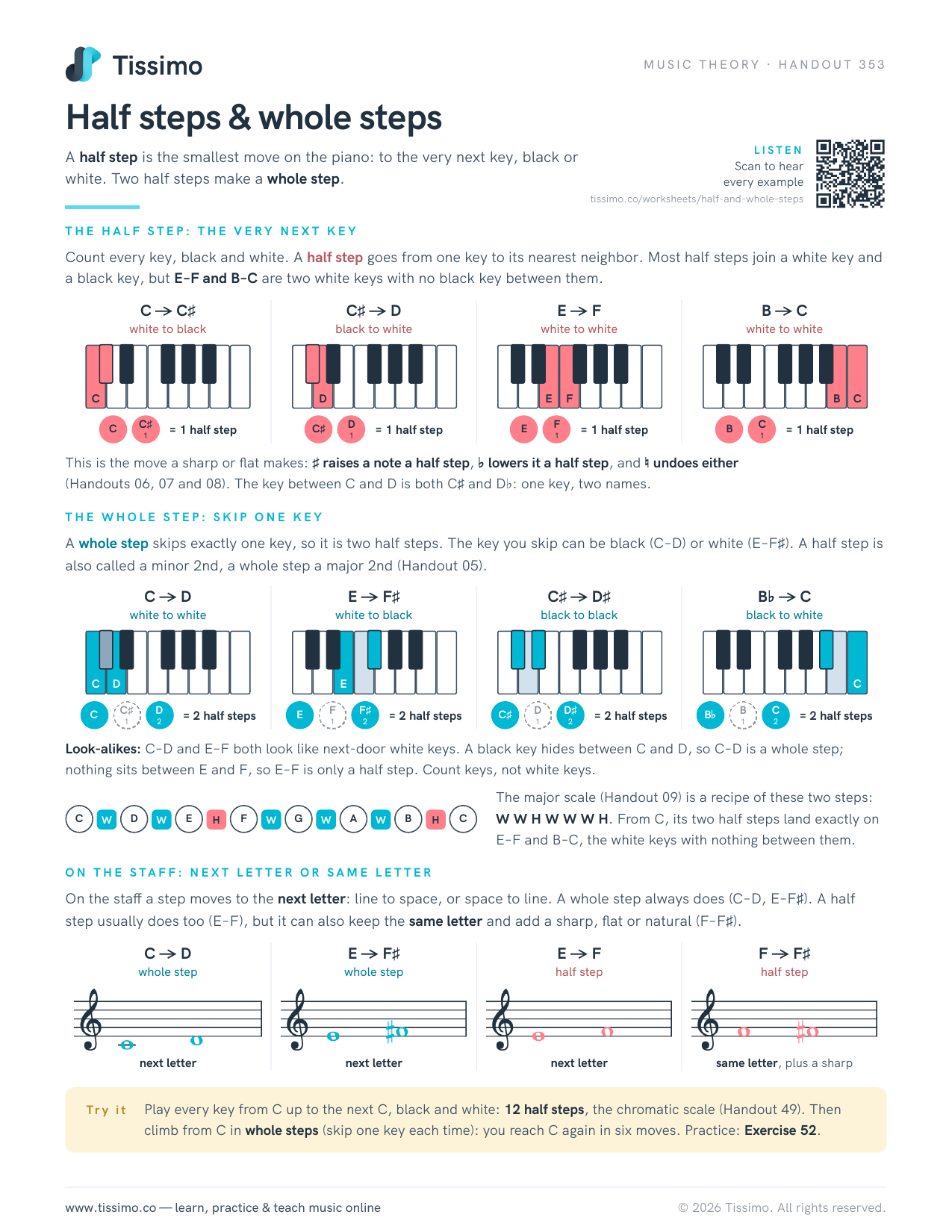 Half steps & whole stepsA half step is the smallest move on the piano: to the very next key, black or white. Two half steps make a whole step.
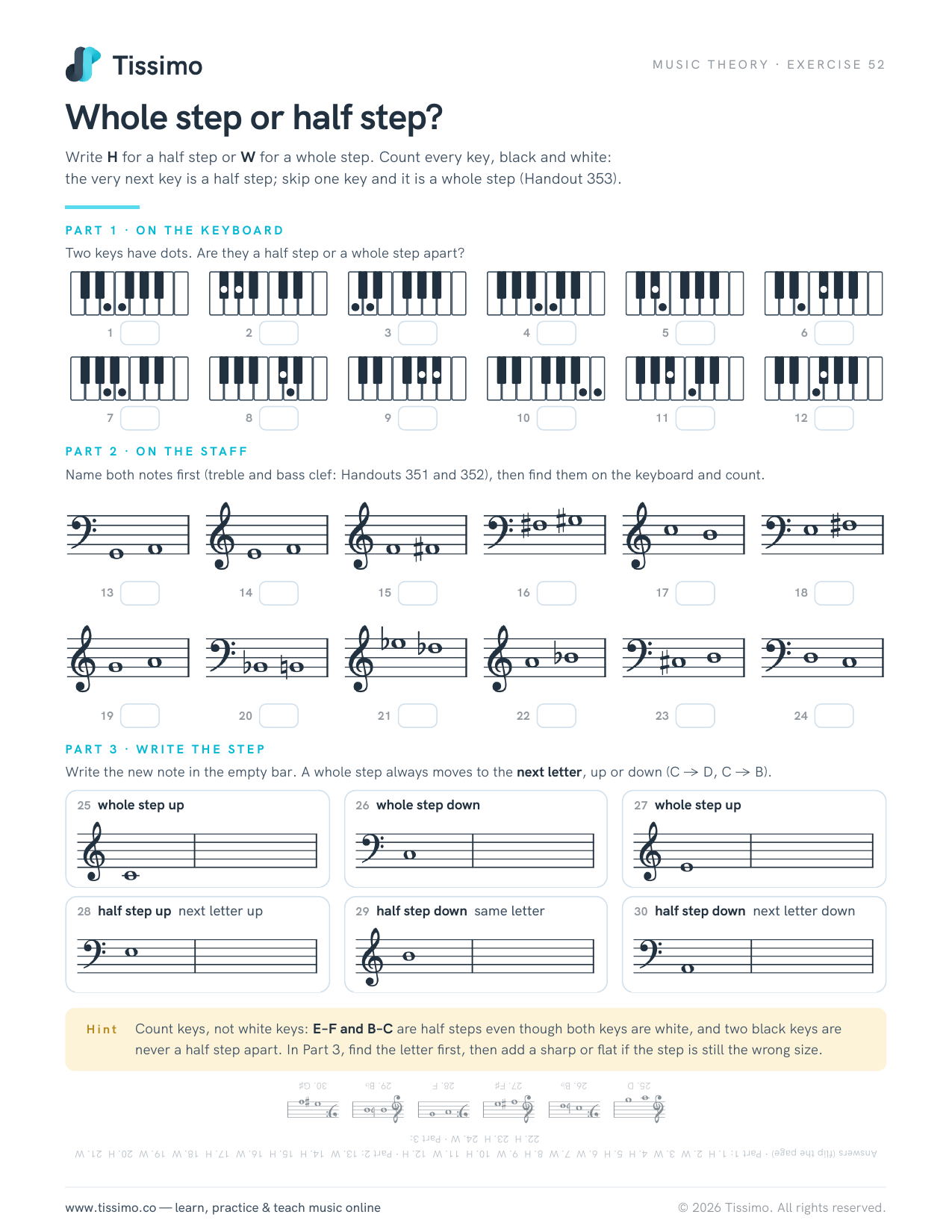 Whole step or half step?Write H for a half step or W for a whole step. Count every key, black and white: the very next key is a half step; skip one key and it is a whole step (Handout 353).
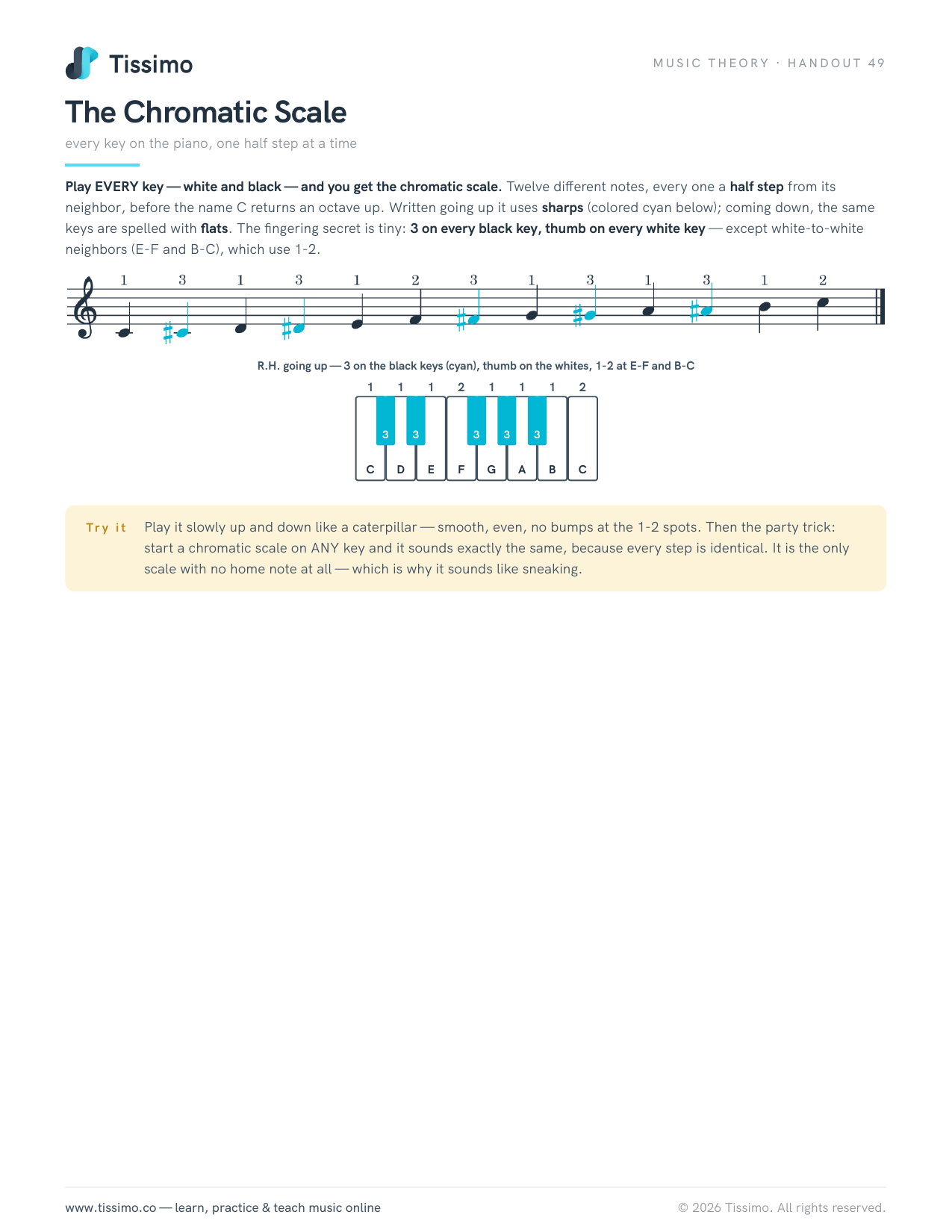 The Chromatic Scaleevery key on the piano, one half step at a time
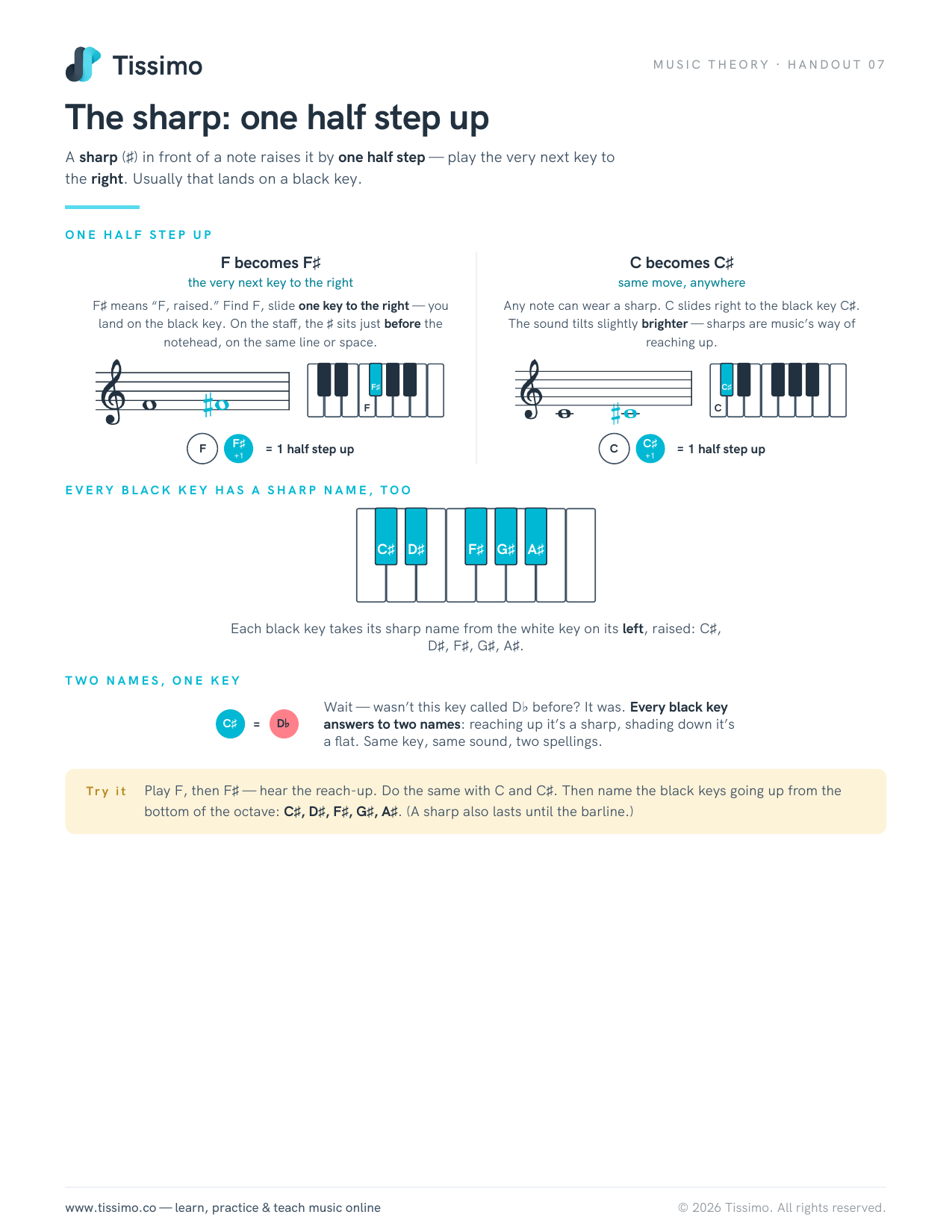 The sharp: one half step upA sharp (♯) in front of a note raises it by one half step (Handout 353) — play the very next key to the right. Usually that lands on a black key.
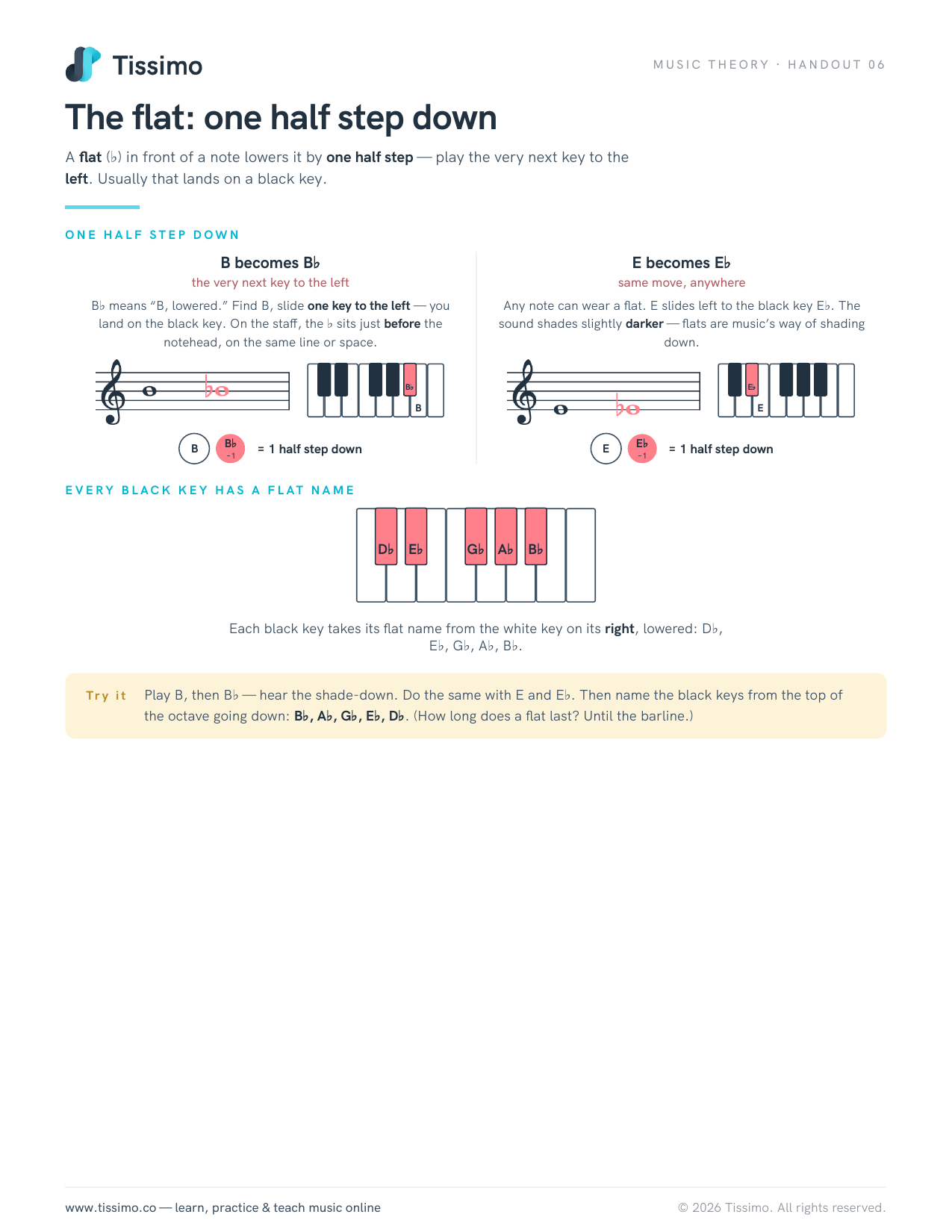 The flat: one half step downA flat (♭) in front of a note lowers it by one half step (Handout 353) — play the very next key to the left. Usually that lands on a black key.
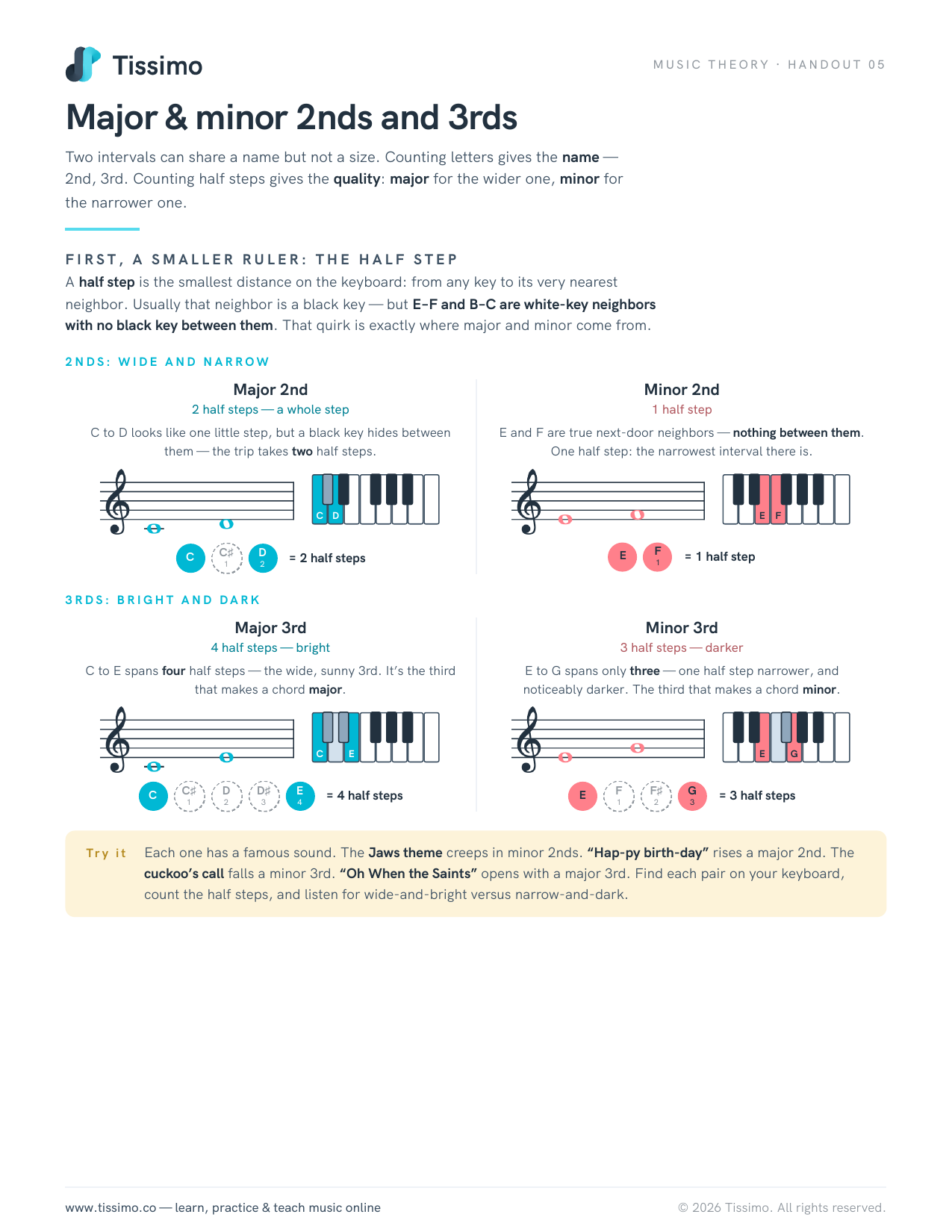 Major & minor 2nds and 3rdsTwo intervals can share a name but not a size. Counting letters gives the name — 2nd, 3rd. Counting half steps gives the quality: major for the wider one, minor for the narrower one.