Pitch & Intervals
Whole Step (Whole Tone)
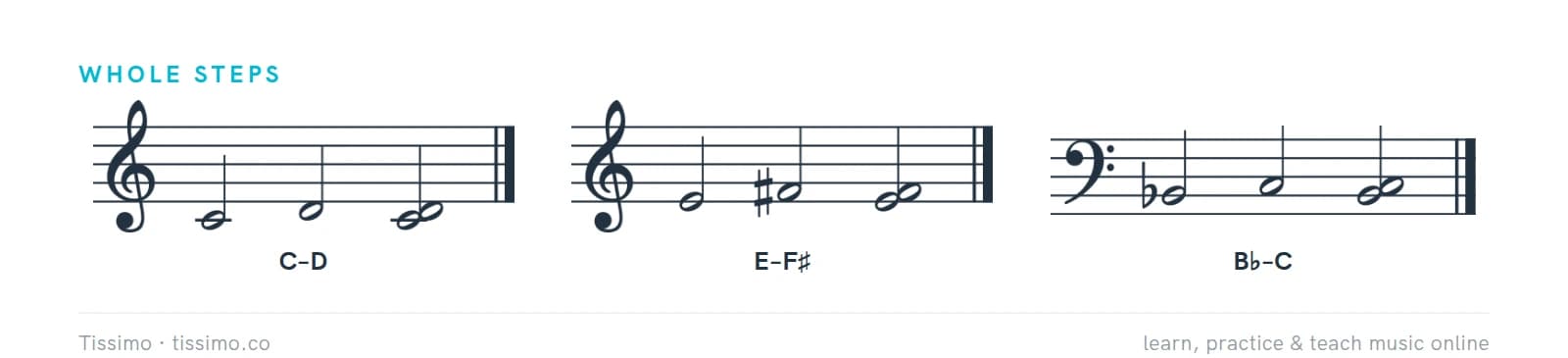
A whole step, or whole tone, is an interval of two half steps: from one piano key, skip the very next key and land on the one after it. C to D and E to F♯ are whole steps.
A whole step is two half steps added together. On the piano, start on any key, skip exactly one key (black or white) and land on the next one: C to D skips C♯, E to F♯ skips F. British musicians call it a tone or whole tone.
With and without black keys
A black key sits between most pairs of neighboring white keys, so most white-key pairs are whole steps: C–D, D–E, F–G, G–A and A–B. The exceptions are E–F and B–C, which are only half steps. To make a whole step up from E or B you need a black key, E–F♯ and B–C♯. Going down, a whole step below F is E♭, and below C it is B♭.
Spelling a whole step
A whole step normally moves to the next letter name, which makes it a major second: C–D, E–F♯, B♭–C. The same two keys spelled with letters two apart, such as C–E𝄫, form a diminished third. It sounds identical but almost never appears outside advanced harmony, so for everyday reading, think "next letter, two half steps".
Whole steps in scales
The major scale follows a fixed pattern of whole (W) and half (H) steps: W W H W W W H. In C major that gives C–D–E–F–G–A–B–C, with the half steps on E–F and B–C. Every other major key needs sharps or flats to keep the same pattern. A scale built only from whole steps is the whole-tone scale: six notes per octave and no half steps at all.
In equal temperament a whole step measures exactly 200 cents.
Practice telling the two steps apart with Half steps & whole steps and Whole step or half step?.
Common questions
How many half steps are in a whole step?
Two. A whole step skips exactly one key on the piano, so it equals two half steps, or 200 cents in equal temperament.
Is a whole step the same as a major second?
Almost always. A whole step spelled with neighboring letter names (C–D, E–F♯) is a major second. The rare spelling C–E𝄫 covers the same distance but is called a diminished third.
Practice it: free worksheets
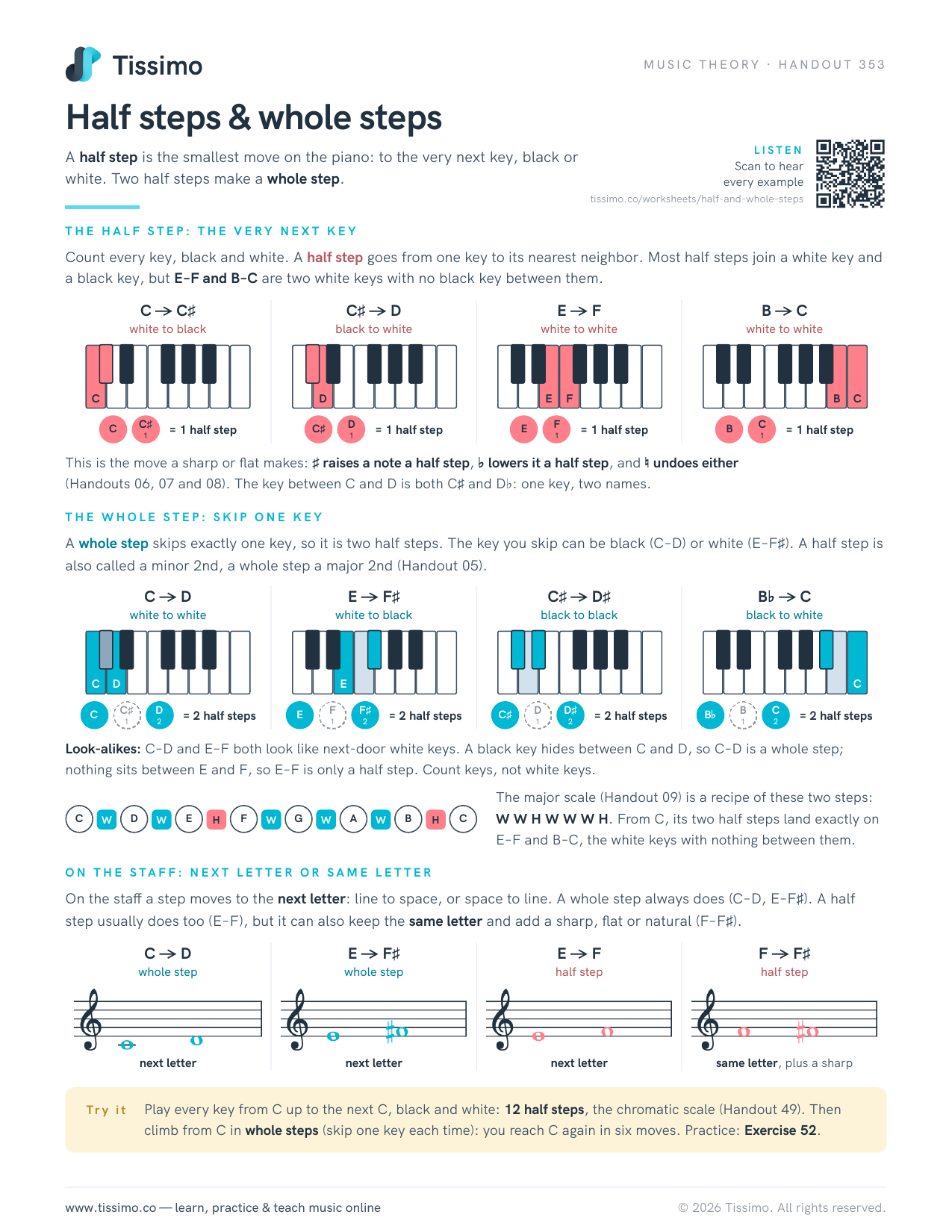 Half steps & whole stepsA half step is the smallest move on the piano: to the very next key, black or white. Two half steps make a whole step.
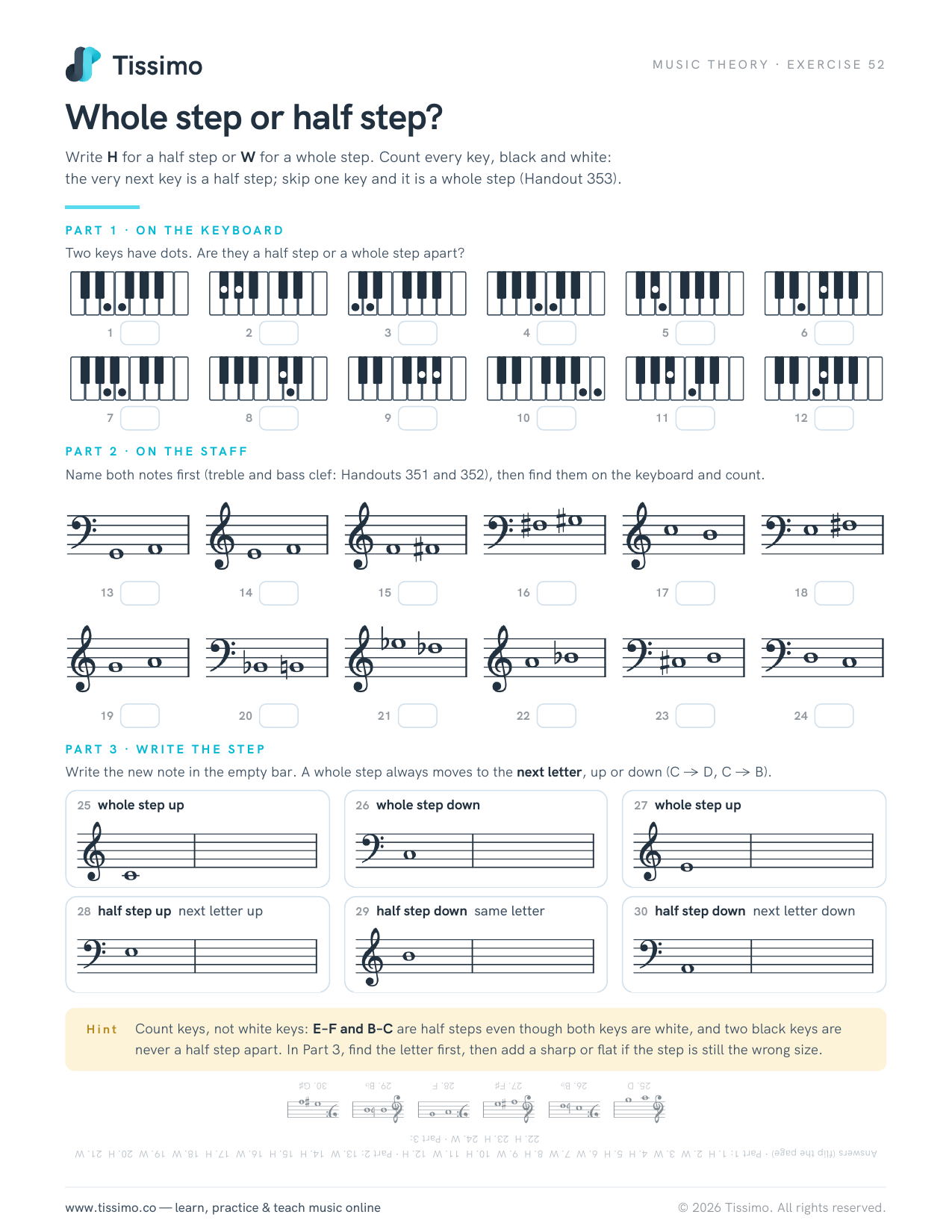 Whole step or half step?Write H for a half step or W for a whole step. Count every key, black and white: the very next key is a half step; skip one key and it is a whole step (Handout 353).
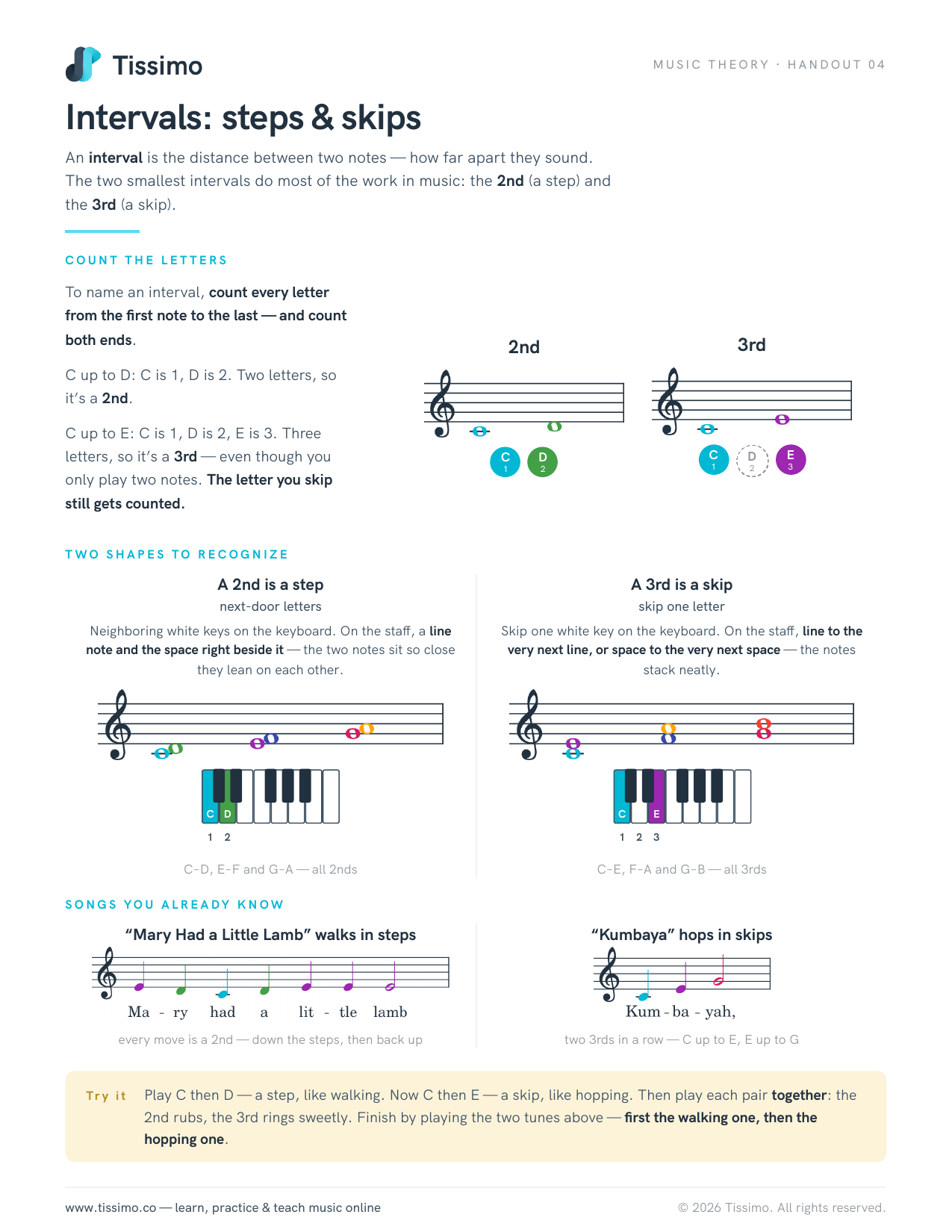 Intervals: steps & skipsAn interval is the distance between two notes — how far apart they sound. Two common melodic movements are the 2nd (a step) and the 3rd (a skip).
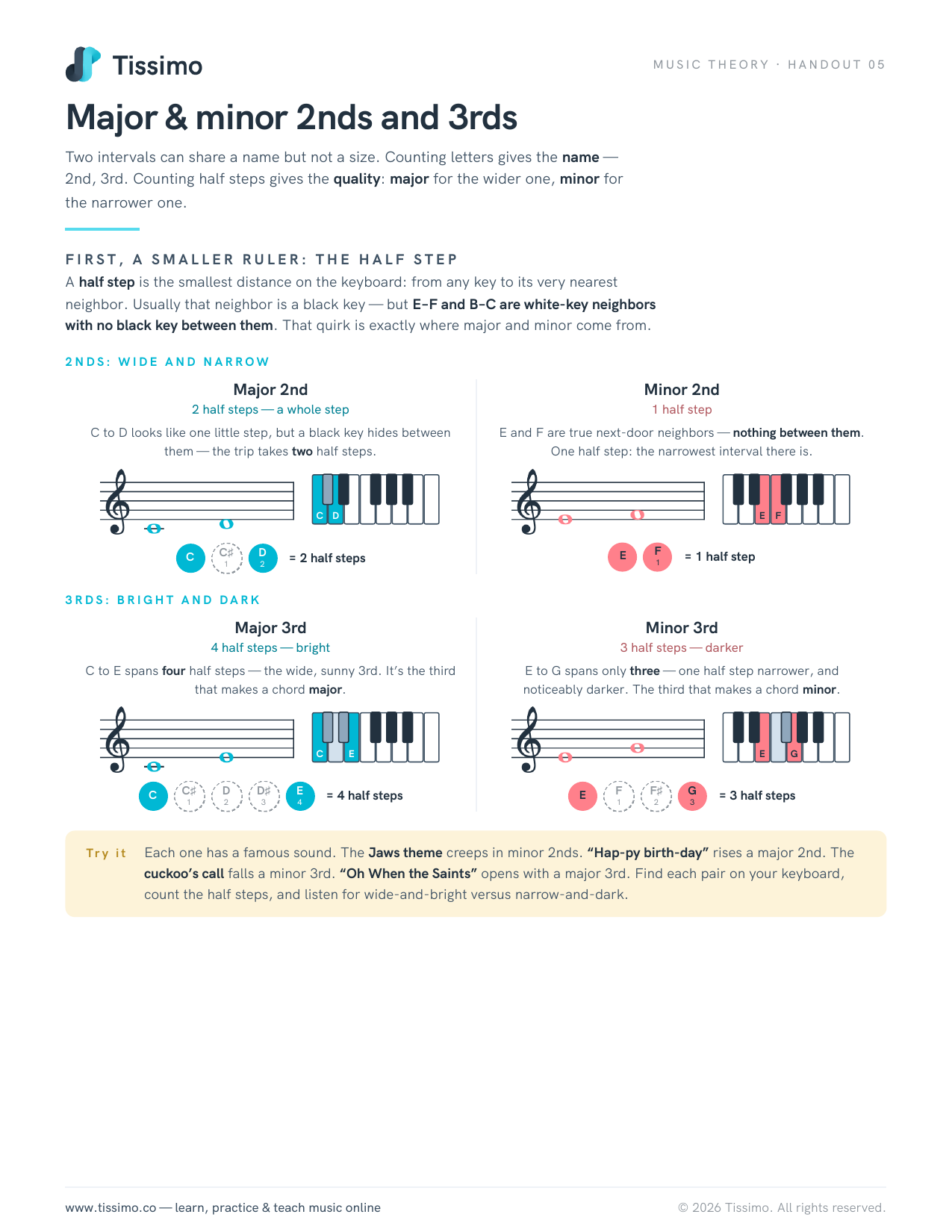 Major & minor 2nds and 3rdsTwo intervals can share a name but not a size. Counting letters gives the name — 2nd, 3rd. Counting half steps gives the quality: major for the wider one, minor for the narrower one.