Rhythm & Meter
Whole Rest
A whole rest is a small filled rectangle hanging below the fourth line of the staff. It means four beats of silence in 4/4, and alone in a bar it marks a whole bar of silence in other time signatures too.
The whole rest is a small, solid rectangle that hangs down from the fourth line of the five-line staff, the second line from the top. In 4/4 it lasts four beats, as long as a whole note. In British English it is called a semibreve rest.
Whole rest or half rest?
The half rest uses the same block shape, but it sits on top of the middle line instead of hanging from the line above. Two memory aids many teachers use:
- The whole rest is heavier (it lasts longer), so it hangs down; the half rest is lighter, so it sits on top.
- The half rest looks like a hat; the whole rest looks like a hole.
A whole bar of silence
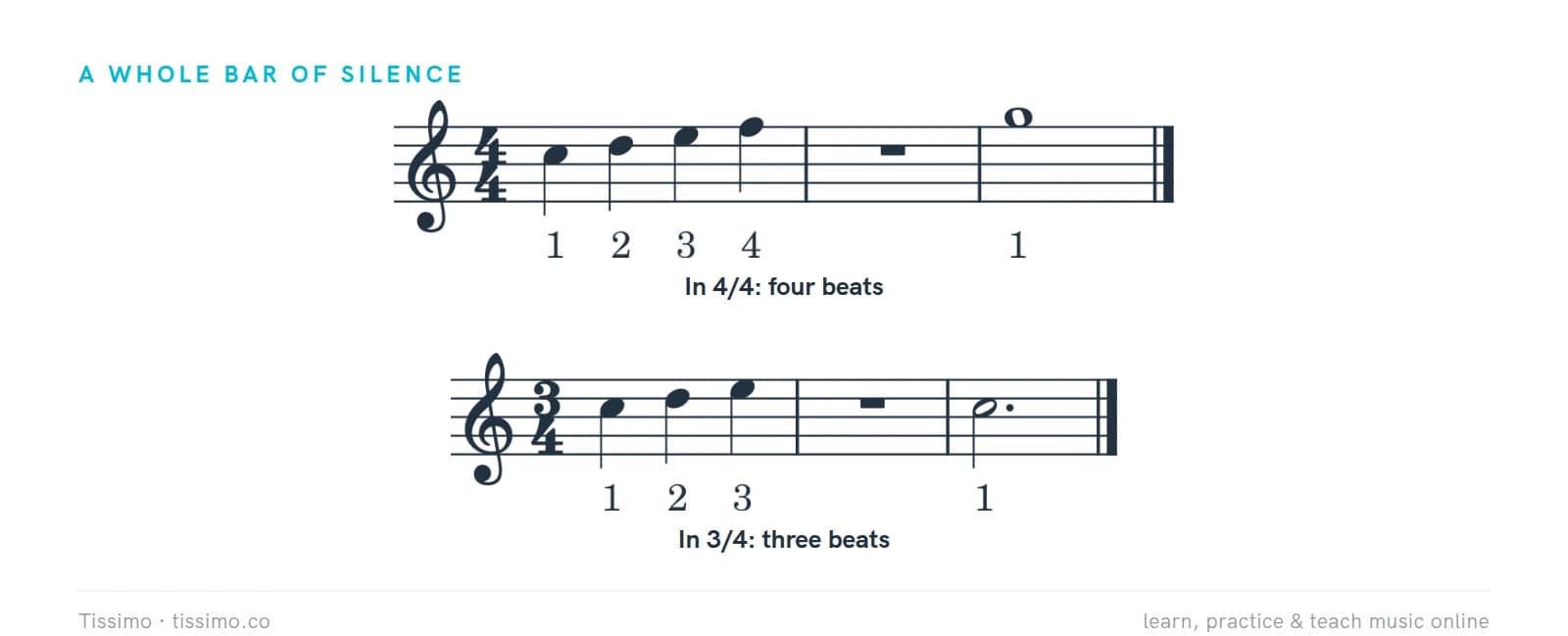
The whole rest has a second job. Placed in the middle of an otherwise empty bar, it means "silent for this entire bar", whatever the time signature. In 3/4 it lasts three beats, in 2/4 two beats, and in 6/8 two dotted-quarter beats. Because of this use it is also called a bar rest or measure rest.
Counting a whole rest
Keep counting through it, beat by beat: "1, 2, 3, 4" in 4/4, or "1, 2, 3" in 3/4. It is easy to rush through a bar of silence, especially when you are nervous; saying the counts makes sure you come back in on time. When a part is silent for many bars, the bar rests are combined into a single multimeasure rest with the number of bars printed above it.
Learn it alongside its relatives in The Rests and The Rest Family, and practice counting long silences with Keep the Pulse Through Silence.
Common questions
How many beats is a whole rest?
Four in 4/4. Alone in a bar, though, it stands for a whole bar of silence in other meters too: three beats in 3/4, two in 2/4.
What is the difference between a whole rest and a half rest?
The whole rest hangs below the fourth line of the staff; the half rest sits on top of the middle line. In 4/4 the whole rest is twice as long.