Rhythm & Meter
Whole Note
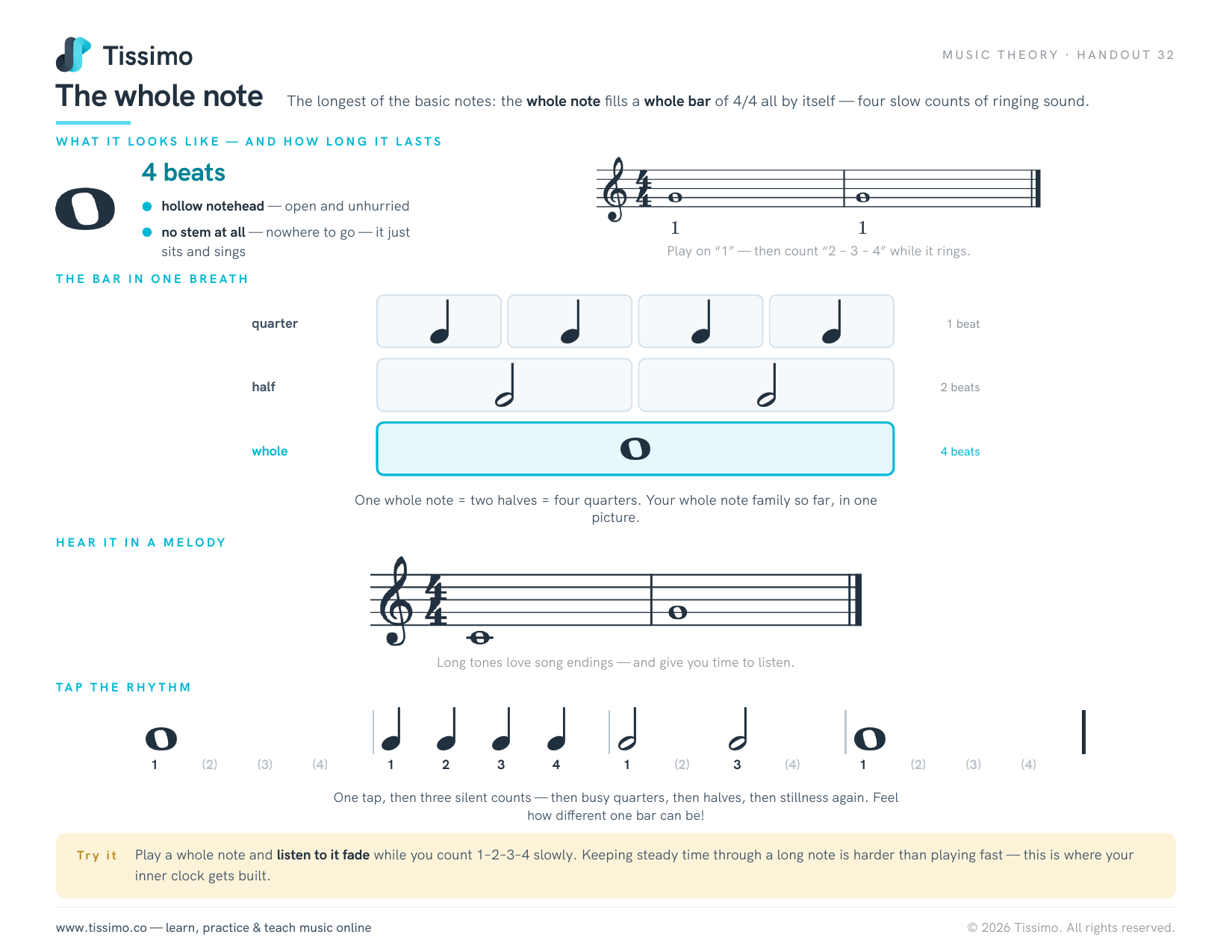
A whole note is an open oval notehead with no stem. In 4/4 time it lasts four beats, a whole bar, and it is the longest note value in everyday use.
The whole note is the longest note you will meet in most music. It is an open, hollow oval with no stem, slightly wider than the head of a half note. In 4/4 it lasts four beats and fills a whole bar by itself, which is how it got its name. In British English it is called a semibreve.
How long is a whole note?
A whole note equals two half notes, four quarter notes or eight eighth notes. In 4/4, where a quarter note gets the beat, that makes it four beats long. Because it lasts four quarter-note beats, a single whole note does not fit in a bar of 3/4 or 2/4; a full bar of sound in 3/4 is written as a dotted half note instead.
In cut time (2/2) the half note gets the beat, so a whole note lasts two beats there, still one full bar.
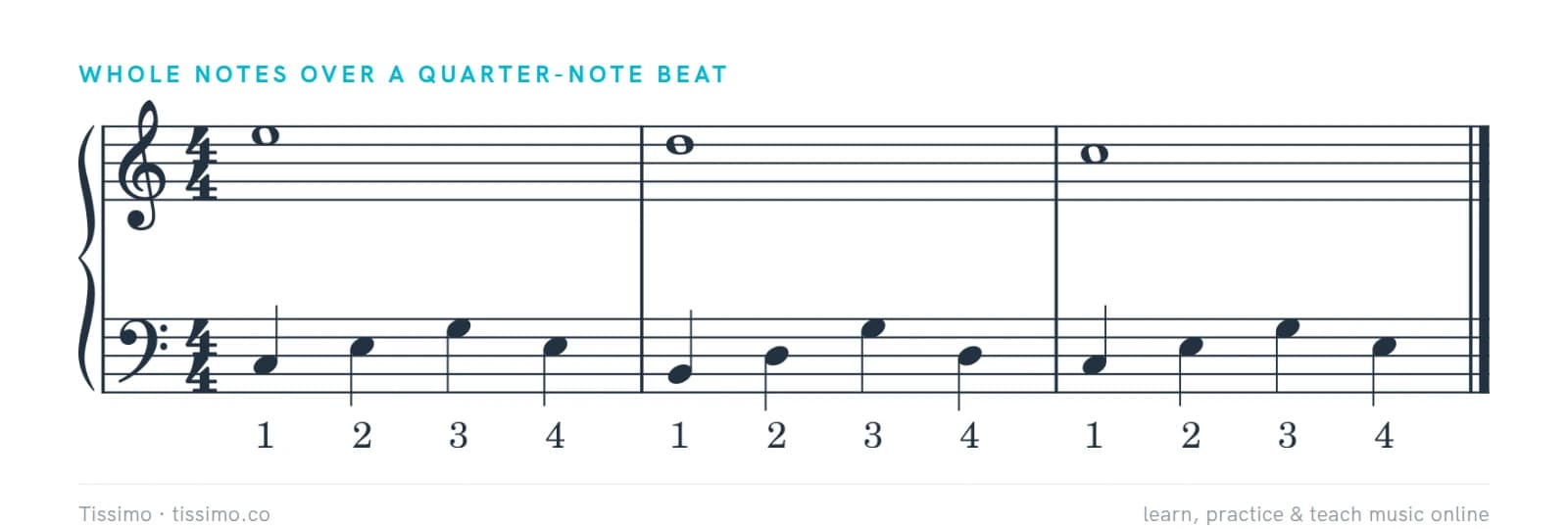
Playing a whole note
Play the note on beat 1 and keep it sounding while you count "1, 2, 3, 4". Release it exactly as the next bar begins, not early. On the piano that means holding the key down; on wind and string instruments it means keeping the breath or bow going evenly to the end, without letting the sound die away too soon.
A whole note longer than one bar is written as two notes joined by a tie. A dotted whole note lasts six quarter-note beats and fills a bar of 6/4 or 3/2.
Whole note and whole rest
The silent partner of the whole note is the whole rest, a small block hanging below the fourth line of the staff. Besides four beats of silence in 4/4, a whole rest is also used for a whole bar of silence in any time signature.
Practice reading and counting it with The Whole Note.
Common questions
How many beats is a whole note?
Four beats in 4/4, where the quarter note gets the beat. In cut time, where the half note gets the beat, it lasts two beats.
Can a whole note be used in 3/4 time?
Not as a single note, because it is longer than the bar. A note that fills a whole bar of 3/4 is written as a dotted half note. A whole rest, on the other hand, can mark a full bar of silence in 3/4.