Notation & Symbols
Tie
A tie is a curved line joining two notes of the same pitch. The second note is not played again: the sound simply continues, so the two lengths add together, often across a bar line.
A tie is a curved line that connects two or more notes of the same pitch. You play the first note and hold it through the length of the second, without playing the second note again. The written values add up: in 4/4, a half note tied to a quarter note lasts three beats.
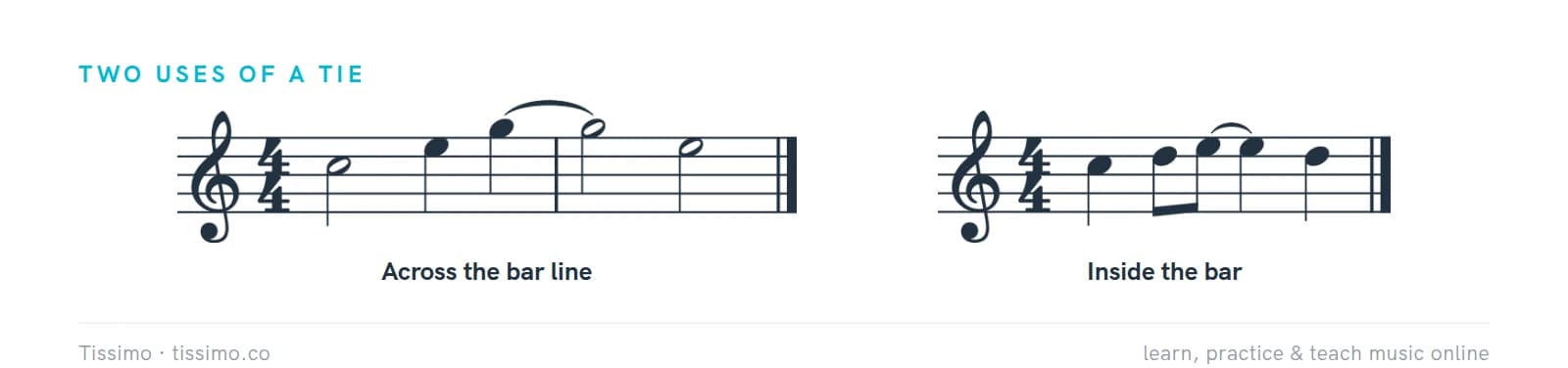
Why ties are needed
- Across a bar line. A note cannot stretch past a bar line on its own, so a sound that continues into the next bar is written as two notes joined by a tie.
- For lengths with no single symbol. A sound lasting five eighth notes has no note value of its own, so it is written as, for example, a half note tied to an eighth note.
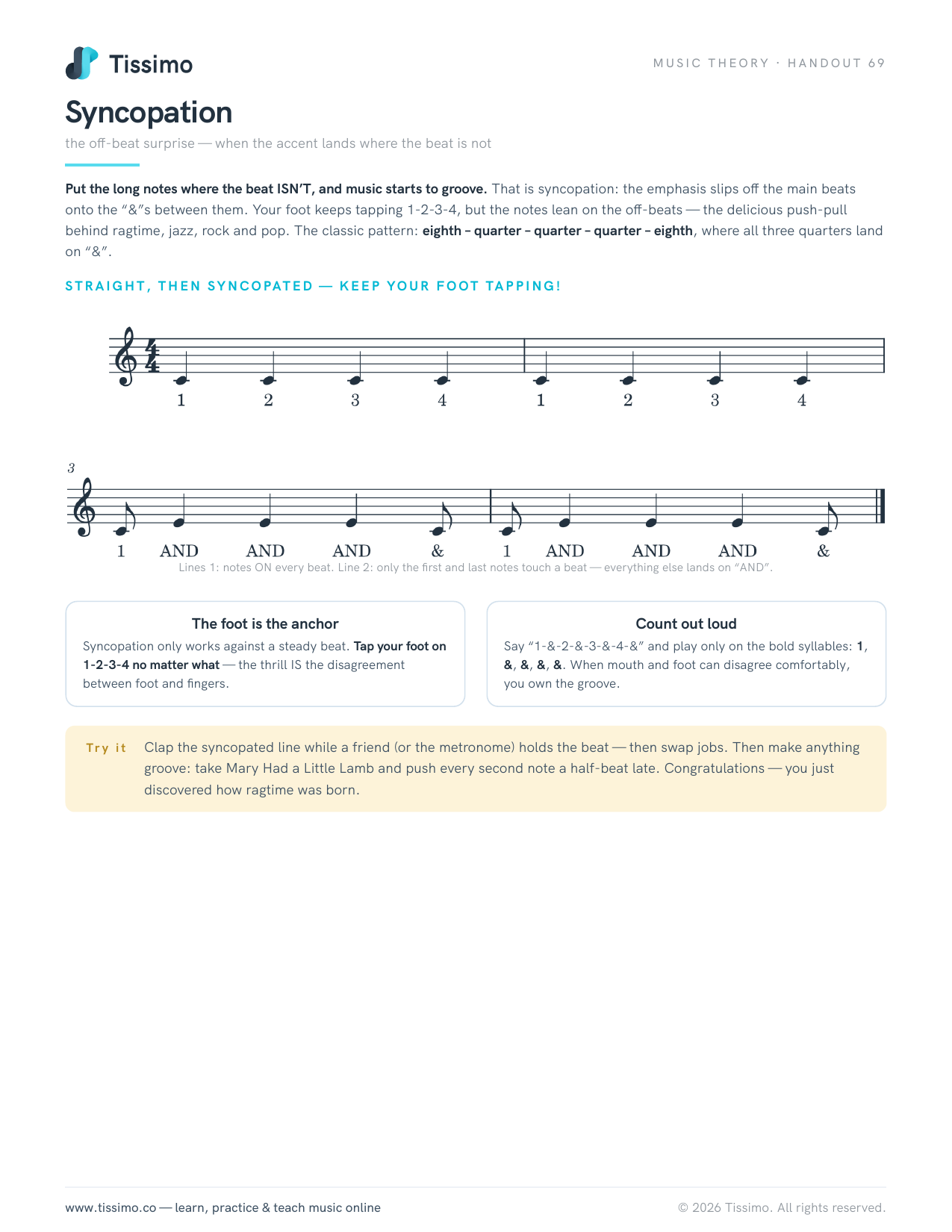
- To show the beat. Even inside a bar, a long note that starts off the beat is often split with a tie, so the middle of the bar stays visible. Many syncopated rhythms are written this way.
How to recognize a tie
A tie connects noteheads, not stems, and usually curves away from the stems. Its notes normally sit on the same line or space, but a clef change can move the same pitch to a different staff position. The essential feature is one sustained pitch across successive written notes, not matching staff positions alone. A slur groups notes that are still played separately. In a chord, each tied note gets its own tie.
A tie also carries an accidental across a bar line: if an F♯ is tied into the next bar, the tied note is still F♯, with no new sign.
Counting tied notes
Count through the tie rather than stopping at it. Say the beats aloud while you hold the note, and play the next note exactly when its beat arrives. Writing the counts under the notes, as in Write the counts 3: triplets & ties, is good practice. To tell ties from slurs at a glance, try Ties vs Slurs.
Common questions
What is the difference between a tie and a slur?
A tie joins two notes of the same pitch, and you play only the first. A slur groups separately played notes, usually with a smooth connection. It can include repeated pitches or start and end on the same pitch, so matching endpoints alone do not identify a tie.
How do you count a tied note?
Add the values together and keep counting while you hold: in 4/4, a quarter note tied to a half note lasts three beats.
Practice it: free worksheets
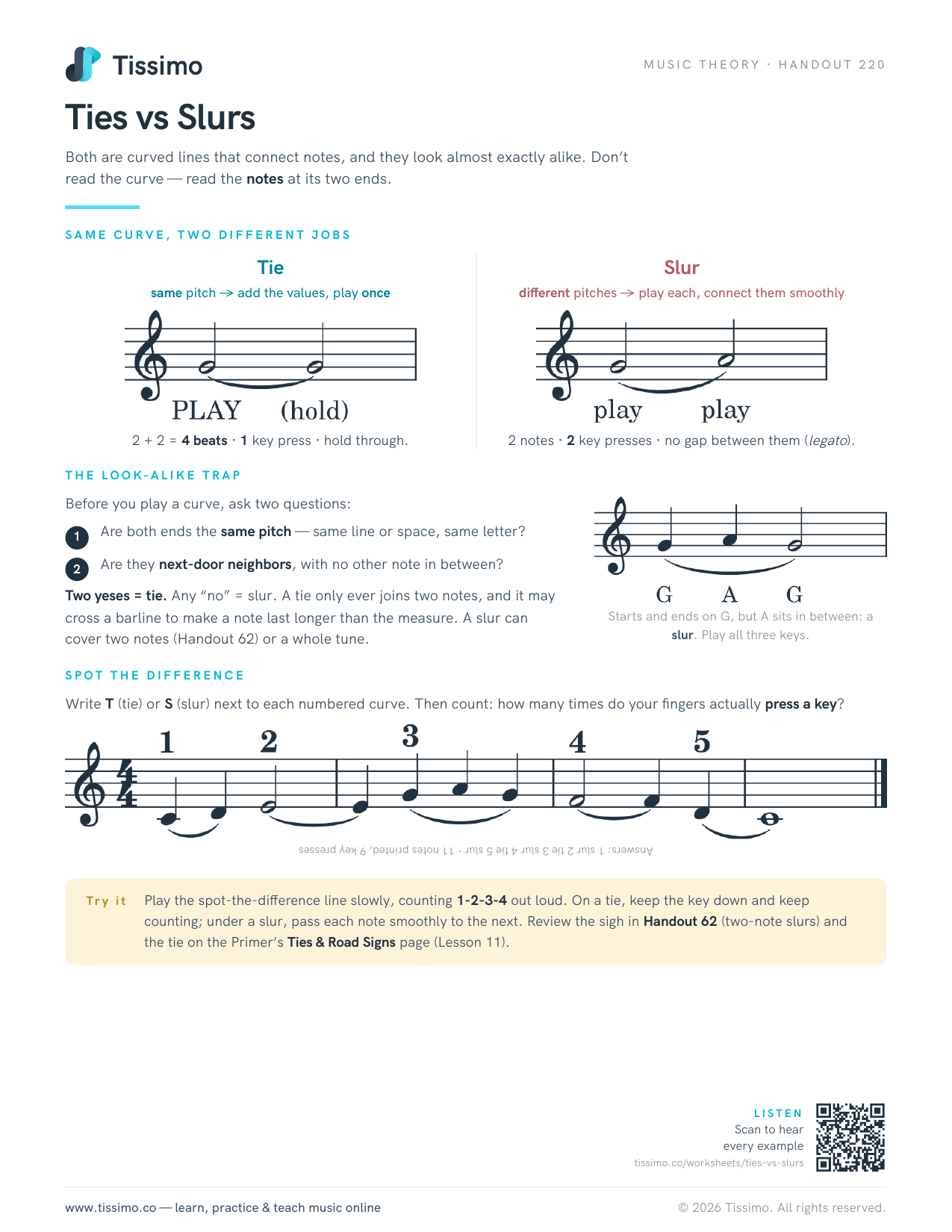 Ties vs SlursBoth are curved lines that connect notes, and they look almost exactly alike. Don’t read the curve — read the notes at its two ends.
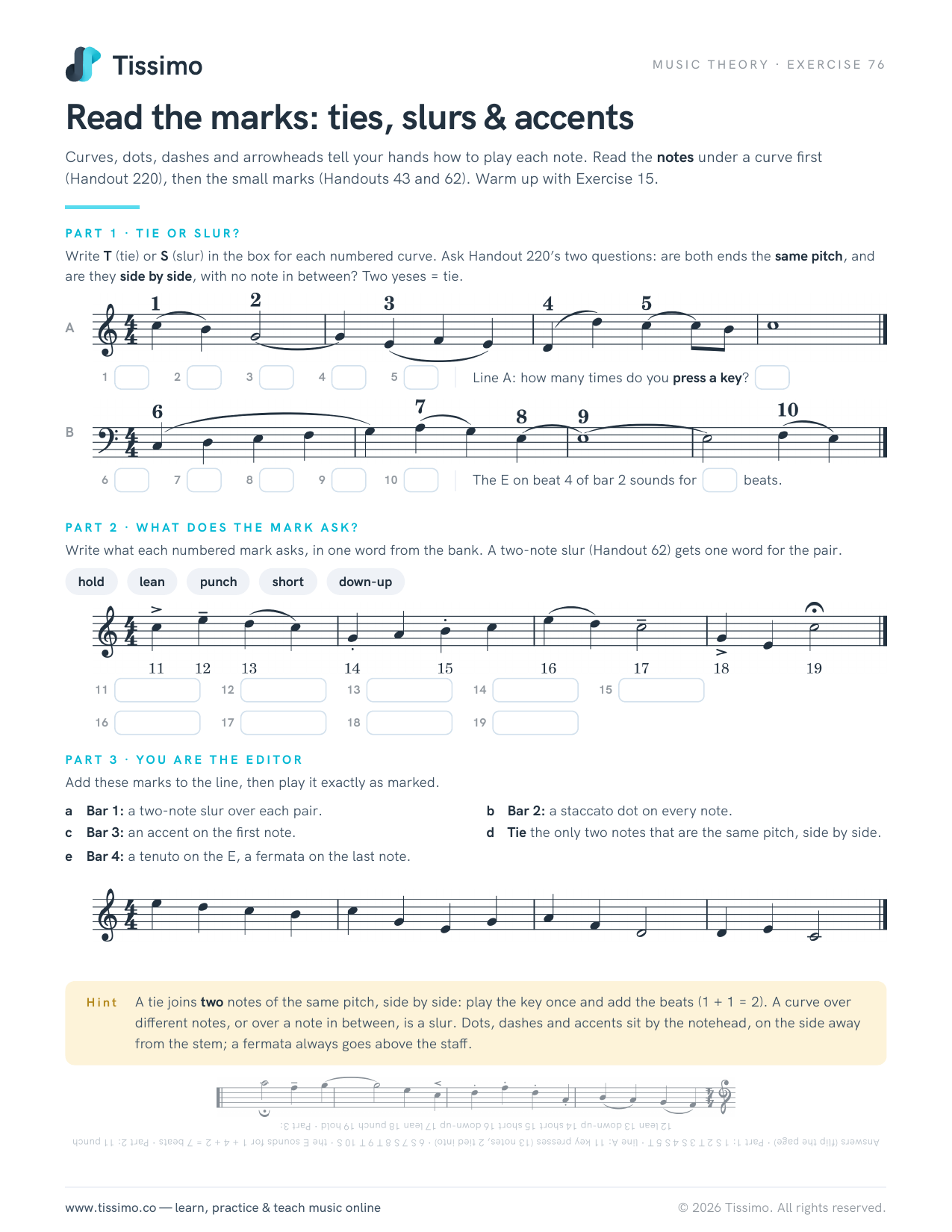 Read the marks: ties, slurs & accentsCurves, dots, dashes and arrowheads tell your hands how to play each note. Read the notes under a curve first (Handout 220), then the small marks (Handouts 43 and 62). Warm up with Exercise 15.
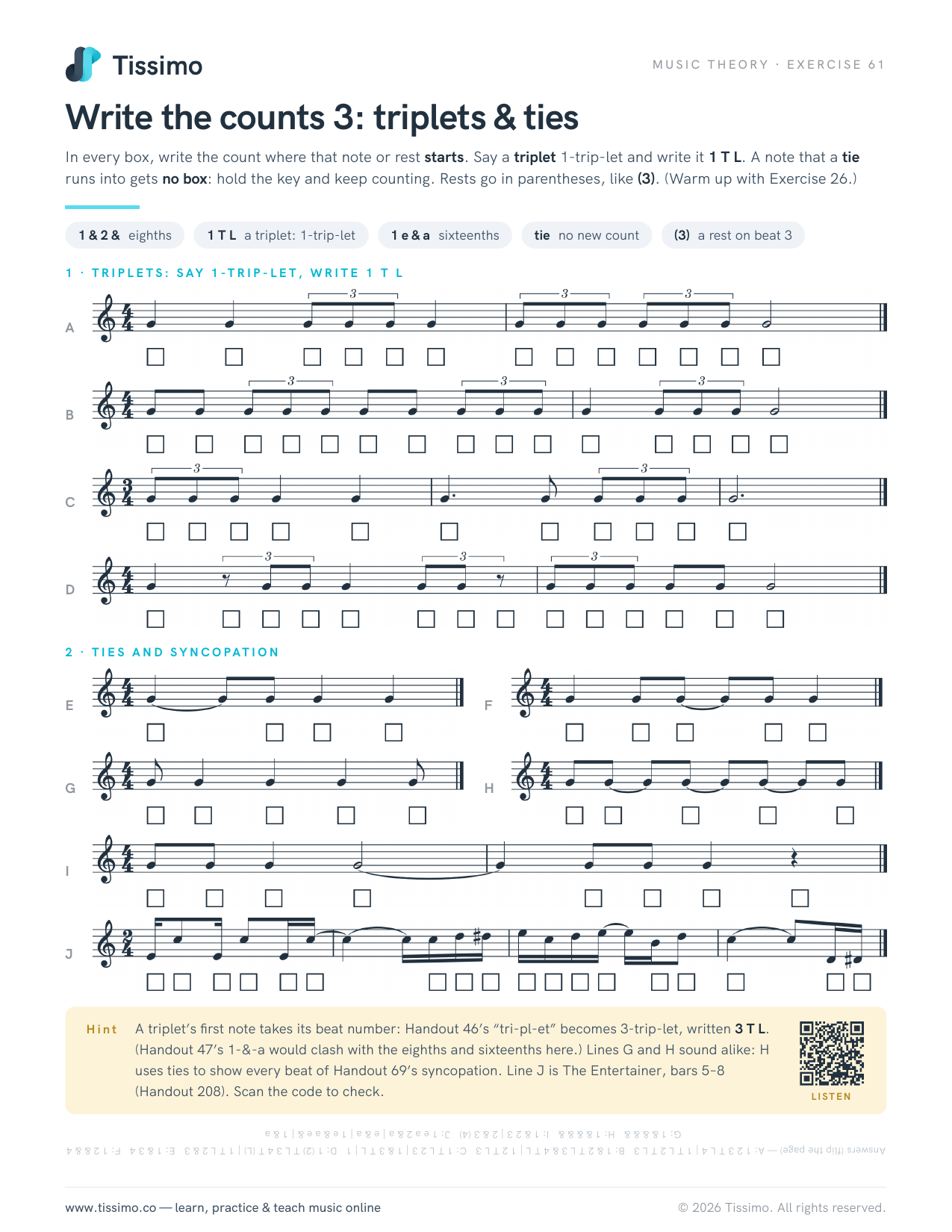 Write the counts 3: triplets & tiesIn every box, write the count where that note or rest starts. Say a triplet 1-trip-let and write it 1 T L. A note that a tie runs into gets no box: hold the key and keep counting. Rests go in parentheses, like (3). (Warm up with Exercise 26.)
 Syncopationthe off-beat surprise — when the accent lands where the beat is not