Notation & Symbols
Bar Line
A bar line is a vertical line drawn across the staff to divide music into measures (bars). Variants such as the double bar line, the final bar line and repeat bar lines mark sections, endings and repeats.
A bar line is a thin vertical line drawn from the top line of the staff to the bottom line. Bar lines cut the music into measures (bars) of equal length, as set by the time signature, so you can see where each group of beats begins. The first beat after a bar line is the downbeat.
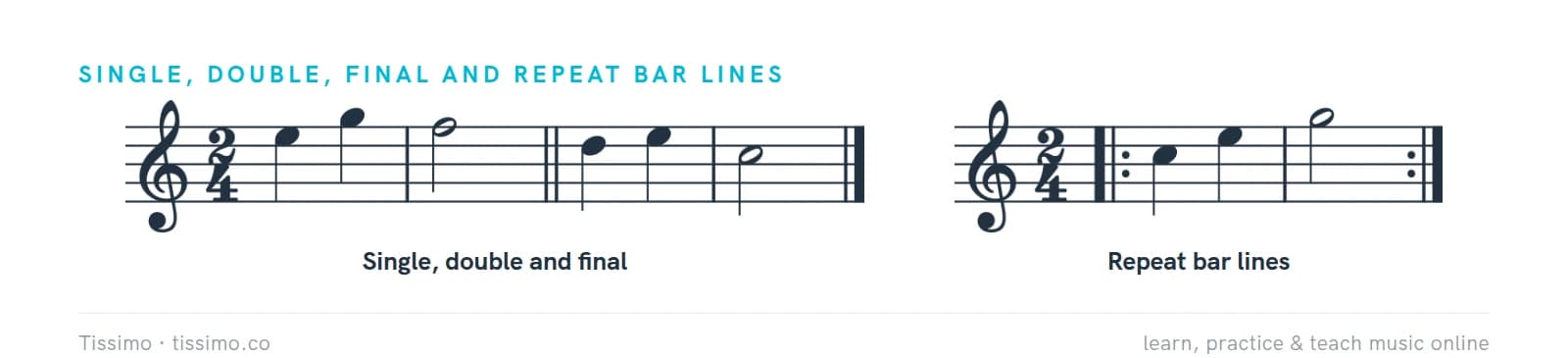
Kinds of bar line
- Single bar line: a thin line between ordinary bars.
- Double bar line: two thin lines, at the end of a section or just before a change of key, meter or tempo.
- Final bar line: a thin line followed by a thick one, at the end of a piece or movement.
- Repeat bar lines: thick and thin lines with two dots, the repeat sign that tells you to play a passage again.
- Dashed bar line: now and then used to split a long bar into easier-to-read parts without changing the meter.
What a bar line does, and does not do
A bar line is a guide for the eye, not a pause: the music runs straight through it, unless a fermata or a caesura says otherwise. One important rule is attached to it, though. An accidental lasts only until the next bar line, so a sharp in one bar does not carry into the next, unless a tie carries that note across.
Bar lines across several staves
In piano music, bar lines usually run straight through both staves of the grand staff, tying the hands together visually. In choral music they are usually drawn through each staff separately, leaving the gaps between staves free for the words. In an orchestral score, they usually join the staves of each instrument family.
Bar lines also give the music its numbering. Many editions print a bar number at the start of each system, so a teacher can say "start at bar 17" and everyone finds the same place.
Practice with Add the Barlines and Complete the measure.
Common questions
Is it bar line or barline?
Both spellings are common and mean the same thing.
Does a bar line cancel an accidental?
Yes. An accidental lasts until the end of its bar. After the bar line the note returns to the key signature, unless it is tied across the bar line.
Practice it: free worksheets
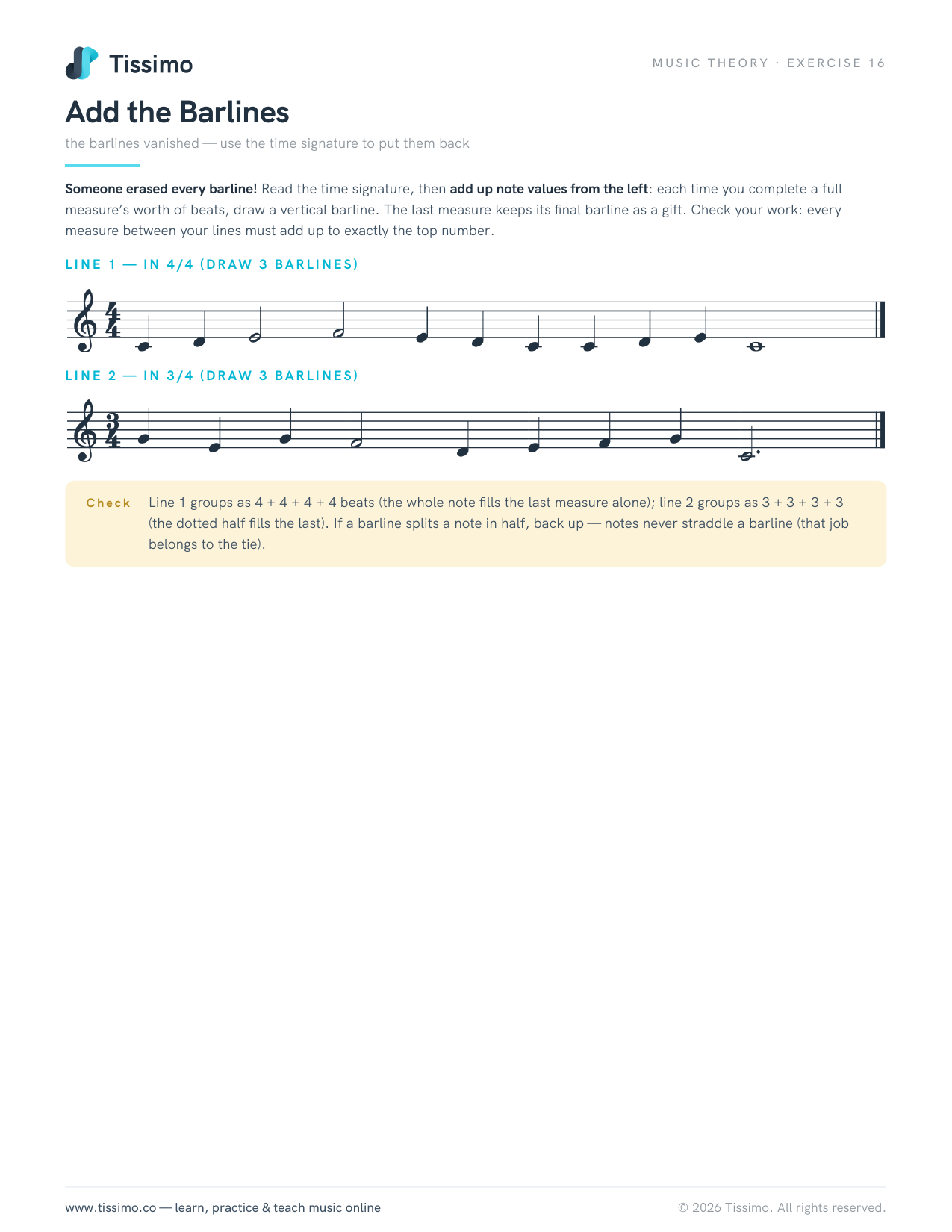 Add the Barlinesthe barlines vanished — use the time signature to put them back
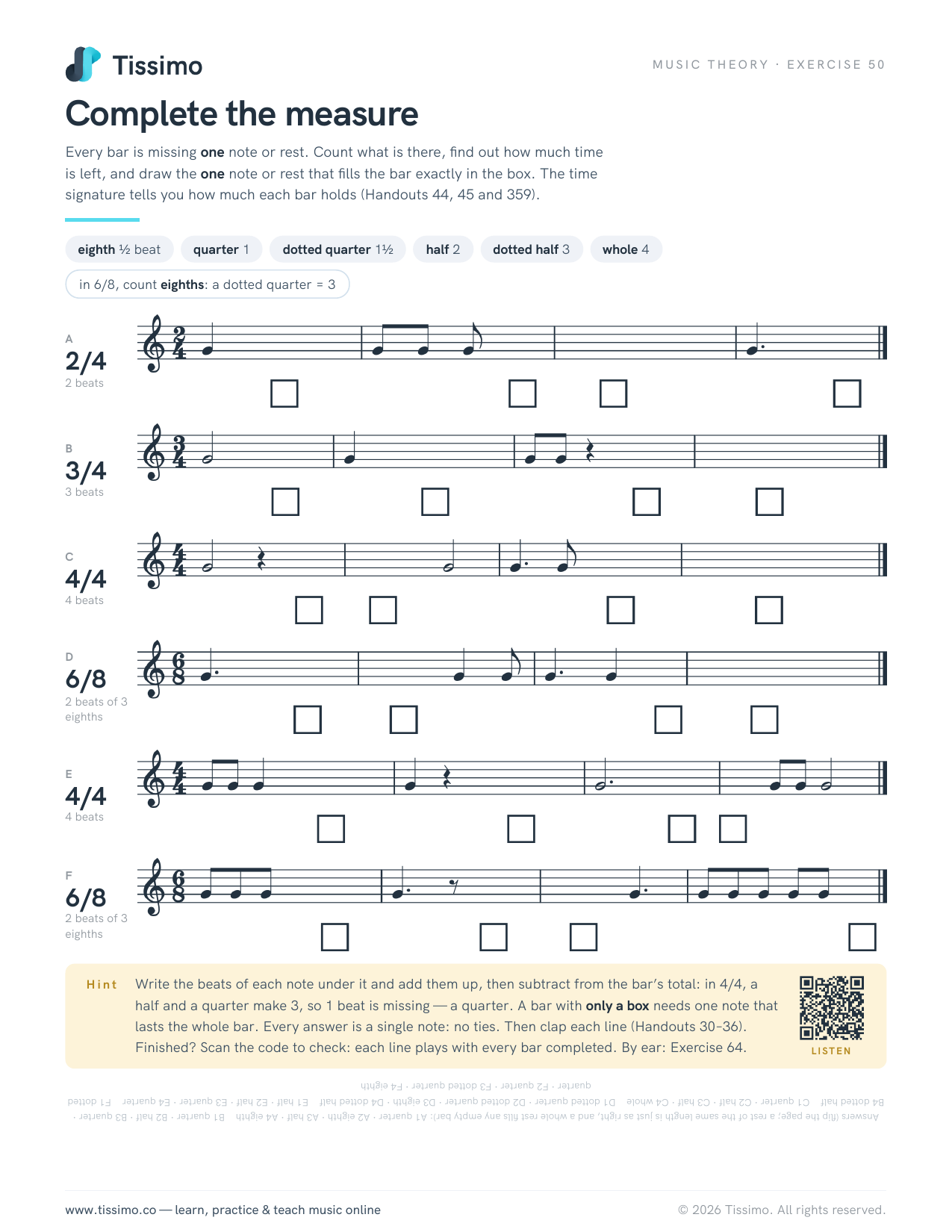 Complete the measureEvery bar is missing one note or rest. Count what is there, find out how much time is left, and draw the one note or rest that fills the bar exactly in the box. The time signature tells you how much each bar holds (Handouts 44, 45 and 359).
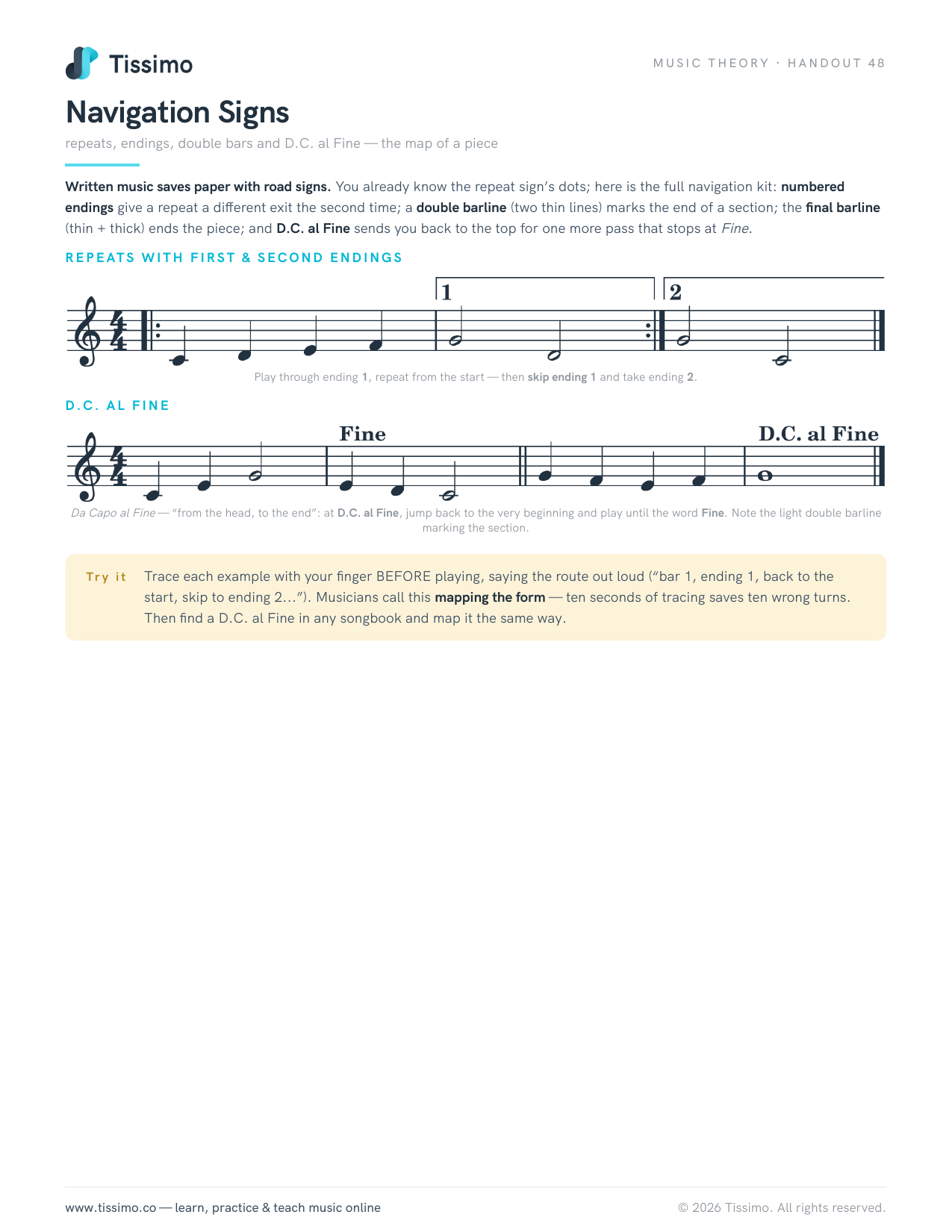 Navigation Signsrepeats, endings, double bars and D.C. al Fine — the map of a piece
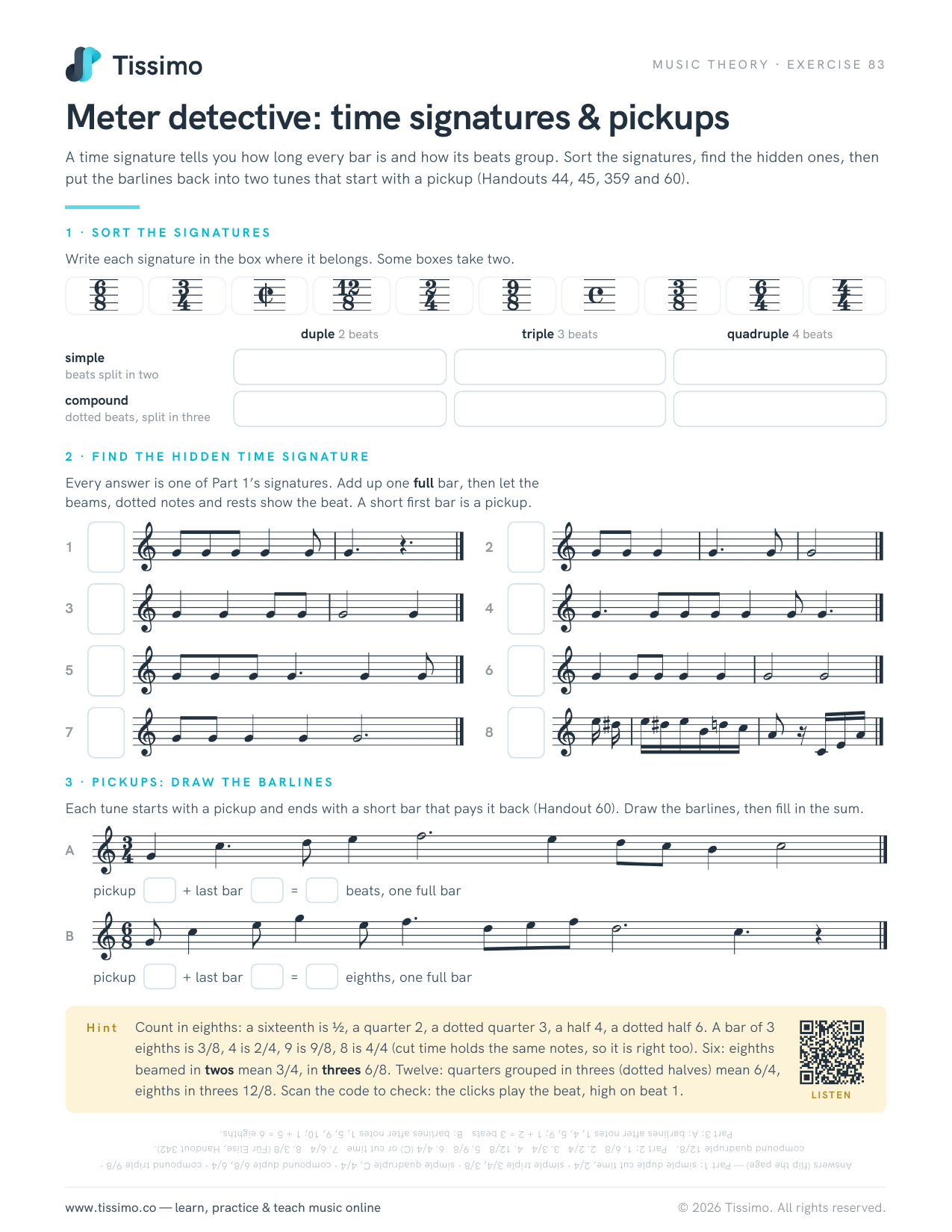 Meter detective: time signatures & pickupsA time signature tells you how long every bar is and how its beats group. Sort the signatures, find the hidden ones, then put the barlines back into two tunes that start with a pickup (Handouts 44, 45, 359 and 60).