Notation & Symbols
Accidental
An accidental is a sign placed before a note that alters or restores its pitch, such as a sharp, flat or natural. It applies at that staff position until another accidental changes it or the measure ends.
An accidental is a sign written just before a notehead, on the same line or space, that alters or restores the note's pitch. The five common signs in standard notation are:
- Sharp (♯): raises the note one half step.
- Flat (♭): lowers it one half step.
- Natural (♮): cancels a sharp or flat, returning to the plain letter name.
- Double sharp, shaped like a small bold x: raises the note two half steps.
- Double flat, two flat signs side by side: lowers the note two half steps.
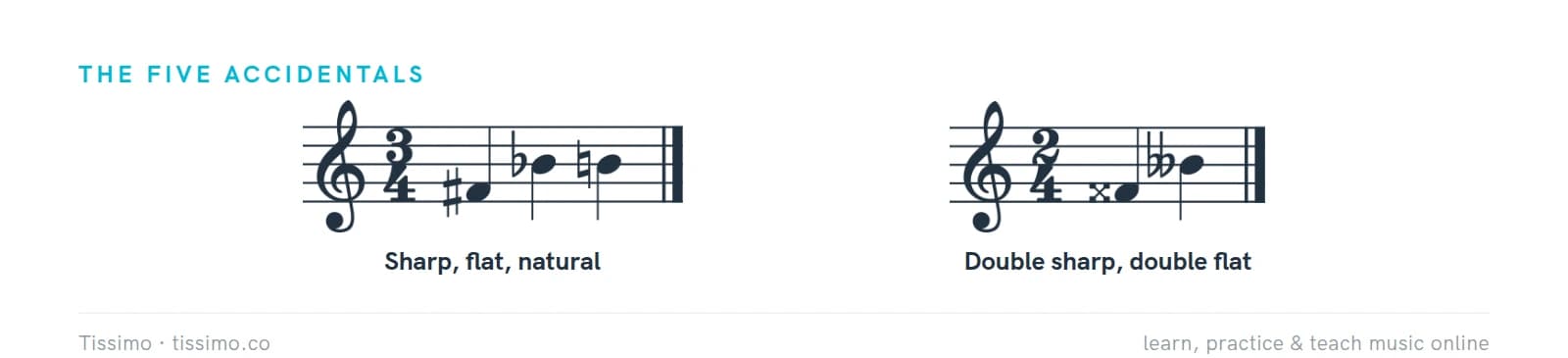
Written before, said after
On the page the accidental comes before the note, so you see it in time to play it. In speech and in note names it comes after the letter: the sign is printed before the F, but you say "F-sharp" and write F♯.
How long an accidental lasts
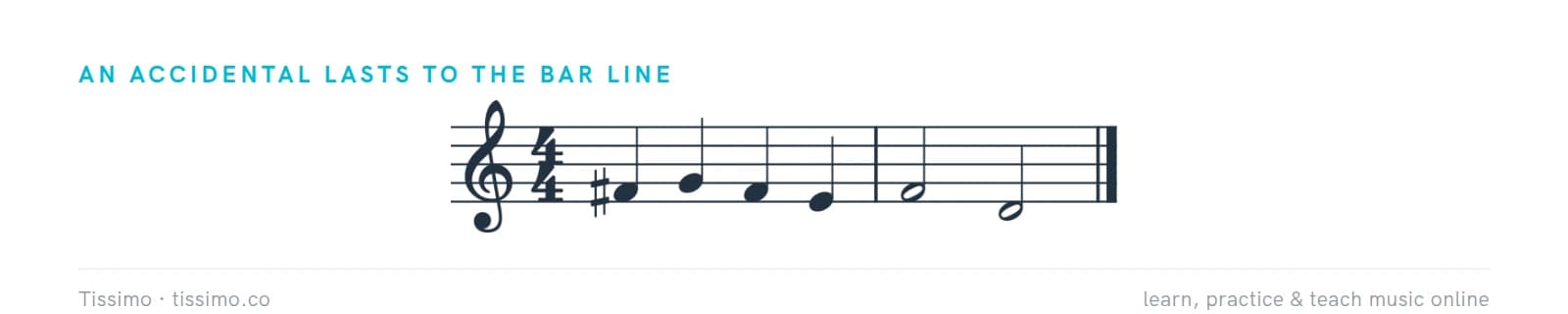
- An accidental affects its note until another accidental changes it or the measure ends. A second F on the same line later in the bar is still F-sharp if no new sign intervenes.
- It affects only that line or space. An F-sharp on the top line does not change an F an octave lower, although many editions add a reminder.
- The next bar line cancels it, unless the note is tied across the bar line. The tied note keeps the accidental; a fresh note on that pitch later in the new bar does not.
Accidentals and key signatures
The key signature works like a set of accidentals that apply to every octave for the whole piece, until it changes. The word "accidental" usually means a sign that is not in the key signature: a note from outside the key, as in a chromatic scale or a secondary dominant. An accidental in the music overrides the key signature until the end of its bar.
Sometimes an accidental is printed even though the rules do not require it, often in parentheses, to prevent a misreading. That is a courtesy accidental.
Practice with Accidentals on the staff, then meet each sign on its own in The sharp, The flat and The natural.
Common questions
How long does an accidental last?
Until the end of the measure, for notes on the same line or space. The next bar line cancels it, unless the note is tied across.
What are the five accidentals?
The sharp, flat, natural, double sharp and double flat.
Practice it: free worksheets
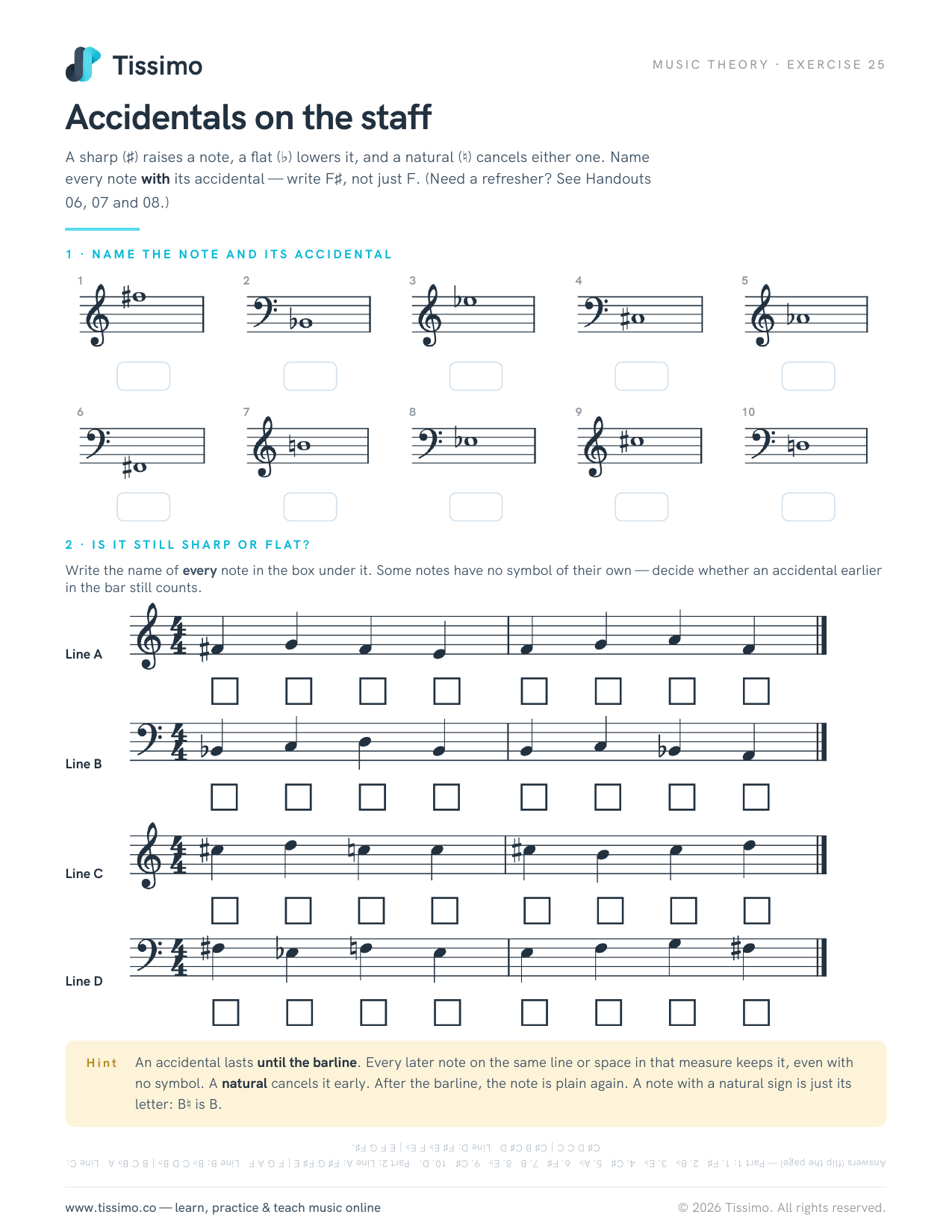 Accidentals on the staffA sharp (♯) raises a note, a flat (♭) lowers it, and a natural (♮) cancels either one. Name every note with its accidental — write F♯, not just F. (Need a refresher? See Handouts 06, 07 and 08.)
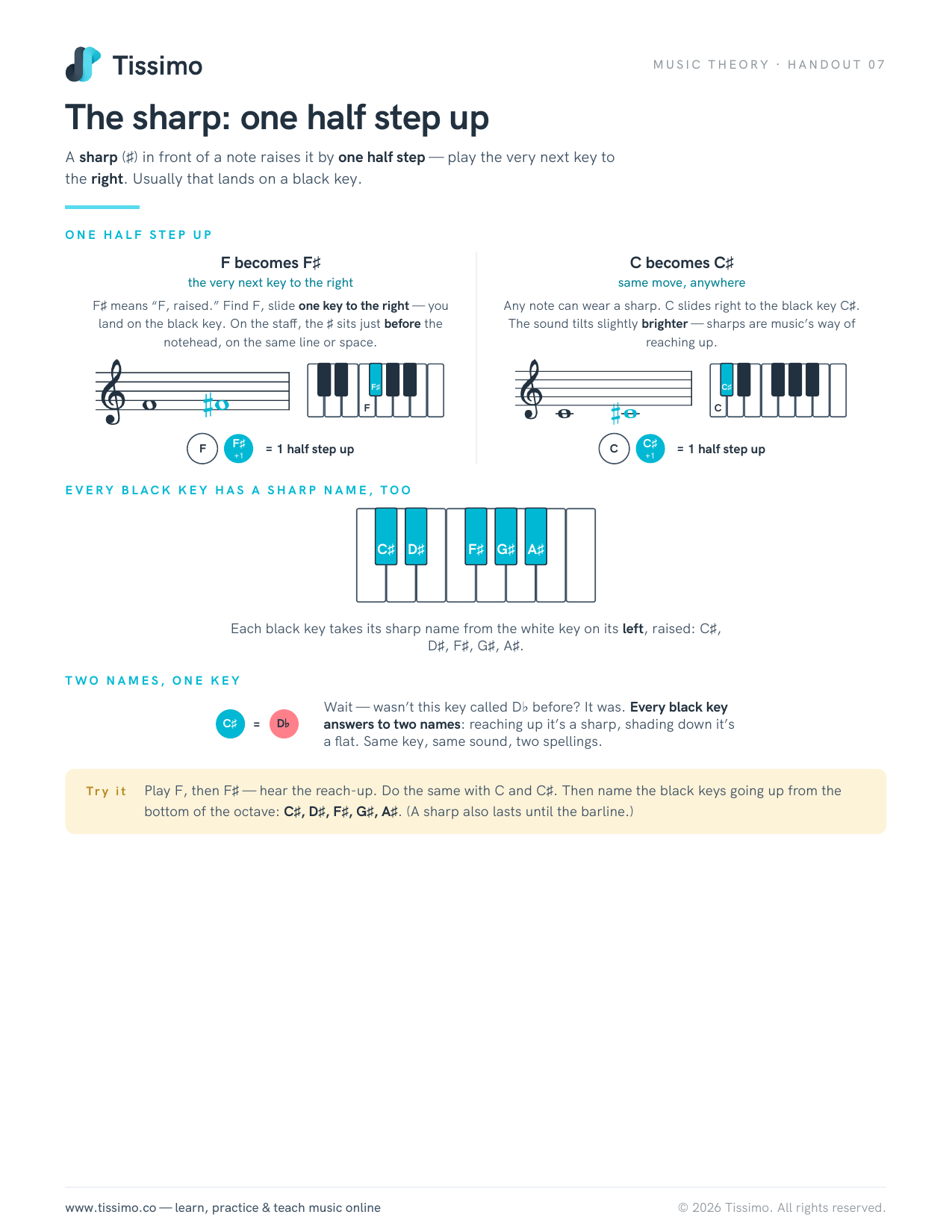 The sharp: one half step upA sharp (♯) in front of a note raises it by one half step (Handout 353) — play the very next key to the right. Usually that lands on a black key.
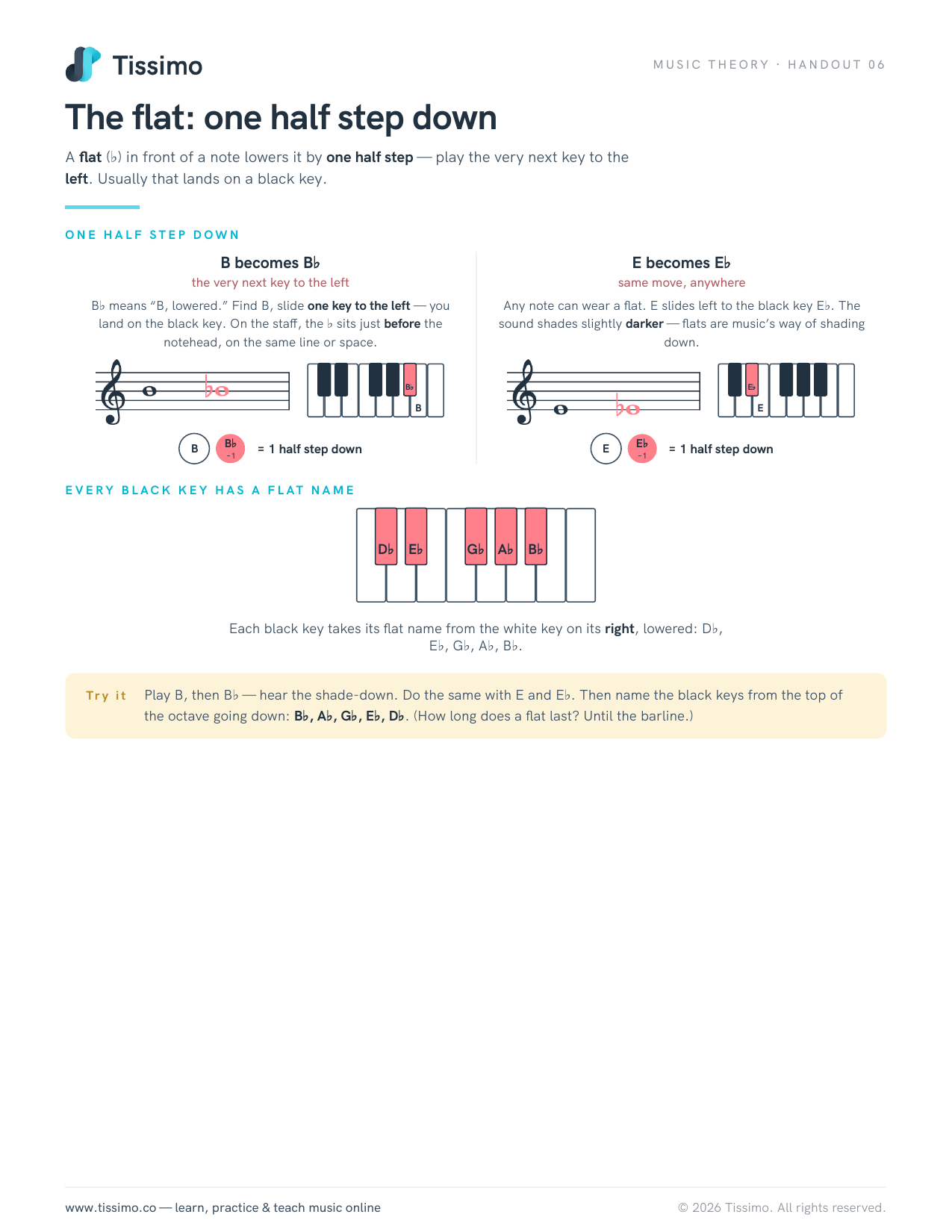 The flat: one half step downA flat (♭) in front of a note lowers it by one half step (Handout 353) — play the very next key to the left. Usually that lands on a black key.
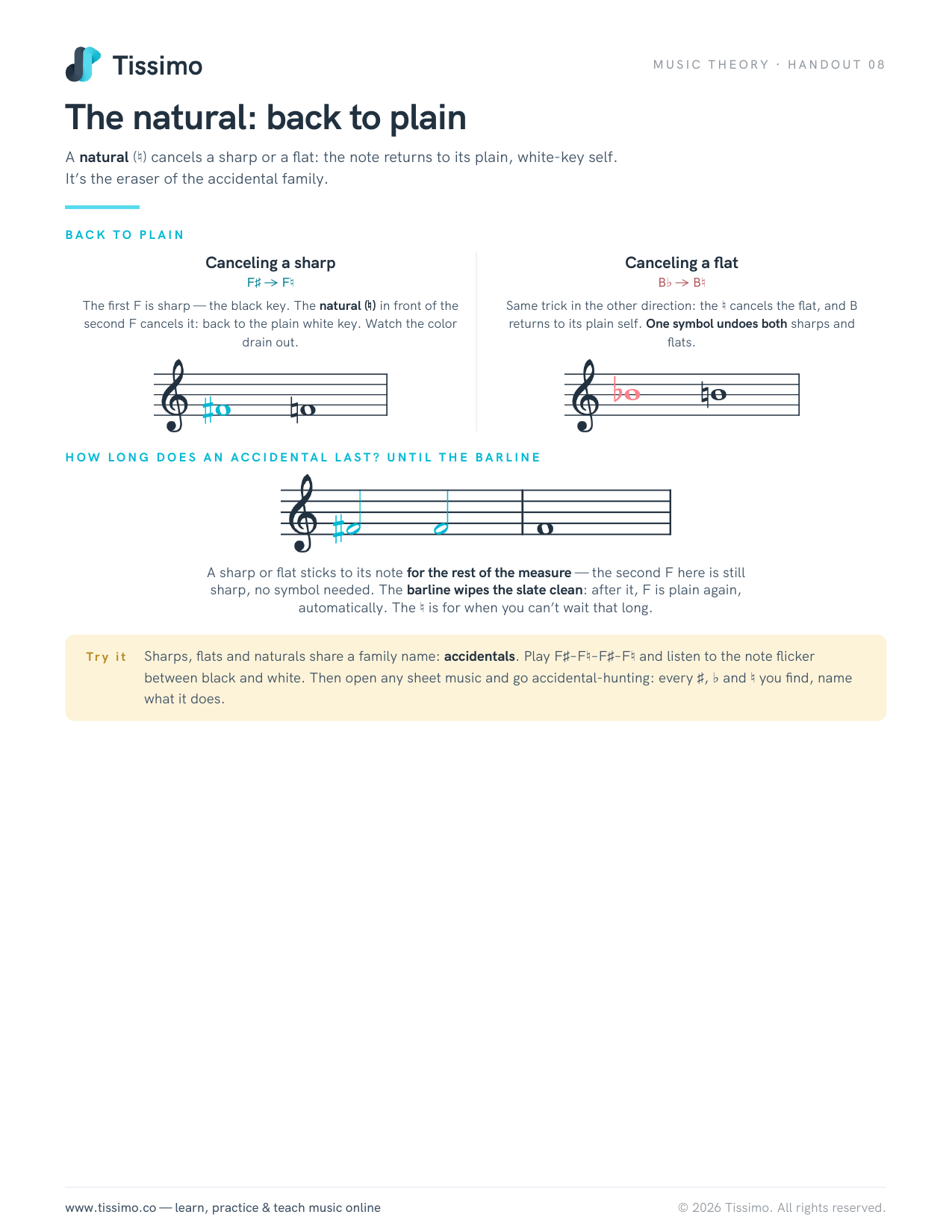 The natural: back to plainA natural (♮) cancels a sharp or a flat: the note returns to its plain, white-key self. It’s the eraser of the accidental family.
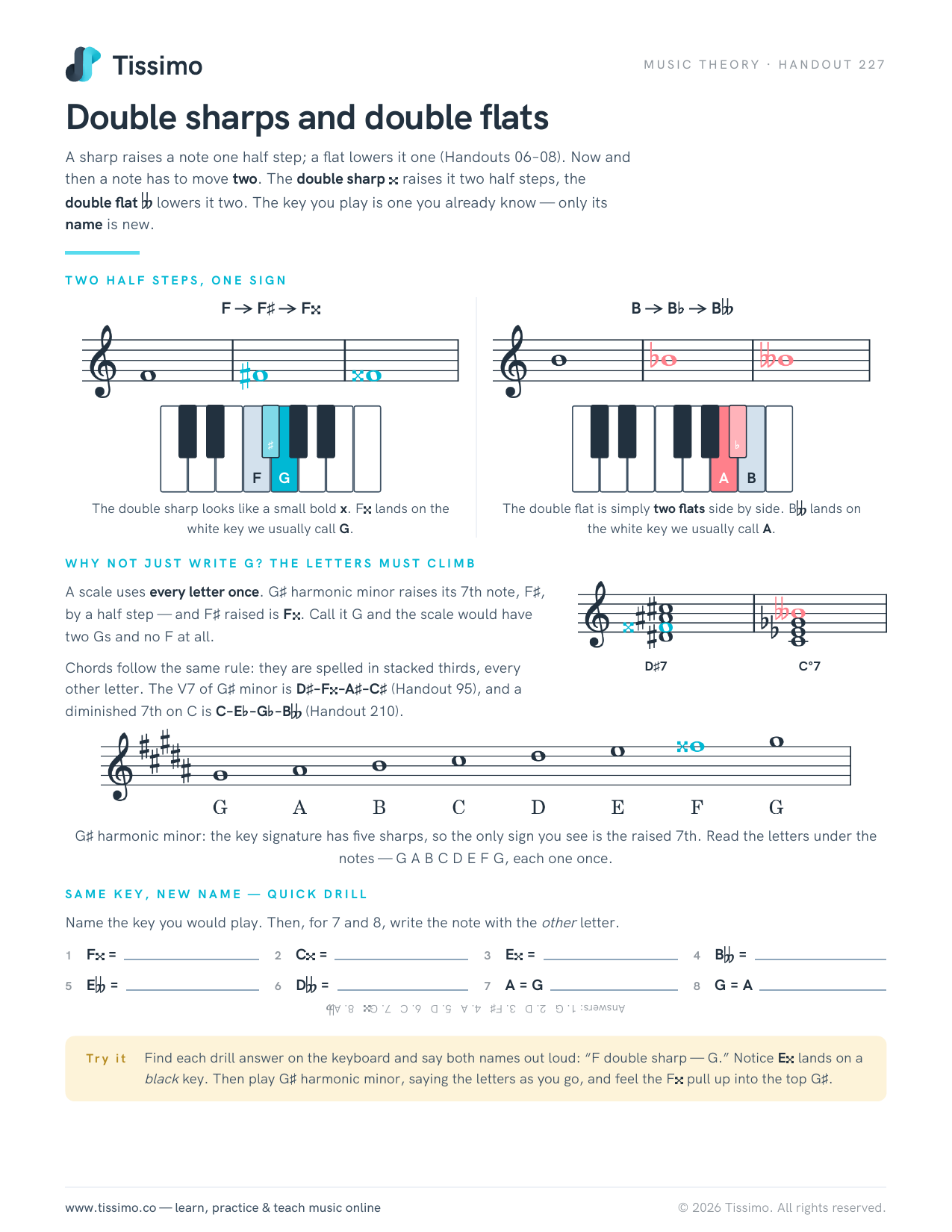 Double sharps and double flatsA sharp raises a note one half step; a flat lowers it one (Handouts 06–08). Now and then a note has to move two. The double sharp raises it two half steps, the double flat lowers it two. The key you play is one you already know — only its name is new.