Notation & Symbols
Double Sharp
A double sharp is an x-shaped sign that raises a note by two half steps, a whole step. F double-sharp is played on the same key as G; the sign appears mostly in keys that already have many sharps.
A double sharp raises a note by two half steps, a whole step. Its sign looks like a small bold x, written before the note like any other accidental. F double-sharp is played on the key we usually call G, and C double-sharp on D.
Why not just write G?
Because a note's letter name shows its job in the key or the chord. Major and minor scales use each letter once, and chords built in thirds use alternate letters, so the spelling keeps those patterns visible. In G♯ minor, the key signature already makes every F into F♯. The harmonic minor scale raises the seventh note by another half step, and that note must still be some kind of F, so it becomes F double-sharp. Writing it as G would give the scale two G's and no F.
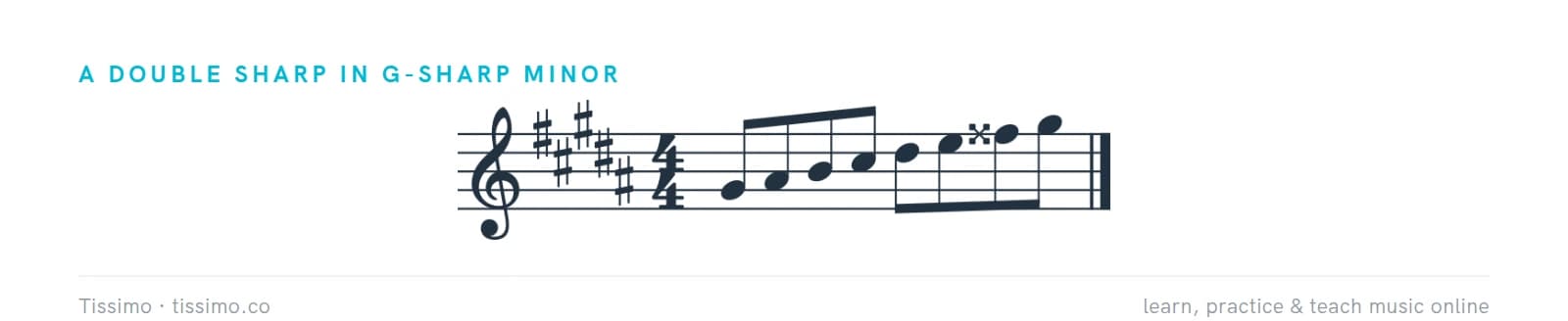
You will meet double sharps mainly in keys with many sharps: the raised seventh of harmonic minor in G♯ minor (F double-sharp) or D♯ minor (C double-sharp), chromatic passages, and chords built on sharp notes, such as the augmented triad on D♯ (D♯, F double-sharp, A double-sharp).
Canceling a double sharp
A natural cancels a double sharp completely. To go from F double-sharp back to F-sharp in the same bar, modern editions simply write a sharp; some older editions write a natural followed by a sharp.
Reading tip
Read a double sharp in two steps: find the plain letter, then move two keys to the right. F, then F♯ one key up, then F double-sharp two keys up, on G. The enharmonic equivalent name (G) tells you which key to press; the written name (F double-sharp) tells you what the note is doing.
Practice with Double sharps and double flats.
Common questions
What does a double sharp look like?
A small, bold x placed just before the note.
Is F double-sharp the same as G?
On the piano, yes: both are played on the same key (enharmonic equivalent notes). The name F double-sharp is used when the note's role in the key or chord calls for a kind of F.
Practice it: free worksheets
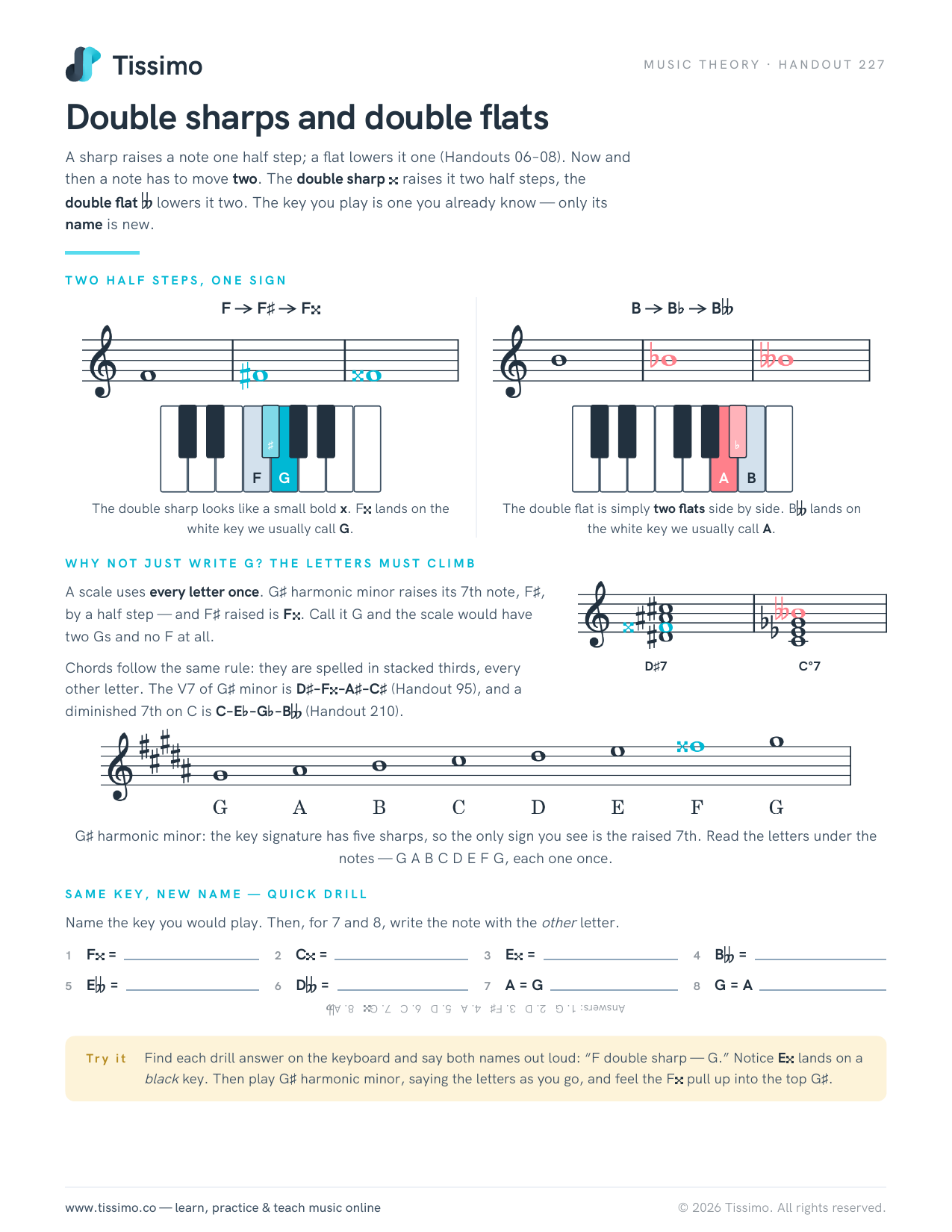 Double sharps and double flatsA sharp raises a note one half step; a flat lowers it one (Handouts 06–08). Now and then a note has to move two. The double sharp raises it two half steps, the double flat lowers it two. The key you play is one you already know — only its name is new.
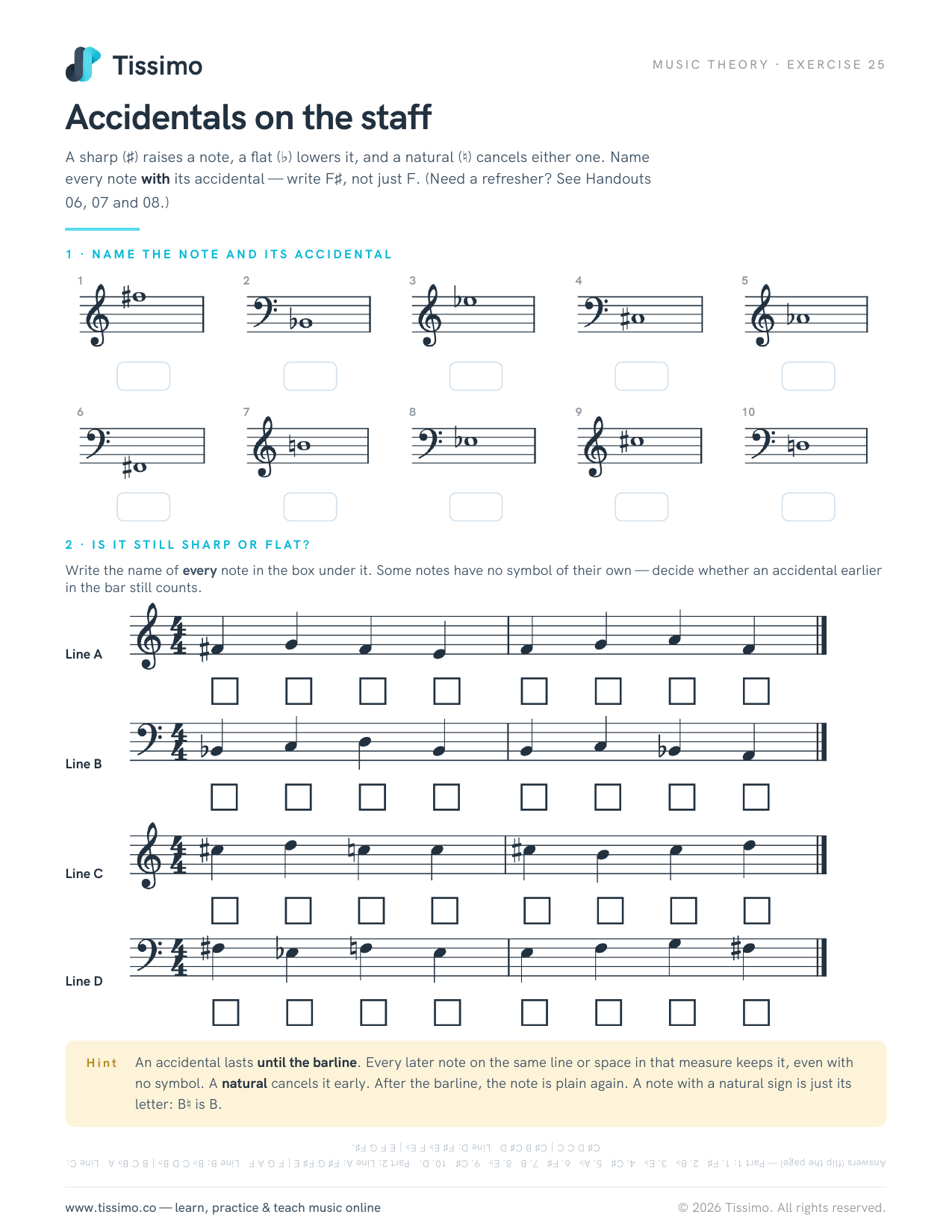 Accidentals on the staffA sharp (♯) raises a note, a flat (♭) lowers it, and a natural (♮) cancels either one. Name every note with its accidental — write F♯, not just F. (Need a refresher? See Handouts 06, 07 and 08.)
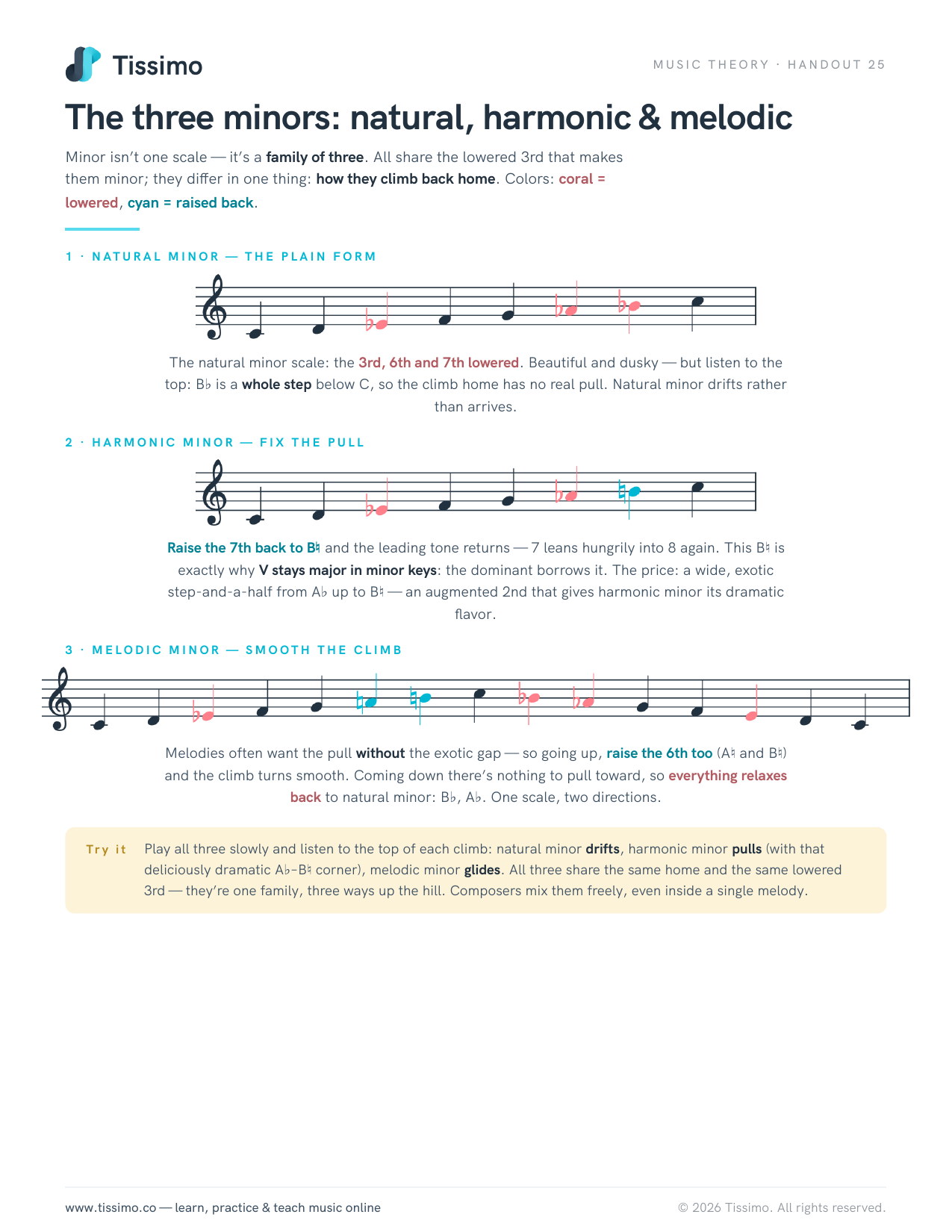 The three minors: natural, harmonic & melodicMinor isn’t one scale — it’s a family of three. All share the lowered 3rd that makes them minor; they differ in one thing: how they climb back home. Colors: coral = lowered, cyan = raised back.