Notation & Symbols
Natural
Written as ♮
A natural (♮) is a sign that cancels a sharp or flat, returning a note to its plain letter pitch. It can cancel an earlier accidental in the same bar or a sharp or flat from the key signature.
A natural sign cancels a sharp or a flat. A note with a natural is played at its plain letter pitch, which on the piano is one of the white keys C, D, E, F, G, A and B. The sign, ♮, looks like a small box with a short stem rising from its left side and another falling from its right side.
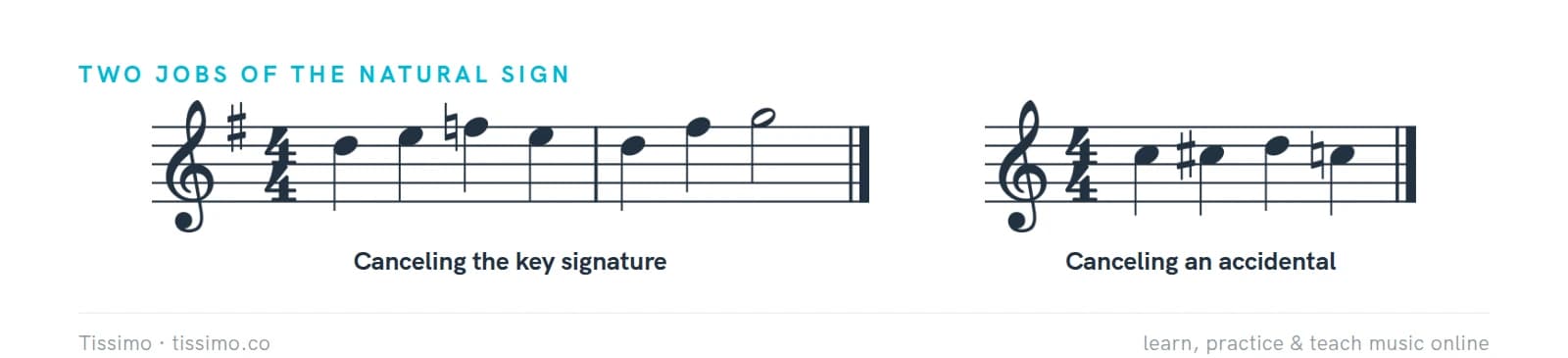
Its two jobs
- Canceling the key signature. In G major every F is F♯, because of the key signature. A natural before an F turns it into F natural for the rest of that measure.
- Canceling an earlier accidental. If a bar has a C♯ and the composer then wants a plain C in the same bar, the second C needs a natural, because the sharp would otherwise still be in force.
Like every accidental, a natural lasts only until the next bar line. After that, the key signature applies again.
Naturals at key changes
When a piece changes to a key with fewer sharps or flats, naturals often appear just before the new key signature to cancel the old one. Practice varies: some editions cancel every old sharp or flat, others only the ones that disappear. A change to C major or A minor, which have no sharps or flats, is usually shown with naturals, since otherwise there would be nothing to see.
Natural notes and white keys
On the piano, the natural notes are the white keys. The reverse is not quite true: E♯ and B♯ are also played on white keys (F and C), and so are F♭ and C♭ (E and B). "Natural" describes a note's name, a letter with no sharp or flat, not the color of the key.
Practice with The natural: back to plain and Accidentals on the staff.
Common questions
Is a natural note always a white key?
On the piano, yes: the natural notes C, D, E, F, G, A and B are the white keys. Some white keys also have sharp or flat names, such as E-sharp for F.
How long does a natural sign last?
Until the end of the measure, like any accidental. After the bar line, the key signature applies again.
Practice it: free worksheets
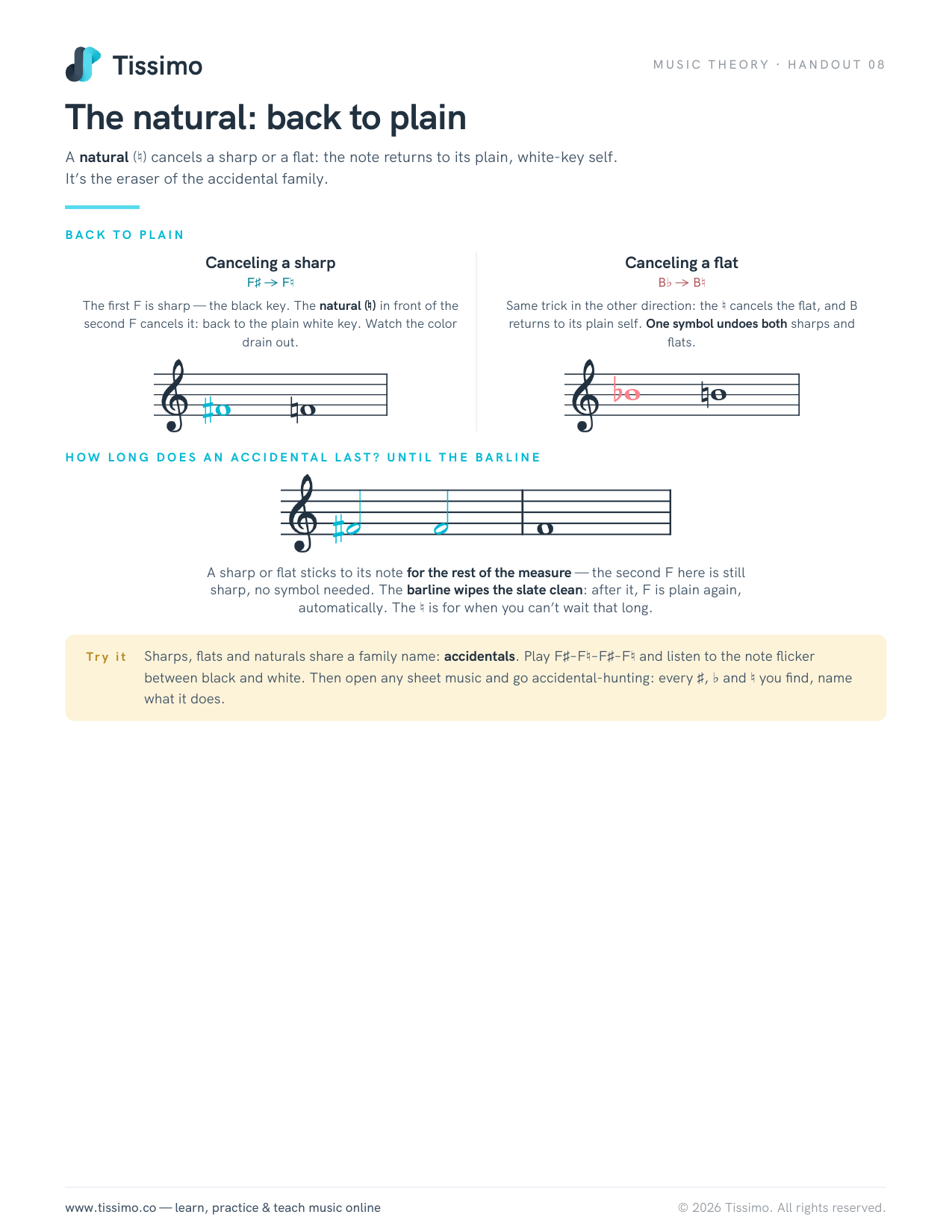 The natural: back to plainA natural (♮) cancels a sharp or a flat: the note returns to its plain, white-key self. It’s the eraser of the accidental family.
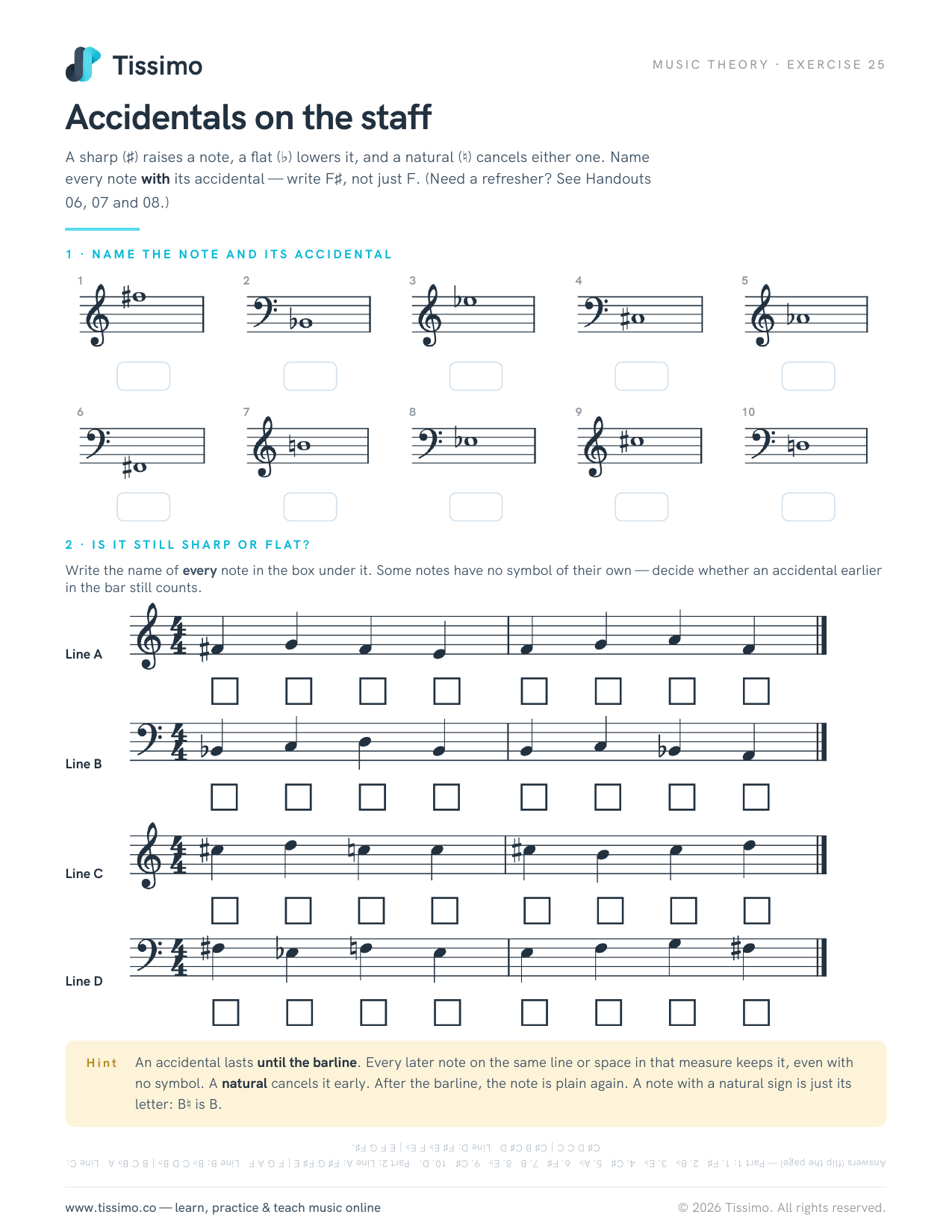 Accidentals on the staffA sharp (♯) raises a note, a flat (♭) lowers it, and a natural (♮) cancels either one. Name every note with its accidental — write F♯, not just F. (Need a refresher? See Handouts 06, 07 and 08.)
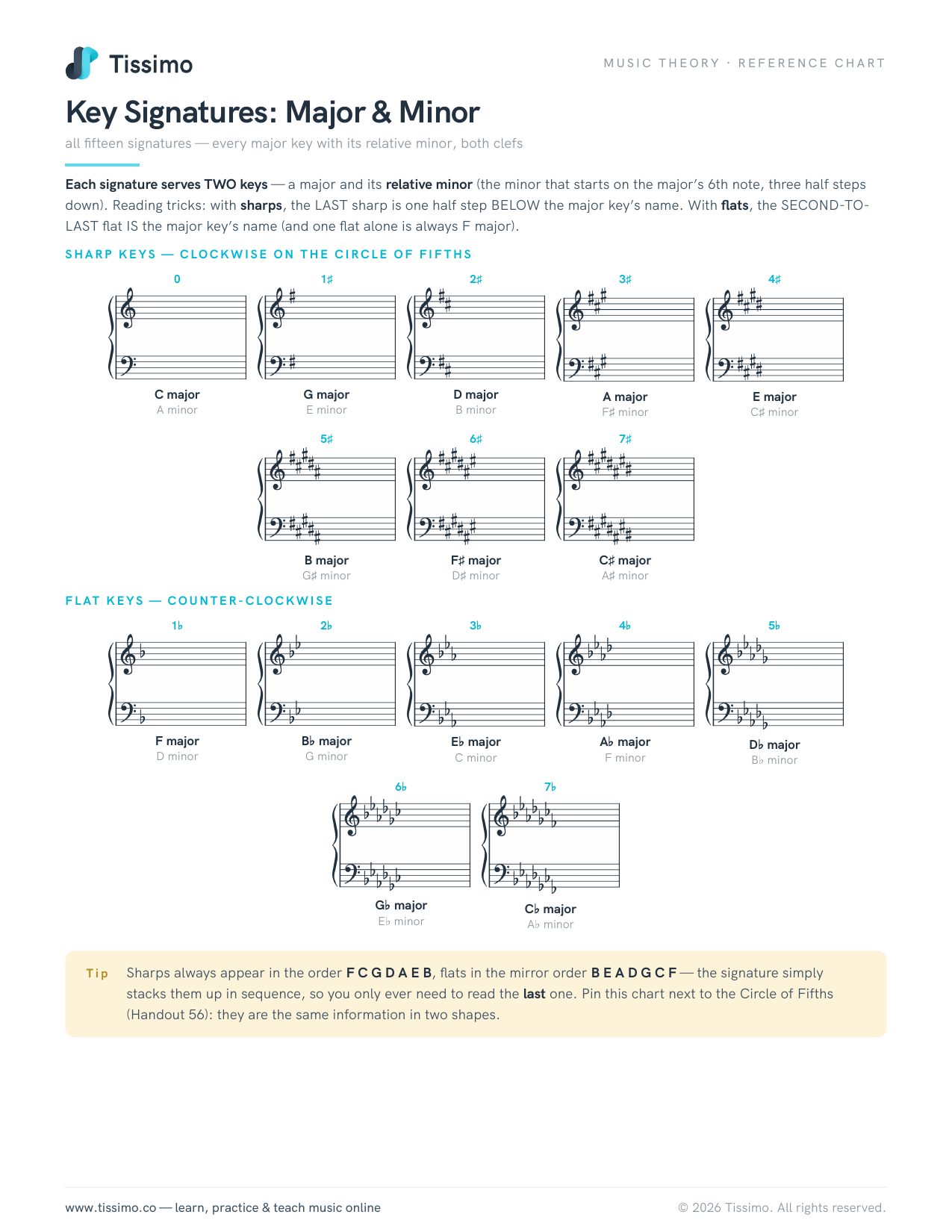 Key Signatures: Major & Minorall fifteen signatures — every major key with its relative minor, both clefs