Notation & Symbols
Courtesy Accidental
A courtesy accidental is a sharp, flat or natural that the rules do not require but that is printed as a reminder, often in parentheses. It usually appears in the bar after an accidental, once the bar line has canceled it.
By the strict rules, an accidental lasts until the end of its bar, and the next bar line cancels it. In practice, players often carry an accidental over in their heads. A courtesy accidental (also called a cautionary or reminder accidental) is printed to prevent that mistake: a sign that changes nothing, but confirms what the note is.
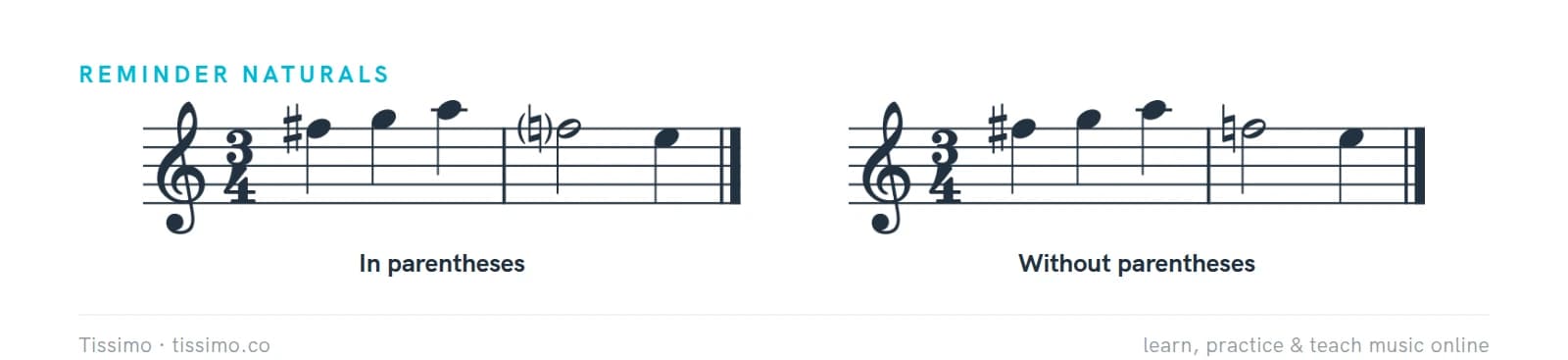
Where courtesy accidentals appear
- In the bar after an accidental. If bar 1 has F♯ and bar 2 has a plain F, a courtesy natural on the F in bar 2 reminds you that the sharp is gone.
- After a tie. If a sharpened note is tied across the bar line and the same letter returns later in the new bar, a reminder shows whether it is still sharp.
- In another octave. An F♯ near the top of the staff does not, strictly, affect an F an octave lower in the same bar, but editors often add a reminder.
- Between the hands. In piano music, an accidental on one staff does not apply to the other staff. A courtesy sign helps when both hands play the same letter name close together.
How they look
Many editions put courtesy accidentals in parentheses, so you can tell at a glance that nothing new is happening. Others print them plain, exactly like ordinary accidentals; that does no harm, because a courtesy accidental always agrees with the rules anyway.
When you write music
Add a courtesy accidental wherever a reader might hesitate. Too many make a page cluttered, but a missing one causes far more wrong notes than an extra one. A useful habit: after any accidental, check the same note in the next bar.
Practice reading accidentals in Accidentals on the staff.
Common questions
Do you have to write courtesy accidentals?
No rule requires them; the note would be correct without them. They are there to prevent mistakes, and good editions use them wherever a reader might hesitate.
What does an accidental in parentheses mean?
It is a courtesy (reminder) accidental. It does not change the note; it confirms what the note already is.
Practice it: free worksheets
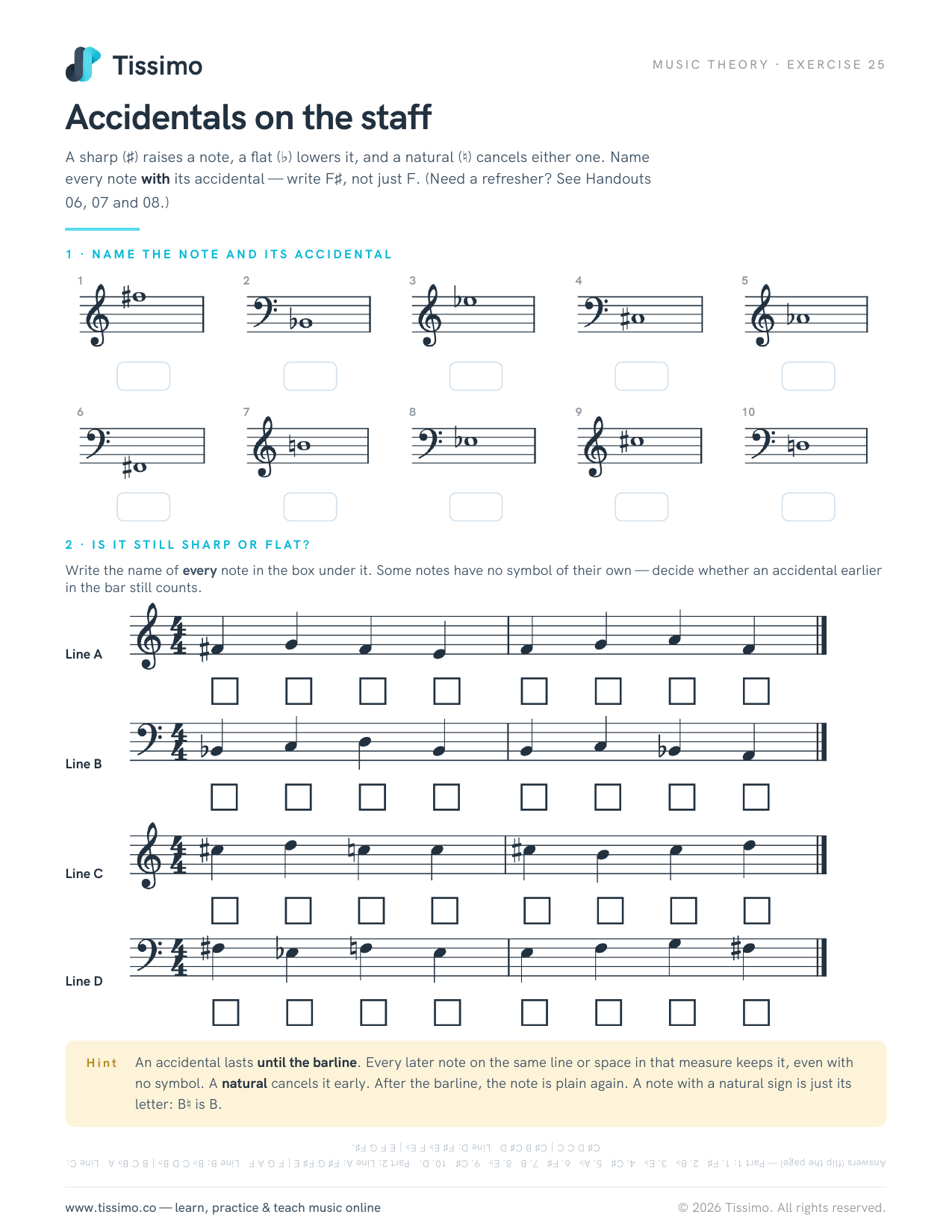 Accidentals on the staffA sharp (♯) raises a note, a flat (♭) lowers it, and a natural (♮) cancels either one. Name every note with its accidental — write F♯, not just F. (Need a refresher? See Handouts 06, 07 and 08.)
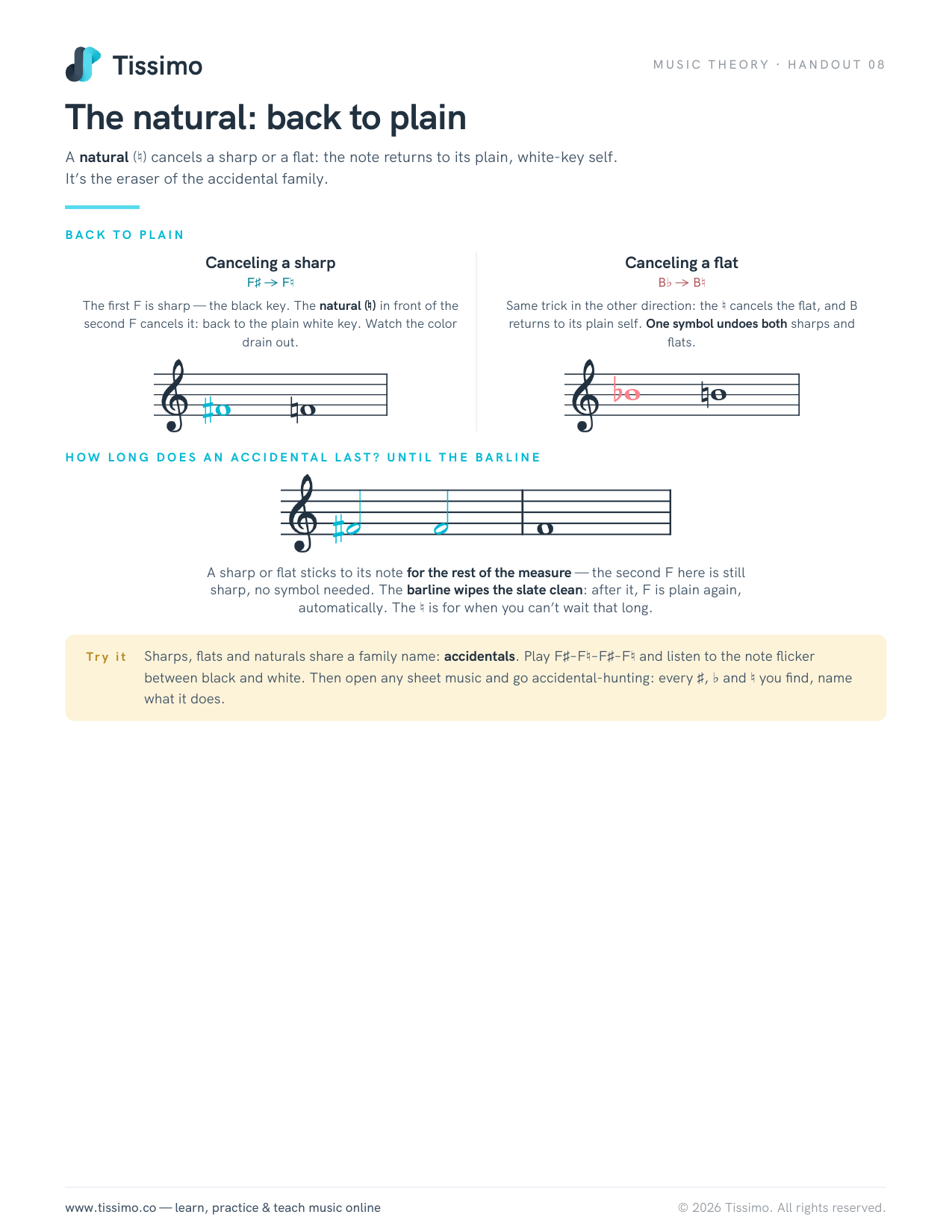 The natural: back to plainA natural (♮) cancels a sharp or a flat: the note returns to its plain, white-key self. It’s the eraser of the accidental family.