Styles, Genres & Eras
Country Music
Country music is an American popular genre that grew out of the folk music of the rural South in the 1920s, known for storytelling lyrics, simple chord progressions and the sound of guitar, fiddle and steel guitar.
Country music grew from the folk traditions of the rural American South, especially Appalachia: British and Irish ballads and fiddle tunes, combined with the blues, gospel hymns and, later, popular song. It became a commercial genre in the 1920s, when record companies and radio stations began recording and broadcasting rural musicians.
Beginnings
The 1927 recording sessions in Bristol, on the Tennessee–Virginia border, are often called the "big bang" of country music: they produced the first records of the Carter Family and of Jimmie Rodgers. Radio programs such as the Grand Ole Opry in Nashville, broadcasting since 1925, brought country to a national audience, and Nashville became the center of the industry.
Musical features
- Storytelling lyrics about love, heartbreak, home, work and faith, usually in verse–chorus or strophic form.
- Simple, clear harmony: I, IV and V chords, often with a V7.
- Characteristic instruments: acoustic guitar, fiddle, steel guitar (lap steel and pedal steel), banjo, mandolin, bass and drums.
- The "boom-chick" accompaniment: a bass note alternating between root and fifth on the beats, with strummed chords between, often in 2/4 or 4/4.
- Vocal style with a recognizable twang, slides and a strong sense of the words.
Styles
- Bluegrass (from the 1940s, Bill Monroe): fast, acoustic, virtuosic, with banjo, mandolin, fiddle and close vocal harmony.
- Honky-tonk (1940s–50s, Hank Williams): songs of heartbreak for dance halls, with steel guitar and fiddle.
- The Nashville sound (late 1950s–60s, Patsy Cline): smoother production with strings and backing choirs.
- Outlaw country (1970s, Willie Nelson, Waylon Jennings): a rougher reaction against Nashville polish.
- Country pop and contemporary country: from Dolly Parton and Johnny Cash, both crossing into the mainstream, to today's stars, with strong influences from rock and pop.
The Nashville number system
Nashville studio musicians often write charts using numbers instead of chord names: 1 for the I chord, 4 for IV, 5 for V and so on. Because the chart is in numbers, the band can play a song in any key the singer wants. It is the same idea as Roman numeral analysis.
Playing country
On guitar, learn the open chords and a boom-chick strum with alternating bass. On piano, play the bass note on the beat and the chord on the off-beat, and decorate the melody with slides from a half step below. The Em, Am and C and Primary chords worksheets are a good start.
Common questions
Where did country music come from?
From the folk music of the rural American South, especially Appalachia, mixing British and Irish ballads and fiddle tunes with blues and gospel. It became a commercial genre in the 1920s.
What is the Nashville number system?
A way of writing chord charts with numbers for the scale degrees (1, 4, 5 and so on) instead of chord names, so a band can play a song in any key.
Practice it: free worksheets
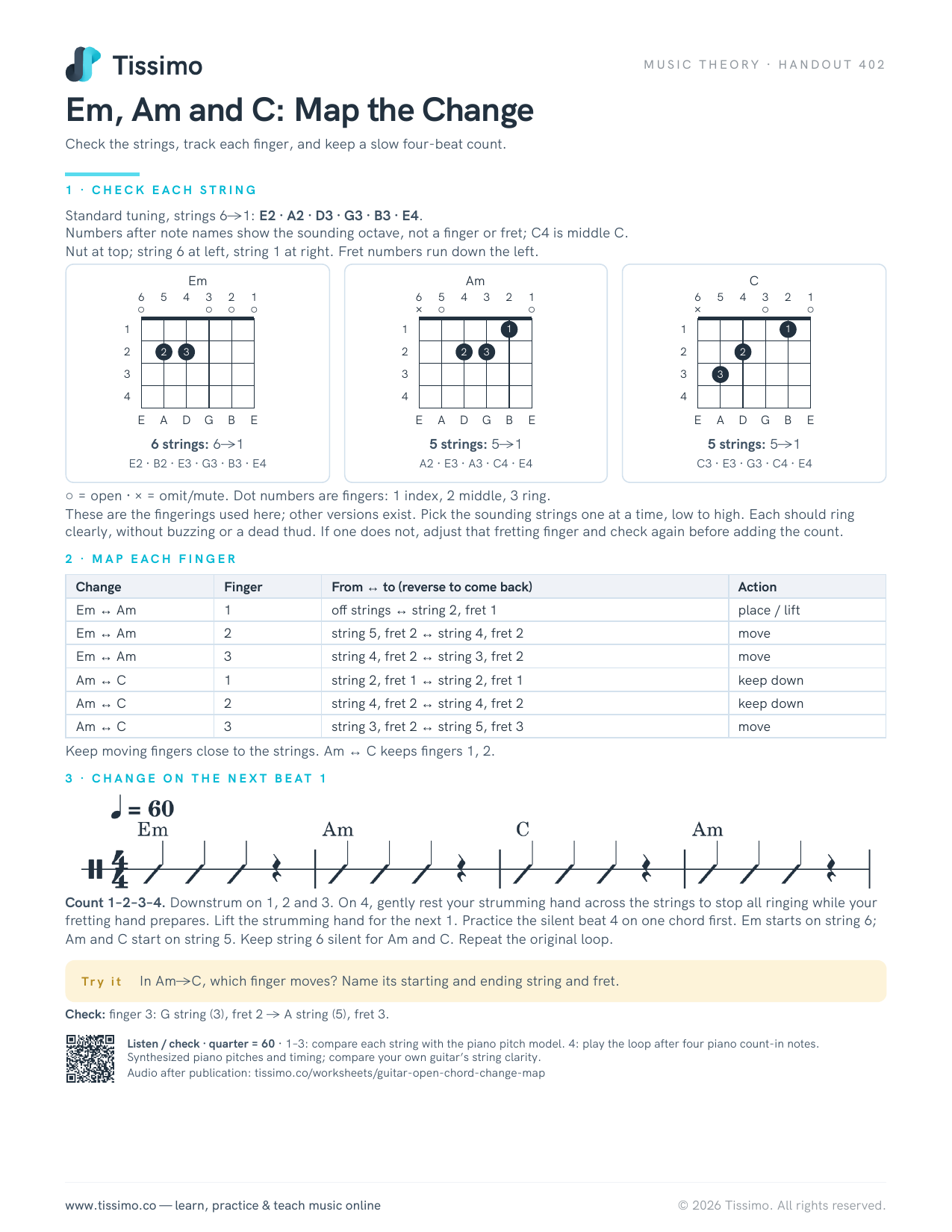 Em, Am and C: Map the ChangeCheck the strings, track each finger, and keep a slow four-beat count.
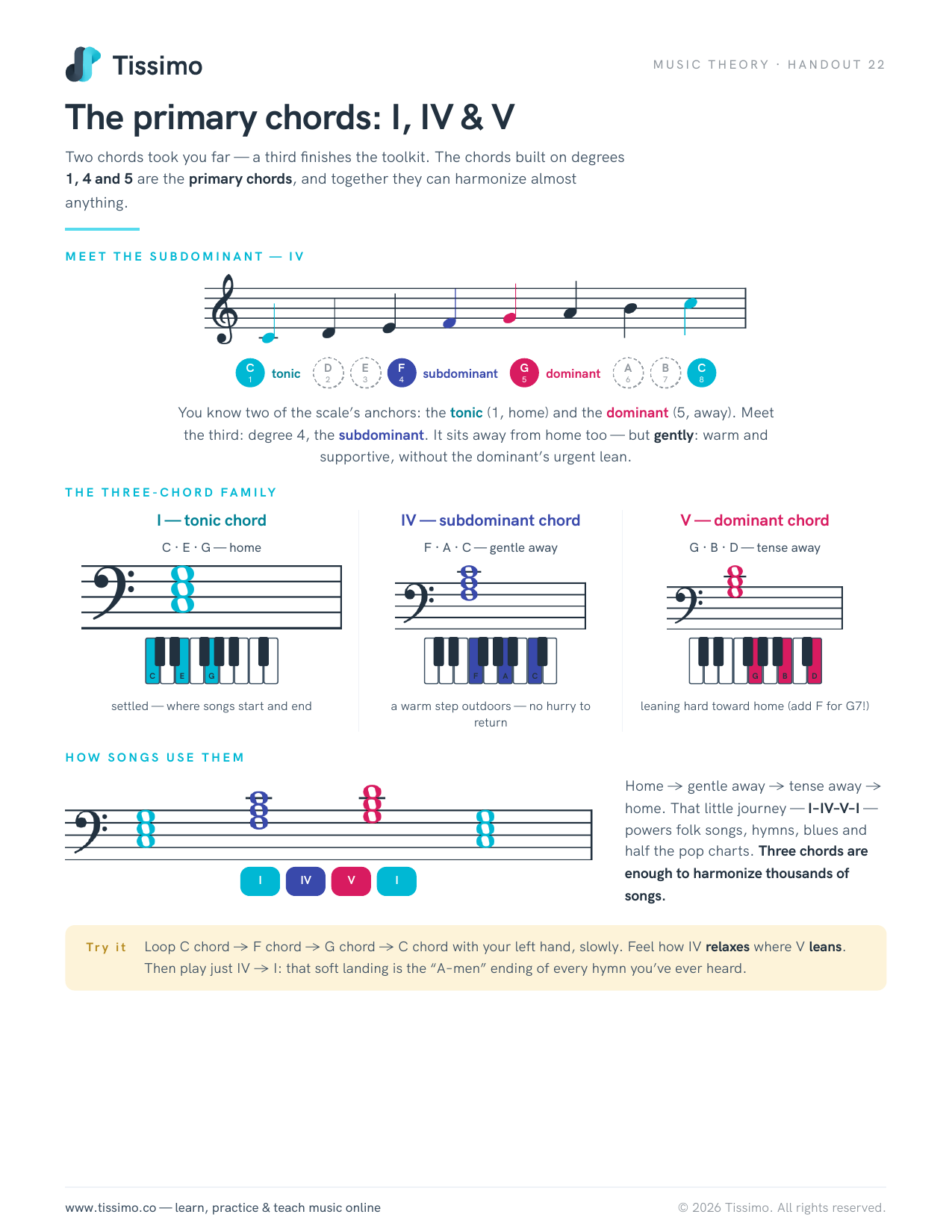 The primary chords: I, IV & VTwo chords took you far — a third finishes the toolkit. The chords built on degrees 1, 4 and 5 are the primary chords, and together they can harmonize almost anything.
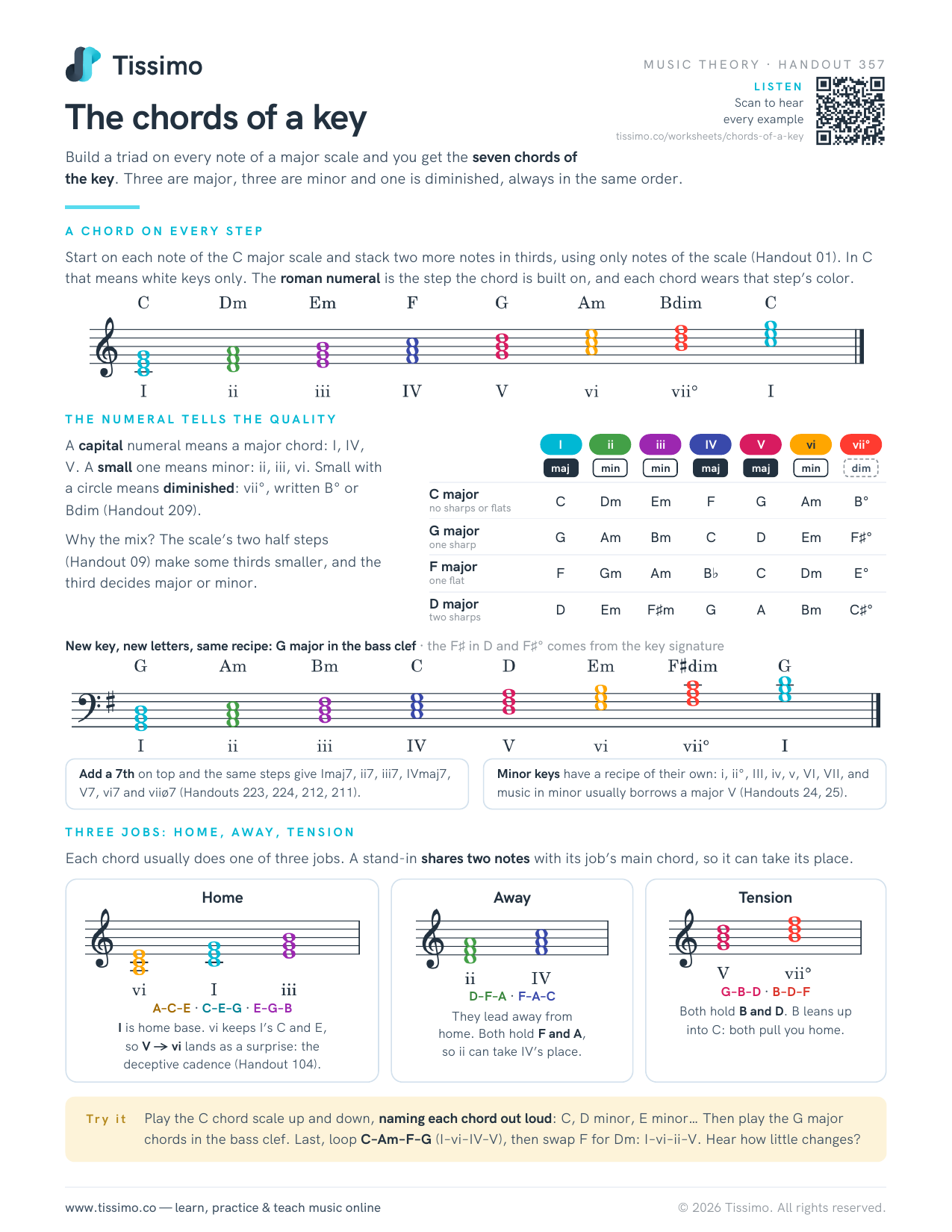 The chords of a keyBuild a triad on every note of a major scale and you get the seven chords of the key. Three are major, three are minor and one is diminished, always in the same order.
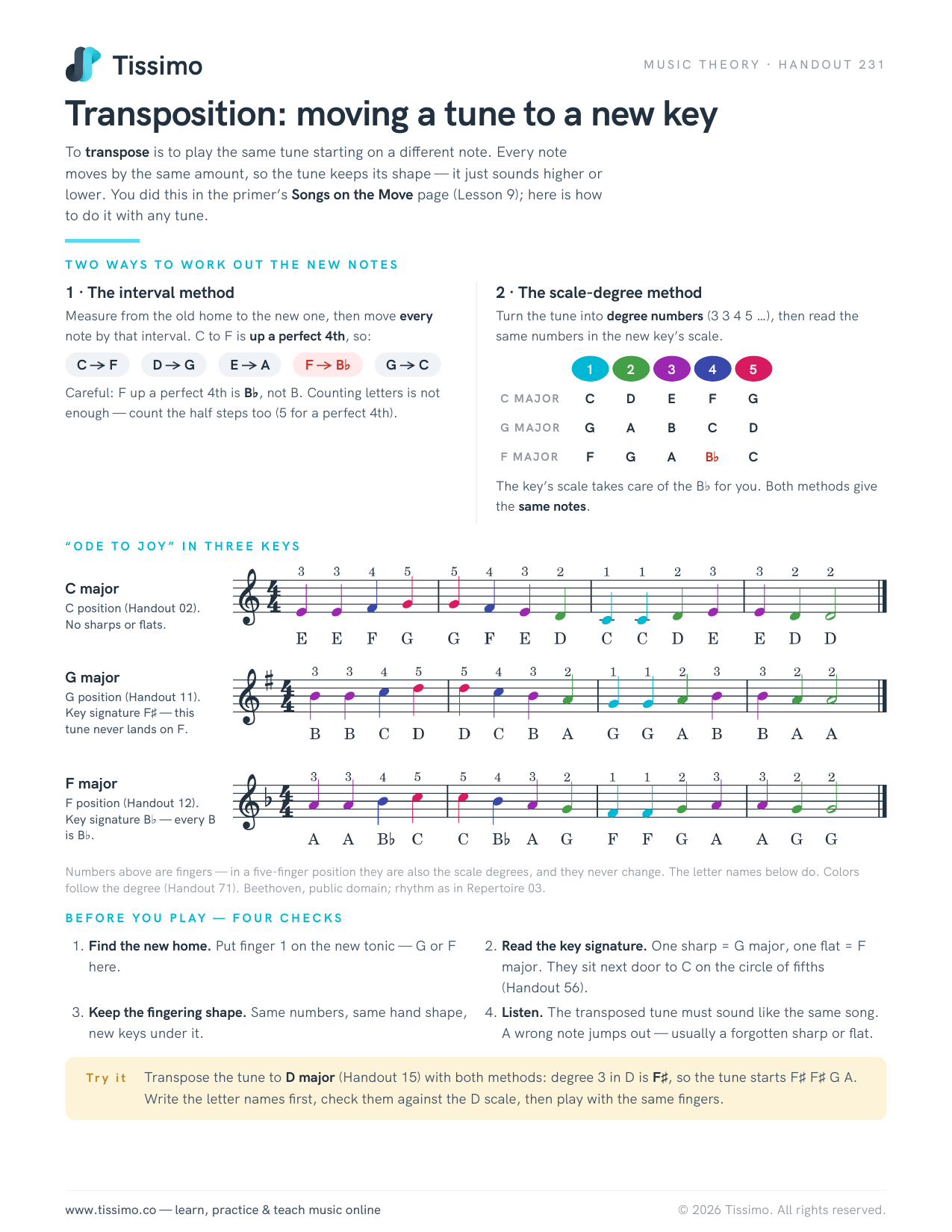 Transposition: moving a tune to a new keyTo transpose is to play the same tune starting on a different note. Every note moves by the same amount, so the tune keeps its shape — it just sounds higher or lower. Here is how to do it with any tune.