Styles, Genres & Eras
Folk Music
Folk music is traditional music passed on by ear within a community, usually with no known composer and many local variants. The term also covers the singer-songwriter folk revival of the 1950s and 60s.
Folk music, in its traditional sense, is the music of ordinary people, learned by listening and passed from generation to generation without being written down. Songs and tunes change as they travel, so the same ballad may exist in dozens of versions in different villages. Most traditional folk songs have no known composer.
Every culture has its own folk music: work songs, lullabies, dance tunes, ballads that tell stories, songs for weddings, funerals and festivals.
Typical features
Folk traditions vary enormously around the world, but European and North American folk song often has:
- Strophic form: many verses sung to the same tune.
- Simple, singable melodies, often based on modes (Dorian, Mixolydian, Aeolian) or the pentatonic scale rather than major and minor.
- Acoustic instruments: voice alone, or with fiddle, guitar, banjo, accordion, bagpipes, flute or whistle.
- Drones and repetitive dance rhythms in instrumental music.
Collectors and scholars
From the 19th century, scholars began writing down folk songs before they disappeared. Francis James Child collected English and Scottish ballads (the "Child ballads"); Cecil Sharp collected songs in England and in the Appalachian Mountains; Béla Bartók and Zoltán Kodály recorded thousands of songs in Hungary and neighboring regions; and John and Alan Lomax made field recordings across the United States for the Library of Congress. Composers often built these melodies into concert music (see nationalism).
The folk revival
In the 1950s and 60s, a folk revival in the United States and Britain brought folk songs, and newly written songs in folk style, to a mass audience. Woody Guthrie and Pete Seeger were its elders; Joan Baez and Bob Dylan were among its young stars. Many revival songs carried political messages, and the movement created the modern singer-songwriter. Today "folk" also names a broad genre of acoustic, song-centered music.
Playing and learning folk music
Folk music is meant to be learned by ear: listen, sing along, and pick up tunes from other players. Session players learn dozens of tunes this way. On guitar, a few open chords and a steady strum or fingerpicking pattern will accompany most folk songs. The Modes and Pentatonic & Blues Scales worksheets cover scales many folk tunes use.
Common questions
What makes a song a folk song?
Traditionally, it is passed on orally within a community, has no known composer and exists in many variants. Today the word is also used for newly written songs in an acoustic, traditional style.
Who started the folk revival?
No single person. Collectors such as Alan Lomax and performers such as Woody Guthrie and Pete Seeger laid the ground, and in the 1960s Joan Baez and Bob Dylan brought it to a mass audience.
Practice it: free worksheets
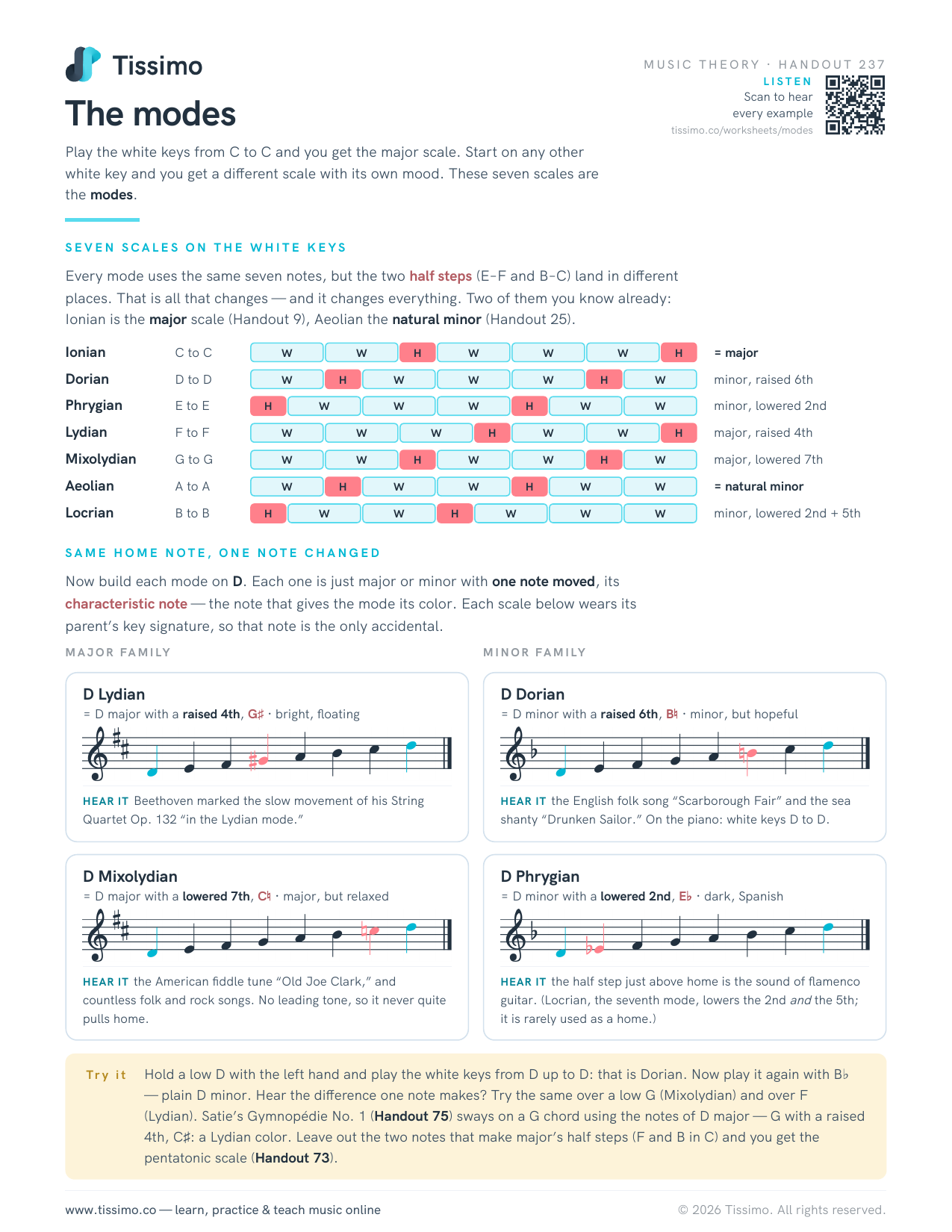 The modesPlay the white keys from C to C and you get the major scale. Start on any other white key and you get a different scale with its own mood. These seven scales are the modes.
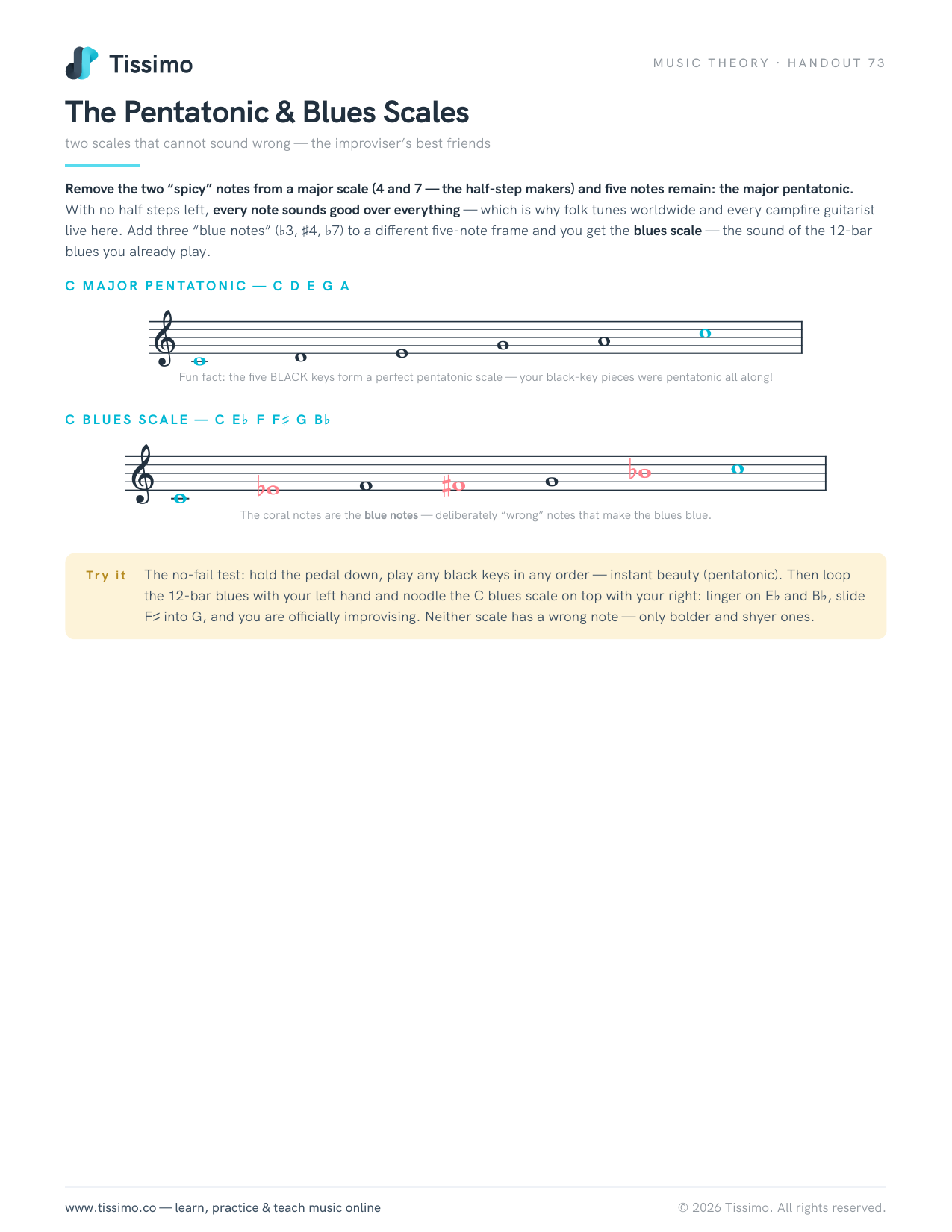 The Pentatonic & Blues Scalestwo scales that cannot sound wrong — the improviser’s best friends
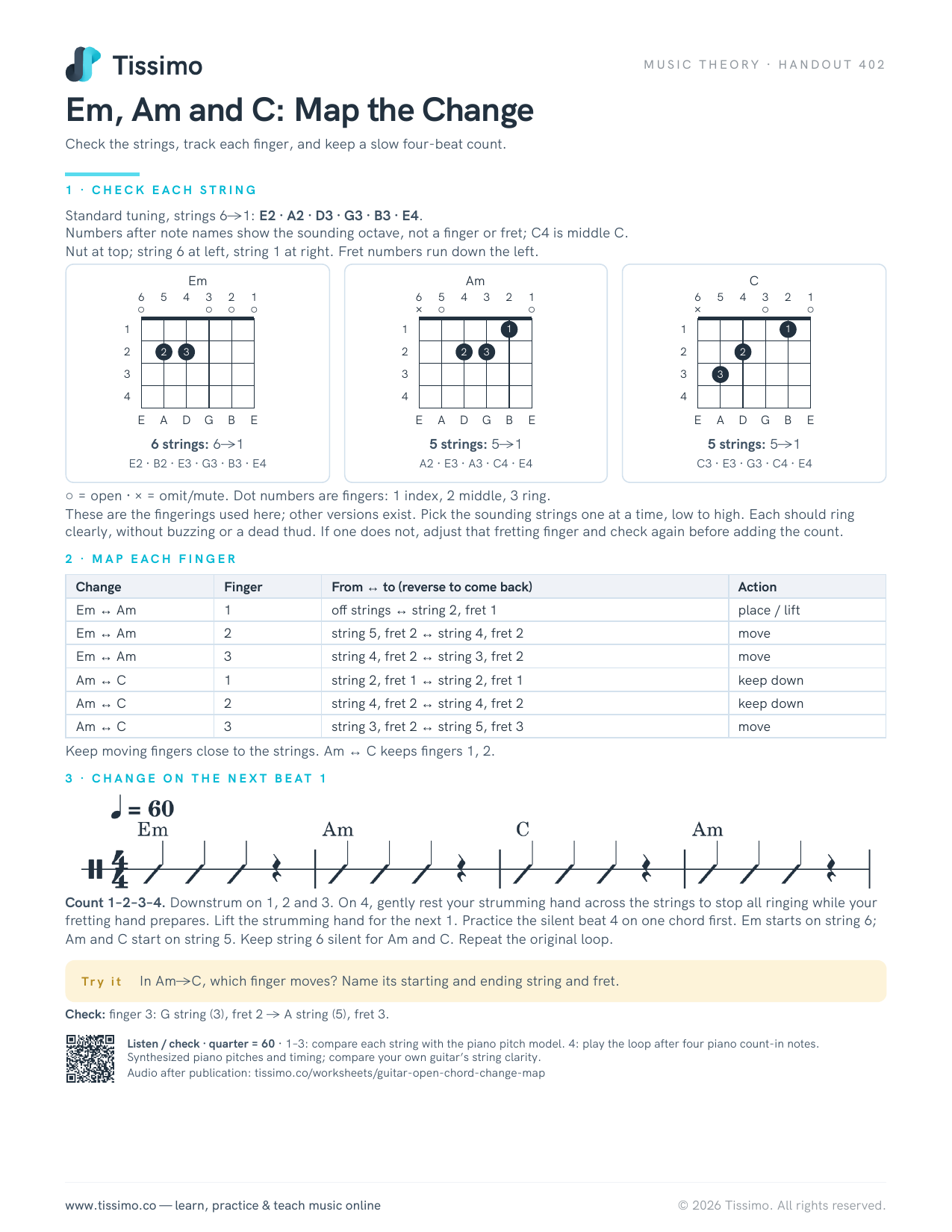 Em, Am and C: Map the ChangeCheck the strings, track each finger, and keep a slow four-beat count.
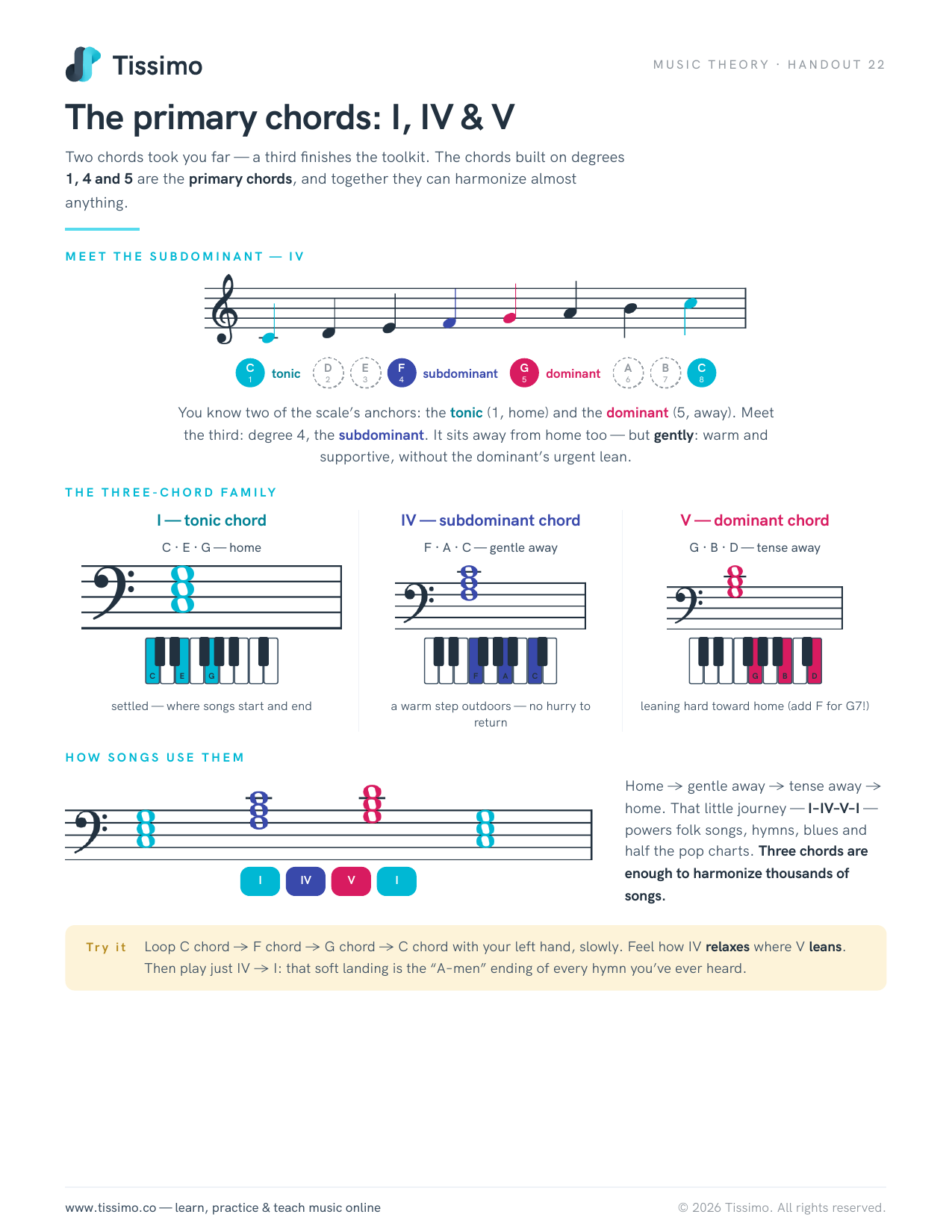 The primary chords: I, IV & VTwo chords took you far — a third finishes the toolkit. The chords built on degrees 1, 4 and 5 are the primary chords, and together they can harmonize almost anything.