Styles, Genres & Eras
Twentieth-Century Music
Twentieth-century music is the art music of the 1900s, an era of many competing styles, from impressionism, atonality and serialism to neoclassicism, electronic music, chance music and minimalism.
No single style defines the 20th century. Where earlier eras shared a common musical language, 20th-century composers went in many directions at once, often reacting against the late Romantic style and against each other. New technology, recording, radio, film and electronics, changed how music was made and heard.
Main currents
- Impressionism (around 1890–1920): Debussy and Ravel, with color and atmosphere in place of functional harmony.
- Atonality (from around 1908): Arnold Schoenberg and his students Alban Berg and Anton Webern abandoned a home key altogether (see atonality).
- Twelve-tone music and serialism (from the 1920s): Schoenberg's method of ordering all twelve notes, later extended after World War II by composers such as Pierre Boulez, Karlheinz Stockhausen and Milton Babbitt to rhythm, dynamics and timbre.
- Rhythmic primitivism: Igor Stravinsky's The Rite of Spring (1913), whose premiere in Paris caused a famous uproar, put pounding, irregular rhythm at center stage.
- Neoclassicism (from around 1920): Stravinsky, Prokofiev and others returned to Baroque and Classical forms with modern harmony.
- Folk-based modernism: Béla Bartók collected thousands of folk songs and built a personal style from their scales and rhythms.
- Electronic music: from Pierre Schaeffer's musique concrète (recorded sounds, from 1948) to tape and synthesizer music.
- Chance and experimental music: John Cage's 4′33″ (1952), in which the performer plays nothing for the whole piece and the "music" is the sound of the room.
- Minimalism (from the 1960s): Terry Riley, Steve Reich, Philip Glass.
American composers such as Charles Ives, George Gershwin, Aaron Copland and Leonard Bernstein drew on hymns, jazz and folk song.
New techniques
Expect irregular and changing meters, polyrhythm, dissonance treated as a sound in its own right, extended playing techniques, microtones, and new notations, including graphic scores.
Playing 20th-century music
Count carefully: meter changes and irregular rhythms are common. Read every accidental, because there may be no key to fall back on, and follow the composer's specific instructions on the score. The Feeling 5/8 and 7/8, New Meter, Same Eighth and A Sound Score Needs a Legend worksheets practice some of these skills.
Common questions
What are the main styles of 20th-century music?
Impressionism, atonality and twelve-tone serialism, neoclassicism, folk-influenced modernism, electronic music, chance music and minimalism, alongside jazz, film music and popular styles.
Why does some 20th-century music sound so dissonant?
Many composers stopped treating dissonance as something that must resolve. In atonal and serial music there is no home key, so tension and release work in new ways.
Practice it: free worksheets
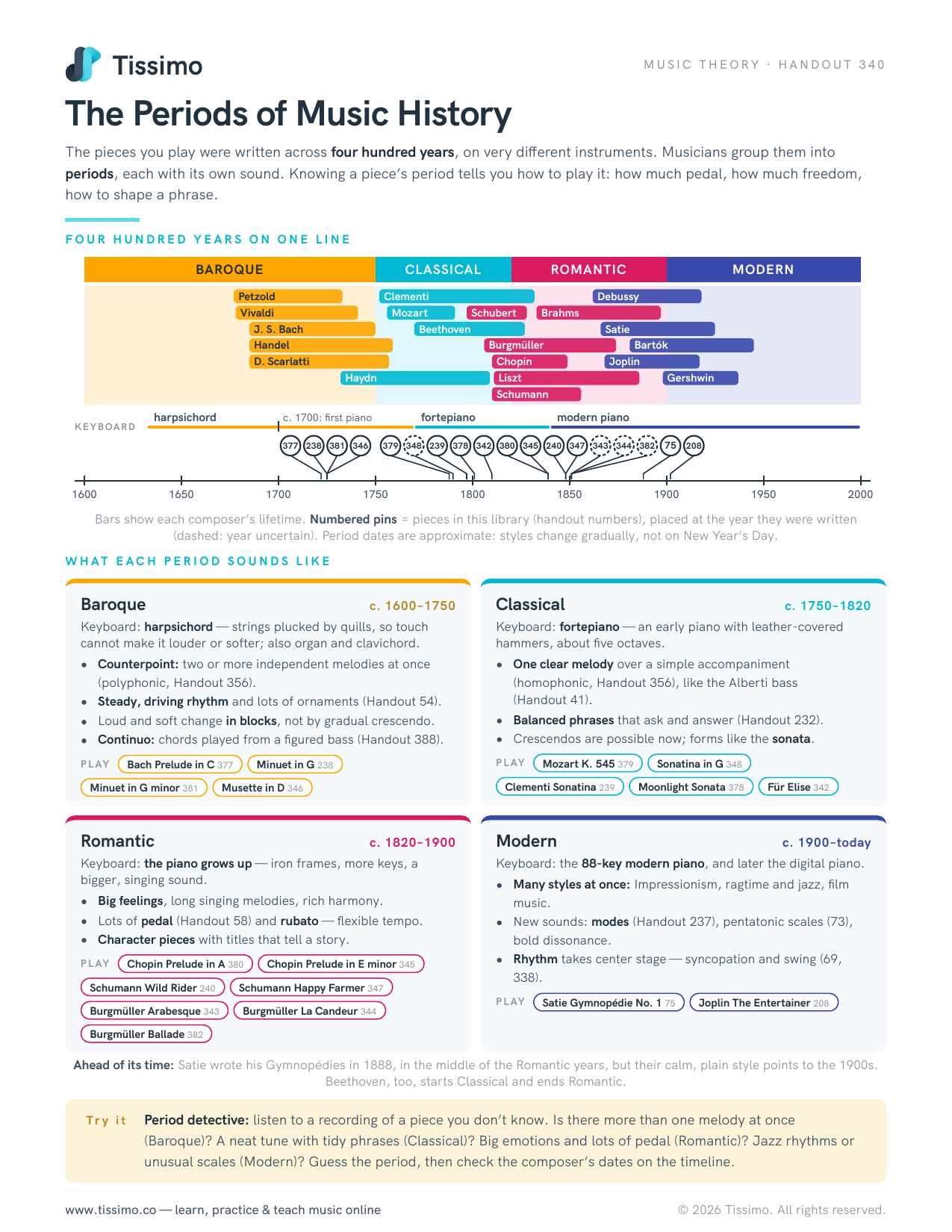 The Periods of Music HistoryThe pieces you play were written across four hundred years, on very different instruments. Musicians group them into periods, each with its own sound. Knowing a piece’s period tells you how to play it: how much pedal, how much freedom, how to shape a phrase.
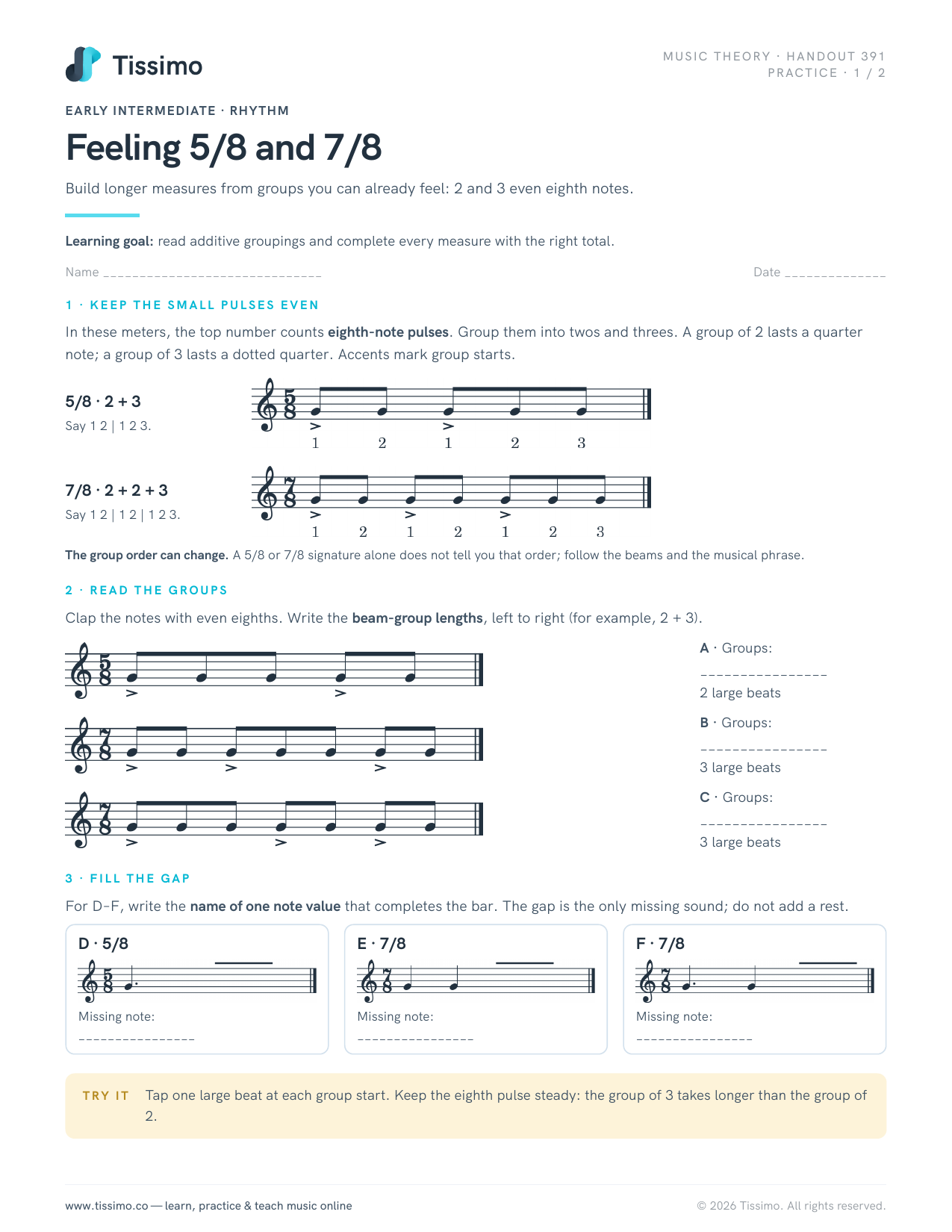 Feeling 5/8 and 7/8Build longer measures from groups you can already feel: 2 and 3 even eighth notes.
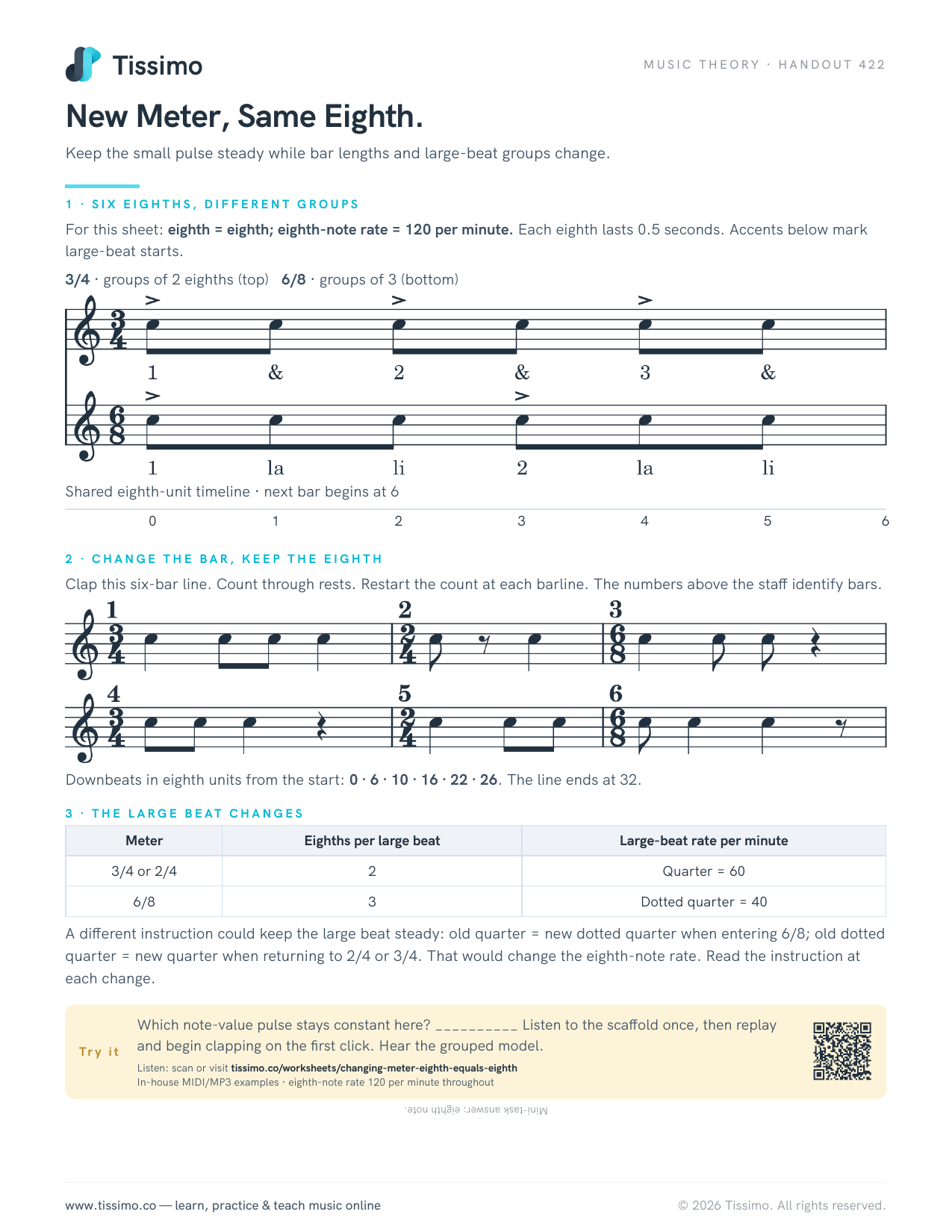 New Meter, Same Eighth.Keep the small pulse steady while bar lengths and large-beat groups change.
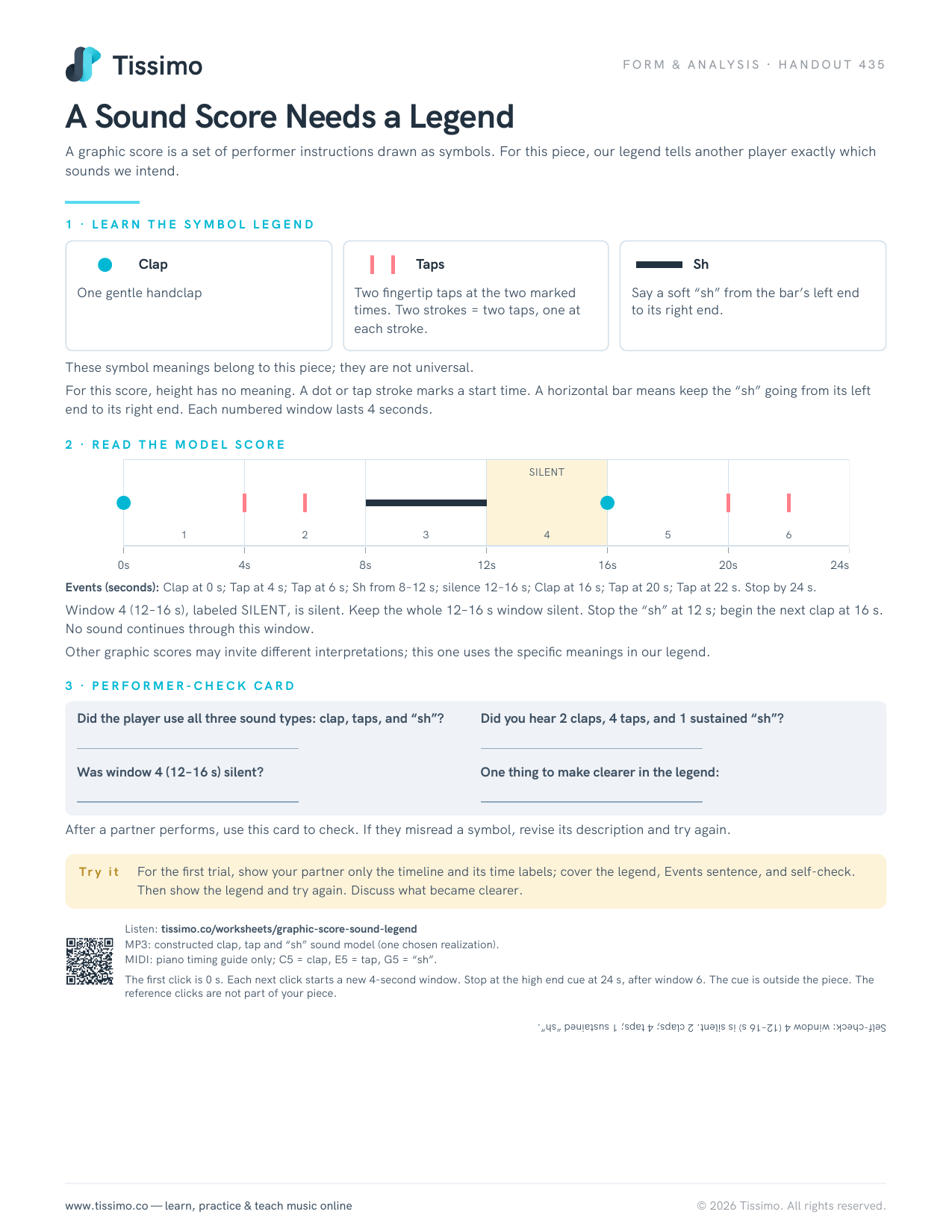 A Sound Score Needs a LegendA graphic score is a set of performer instructions drawn as symbols. For this piece, our legend tells another player exactly which sounds we intend.
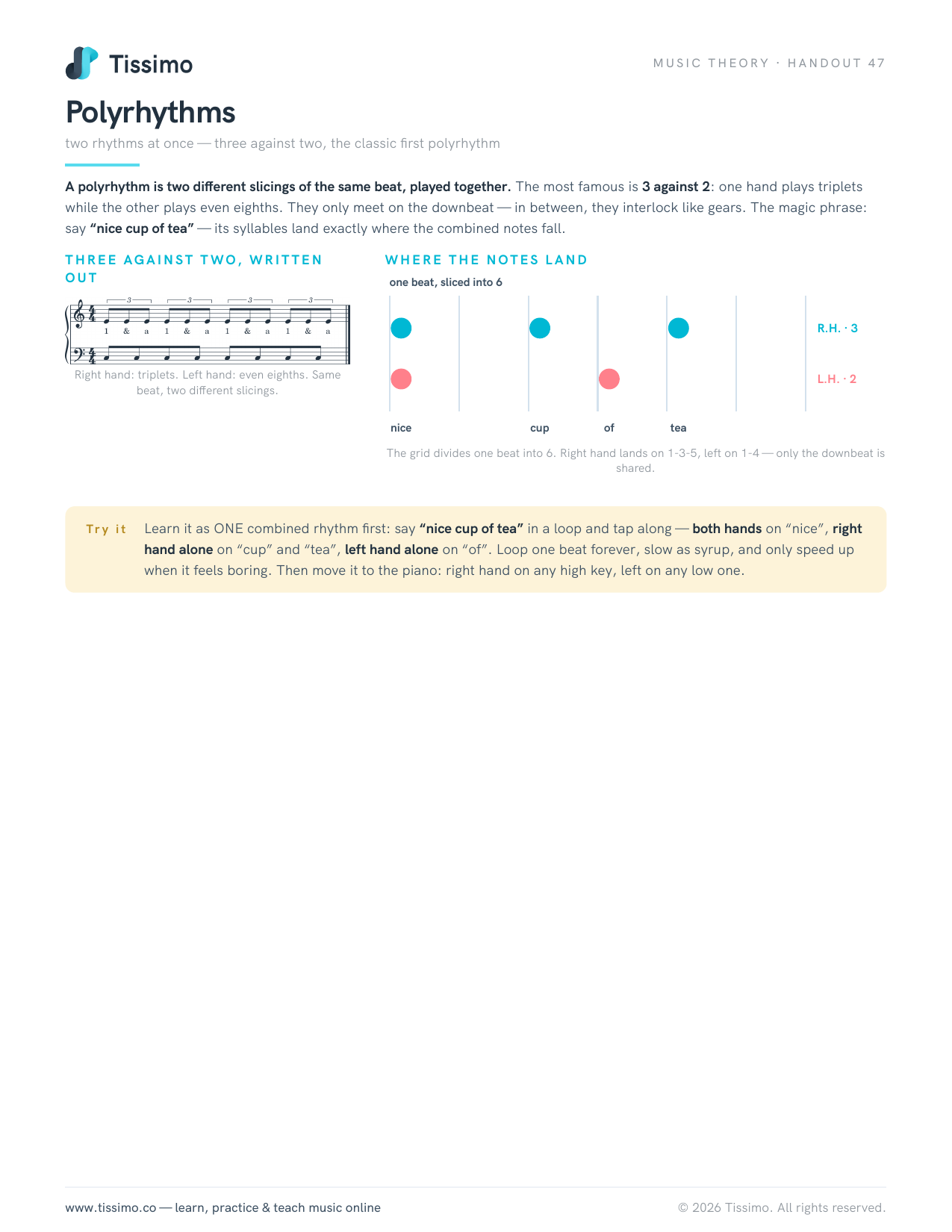 Polyrhythmstwo rhythms at once — three against two, the classic first polyrhythm