Styles, Genres & Eras
Minimalism
Minimalism is a style that began in the United States in the 1960s, built on short repeated patterns, a steady pulse and consonant harmony that change only gradually, as in the music of Steve Reich and Philip Glass.
Minimalist music is made from very little material, repeated many times and changed slowly. A short pattern loops over a steady pulse, and the interest lies in how it gradually shifts, layers or grows. The effect can be hypnotic, and listening closely, you start to notice details that a busier texture would hide.
Characteristics
- Repetition of short patterns, often for long stretches.
- A steady pulse, frequently in even eighth or sixteenth notes.
- Consonant, slow-moving harmony, often staying on one chord or alternating between two.
- Gradual processes that the listener can follow: notes added one at a time, patterns drifting out of sync, textures building up and thinning out.

The pioneers
Minimalism began in the 1960s in the United States, partly as a reaction against the complexity of serialism:
- La Monte Young explored long, sustained tones and drones.
- Terry Riley's In C (1964) gives a group of players 53 short phrases, each repeated as many times as the player chooses over a steady pulse.
- Steve Reich developed phasing: two identical patterns start together and one gradually pulls ahead, creating constantly changing combinations (It's Gonna Rain, Piano Phase). His Music for 18 Musicians is a landmark.
- Philip Glass used additive process, in which a figure grows or shrinks note by note, and wrote the opera Einstein on the Beach (1976).
Reich studied drumming in Ghana and Glass worked with the Indian musician Ravi Shankar, and both cited non-Western music among their influences.
After the pioneers
John Adams brought minimalist techniques into large orchestral works and operas (Short Ride in a Fast Machine, Nixon in China), a style sometimes called post-minimalism. The Estonian composer Arvo Pärt developed a spare, bell-like style he calls tintinnabuli, as in Spiegel im Spiegel. Minimalism also shaped film scores and electronic and ambient music.
Playing minimalist music
The challenges are concentration and evenness. Count repetitions reliably (many players keep tallies on the score), keep the pulse rock-steady, and make each change of pattern precise. Practicing an ostinato, for example with the Ostinato worksheet, is good preparation.
Common questions
Who are the main minimalist composers?
La Monte Young, Terry Riley, Steve Reich and Philip Glass are the founding figures; John Adams and Arvo Pärt are often grouped with them.
What is phasing in music?
A technique associated with Steve Reich: two performers or recordings play the same repeating pattern, and one gradually speeds ahead so that the two drift apart and create new combinations.
Practice it: free worksheets
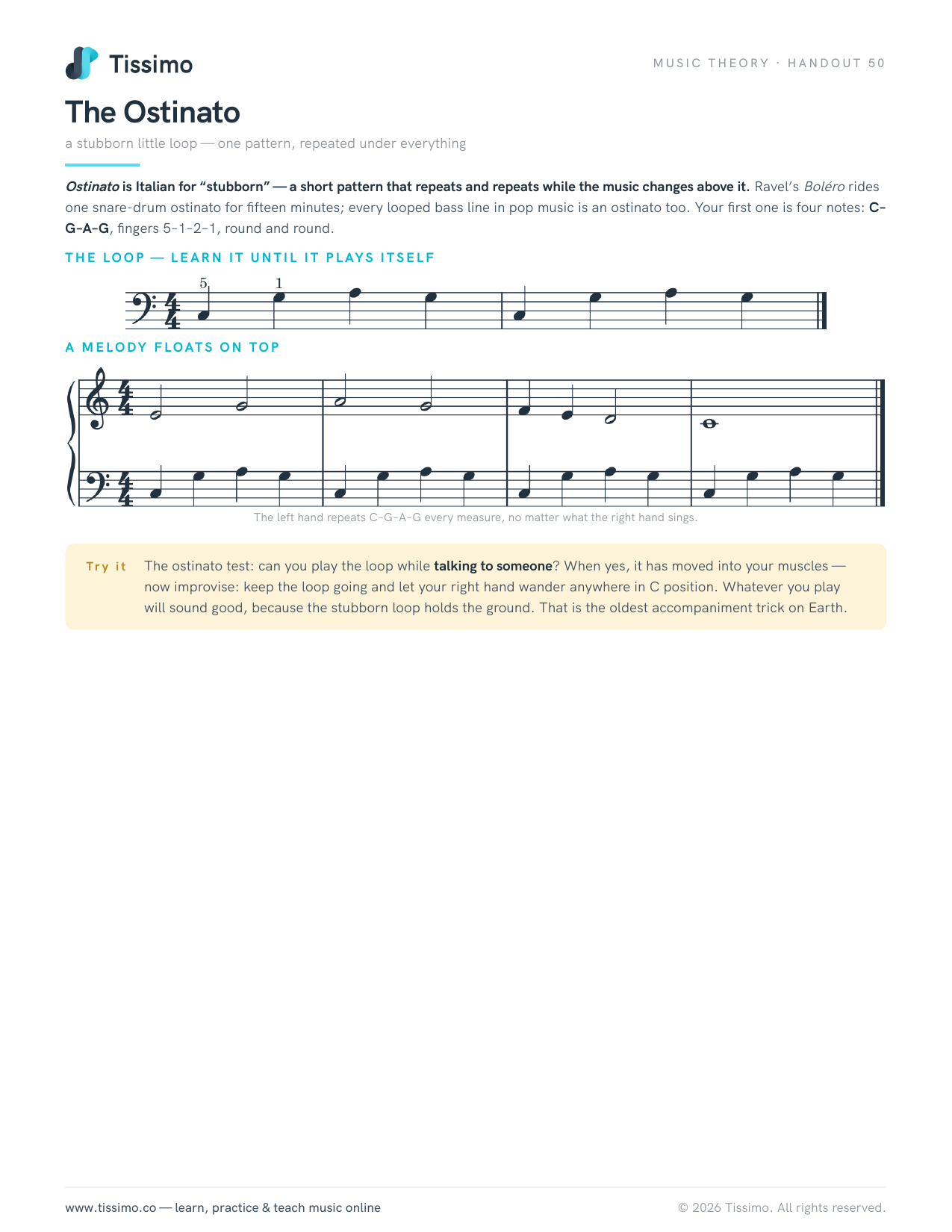 The Ostinatoa stubborn little loop — one pattern, repeated under everything
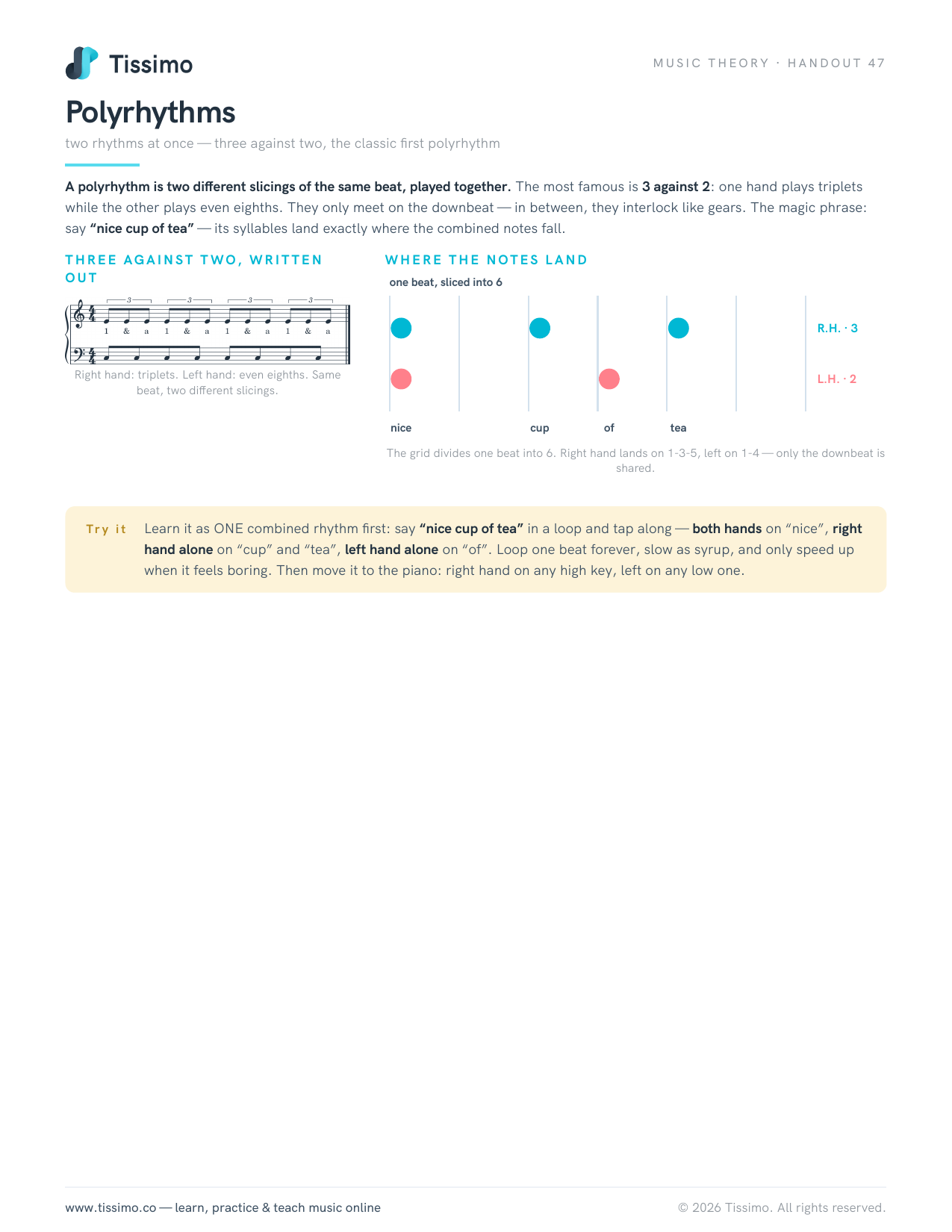 Polyrhythmstwo rhythms at once — three against two, the classic first polyrhythm
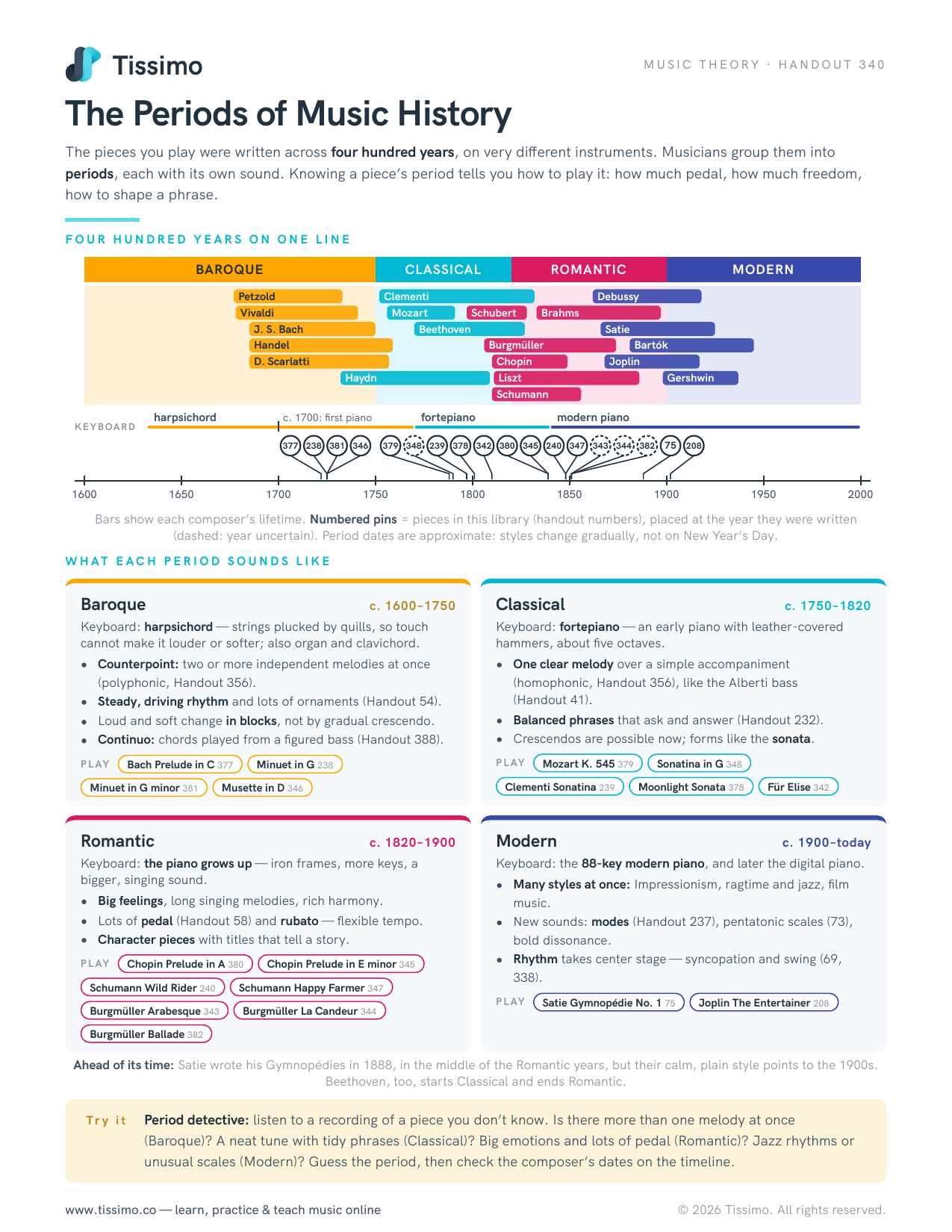 The Periods of Music HistoryThe pieces you play were written across four hundred years, on very different instruments. Musicians group them into periods, each with its own sound. Knowing a piece’s period tells you how to play it: how much pedal, how much freedom, how to shape a phrase.