Music Production
MIDI
Pronounced MID-eeWritten as MIDI
MIDI (Musical Instrument Digital Interface) is a standard language that lets keyboards, computers and other electronic instruments exchange performance data, such as which note was played, how hard and for how long. It carries instructions, not sound.
MIDI was introduced in the early 1980s so that electronic instruments from different manufacturers could work together. It is still the standard that connects keyboards, drum pads, computers and software instruments today.
Instructions, not audio
The most important thing to understand about MIDI is that it contains no sound. When you press middle C on a MIDI keyboard, it sends a short message that means, in effect, "note 60 on, velocity 90". An instrument, such as a synthesizer or a piano plug-in in your DAW, receives that message and makes the sound. That is why you can record a part with a piano sound and switch it to strings afterward, fix a wrong note, or change the tempo with no loss of quality.
What MIDI 1.0 messages carry
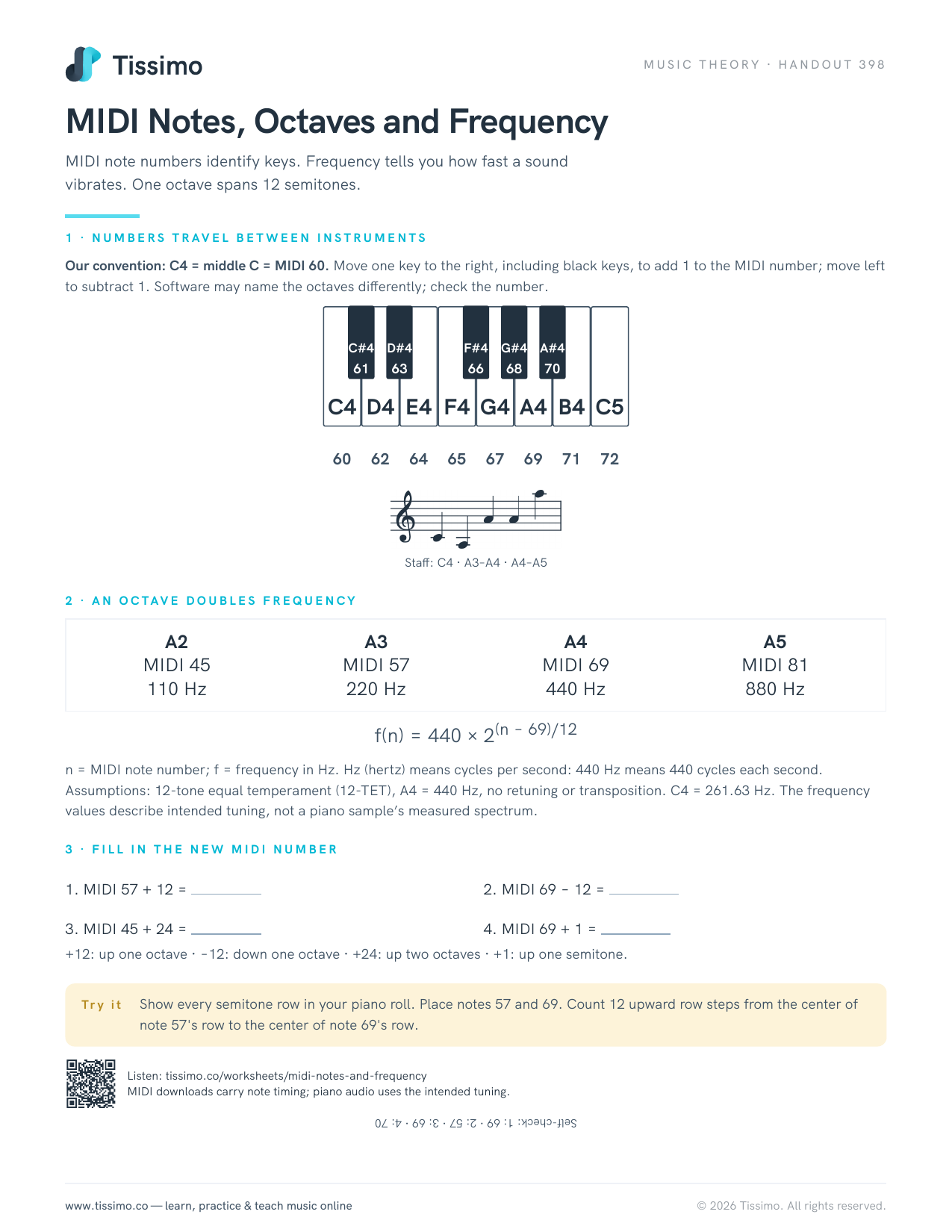
- Note on and note off, with a note number from 0 to 127. Middle C is note 60, and each half step adds or subtracts 1, so an octave spans 12 numbers.
- Velocity, from 0 to 127: how hard, or strictly how fast, the key was struck.
- Control change (CC) messages for knobs, sliders and pedals. A few numbers are standardized: CC 64 is the sustain pedal, CC 1 the modulation wheel, CC 7 volume and CC 10 pan.
- Pitch bend, program change (choosing a sound) and aftertouch (pressure on a key that is already down).
These channel messages use one of 16 channels per MIDI 1.0 port. A device may expose several ports, and system messages such as MIDI clock are not assigned to a channel.
Note numbers and octave names
Note 60 is always middle C, but manufacturers name it differently. Many follow scientific pitch notation, where middle C is C4; some call it C3. When a piano roll labels a key "C3", check where note 60 sits before assuming anything. MIDI Notes, Octaves and Frequency practices the conversions.
Connections and files
MIDI travels over round 5-pin cables, over USB, and between programs inside a computer. A Standard MIDI File (".mid") stores a whole performance, with its notes, timing and tempo, and opens in almost any DAW or notation program. MIDI 2.0 adds higher-resolution channel messages and richer communication while supporting compatibility with MIDI 1.0. Its Universal MIDI Packet format can carry 16 groups of 16 channels; MIDI 2.0 note velocity uses 16 bits rather than MIDI 1.0's 7 bits.
Common questions
Is MIDI the same as audio?
No. MIDI is a set of instructions: which notes, how hard and when. Audio is recorded sound. A MIDI part makes no sound until it is sent to an instrument.
What MIDI note number is middle C?
60. Each half step changes the number by one, so the C an octave higher is 72 and the A above middle C (A440) is 69.
What is a MIDI controller?
Any device that sends MIDI, such as a keyboard, a pad controller or a box of faders. Many controllers make no sound of their own and play the instruments in your computer.