Music Production
Sequencer
A sequencer is a device or program that records, stores and plays back a series of musical events, such as notes and drum hits, in time. A step sequencer builds patterns on a grid, often 16 steps to a bar.
A sequencer plays music from instructions rather than from recorded sound. It stores a sequence: which notes happen when, how long they last and how hard they are played. It sends those instructions to instruments, usually as MIDI. The idea is older than MIDI: early electronic studios and analog synthesizers used sequencers with a row of knobs, one per step, to play repeating patterns.
Two kinds of sequencing
- Linear (real-time) sequencing: you play into it as you would record, and it captures the timing of your performance across the whole song. The MIDI tracks of a DAW work this way, and you edit them in the piano roll.
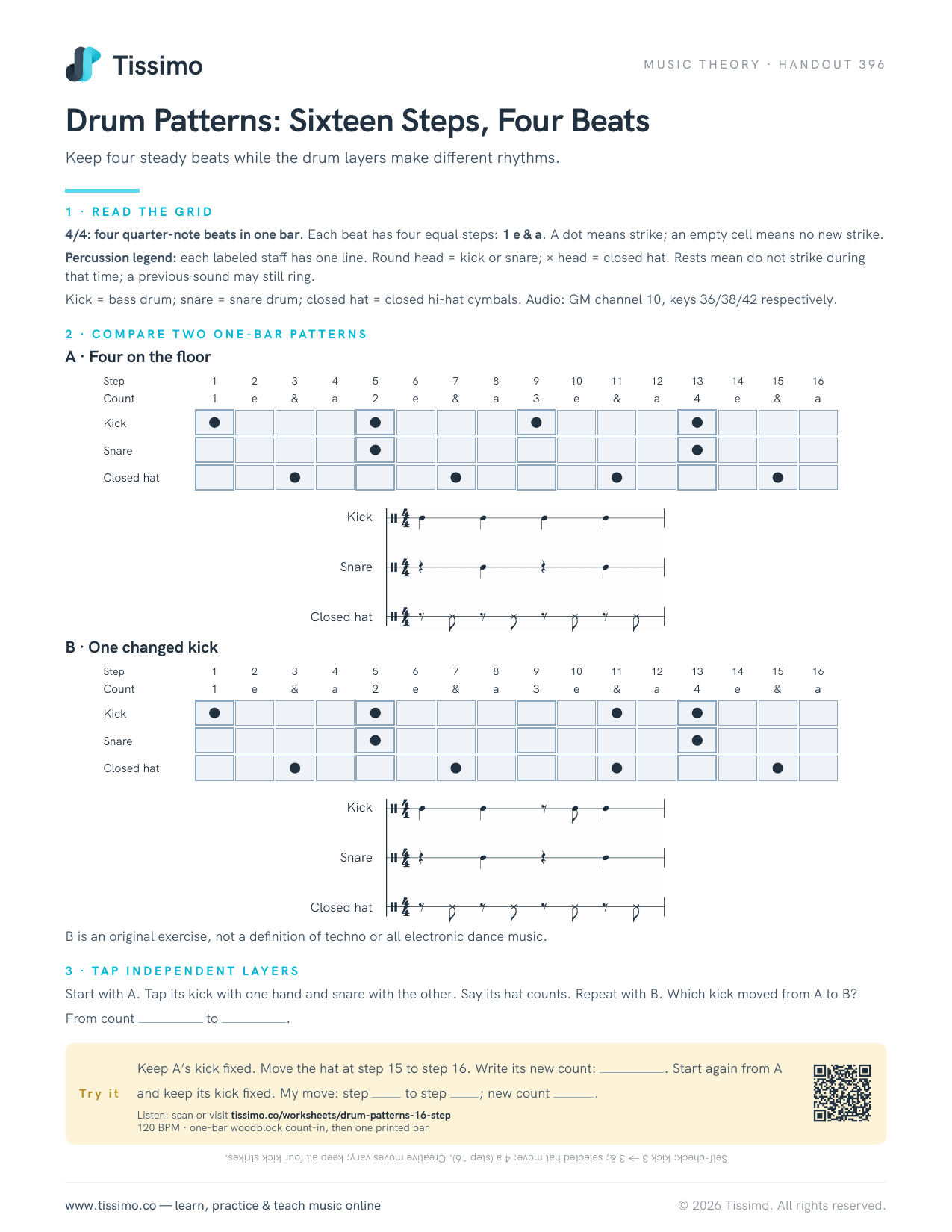
- Step sequencing: you build a short pattern step by step on a grid. Each step is a fixed slice of time, most often a sixteenth note, so 16 steps make one bar of 4/4. You switch each step on or off and give it a note, and the pattern loops. Drum machines and many synthesizers work this way.

How a step sequencer counts
In 4/4 with sixteenth-note steps, steps 1, 5, 9 and 13 fall on the four beats, steps 3, 7, 11 and 15 on the "and"s, and the even-numbered steps on the sixteenths in between (subdivision). A basic dance beat, for example, puts a kick drum on steps 1, 5, 9 and 13. Many step sequencers let each step carry its own velocity and note length (gate), and offer swing, which delays the even-numbered steps.
Patterns and songs
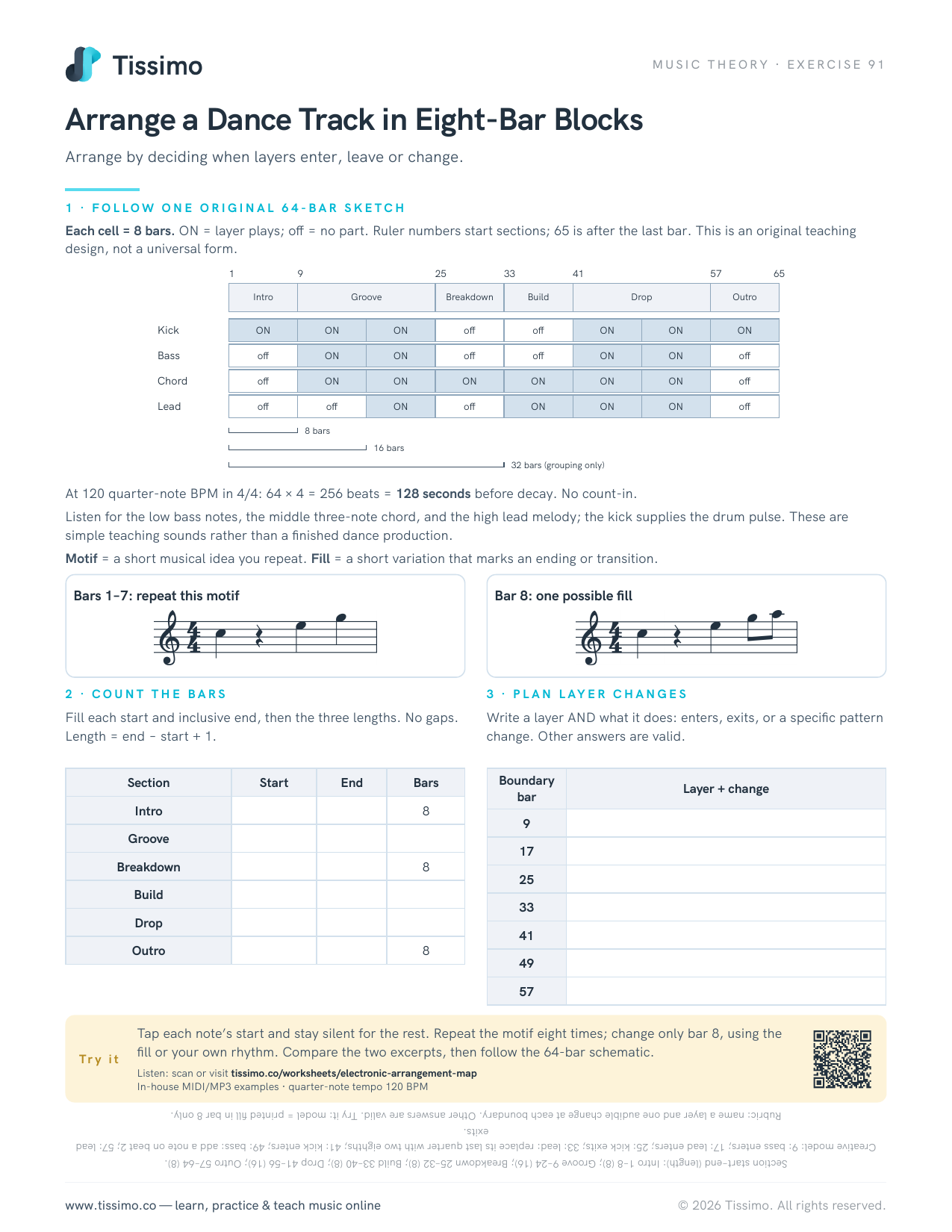
Patterns are usually one, two or four bars long. A pattern sequencer lets you chain them, for example the verse pattern four times and then the chorus pattern, building a whole song from short loops. Drum Patterns: Sixteen Steps, Four Beats builds drum grooves this way, and Arrange a Dance Track in Eight-Bar Blocks turns patterns into a song.
Try it
On any step sequencer, or in a DAW's drum editor, at about 120 BPM:
- Put a kick drum on steps 1, 5, 9 and 13.
- Add a snare or clap on steps 5 and 13, beats 2 and 4, the backbeat.
- Add a closed hi-hat on every odd-numbered step, the eighth notes.
- Now move one kick to step 11 or 15 and hear how the groove changes.
A related tool, the arpeggiator, generates its pattern from the chord you hold instead of from stored steps.
Common questions
What is a step sequencer?
A sequencer you program one step at a time on a grid, usually 16 sixteenth-note steps per bar of 4/4. Each step is switched on or off and given a note, and the pattern loops.
Is a DAW a sequencer?
It contains one. The MIDI tracks of a DAW are a linear sequencer, and many DAWs also include step-sequencer and drum-pattern editors.