Music Production
Piano Roll
A piano roll is the MIDI editor in a DAW: a grid with a piano keyboard down the side, where each note is a bar whose height on the grid is its pitch and whose length is its duration.
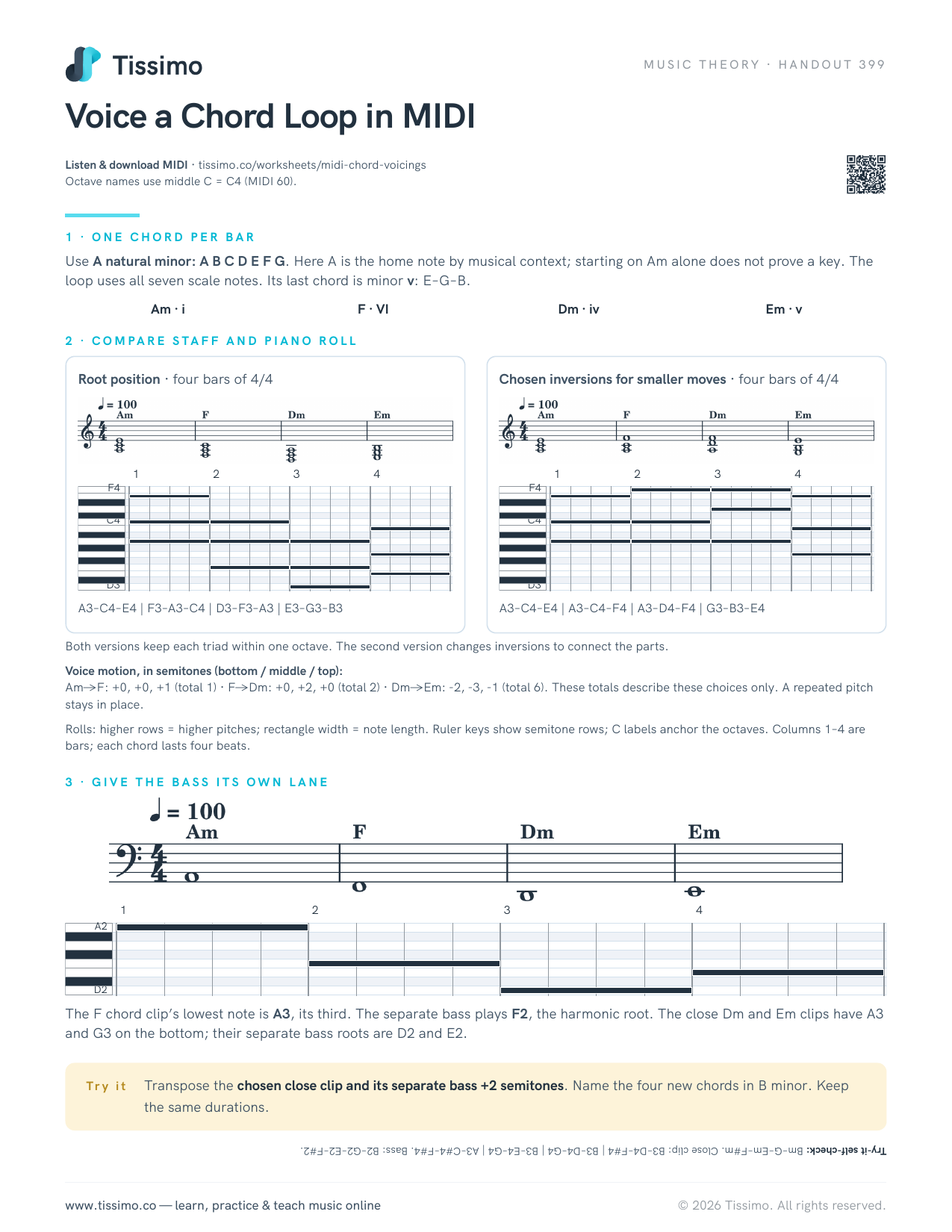
Open a MIDI part in almost any DAW and you see a piano roll. Pitch runs up and down, with a keyboard along the left edge so you can see which row is which note. Time runs from left to right, divided by the grid of bars and beats. Each note is a rectangle: where it starts is when it plays, its length is how long it lasts, and its row is its pitch.
Where the name comes from
Before electronic instruments, player pianos played music from long rolls of paper punched with holes. Each hole's position across the roll chose the note, and the length of the hole decided how long the note sounded. A DAW's MIDI editor looks much like one of those rolls turned on its side, so it borrowed the name.
What you can do in a piano roll
- Draw notes with the mouse, without playing a keyboard.
- Move notes to change their pitch or timing, and drag their ends to change their length.
- Quantize timing to the grid, or set the grid ("snap") so new notes land exactly on eighths or sixteenths.
- Edit velocity, usually in a lane of bars below the notes.
- Transpose a selection up or down, or copy a pattern to fill several bars.
- Edit controller data, such as the sustain pedal, modulation or pitch bend, in further lanes (MIDI).
Piano roll or notation?
A piano roll shows exactly what a MIDI performance does, including timing that is slightly off the beat and every note's precise length. Notation shows what a musician should read, rounded to clean rhythms. Many DAWs offer both views of the same part. If you read music, the notation view helps you check that a part makes musical sense; the piano roll is better for fine timing and velocity edits.
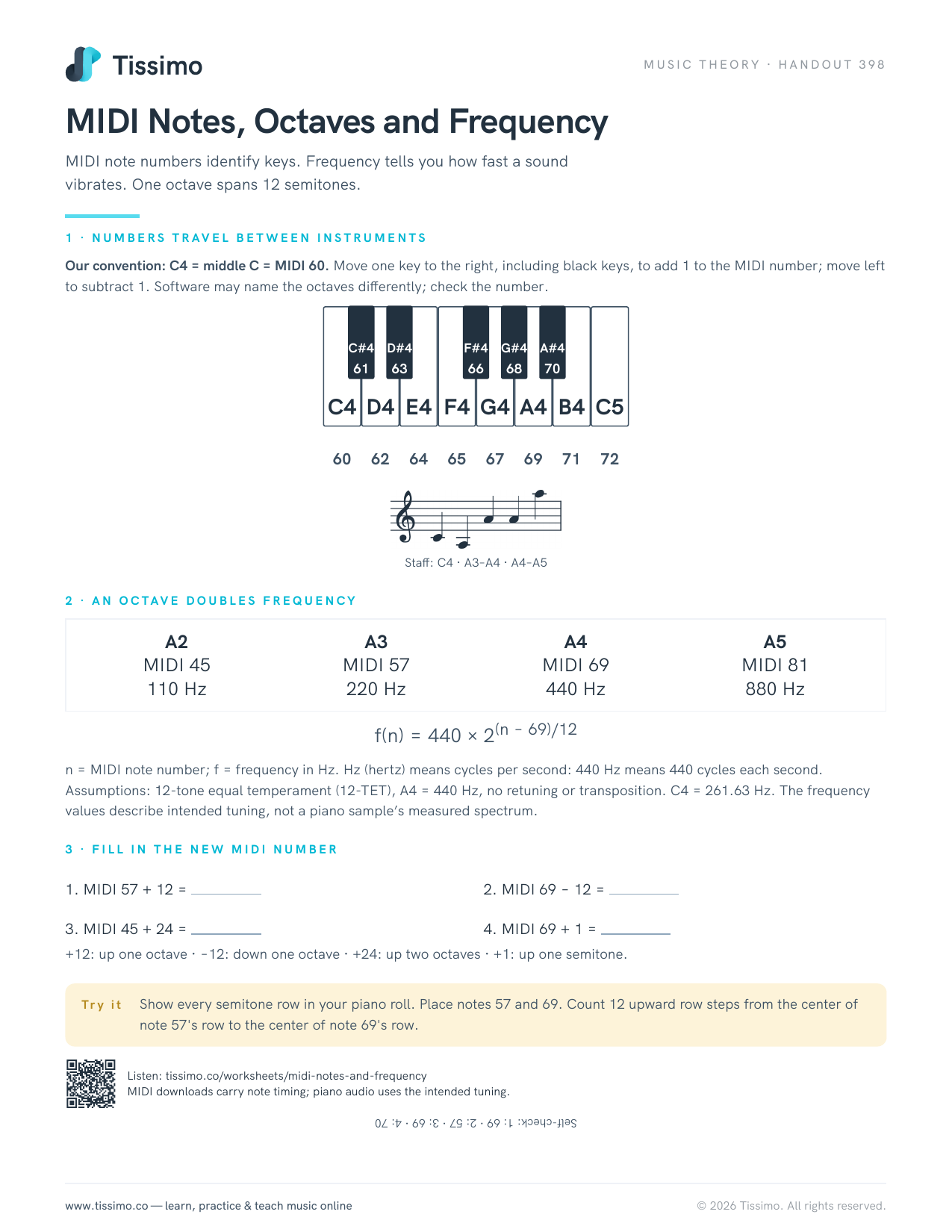
Learning to read both is easy once you see the link: one row up in a piano roll is a half step higher, and twelve rows make an octave.
Try it
Draw a C major chord in a piano roll: three notes stacked on C, E and G, each one bar long. Then turn it into A minor by moving the G up two rows to A. Moving chord tones by the smallest steps like this is the whole idea of Voice a Chord Loop in MIDI.
Common questions
Why is it called a piano roll?
After the paper rolls of player pianos, whose punched holes showed each note's pitch by their position and its length by their length, much like the bars in a DAW's MIDI editor.
Is a piano roll only for piano sounds?
No. It edits MIDI notes for any instrument: drums, bass, synthesizers or strings. Only the name comes from the piano.