Pitch & Intervals
Pitch
Pitch is how high or low a sound is. It depends mainly on how fast the sound vibrates: the faster the vibration (the higher the frequency), the higher the pitch.
Pitch is how high or low a musical sound seems to you. A piccolo plays high pitches and a tuba low ones, and when you sing up a scale your pitch rises step by step.
What makes a pitch high or low
Every musical sound is a vibration: a string, a column of air or your vocal folds moving back and forth many times a second. The number of vibrations per second is the sound's frequency, measured in hertz (Hz). Faster vibration sounds higher. The A that orchestras tune to vibrates 440 times a second (A440); the A an octave lower vibrates 220 times, and the A an octave higher 880 times.
Pitch is the name for what you hear, frequency the name for what you can measure. The two track each other closely, but pitch is worked out by your ear and brain. You can even hear a low pitch when the lowest frequency of a sound is missing altogether, as on a small phone speaker (see fundamental).
Pitch on the page and on the keyboard
Written music shows pitch vertically: the higher a note sits on the staff, the higher it sounds. On the piano, pitch rises from left to right.
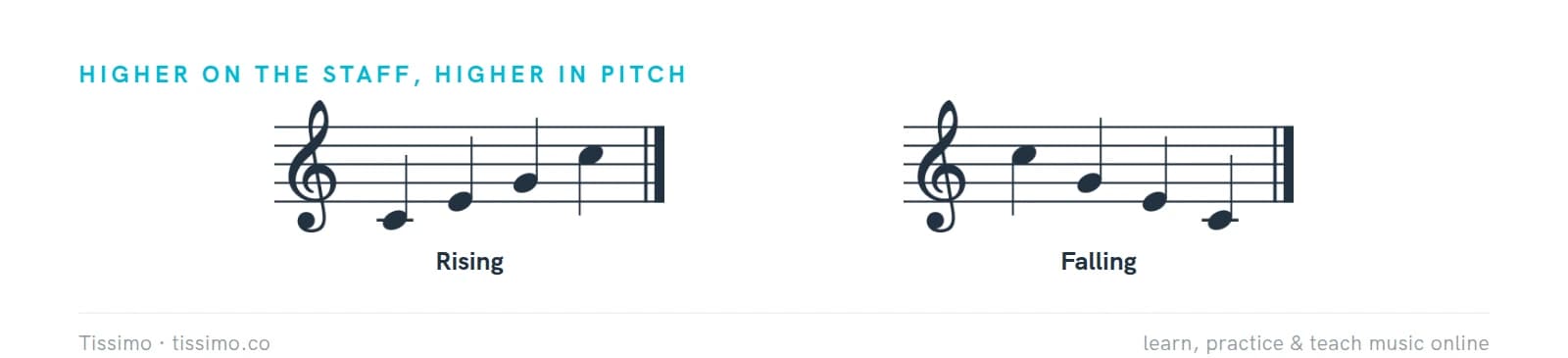
The clef tells you which pitch each line and space stands for, so the same pitch can sit in different places on the page. Middle C is written on a ledger line below the treble staff and on a ledger line above the bass staff. The sound is the same; only its place on the page changes.
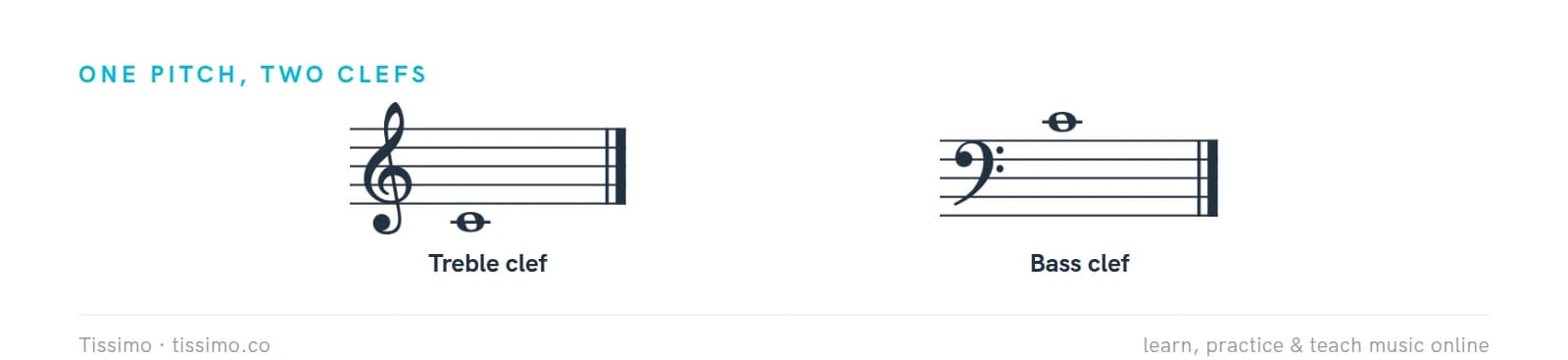
Each pitch has a letter name from A to G, sometimes with a sharp or a flat (see note names). To say exactly which C you mean, musicians add an octave number: middle C is C4 in scientific pitch notation.
Definite and indefinite pitch
The piano, violin, flute and voice produce a definite pitch: you can sing it back and name it. Many percussion instruments, such as the snare drum or a crash cymbal, produce an indefinite pitch: you hear them as higher or lower, but not as a note you could name. Timpani and the xylophone are percussion instruments with definite pitch.
Pitch and your ear
Most people remember melodies not as fixed pitches but as the distances between them, the intervals. That is why you recognize a tune whether it starts high or low. Hearing those distances is relative pitch; naming a pitch with no reference at all is perfect pitch, which is much rarer.
Map pitches to keys with The piano keyboard, then see them written in The Staff & the Treble Clef.
Common questions
What is the difference between pitch and frequency?
Frequency is a measurement: how many times per second a sound vibrates, in hertz. Pitch is how high or low you hear the sound. A higher frequency gives a higher pitch, so the words are often used interchangeably, but pitch is a perception and frequency is physics.
What is the difference between pitch and tone?
Tone has several meanings: a sound with a definite pitch, the color of a sound (timbre), or, in British usage, a whole step. Pitch only means how high or low a sound is.
Practice it: free worksheets
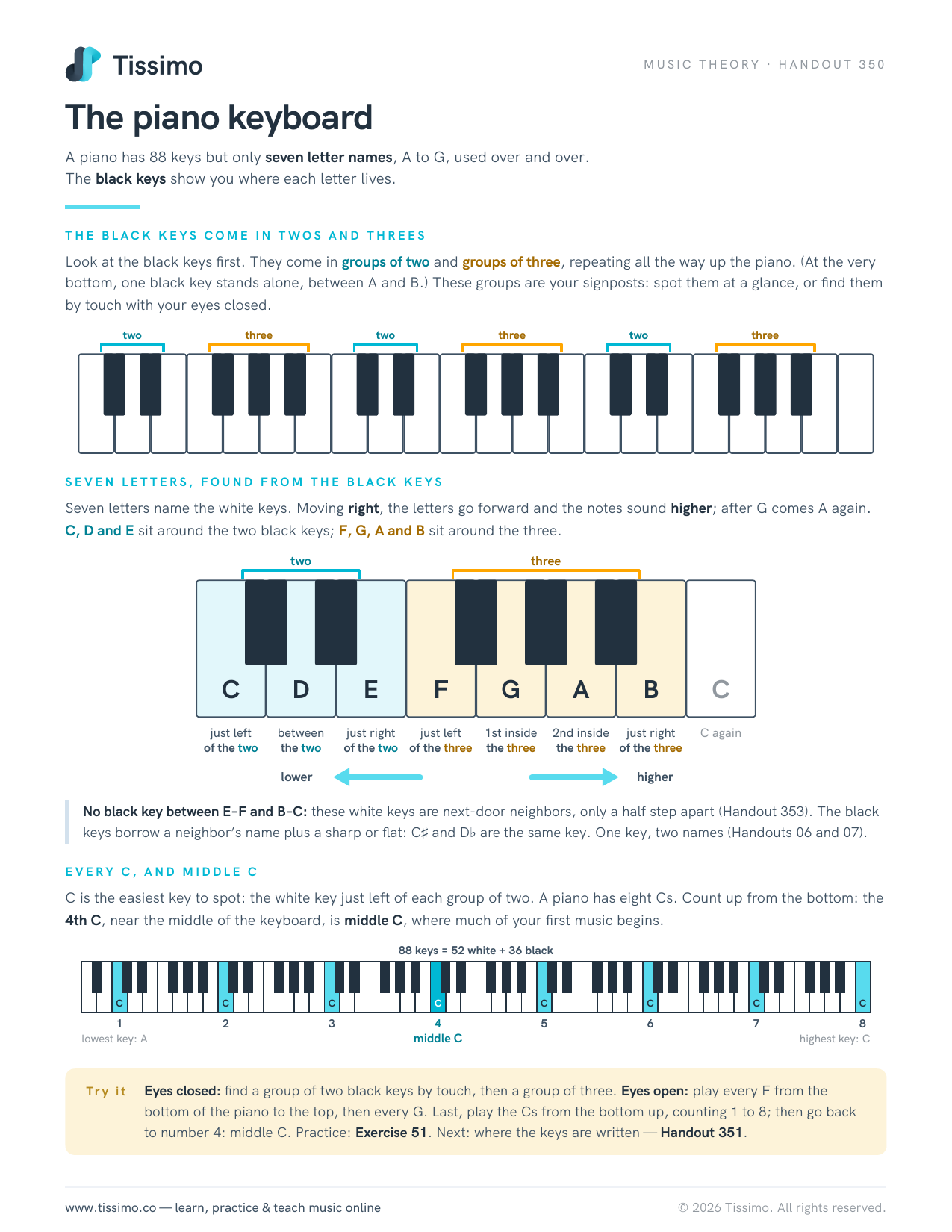 The piano keyboardA piano has 88 keys but only seven letter names, A to G, used over and over. The black keys show you where each letter lives.
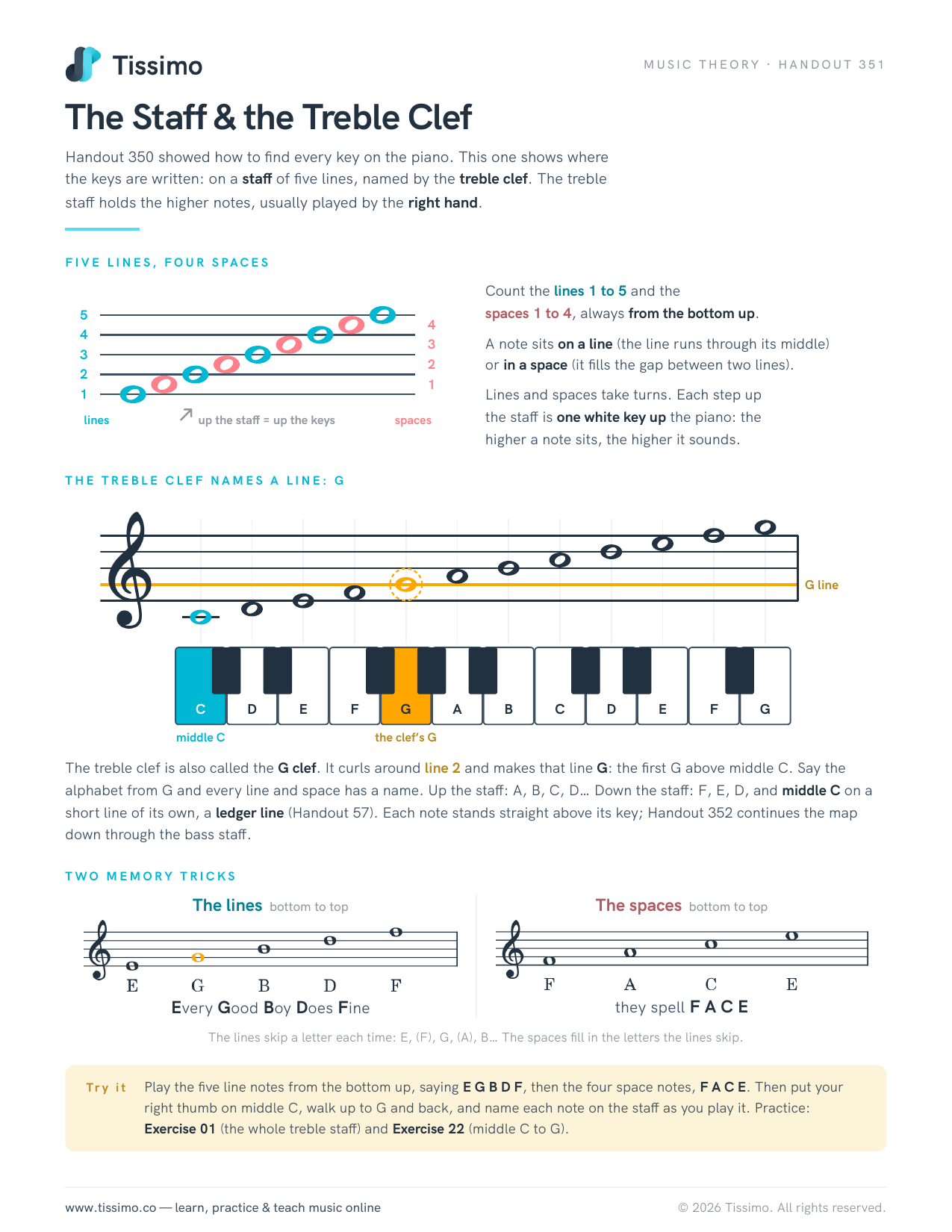 The Staff & the Treble ClefHandout 350 showed how to find every key on the piano. This one shows where the keys are written: on a staff of five lines, named by the treble clef. The treble staff holds the higher notes, usually played by the right hand.
 The Bass Clef & the Grand StaffThe bass staff holds the lower notes, usually played by the left hand. It works just like the treble staff (Handout 351), but its clef names a different line.
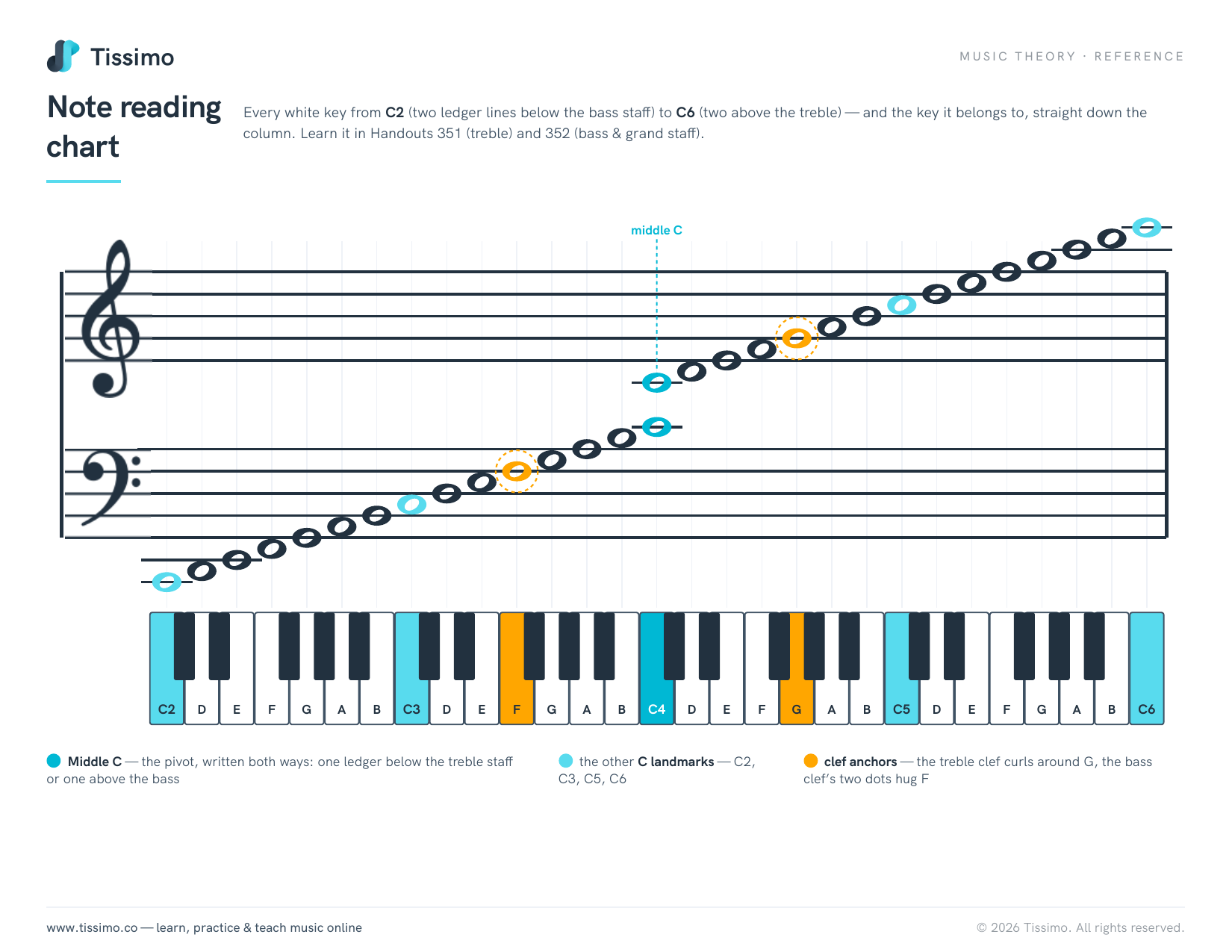 Note reading chartEvery white key from C2 (two ledger lines below the bass staff) to C6 (two above the treble) — and the key it belongs to, straight down the column. Learn it in Handouts 351 (treble) and 352 (bass & grand staff).
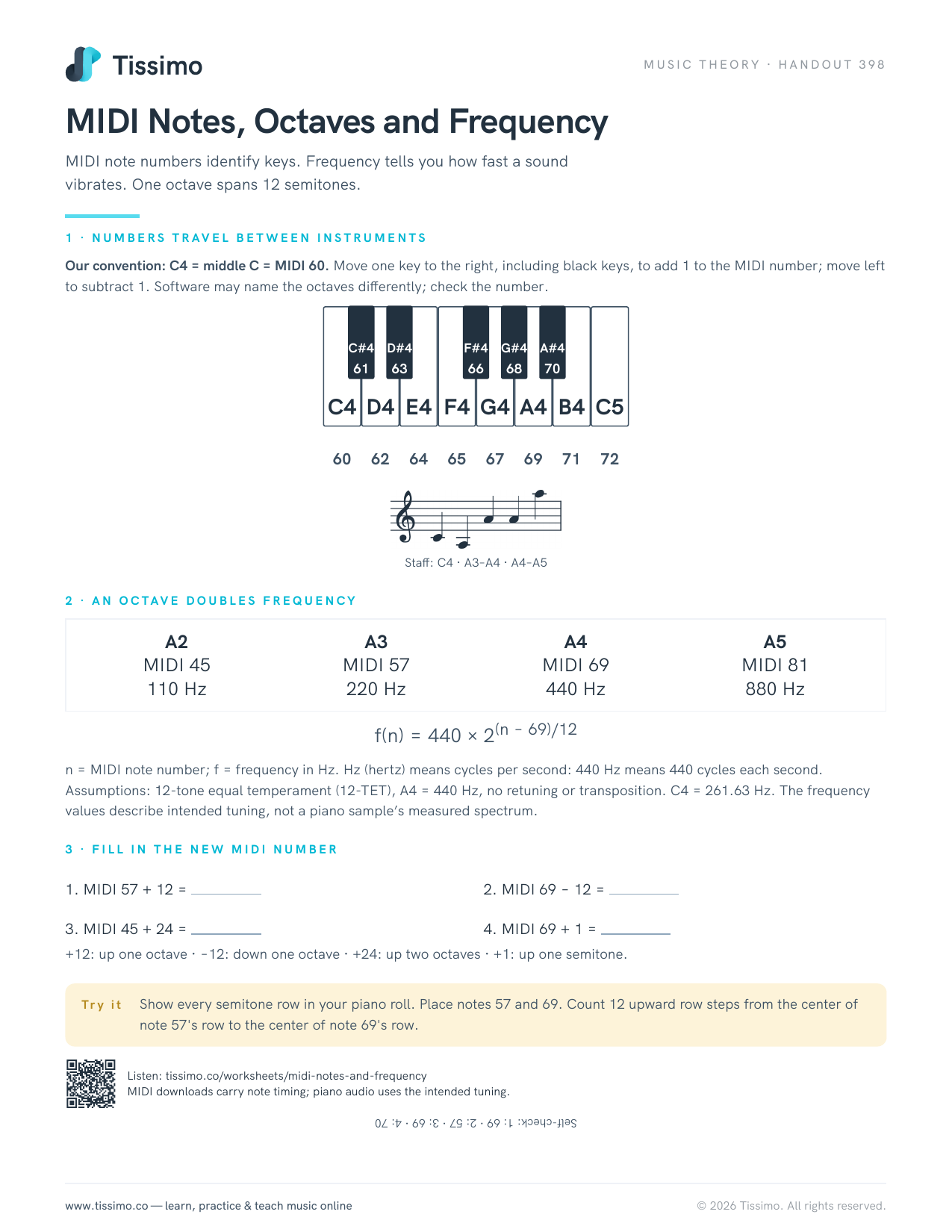 MIDI Notes, Octaves and FrequencyMIDI note numbers identify keys. Frequency tells you how fast a sound vibrates. One octave spans 12 semitones.