Sound & Acoustics
Fundamental
The fundamental frequency is the base frequency of a harmonic tone: its repetition rate and first harmonic. It normally establishes perceived pitch even when the component at that frequency is absent.
For a periodic musical tone, the fundamental frequency is the rate at which the whole waveform repeats. In the harmonic series it is harmonic number 1, often written f₀ ("f-zero"). When present, this component is the lowest harmonic, but it need not be the strongest. Higher vibration modes of a string or air column contribute overtones; real instruments may depart from an ideal harmonic series.
The fundamental sets the pitch
When you name a note, you are normally naming its fundamental. With A440 tuning, a harmonic tone on A4 has a fundamental of 440 Hz, with higher harmonics at 880, 1,320 and 1,760 Hz and up. Those overtones change the timbre, not the note name.
What decides the fundamental
For a vibrating string, three things matter:
- Length. Halve the vibrating length and the fundamental doubles, an octave higher. That is what your finger does on a guitar fret or a violin fingerboard.
- Tension. A tighter string vibrates faster; that is how you tune with the pegs.
- Mass per unit length. At the same length and tension, a heavier string vibrates more slowly, which is why bass strings are thick and often wound with wire.
Wind instruments work the same way with the length of the air column: longer tube, lower fundamental. Opening a tone hole on a flute, or pressing a valve on a trumpet, changes that effective length.
The missing fundamental
Here is a surprise: you can hear a pitch even when its fundamental is absent. If a sound contains 220, 330 and 440 Hz, your brain recognizes them as harmonics 2, 3 and 4 of 110 Hz and hears a pitch at 110 Hz, even though there is no frequency component at 110 Hz. This effect, the missing fundamental, is why a bass line stays recognizable on a phone speaker that cannot reproduce those low frequencies. Some pipe organs use a related trick, sounding two pipes a fifth apart to suggest a lower note than either.
Fundamental or root?
A fundamental belongs to a single tone. The root is the note a chord is built on. Older theory books sometimes call a chord's root its "fundamental", after Jean-Philippe Rameau's idea of the fundamental bass, so read the context.
Explore fundamentals and their harmonics in Synth Waveforms and Their Harmonics and Open String, Touch Point, Sound.
Common questions
What is the fundamental frequency of a note?
For a periodic tone, it is the frequency at which the waveform repeats, normally determining its pitch. With A440 tuning, A4 has a fundamental of 440 Hz. Higher harmonics are multiples of that frequency, and the fundamental component itself can be absent.
Is the fundamental the same as the first harmonic?
Yes. In the harmonic series the fundamental is harmonic 1. It is not an overtone: in a complete harmonic series, the first overtone is harmonic 2.
Practice it: free worksheets
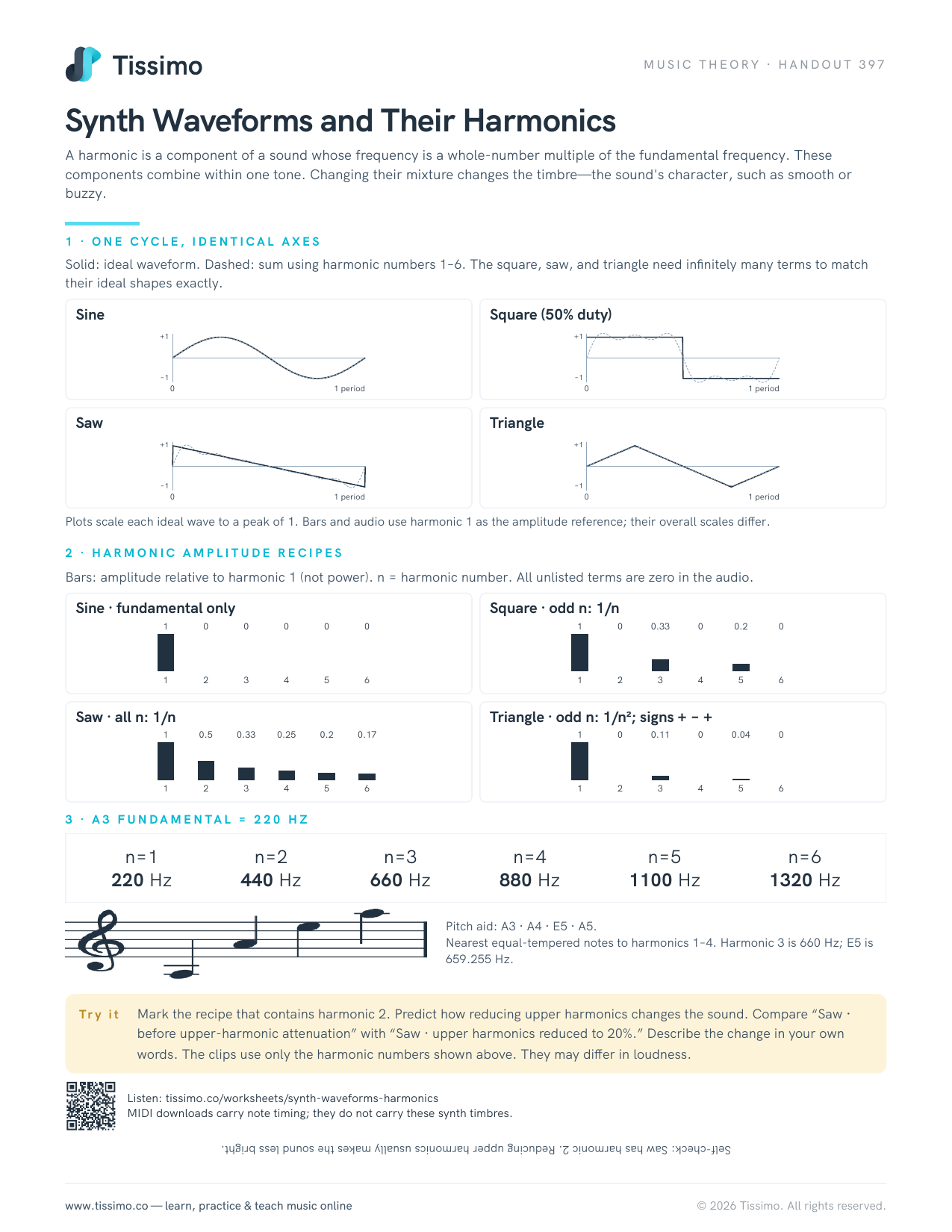 Synth Waveforms and Their HarmonicsA harmonic is a component of a sound whose frequency is a whole-number multiple of the fundamental frequency. These components combine within one tone. Changing their mixture changes the timbre—the sound's character, such as smooth or buzzy.
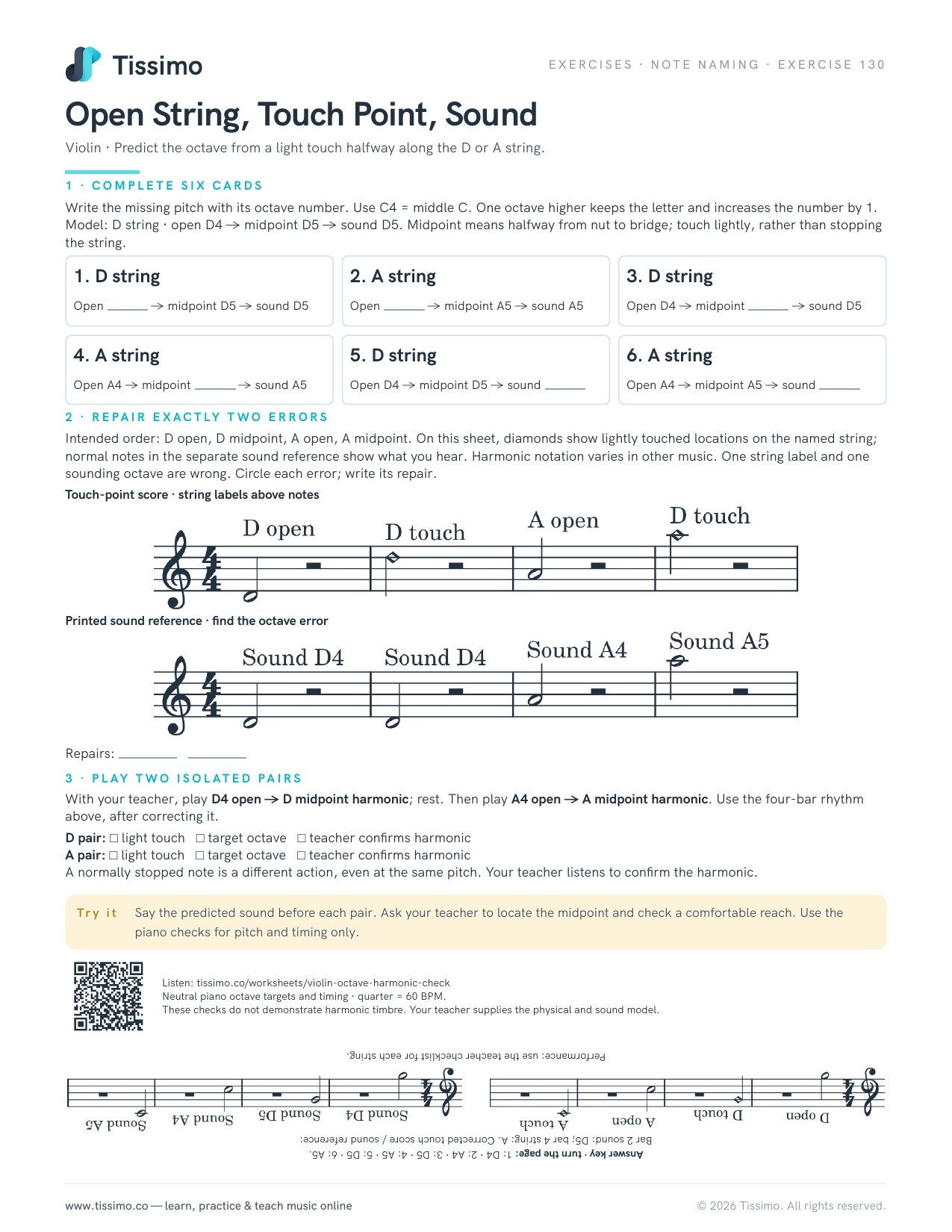 Open String, Touch Point, SoundViolin · Predict the octave from a light touch halfway along the D or A string.
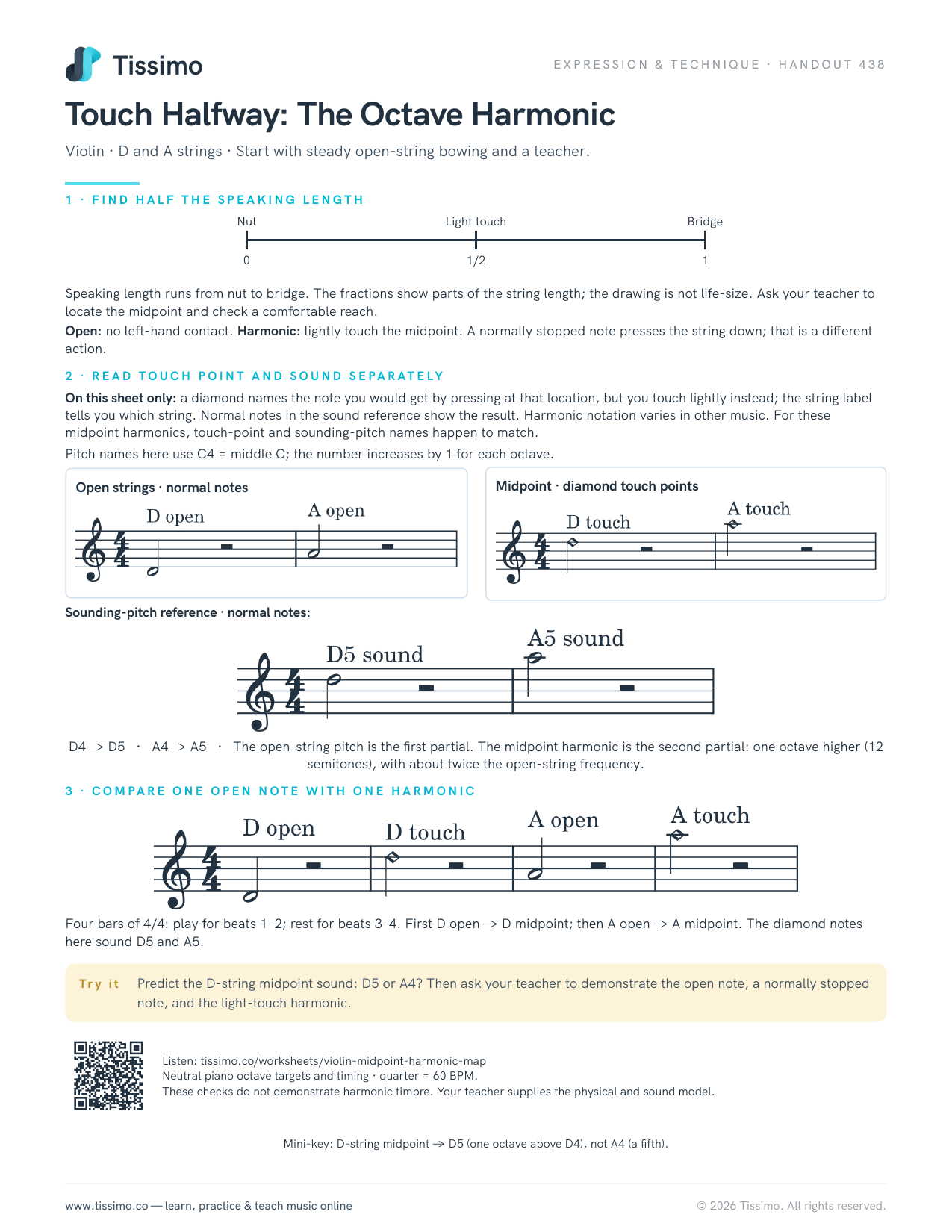 Touch Halfway: The Octave HarmonicViolin · D and A strings · Start with steady open-string bowing and a teacher.