Sound & Acoustics
Just Intonation
Just intonation tunes intervals to simple whole-number frequency ratios, such as 3:2 for a perfect fifth and 5:4 for a major third, so chords ring without beating. On a fixed keyboard it cannot stay pure in every key.
Just intonation is tuning by pure ratios. Two notes whose frequencies form a simple whole-number ratio share many overtones, so when they sound together they blend smoothly, without the wobble of beating. Just intonation builds its intervals from those ratios. "Just" here means exact, as in "justified".
The pure intervals
The most important just ratios come straight from the harmonic series:
- Octave 2:1 (1,200 cents)
- Perfect fifth 3:2 (702.0 cents)
- Perfect fourth 4:3 (498.0 cents)
- Major third 5:4 (386.3 cents)
- Minor third 6:5 (315.6 cents)
- Major sixth 5:3 (884.4 cents)
- Minor sixth 8:5 (813.7 cents)
A just major triad has frequencies in the ratio 4:5:6, exactly harmonics 4, 5 and 6 of one fundamental. On middle C (261.63 Hz) that puts E at 327.03 Hz and G at 392.44 Hz, while a piano in equal temperament plays E at 329.63 Hz and G at 392.00 Hz. The difference in the third, about 14 cents, is why a just major chord sounds so calm next to a piano chord.
Why it can't work everywhere
Pure ratios don't add up neatly. In a just C major scale the whole step C–D is 9:8 (203.9 cents) but D–E is 10:9 (182.4 cents). The two differ by the syntonic comma, 81:80, about 21.5 cents. So the "same" step comes in two sizes, and the fifth D–A built from those scale notes is a whole comma narrower than pure. Move to another key and you need yet another set of notes. An instrument with fixed pitches, such as a piano with 12 keys per octave, cannot have pure intervals in every key. That is the problem temperament solves.
Who uses it
Musicians who can bend pitch while they play often lean toward just intonation, especially in sustained chords:
- Unaccompanied choirs and barbershop quartets, who place major thirds low so that chords "lock" and ring.
- String quartets and brass ensembles in slow, held chords.
- Composers who write for retuned instruments or electronics, such as Harry Partch and Ben Johnston in the 20th century.
In practice good intonation is flexible: a player may tune a chord justly and then nudge a melody note higher or lower for expression.
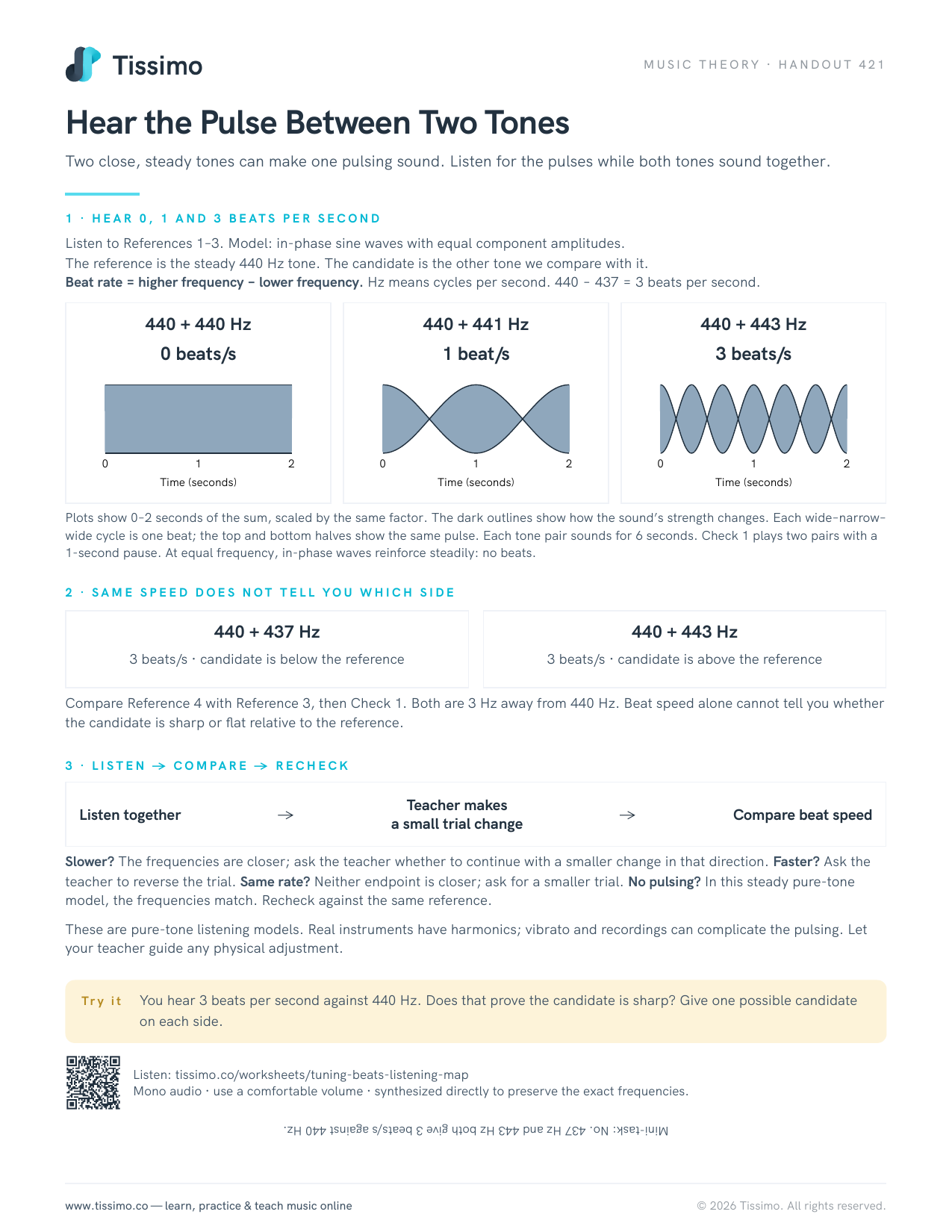
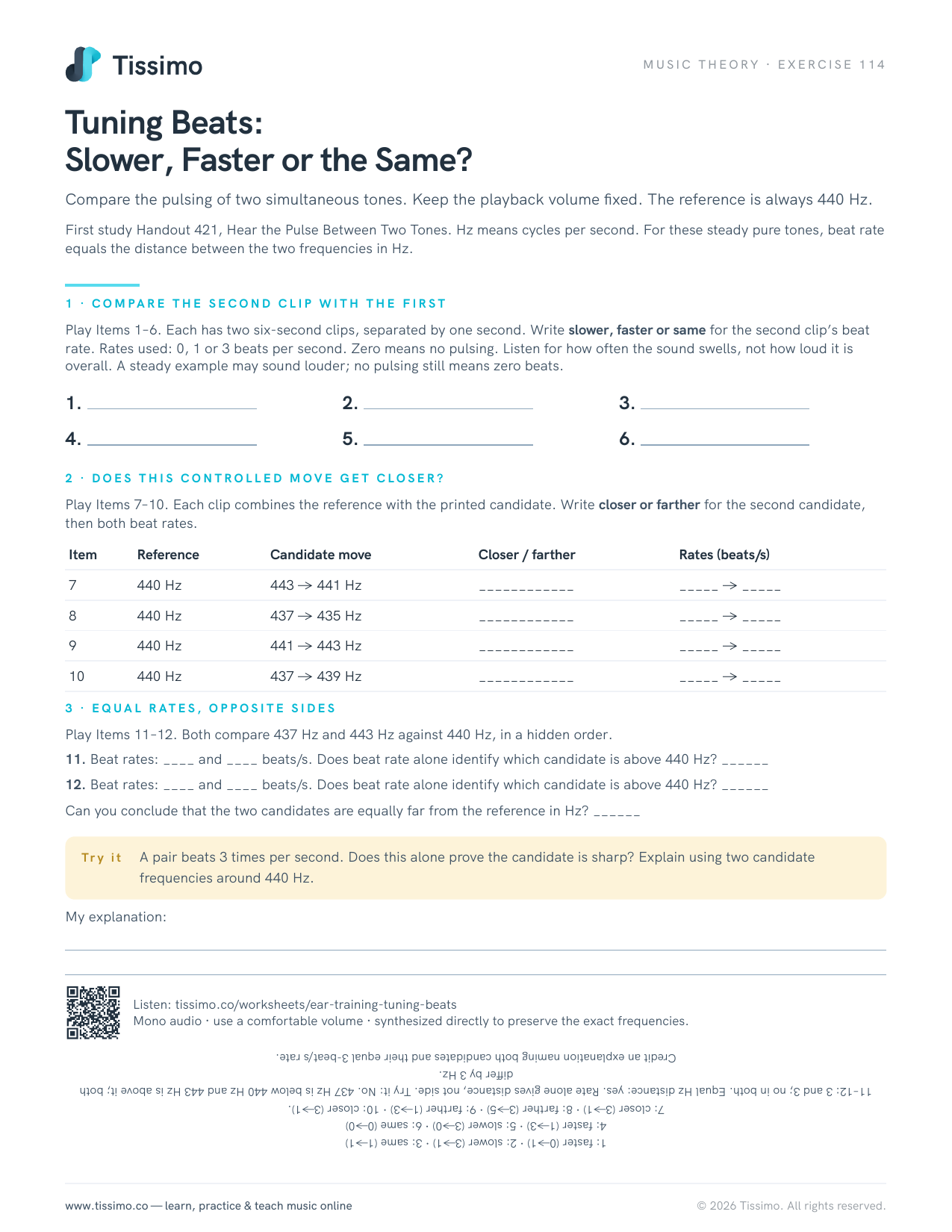
Listen for the pulsing that pure tuning removes in Hear the Pulse Between Two Tones.
Common questions
What is the difference between just intonation and equal temperament?
Just intonation uses pure whole-number ratios, so its chords ring without beats, but only in a limited set of keys. Equal temperament makes all 12 half steps the same size, so every key works the same, but its thirds and sixths are slightly off the pure ratios.
Can a piano play in just intonation?
Only in a limited way. A piano can be retuned so that chords in one key are pure, but other keys then sound badly out of tune, because 12 fixed notes per octave cannot hold all the pure ratios at once. Some electronic instruments and software can retune notes as you play to get around this.