Scales, Keys & Modes
Key
A key is the tonal home of a piece of music: a central note, the tonic, plus the scale and chords built around it. A piece in G major treats G as home and uses mostly the notes of the G major scale.
When musicians say a piece is "in G major", they are naming its key. The key tells you two things at once: which note is home (the tonic, here G) and which kind of scale the music mostly draws on (here the major scale, with its F♯). Melodies tend to end on the tonic, chords lean toward the tonic chord, and the other notes of the scale take their roles around it.
Major keys and minor keys
A key is either major or minor. A major key uses the major scale on its tonic; a minor key uses the minor scale, usually mixing its natural, harmonic and melodic forms. With twelve possible tonics and two kinds of key, there are 24 keys. Three major keys and three minor keys can each be spelled two ways (F♯ major and G♭ major, for example), so you will see 30 key names in all, but those enharmonic equivalent pairs sound the same on a piano.
Key and key signature
The key signature at the start of each staff shows the sharps or flats the key needs, so you do not have to write them in front of every note. G major has one sharp, F♯; F major has one flat, B♭. But each key signature belongs to two keys: one sharp means G major or E minor, its relative minor. To tell which:
- Look at the last note of the melody and the last chord. Most pieces end on the tonic.
- Look for an extra accidental. Minor keys usually raise their 7th degree, so a D♯ in a one-sharp piece points to E minor.
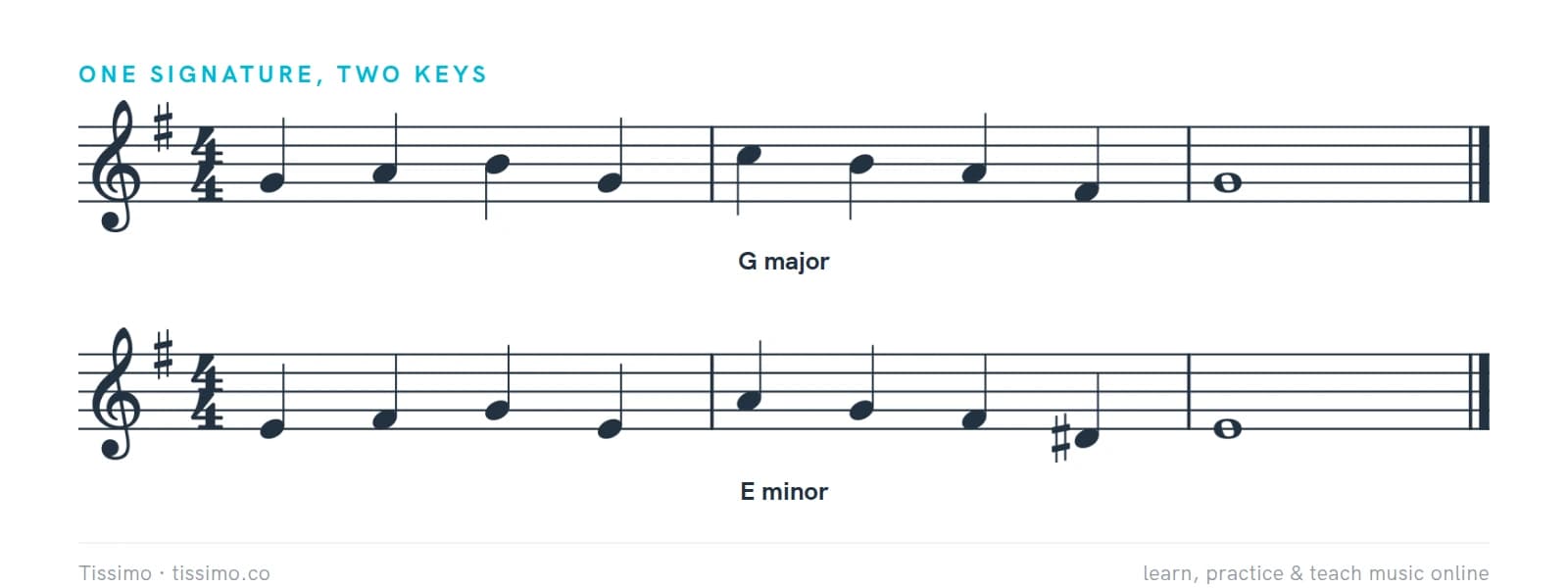
How to find the key of a song
The same steps work by ear. Hum the note that feels like the resting point at the end of a phrase: that is probably the tonic. Then ask whether the music sounds major or minor. The chords help too: a song whose chords are mostly G, C, D and Em is very likely in G major.
Keys and the circle of fifths
Keys are related to one another in a regular way. Moving the tonic up a perfect fifth adds one sharp (C, G, D, A...), and moving it down a fifth adds one flat (C, F, B♭, E♭...). The circle of fifths lays them all out like a clock, and keys next to each other there share six of their seven notes. That closeness is why music most often modulates to a neighboring key.
Other meanings
"Key" also names a lever on an instrument: the keys of a piano, or the keys a flute player presses. And in everyday speech, "changing the key" of a song usually means transposing it: moving the whole thing higher or lower, for example to suit a singer.
Name the Key Signatures and Write the key signatures build the reading skill, and Key Signatures: Major & Minor is a chart of all fifteen.
Common questions
How many keys are there in music?
Twenty-four: a major and a minor key on each of the twelve notes. Because some keys can be spelled two ways (F♯ major and G♭ major, for example), there are 30 key names and 15 key signatures.
What is the difference between a key and a key signature?
The key is the tonal home of the music: its tonic and its scale. The key signature is the group of sharps or flats written at the start of the staff to show that scale. One key signature is shared by two keys, a major key and its relative minor.
Practice it: free worksheets
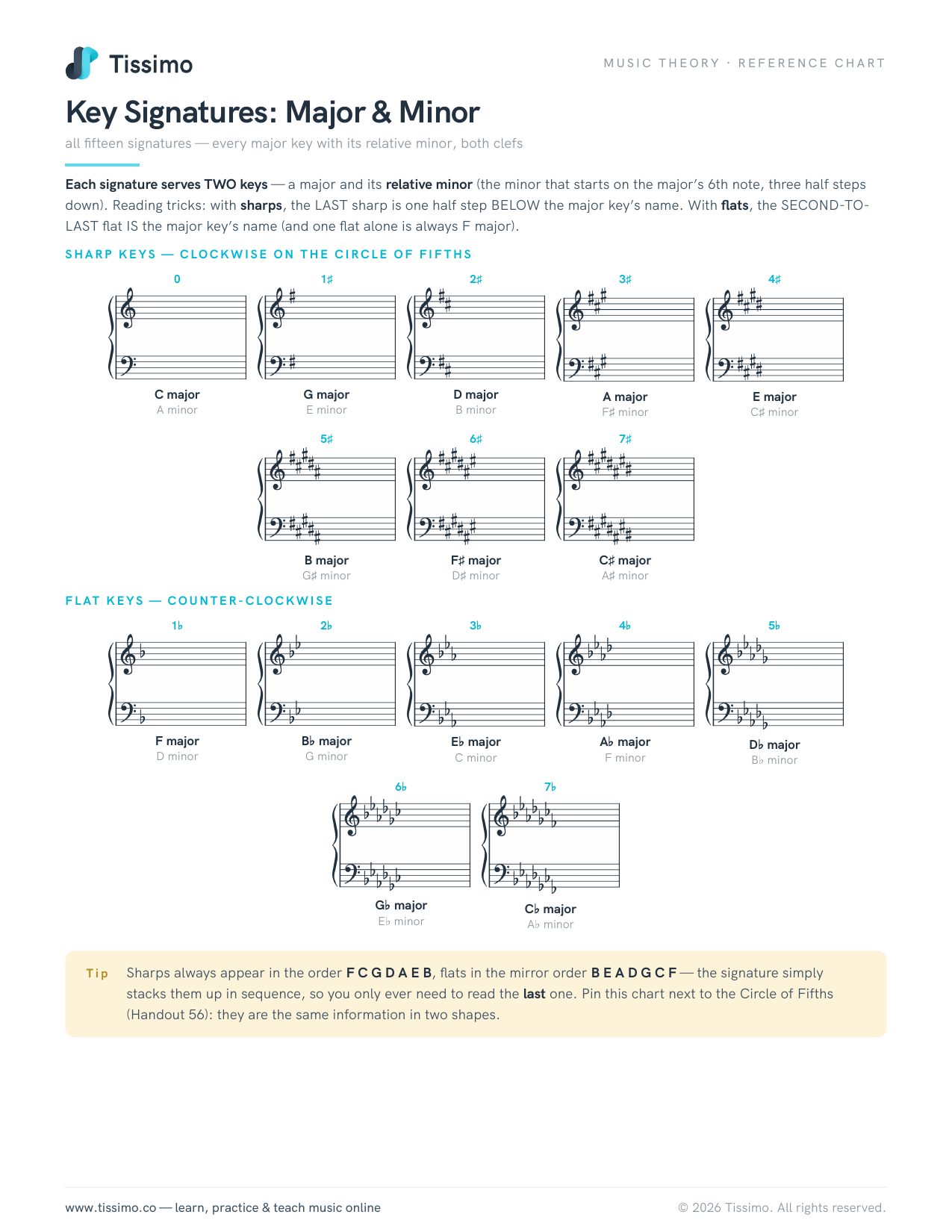 Key Signatures: Major & Minorall fifteen signatures — every major key with its relative minor, both clefs
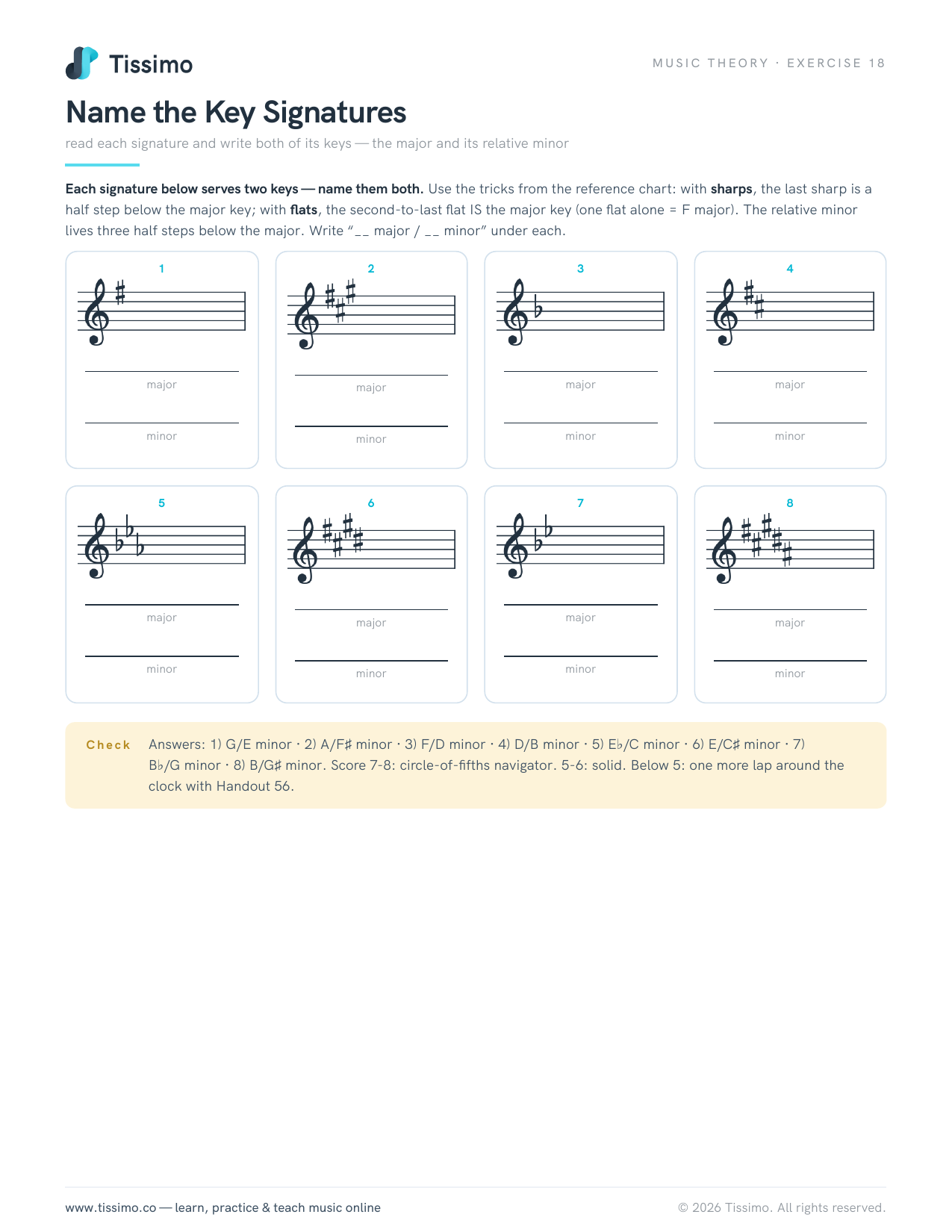 Name the Key Signaturesread each signature and write both of its keys — the major and its relative minor
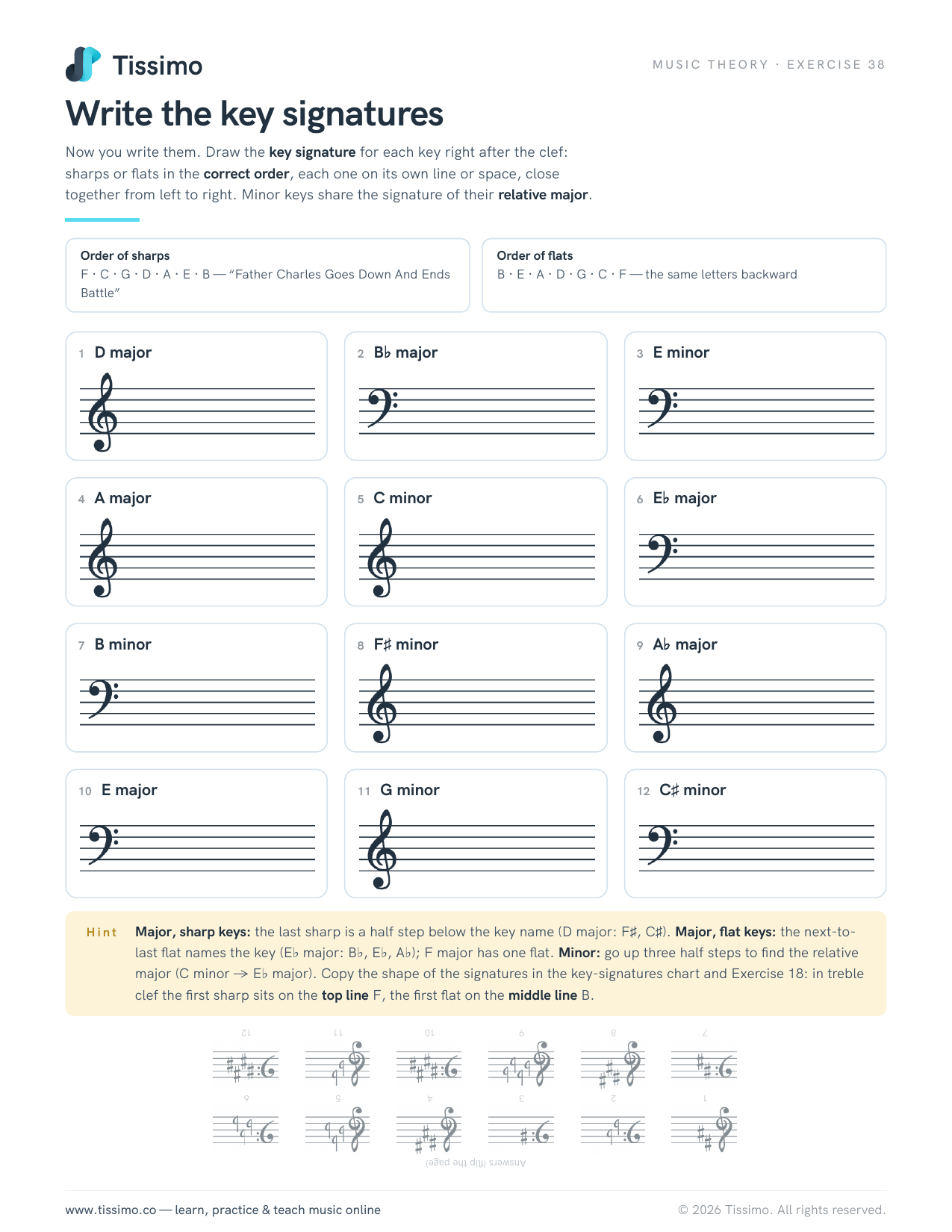 Write the key signaturesNow you write them. Draw the key signature for each key right after the clef: sharps or flats in the correct order, each one on its own line or space, close together from left to right. Minor keys share the signature of their relative major.
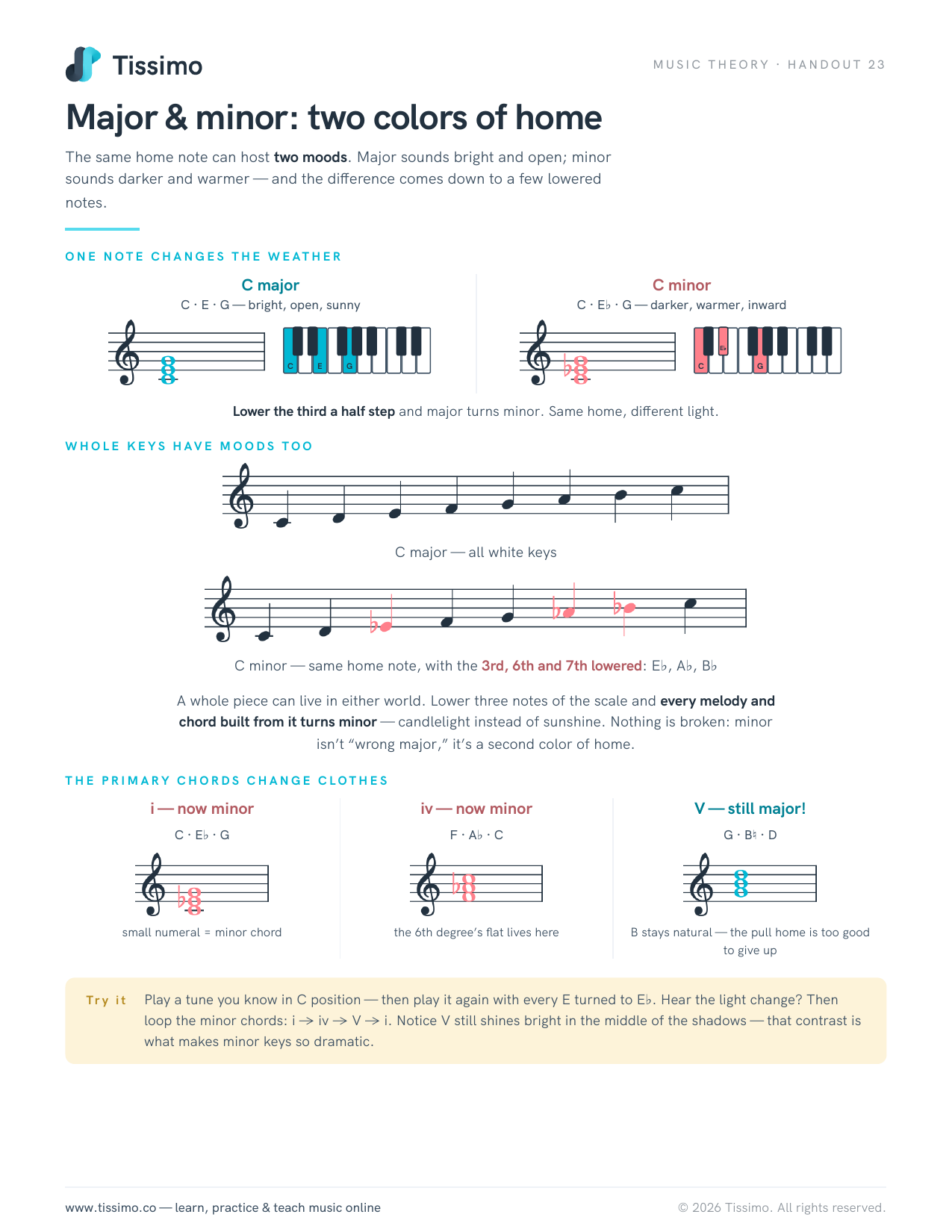 Major & minor: two colors of homeThe same home note can host two moods. Major sounds bright and open; minor sounds darker and warmer — and the difference comes down to a few lowered notes.
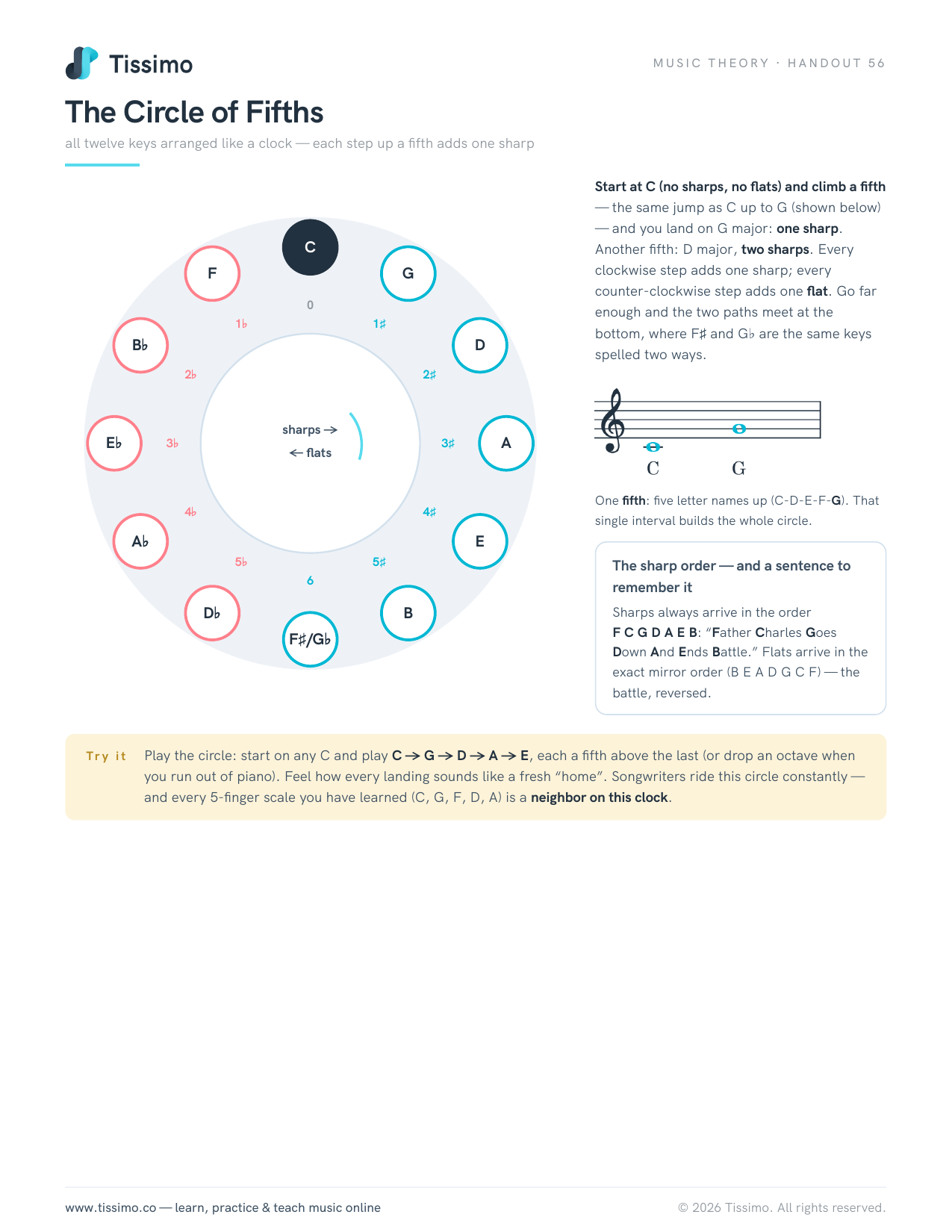 The Circle of Fifthsall twelve keys arranged like a clock — each step up a fifth adds one sharp
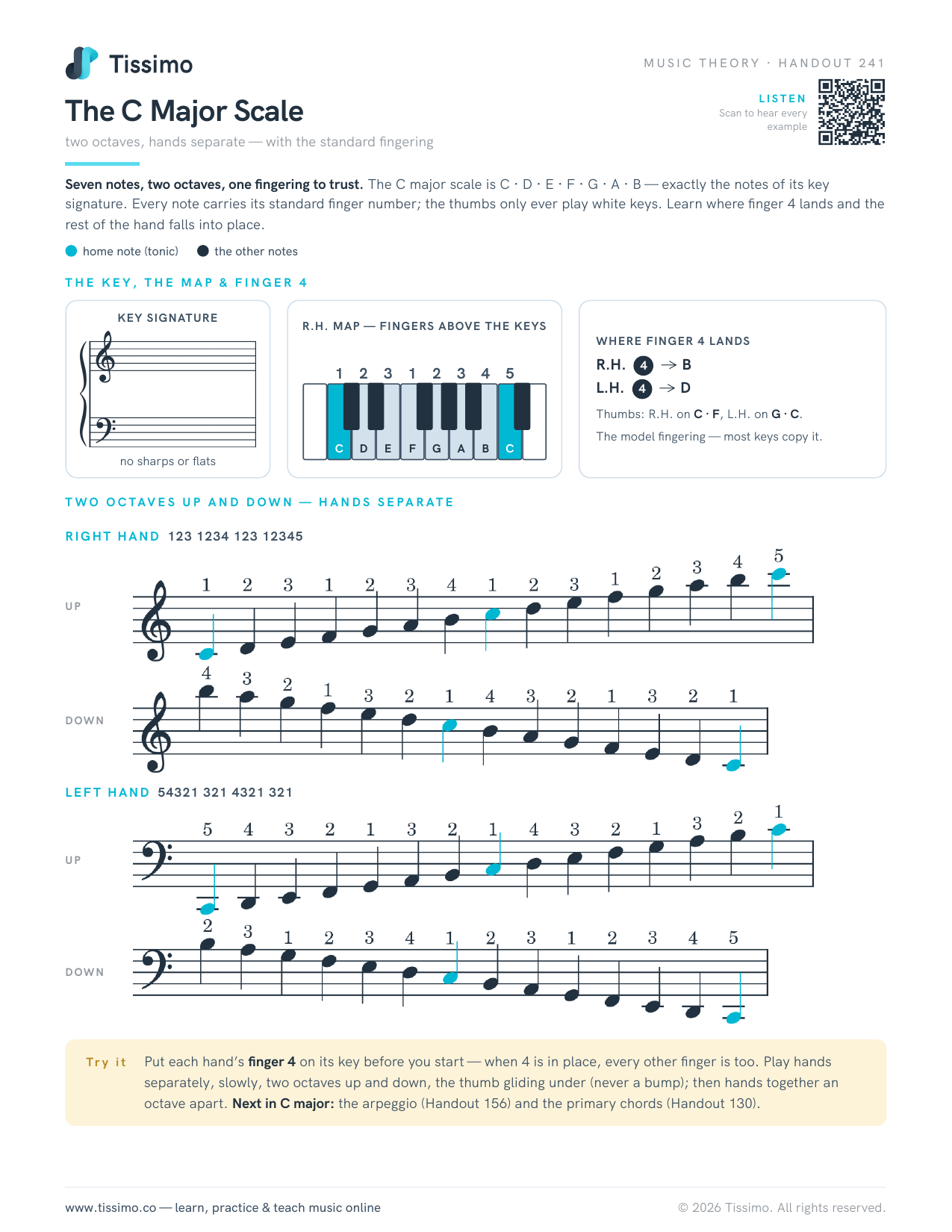 Scales in Every KeyTwo octaves up and down with the standard fingering on every note, in all 24 keys.