Scales, Keys & Modes
Chromatic Scale
Pronounced kroh-MAT-ik
The chromatic scale is a scale of twelve notes per octave, each a half step from the next. On the piano it uses every key, black and white, in order.
The chromatic scale moves only by half steps. Start on any note, play the very next key above it, and keep going: after twelve half steps you arrive at the same letter an octave higher. Because it includes every pitch, there is really only one chromatic scale; starting it on C or on F♯ gives the same twelve notes.
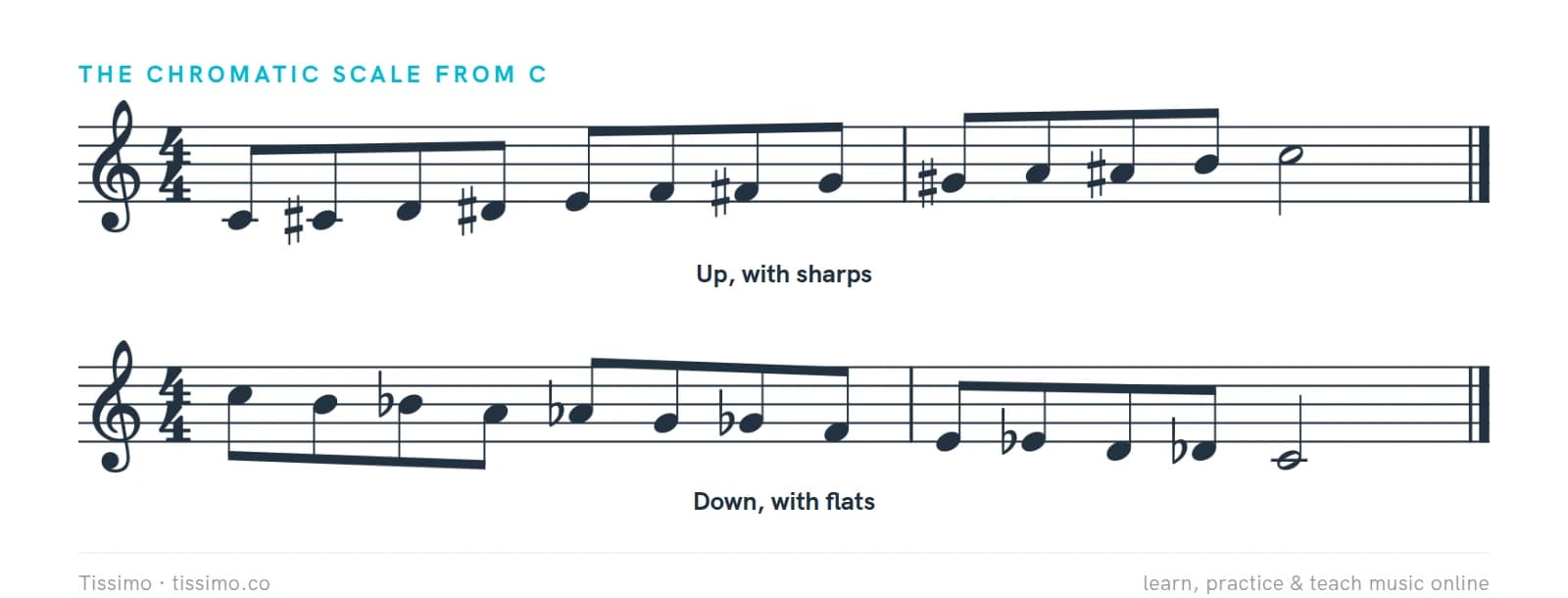
Spelling: sharps up, flats down
The twelve notes can be spelled in more than one way, because each black key has two names (enharmonic equivalent spellings such as C♯ and D♭). A common convention, used in most method books, is to write sharps going up and flats coming down:
- Up: C C♯ D D♯ E F F♯ G G♯ A A♯ B C
- Down: C B B♭ A A♭ G G♭ F E E♭ D D♭ C
This keeps each altered note leaning in the direction the line is moving: a sharp sounds as if it rises to the next letter, a flat as if it falls. Some theory courses also teach a "harmonic" chromatic scale with a fixed spelling based on the key, but for practice and sight-reading, the sharps-up, flats-down habit is the one to know.
Fingering on the piano
The chromatic scale has one of the simplest fingerings there is: the third finger plays every black key, and the thumb plays most white keys. In the right hand going up, where two white keys sit side by side (E–F and B–C), the second of the pair is taken by finger 2. From C that gives:
C(1) C♯(3) D(1) D♯(3) E(1) F(2) F♯(3) G(1) G♯(3) A(1) A♯(3) B(1) C(2)
Keep the hand close to the black keys so the thumb never has far to travel, and keep every motion small. The chromatic scale worksheet has each hand on its own, and The Chromatic Scale: Both Hands puts them together.
Where you hear it
You meet the full chromatic scale in technical studies and fast runs, and short chromatic passages are everywhere: a quick slide into a melody note, a bass line creeping up by half steps, a slinking line in a film score. The scale is also the measuring stick for every interval, since any interval can be counted in half steps.
Chromatic and diatonic
A chromatic note is one that lies outside the key's scale, such as F♯ in C major. A note that belongs to the scale is diatonic. The chromatic scale is the full set of twelve notes from which each seven-note diatonic scale picks its own.
The word chromatic comes from the Greek chroma, color: the extra notes color a plain scale.
Common questions
How many notes are in the chromatic scale?
Twelve different notes, each a half step apart. Written from C to C it shows thirteen, because the top C repeats the first one an octave higher.
Do you use sharps or flats in a chromatic scale?
Either is correct, since each black key has two names. The usual habit is sharps on the way up and flats on the way down, which keeps the line easy to read.
Practice it: free worksheets
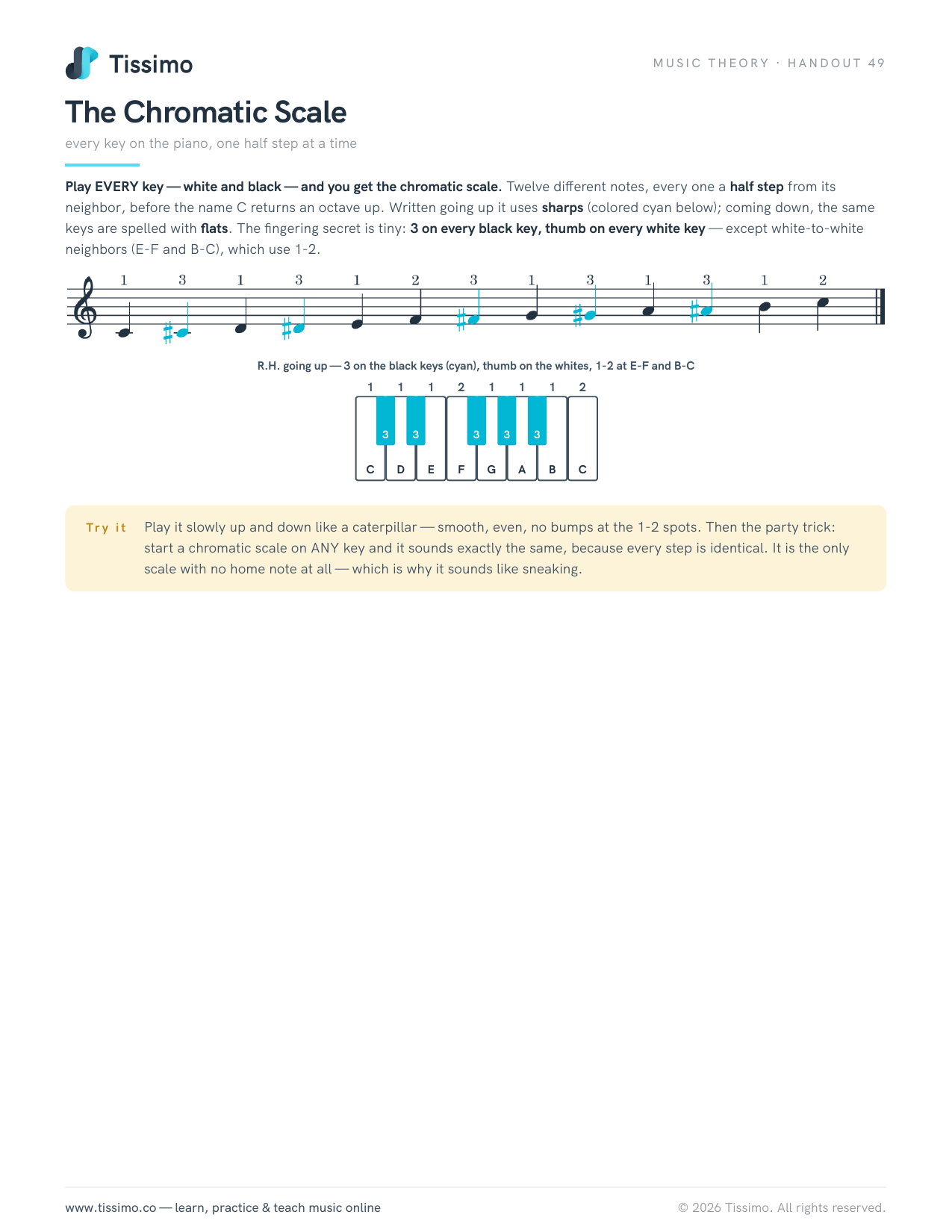 The Chromatic Scaleevery key on the piano, one half step at a time
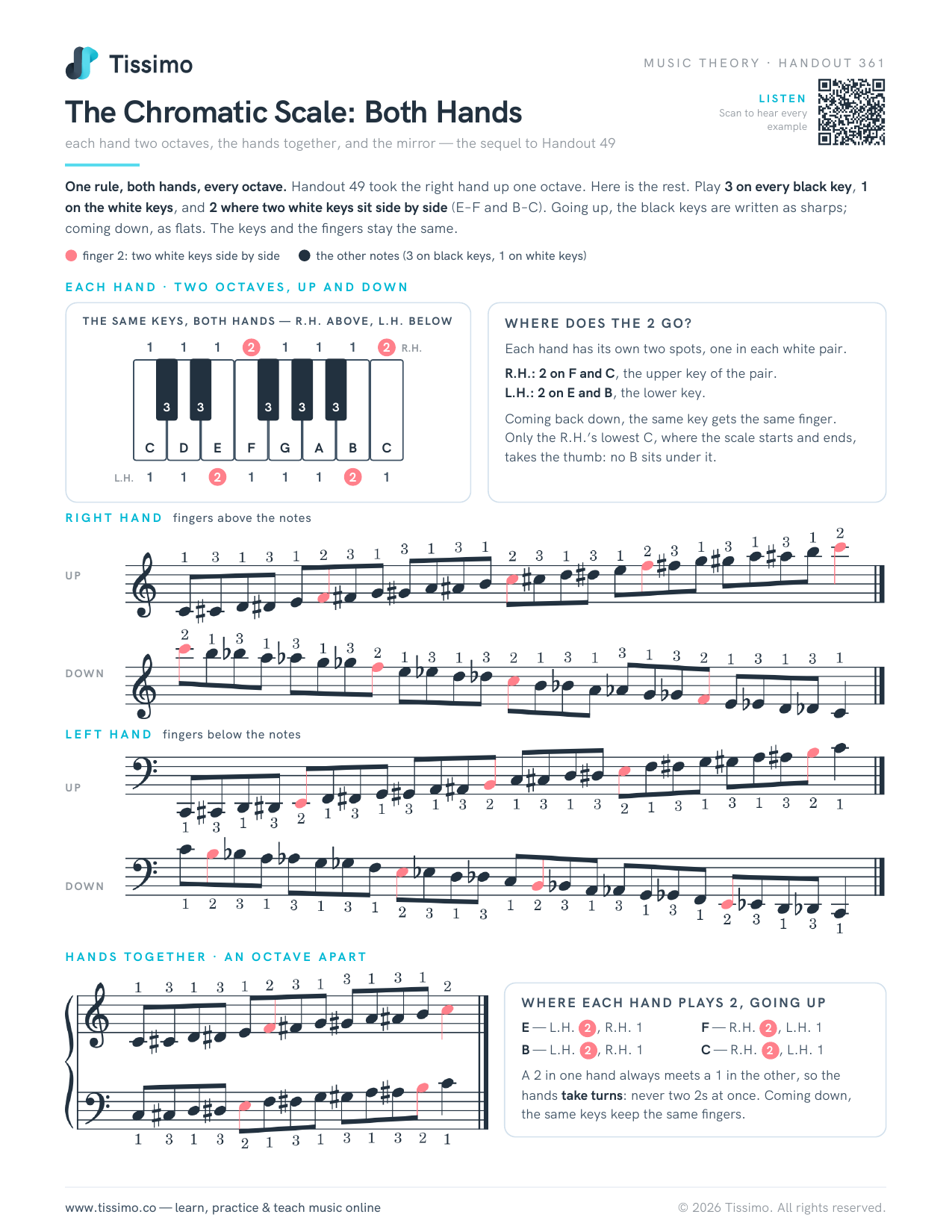 The Chromatic Scale: Both Handseach hand two octaves, the hands together, and the mirror — the sequel to Handout 49
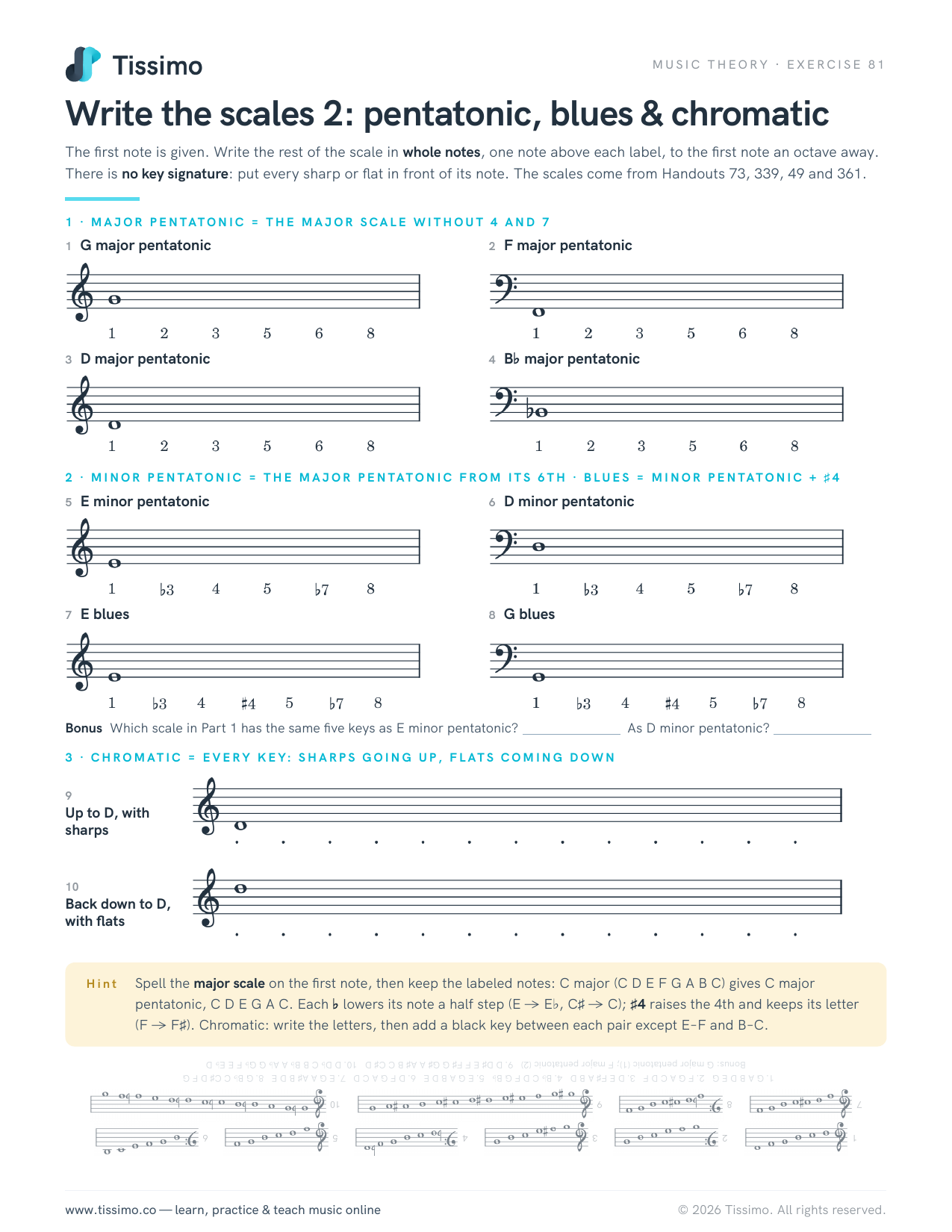 Write the scales 2: pentatonic, blues & chromaticThe first note is given. Write the rest of the scale in whole notes, one note above each label, to the first note an octave away. There is no key signature: put every sharp or flat in front of its note. The scales come from Handouts 73, 339, 49 and 361.
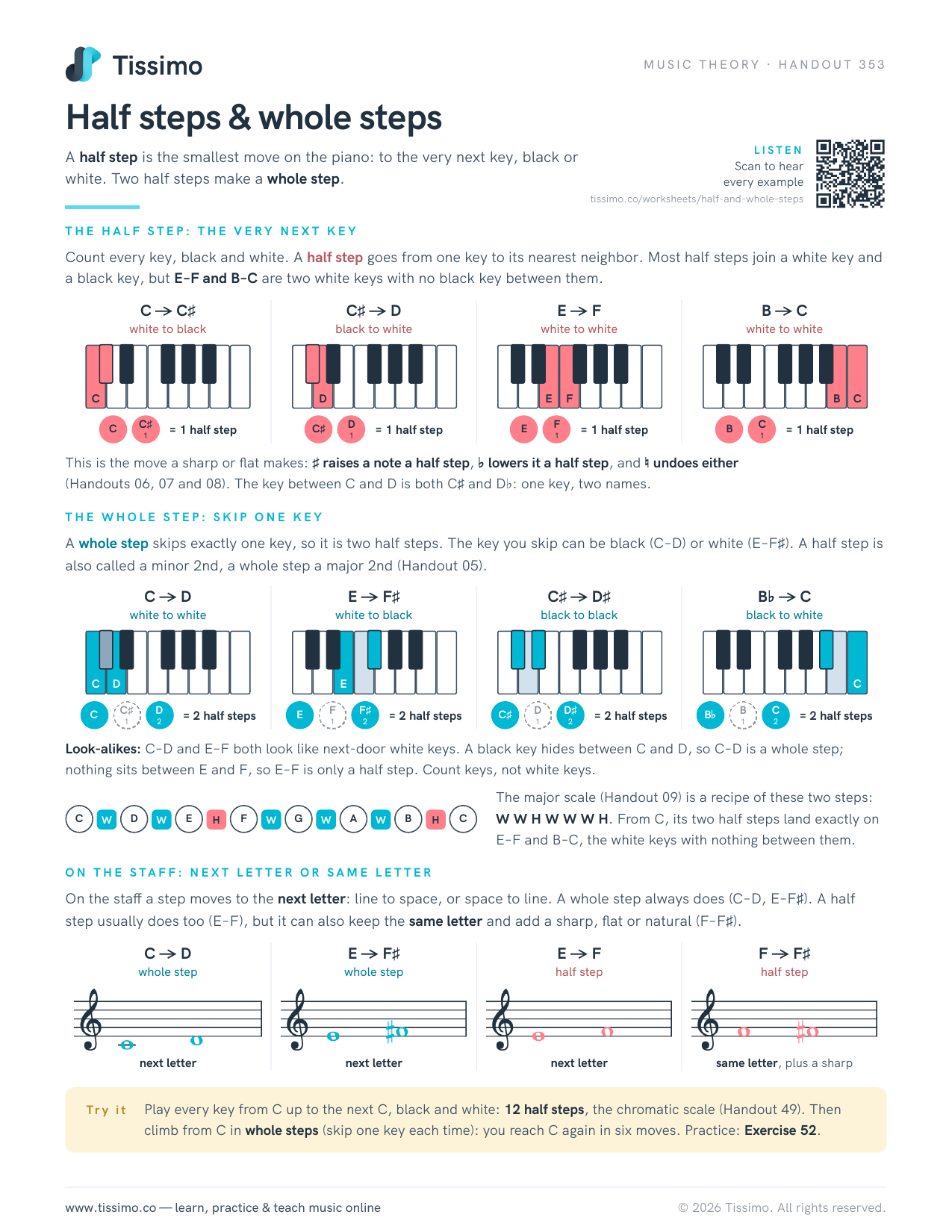 Half steps & whole stepsA half step is the smallest move on the piano: to the very next key, black or white. Two half steps make a whole step.