Pitch & Intervals
Interval
An interval is the distance in pitch between two notes. It is named by counting letter names (a 3rd, a 5th) and described by its quality: major, minor, perfect, augmented or diminished.
An interval is the distance between two pitches. When the two notes sound one after the other it is a melodic interval; when they sound together it is a harmonic interval. Melodies are chains of melodic intervals, and chords are stacks of harmonic ones.

Step 1: the number
Count the letter names from the lower note to the upper one, including both. C up to E is C–D–E, three letters, so it is a 3rd. C up to G is a 5th. Two notes on the same pitch form a unison, and eight letters make an octave. On the staff the count is quick: a 3rd goes from a line to the next line (or a space to the next space), a 2nd from a line to the space right above it.
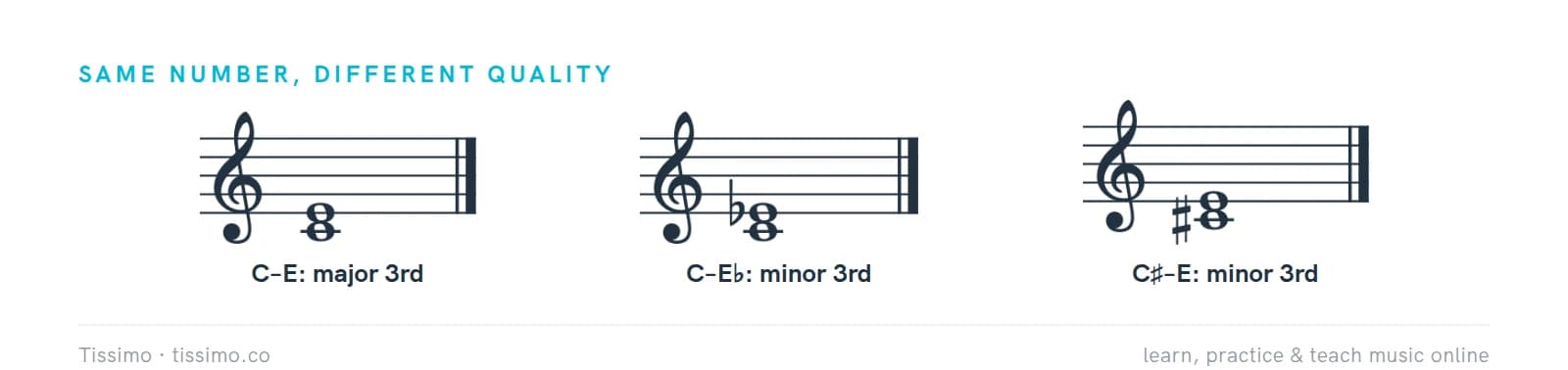
Accidentals don't change the number. C–E, C–E♭ and C♯–E are all 3rds, because the letters are still C and E.
Step 2: the quality
Now count half steps to tell apart intervals with the same number. Unisons, 4ths, 5ths and octaves are perfect. 2nds, 3rds, 6ths and 7ths come in a major and a minor size. A perfect or major interval made a half step wider becomes augmented; a perfect or minor interval made a half step narrower becomes diminished.
The common intervals up to an octave, with their half steps:
- Perfect unison (P1): 0
- Minor 2nd (m2): 1
- Major 2nd (M2): 2
- Minor 3rd (m3): 3
- Major 3rd (M3): 4
- Perfect 4th (P4): 5
- Augmented 4th or diminished 5th, the tritone (A4 or d5): 6
- Perfect 5th (P5): 7
- Minor 6th (m6): 8
- Major 6th (M6): 9
- Minor 7th (m7): 10
- Major 7th (M7): 11
- Perfect octave (P8): 12
Simple and compound intervals
Intervals up to an octave are simple. Wider ones are compound: a 9th is an octave plus a 2nd, a 10th an octave plus a 3rd. Turning an interval upside down, so the lower note becomes the upper one, is called interval inversion.
Hearing intervals
Every interval also has a sound you can learn to recognize. Consonant intervals such as 3rds, 5ths and 6ths sound stable; dissonant ones such as 2nds, 7ths and the tritone sound tense. Recognizing intervals by ear is a core skill of ear training and relative pitch.
Name intervals on the staff with Name the intervals: the distance, keep the Intervals chart nearby, and train your ear with Hearing intervals.
Common questions
How do you identify an interval?
Count the letter names from the lower note to the upper one, counting both ends, to get the number (2nd, 3rd, 4th and so on). Then count the half steps between them to get the quality: a 3rd of four half steps is major, of three half steps minor.
What is the difference between a melodic and a harmonic interval?
A melodic interval is two notes played one after the other, as in a melody. A harmonic interval is two notes played at the same time. The interval's name is the same either way.
Practice it: free worksheets
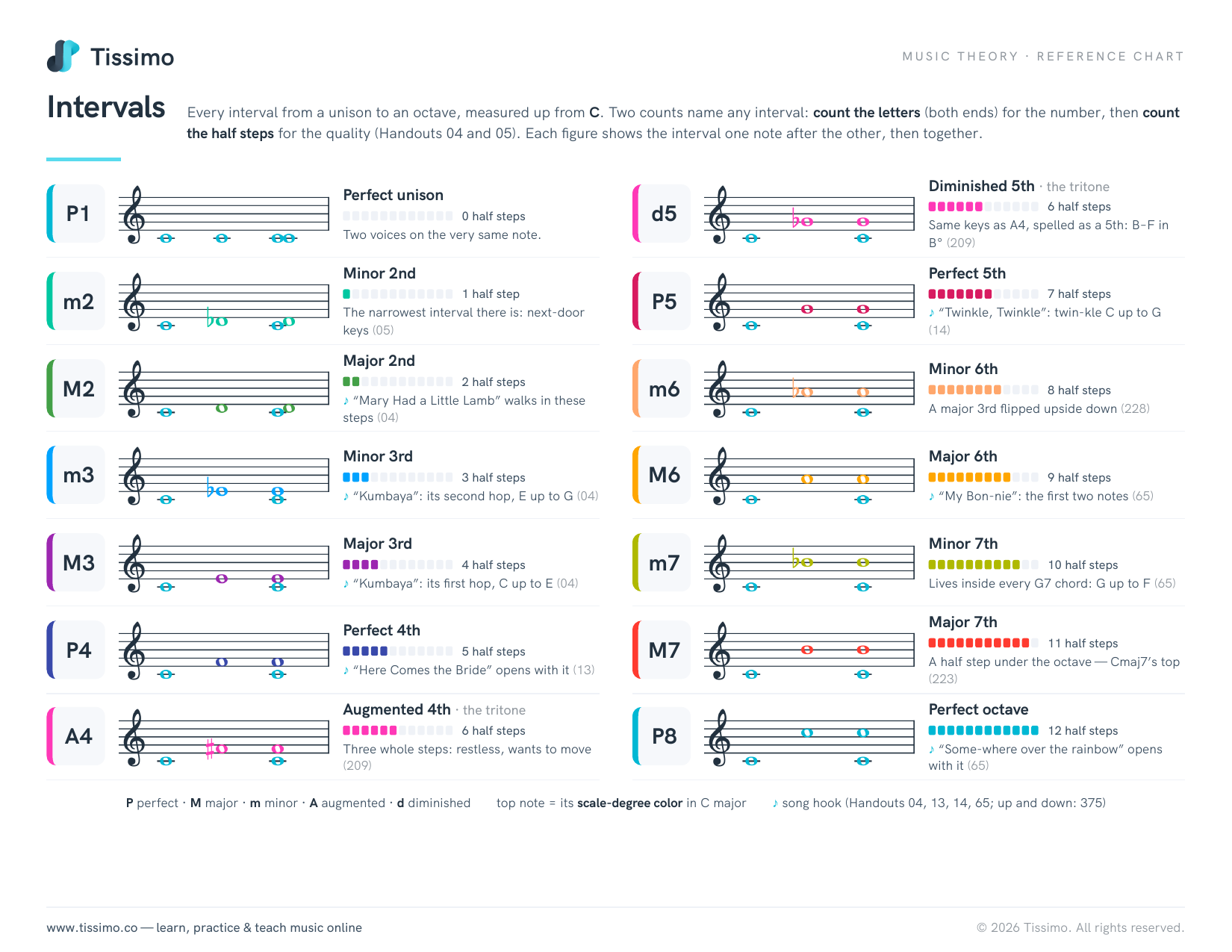 IntervalsEvery interval from a unison to an octave, measured up from C. Two counts name any interval: count the letters (both ends) for the number, then count the half steps for the quality (Handouts 04 and 05). Each figure shows the interval one note after the other, then together.
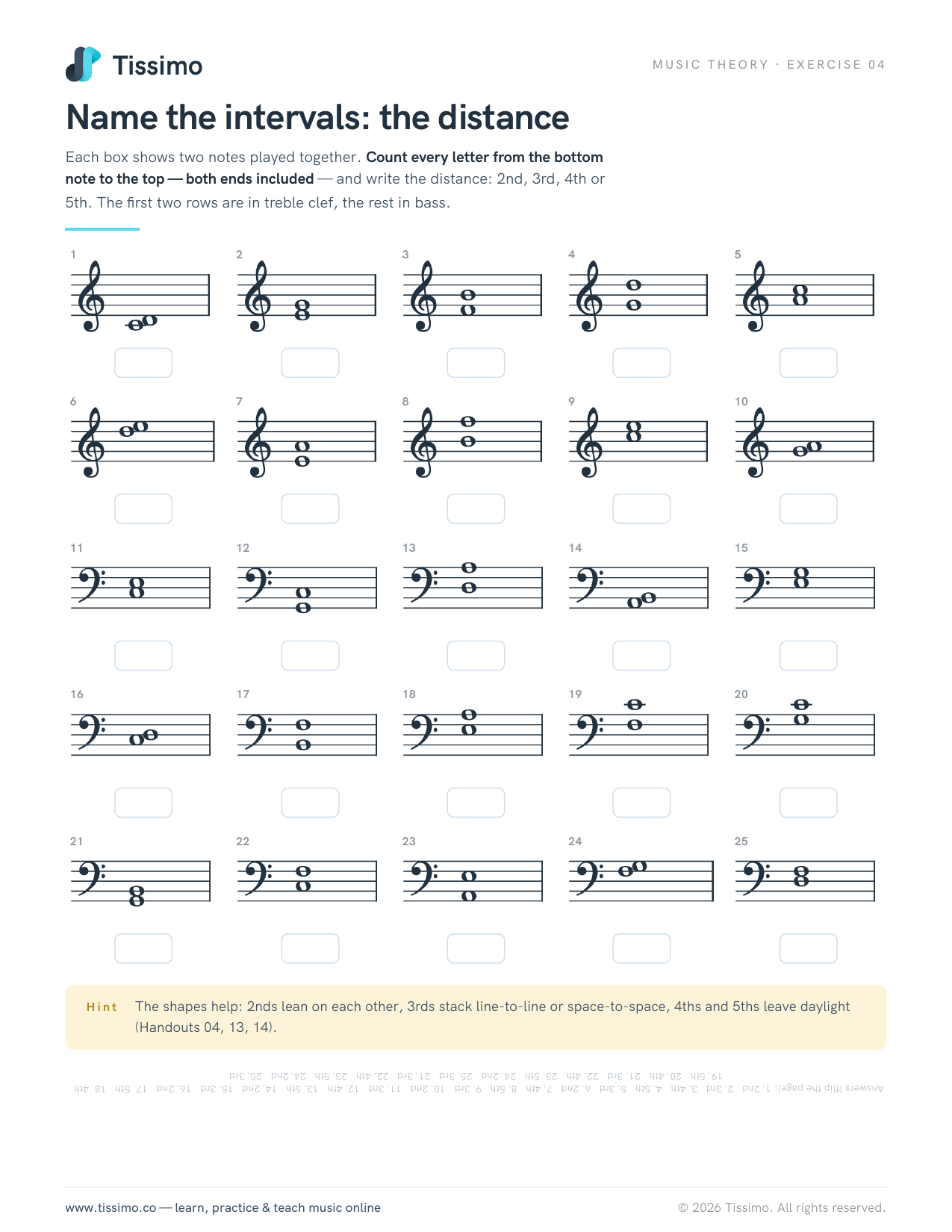 Name the intervals: the distanceEach box shows two notes played together. Count every letter from the bottom note to the top — both ends included — and write the distance: 2nd, 3rd, 4th or 5th. The first two rows are in treble clef, the rest in bass.
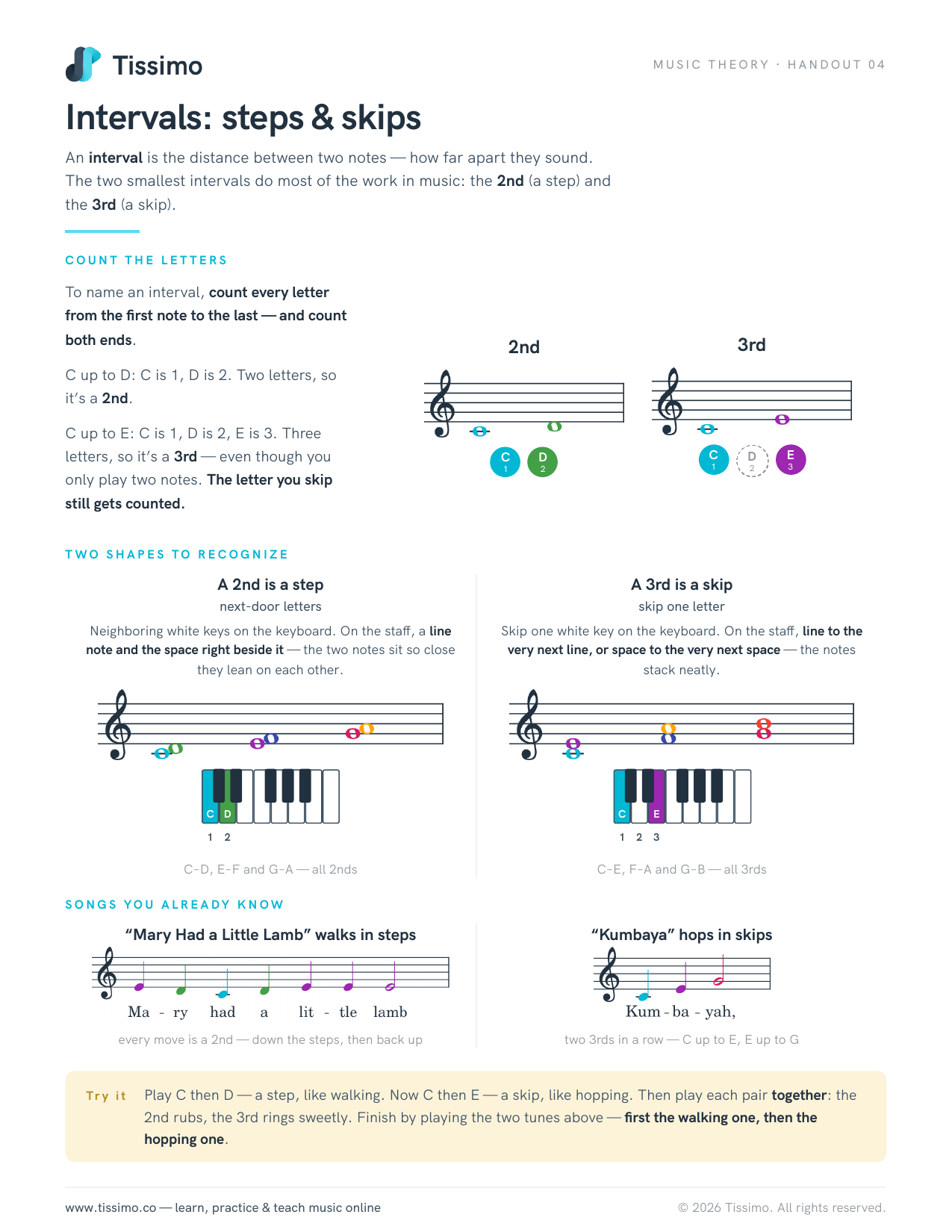 Intervals: steps & skipsAn interval is the distance between two notes — how far apart they sound. Two common melodic movements are the 2nd (a step) and the 3rd (a skip).
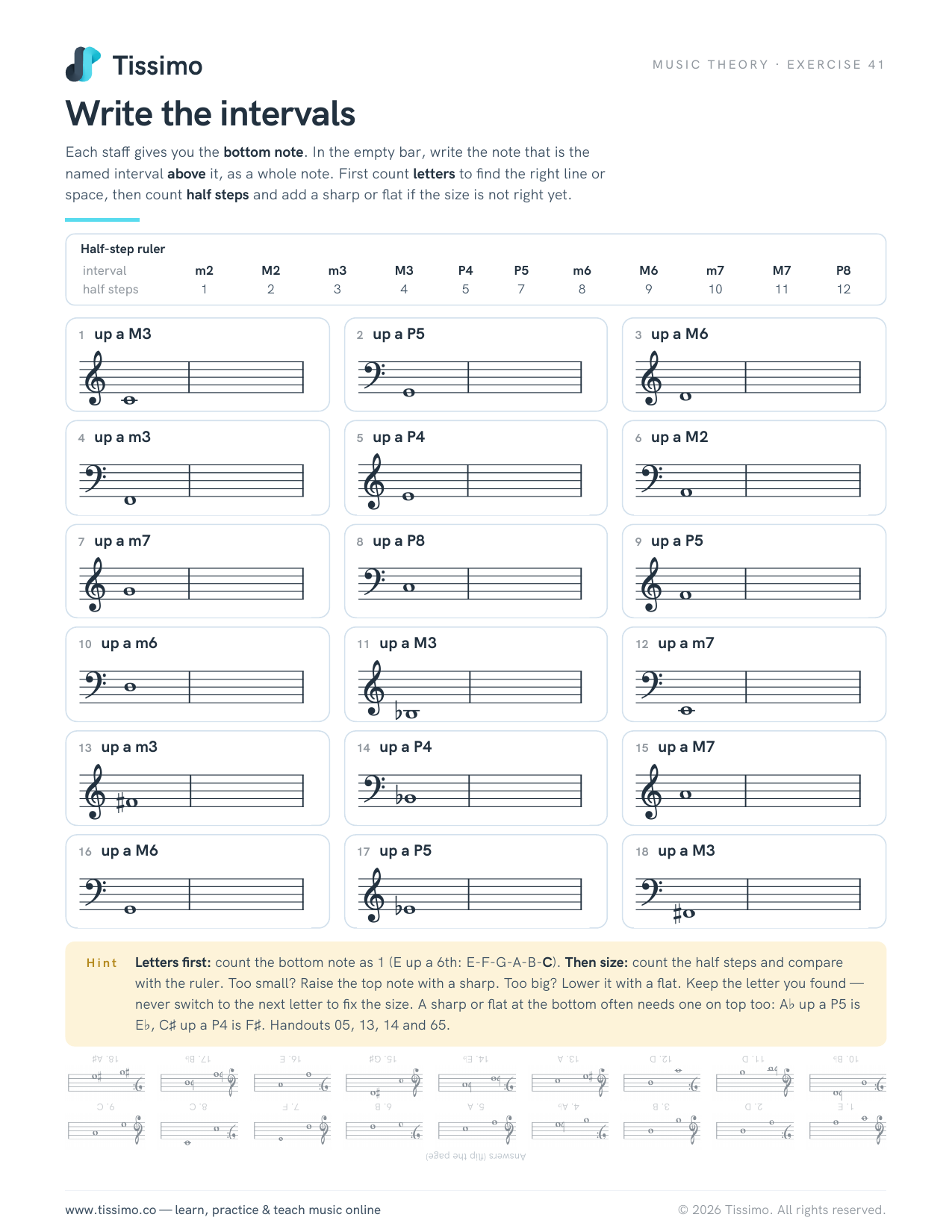 Write the intervalsEach staff gives you the bottom note. In the empty bar, write the note that is the named interval above it, as a whole note. First count letters to find the right line or space, then count half steps and add a sharp or flat if the size is not right yet.
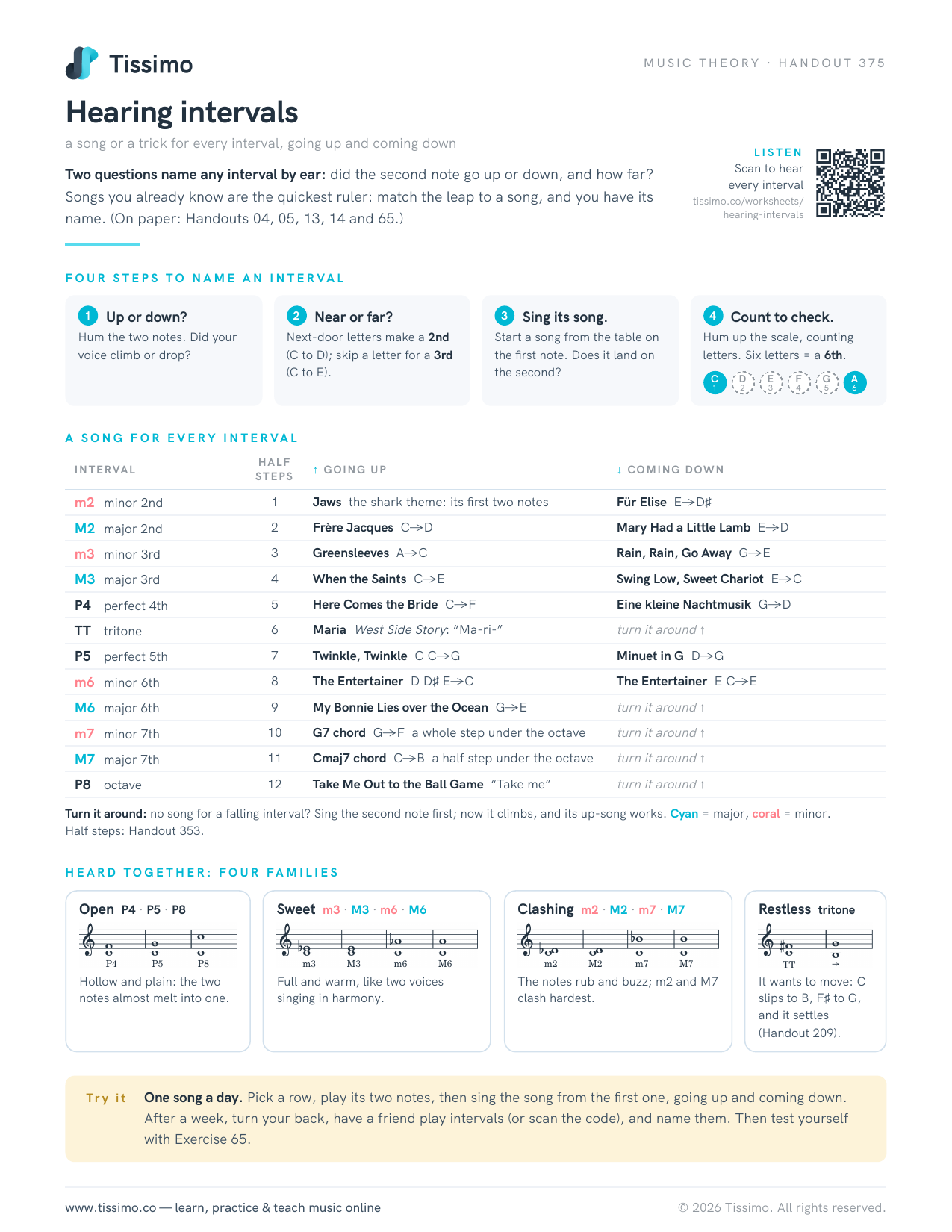 Hearing intervalsa song or a trick for every interval, going up and coming down
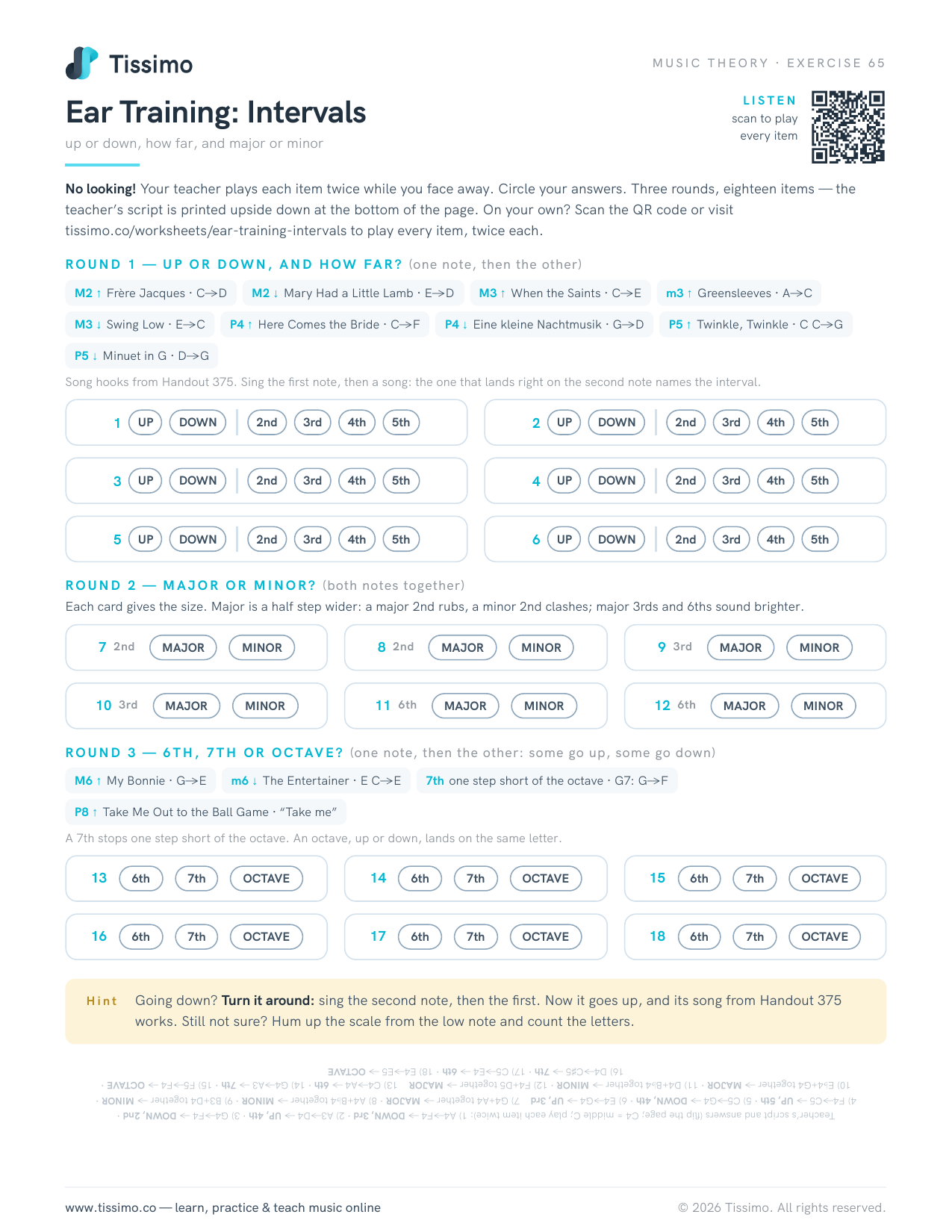 Ear Training: Intervalsup or down, how far, and major or minor