Pitch & Intervals
Compound Interval
A compound interval is an interval wider than an octave, such as a 9th (an octave plus a 2nd) or a 10th (an octave plus a 3rd). It keeps the quality of the simple interval inside it.
A compound interval is any interval wider than an octave. Intervals up to an octave are simple; stretch one by an octave and it becomes compound. C4 up to D5 is a 9th: an octave (C4–C5) plus a 2nd (C5–D5).
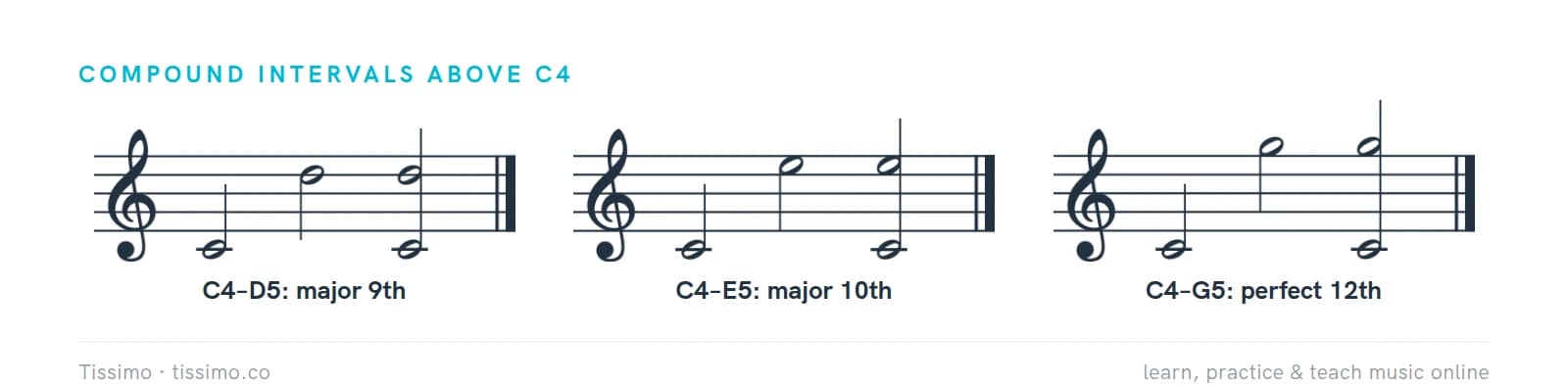
Naming compound intervals
Count the letters from bottom to top, including both, just as for simple intervals. C4–D5 passes through C D E F G A B C D, nine letters: a 9th. To switch between compound and simple names, add or subtract 7, not 8, because the note at the octave is counted twice:
- 9th = 2nd + 7 (C4–D5)
- 10th = 3rd + 7 (C4–E5)
- 11th = 4th + 7 (C4–F5)
- 12th = 5th + 7 (C4–G5)
- 13th = 6th + 7 (C4–A5)
- 15th = a double octave (C4–C6)
The quality carries over unchanged: C4–E5 is a major 10th because C–E is a major 3rd, and C4–G5 is a perfect 12th. In half steps, add 12: a major 10th is 4 + 12 = 16 half steps.
Compound or simple?
In harmony, compound intervals usually act like their simple versions. A 10th between the bass and the melody works like a 3rd, and the chord is still the same chord, so analysts often reduce compound intervals to simple ones ("the melody is a 3rd above the bass" even when it is an octave and a 3rd). Pianists meet 10ths constantly as wide left-hand stretches in stride and ballad accompaniments.
Chord symbols are the exception. In jazz and pop, 9, 11 and 13 name notes stacked above the seventh of an extended chord: C9 is C–E–G–B♭–D. To add the D without the seventh, the symbol is Cadd9 (see added-tone chord).
Inverting compound intervals
To invert a compound interval, reduce it to its simple form first: a major 10th behaves like a major 3rd and inverts to a minor 6th (see interval inversion).
Practice both skills with Inverting intervals & compound intervals.
Common questions
What is a compound interval?
An interval wider than an octave. It is named by counting letters as usual (C4–E5 is a 10th), and it has the same quality as the simple interval inside it: a major 3rd stretched by an octave is a major 10th.
Why do you subtract 7, not 8, to simplify a compound interval?
Because the note at the octave is counted twice: it is the 8th of the first count and the 1st of the next. A 10th is an octave (8) plus a 3rd (3) minus the shared note: 8 + 3 − 1 = 10. So 10 − 7 = 3.
Practice it: free worksheets
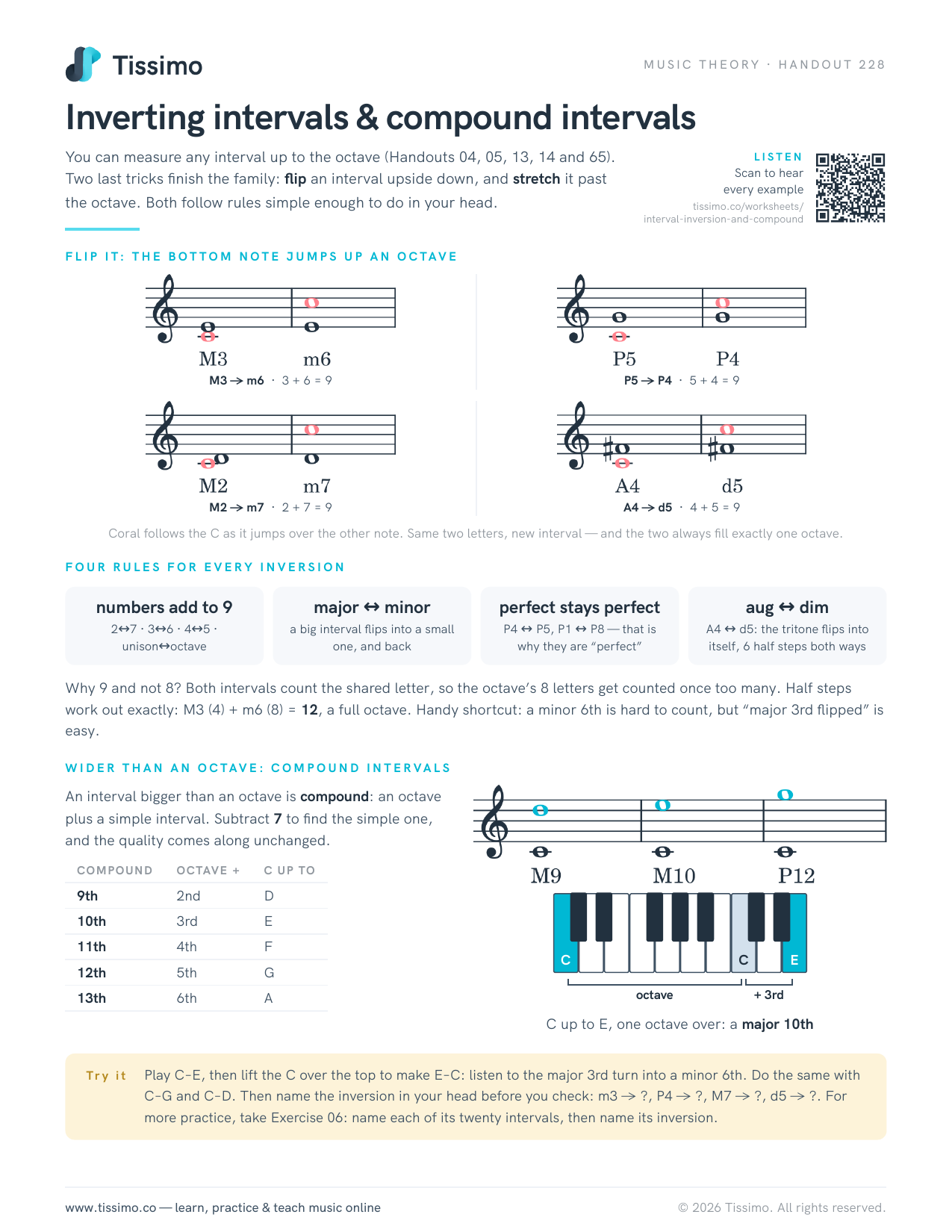 Inverting intervals & compound intervalsYou can measure any interval up to the octave (Handouts 04, 05, 13, 14 and 65). Two last tricks finish the family: flip an interval upside down, and stretch it past the octave. Both follow rules simple enough to do in your head.
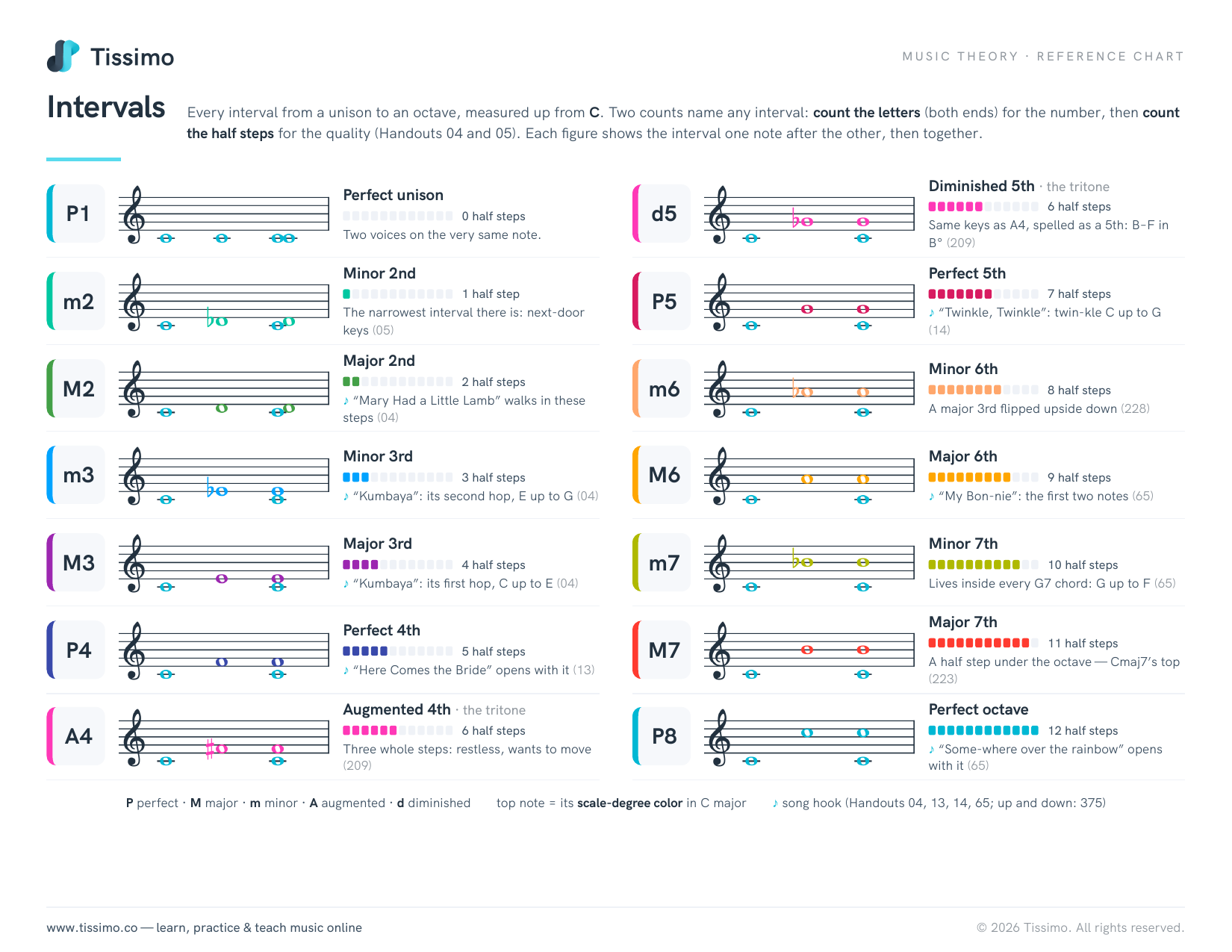 IntervalsEvery interval from a unison to an octave, measured up from C. Two counts name any interval: count the letters (both ends) for the number, then count the half steps for the quality (Handouts 04 and 05). Each figure shows the interval one note after the other, then together.
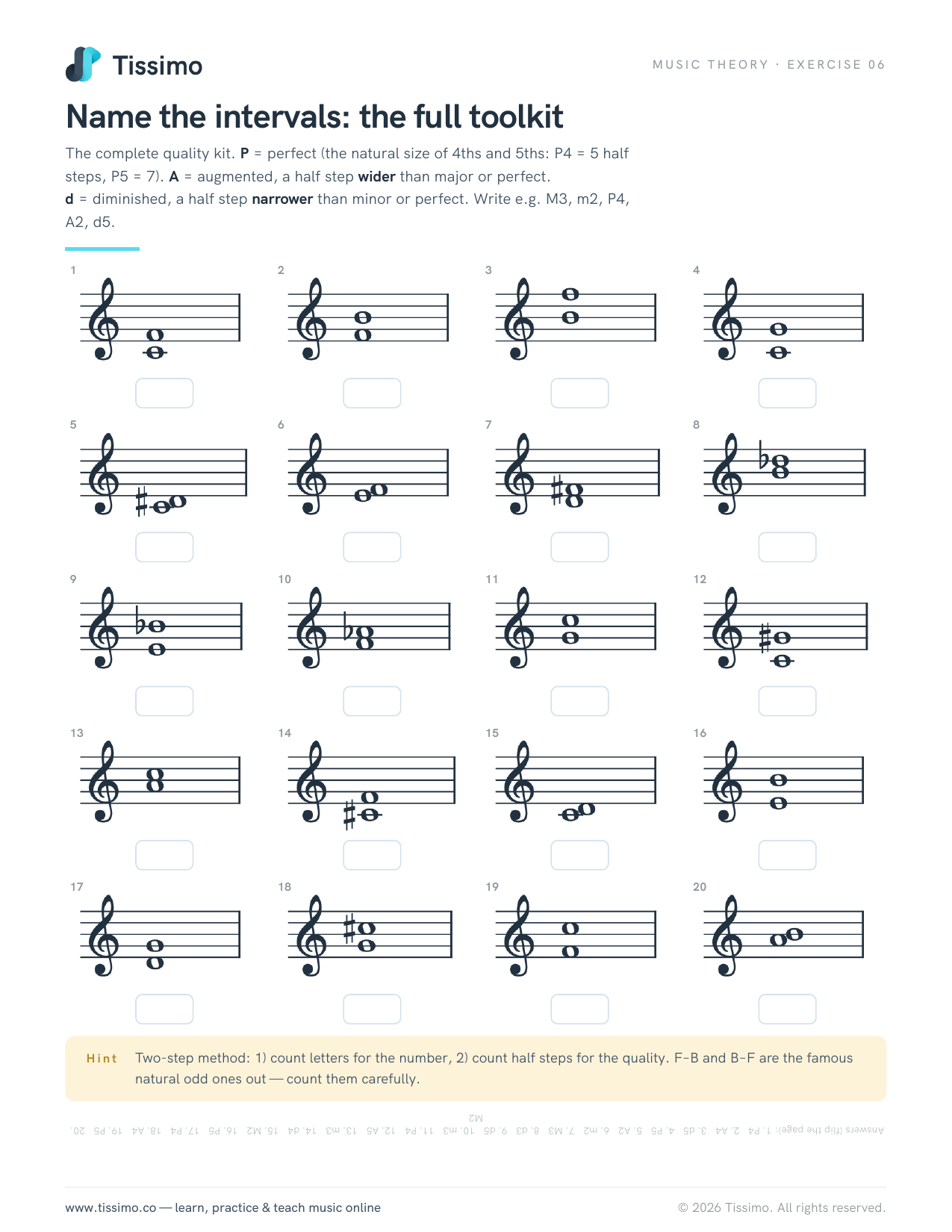 Name the intervals: the full toolkitThe complete quality kit. P = perfect (the natural size of 4ths and 5ths: P4 = 5 half steps, P5 = 7). A = augmented, a half step wider than major or perfect. d = diminished, a half step narrower than minor or perfect. Write e.g. M3, m2, P4, A2, d5.