Chords & Harmony
Added-Tone Chord (add9, 6)
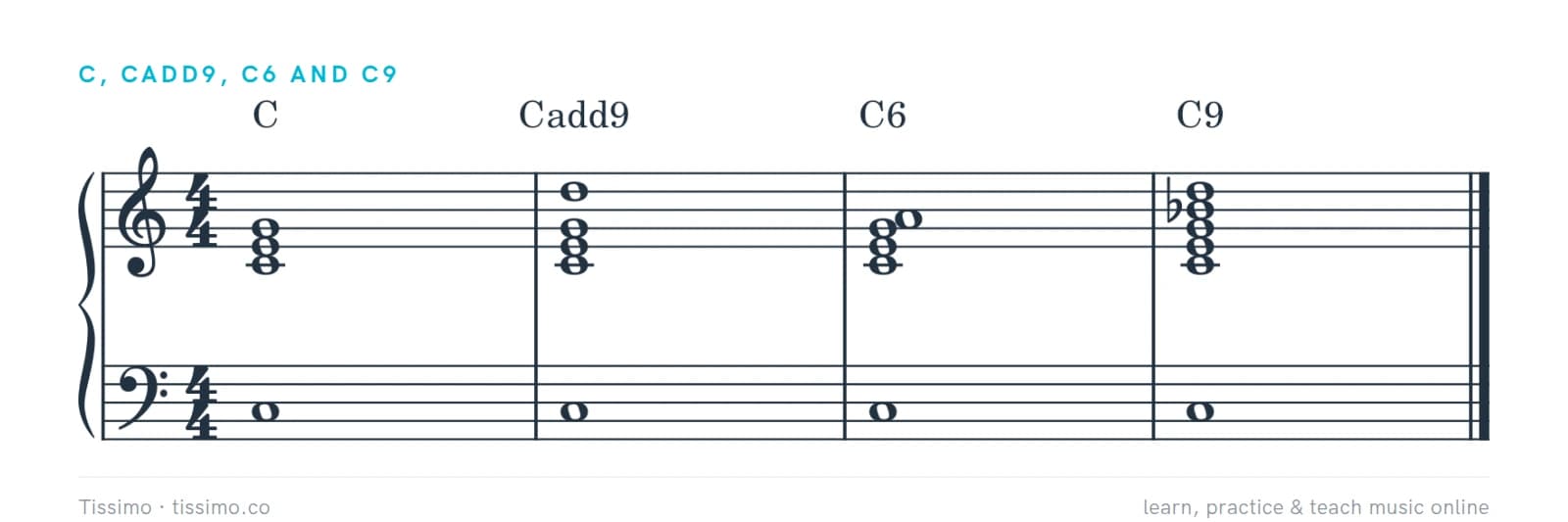
An added-tone chord is a triad with one extra color note but no seventh, most often a 9th (Cadd9: C–E–G–D) or a 6th (C6: C–E–G–A). Unlike C9, Cadd9 has no B♭.
An added-tone chord is a triad with one extra note that is not the next third up. The two common added notes are the 9th and the 6th: Cadd9 is C–E–G with D added, and C6 is C–E–G with A added. Because there is no seventh, these chords keep the plain, stable feel of a triad, with an extra shimmer on top.
add9
Cadd9 contains C, E, G and D. When the D sits close to the root, inside the chord, some charts write Cadd2 instead. It is a staple of pop and rock, and on guitar the open shape x-3-2-0-3-3 is one of the first "pretty" chords many players learn. Compare it with two close relatives:
- C9 also has D on top, but adds the seventh B♭ underneath it, which makes it a dominant chord (see extended chord).
- Csus2 (C–D–G) replaces the third with D instead of adding to it (see suspended chord).
The added sixth
C6 is C–E–G–A, and Cm6 is C–E♭–G–A. The major sixth chord was a favorite final chord in swing-era jazz, where a plain triad could sound bare. Combine both additions and you get C6/9 (C–E–G–A–D), common in jazz and bossa nova.
C6 has the same four notes as Am7 (A–C–E–G). Which name fits depends on the bass and the context: C in the bass and a C-major feel make it C6. In the 18th century, Jean-Philippe Rameau wrote about this kind of chord as the "added sixth" on the subdominant (F–A–C–D in C major) and pointed out that the same notes can also be heard as a D minor seventh chord.
Reading the symbols
A plain 9, 11 or 13 implies a seventh; "add" means there is none. So read closely: Cadd9 and C9 share the D, but only C9 has B♭. A plain 6 never implies a seventh, so C6 is simply C major plus A.
Practice reading them with Chord symbols and Reading a lead sheet.
Common questions
What is the difference between Cadd9 and C9?
Cadd9 is C–E–G plus D, with no seventh. C9 is a dominant seventh chord (C–E–G–B♭) with D on top.
Is C6 the same as Am7?
They use the same four notes, C, E, G and A. The bass and the harmony around the chord decide the name: C6 sounds like a colored C major chord, Am7 like a softened A minor.
Practice it: free worksheets
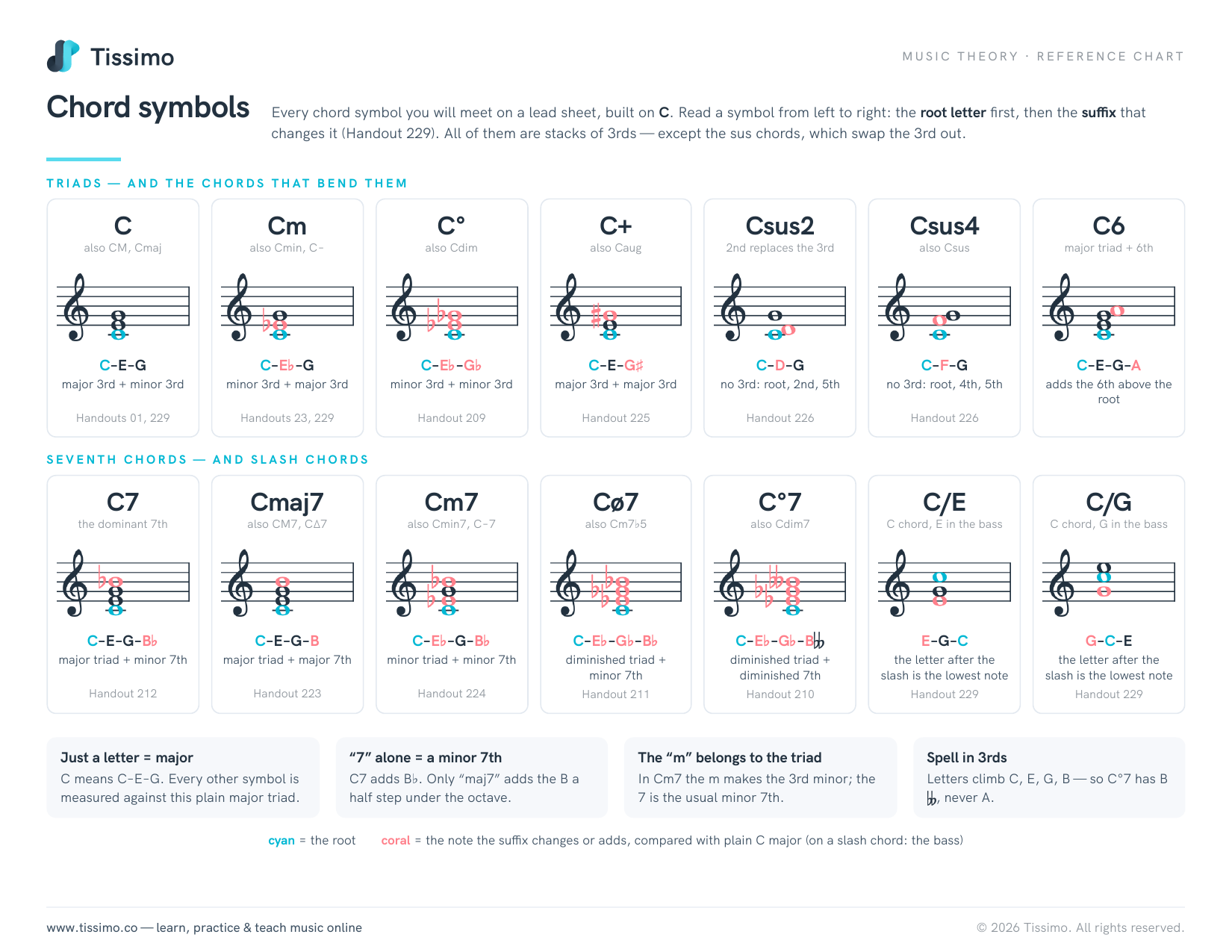 Chord symbolsEvery chord symbol you will meet on a lead sheet, built on C. Read a symbol from left to right: the root letter first, then the suffix that changes it (Handout 229). All of them are stacks of 3rds — except the sus chords, which swap the 3rd out.
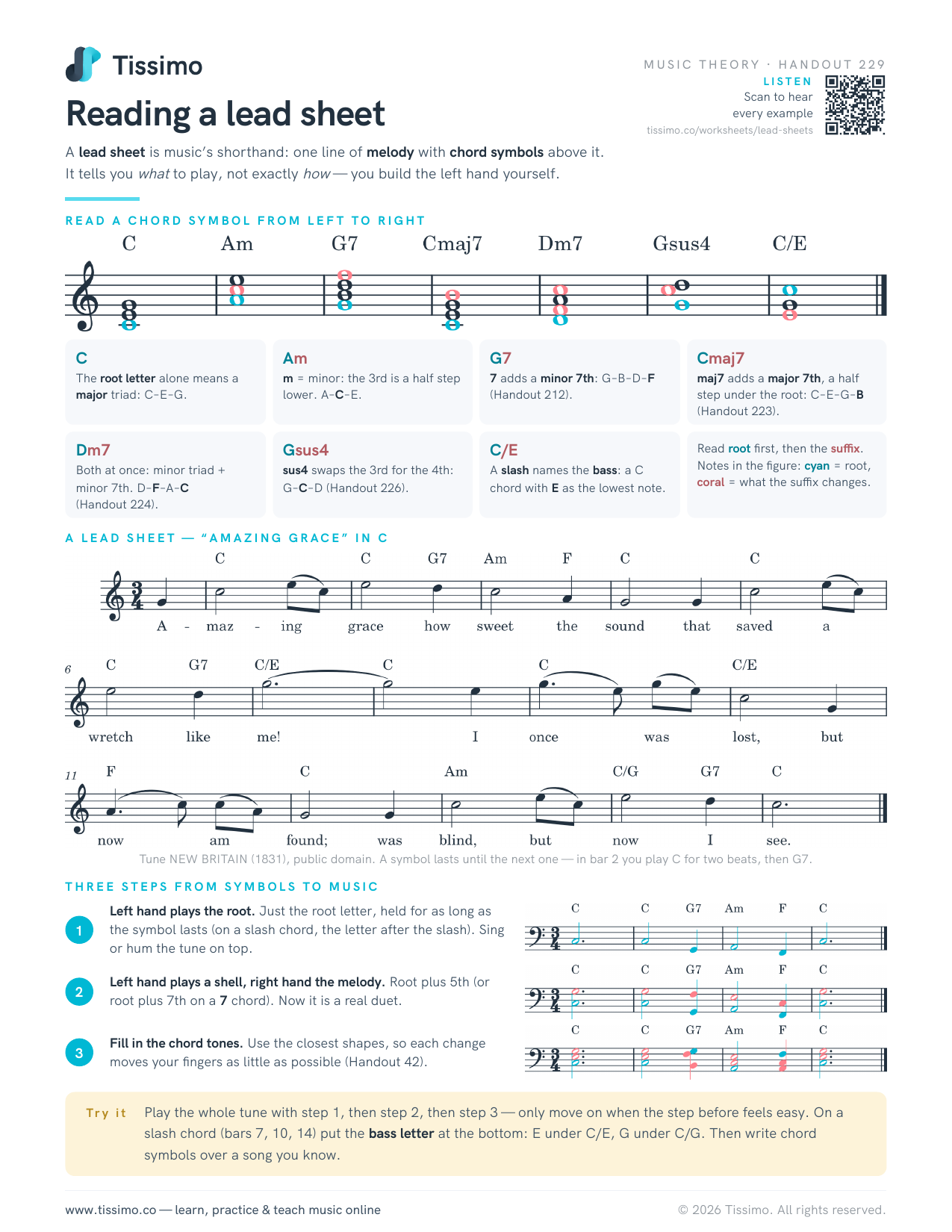 Reading a lead sheetA lead sheet is music’s shorthand: one line of melody with chord symbols above it. It tells you what to play, not exactly how — you build the left hand yourself.
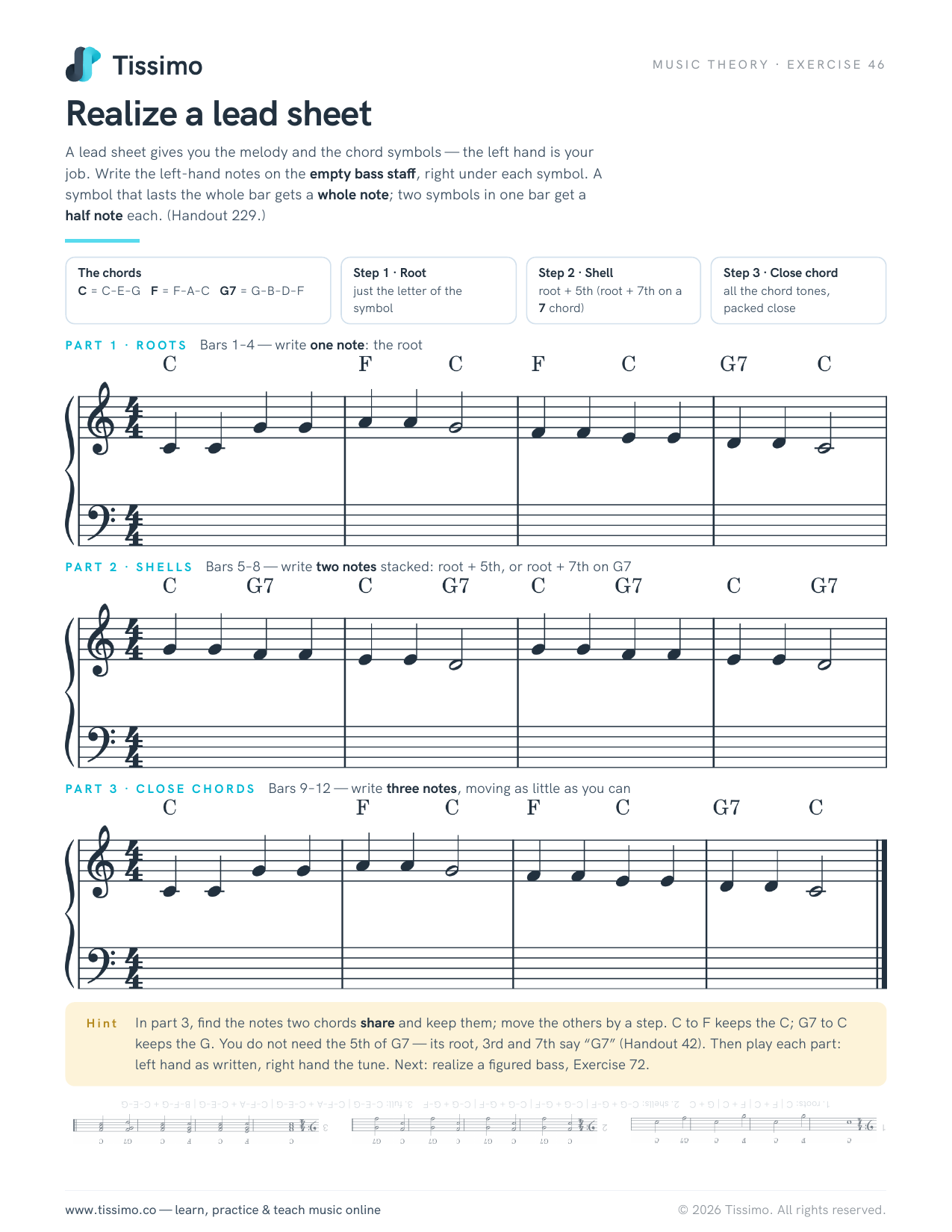 Realize a lead sheetA lead sheet gives you the melody and the chord symbols — the left hand is your job. Write the left-hand notes on the empty bass staff, right under each symbol. A symbol that lasts the whole bar gets a whole note; two symbols in one bar get a half note each. (Handout 229.)