Chords & Harmony
Diminished Triad
A diminished triad is a three-note chord made of two stacked minor thirds, such as B–D–F. Its outer notes form a diminished fifth, which gives it a tense sound that wants to resolve.
A diminished triad is a three-note chord built from two stacked minor thirds. On B it is B–D–F; on C it is C–E♭–G♭. Its outer notes are a diminished fifth apart (6 half steps), the interval also called the tritone, and that is what makes it sound tense and restless. Listeners hear it as a chord on its way somewhere else.
How to build one
Count 3 half steps from the root to the third and 3 more to the fifth, 6 in all. Compared with a minor triad, the fifth is one half step lower: C–E♭–G (minor) becomes C–E♭–G♭ (diminished). Spell it with three letters a third apart (C–E♭–G♭, not C–E♭–F♯) so that it still looks like a stack of thirds on the staff.

Symbols
Chord symbols write it with a small circle (B°) or with "dim" (Bdim). Roman numerals use a small letter plus the circle: vii° in a major key, ii° in a minor key.
Where you find it
In a major key the only diminished triad sits on the seventh degree, the leading tone: B–D–F in C major. That chord holds the two most active notes of the key, B (which pulls up to C) and F (which tends to fall to E), so it behaves much like a dominant chord. In fact it is G7 without its root G. In a minor key, a diminished triad appears on degree 2 (B–D–F in A minor) and, once the seventh is raised as in harmonic minor, on degree 7 as well (G♯–B–D).
How it resolves
In traditional part writing, vii° appears most often in first inversion (vii°6), with its third in the bass, and moves to the tonic chord. The leading tone rises to the tonic. The chord's fifth (F in C major) usually falls by step, but when it lies below the leading tone, as here, it may rise instead, which gives the tonic chord all three of its notes.
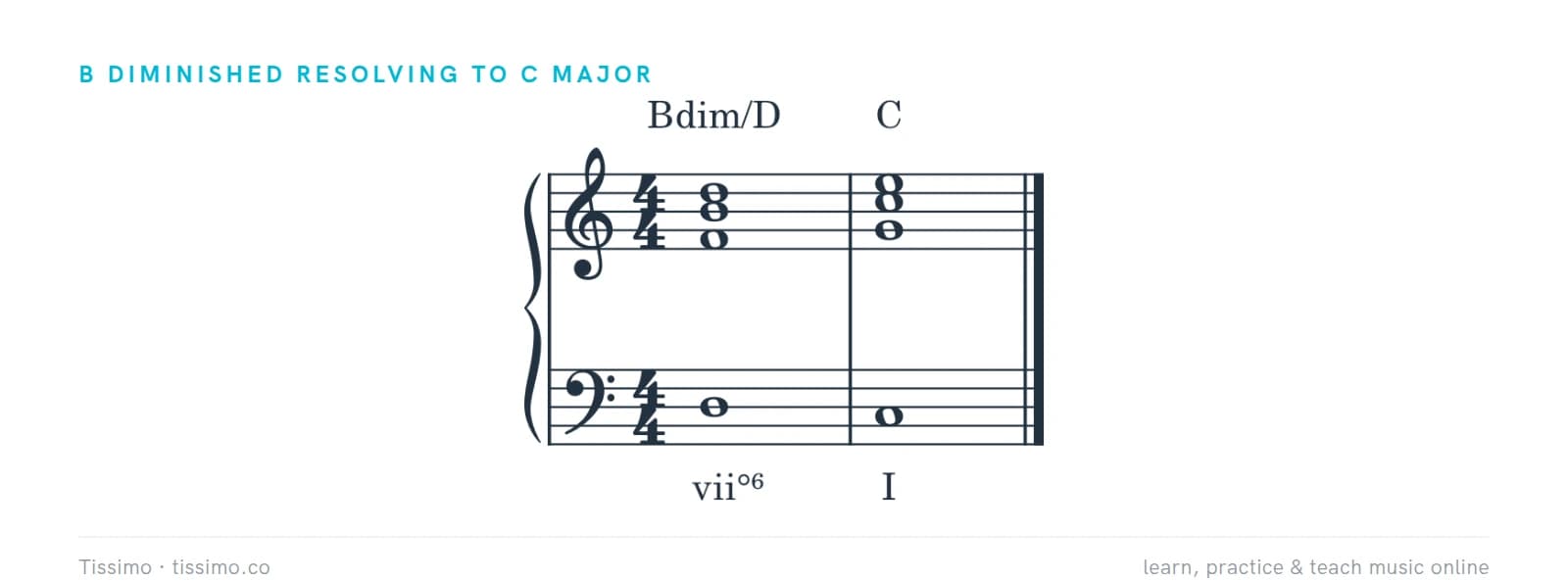
Practice: The diminished triad and Chord quality review. For the four-note version, see diminished seventh chord and half-diminished seventh chord.
Common questions
Why does a diminished chord sound tense?
Its outer notes form a diminished fifth, the tritone, one of the most dissonant intervals in tonal music. In a key, those two notes usually include the leading tone, which pulls strongly toward the tonic.
What is the difference between a diminished triad and a diminished seventh chord?
The triad has three notes (B–D–F). A diminished seventh chord adds one more minor third on top (B–D–F–A♭), so it has four notes, all 3 half steps apart.
Practice it: free worksheets
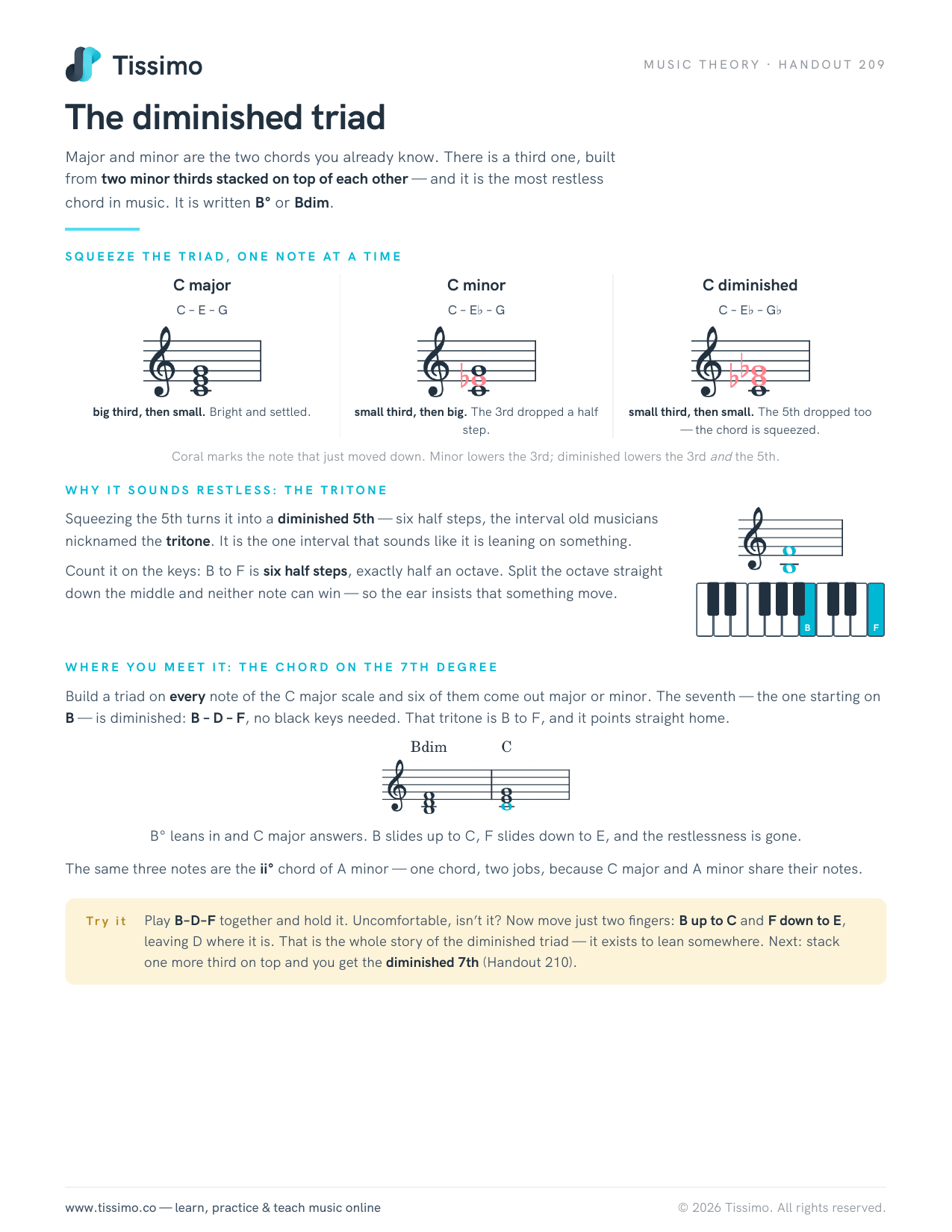 The diminished triadMajor and minor are the two chords you already know. There is a third one, built from two minor thirds stacked on top of each other — and it is the most restless chord in music. It is written B° or Bdim.
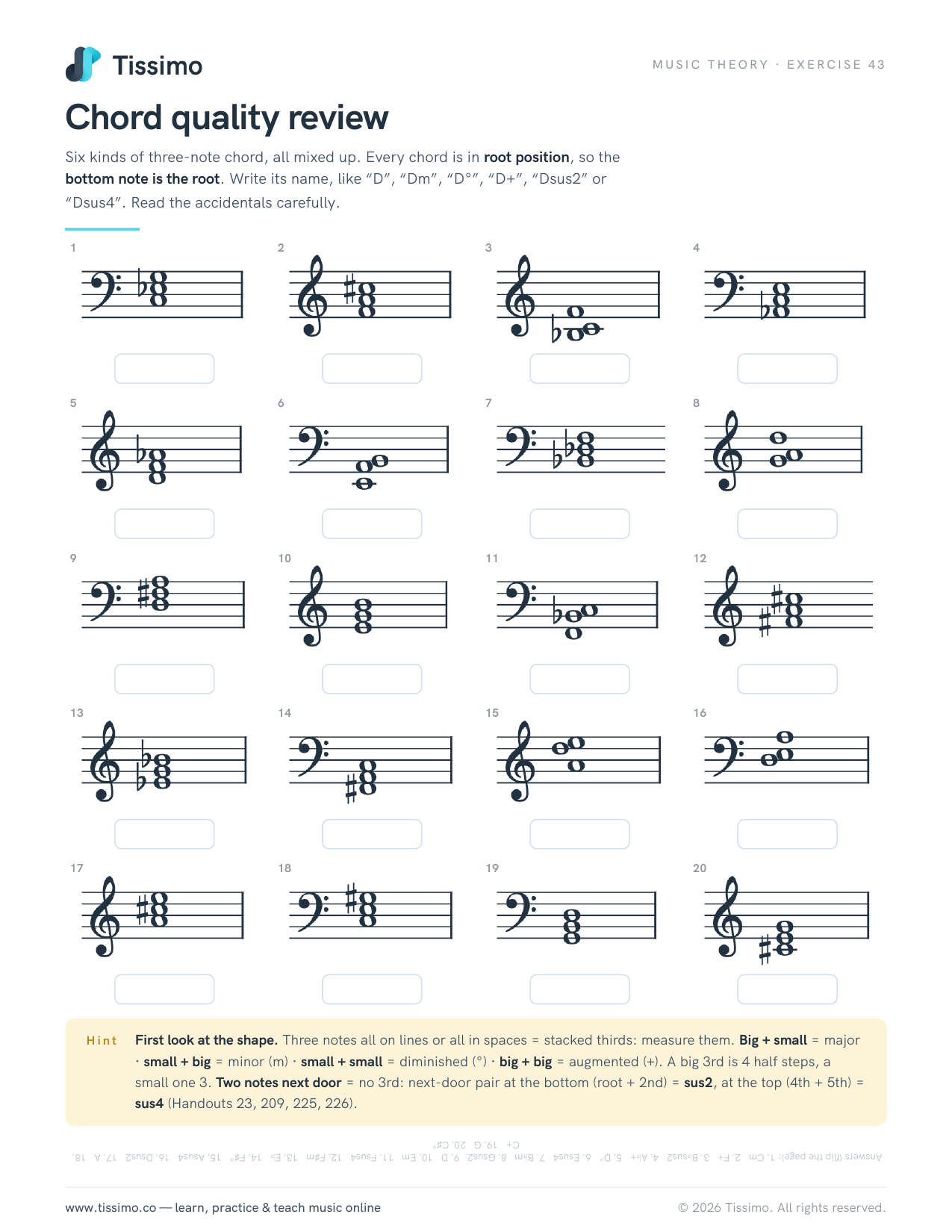 Chord quality reviewSix kinds of three-note chord, all mixed up. Every chord is in root position, so the bottom note is the root. Write its name, like “D”, “Dm”, “D°”, “D+”, “Dsus2” or “Dsus4”. Read the accidentals carefully.
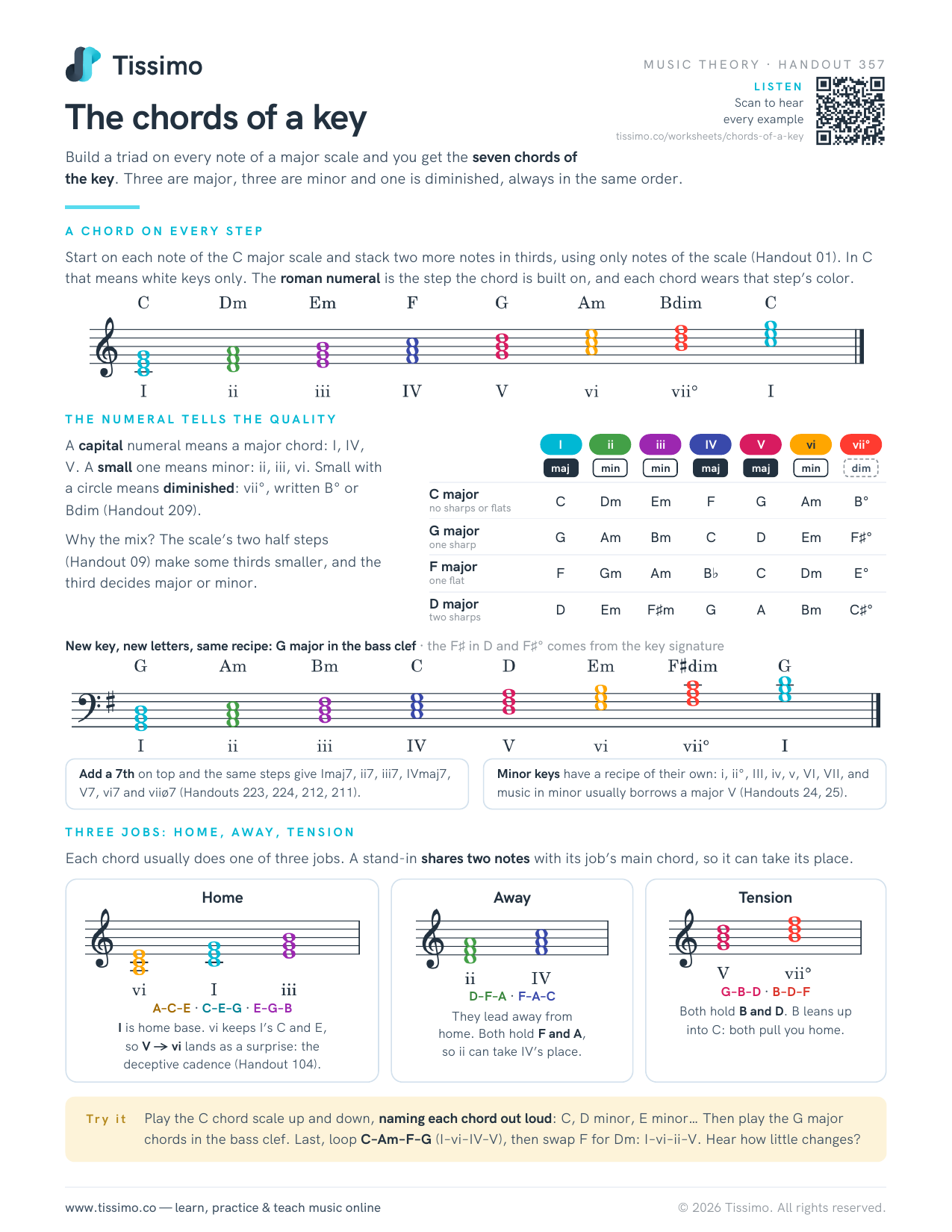 The chords of a keyBuild a triad on every note of a major scale and you get the seven chords of the key. Three are major, three are minor and one is diminished, always in the same order.
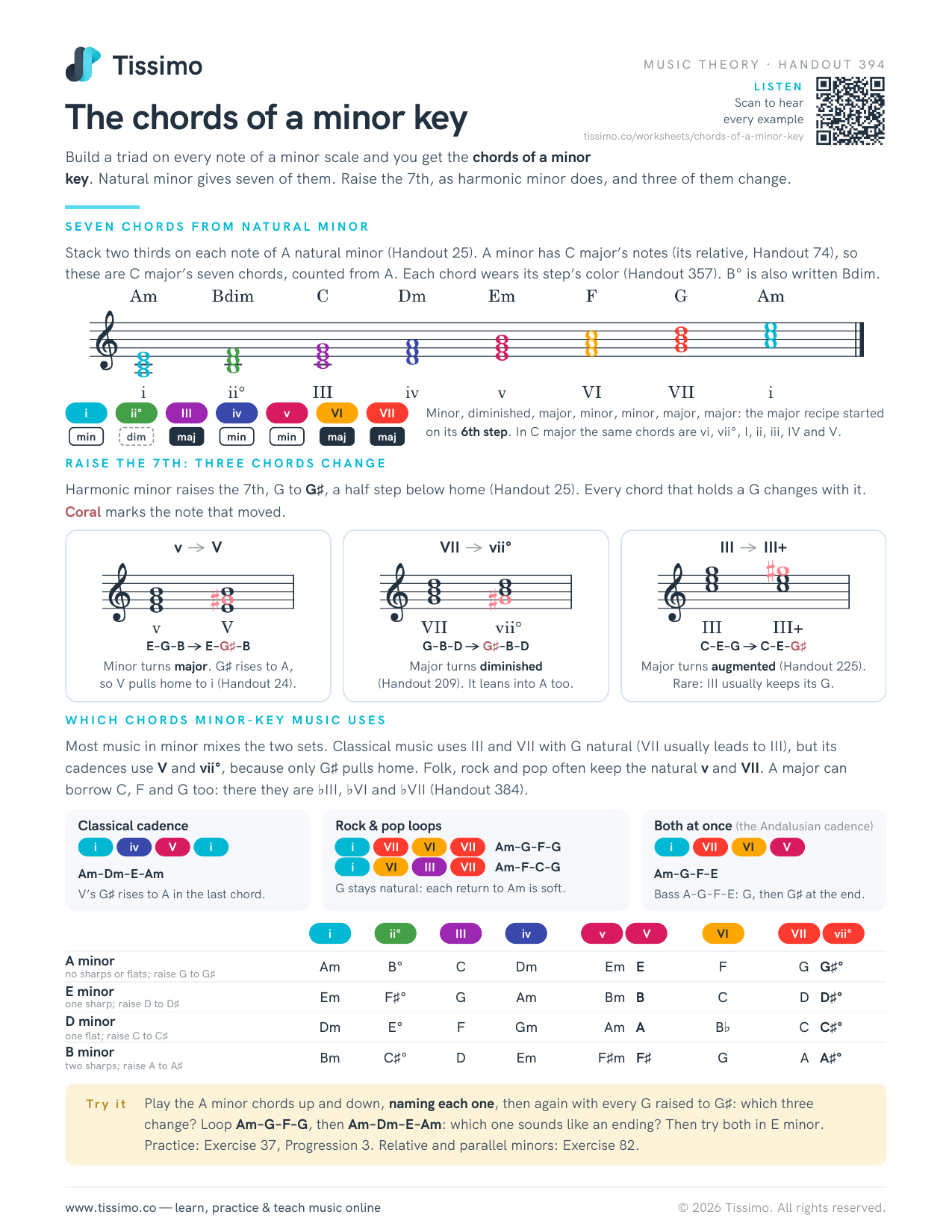 The chords of a minor keyBuild a triad on every note of a minor scale and you get the chords of a minor key. Natural minor gives seven of them. Raise the 7th, as harmonic minor does, and three of them change.
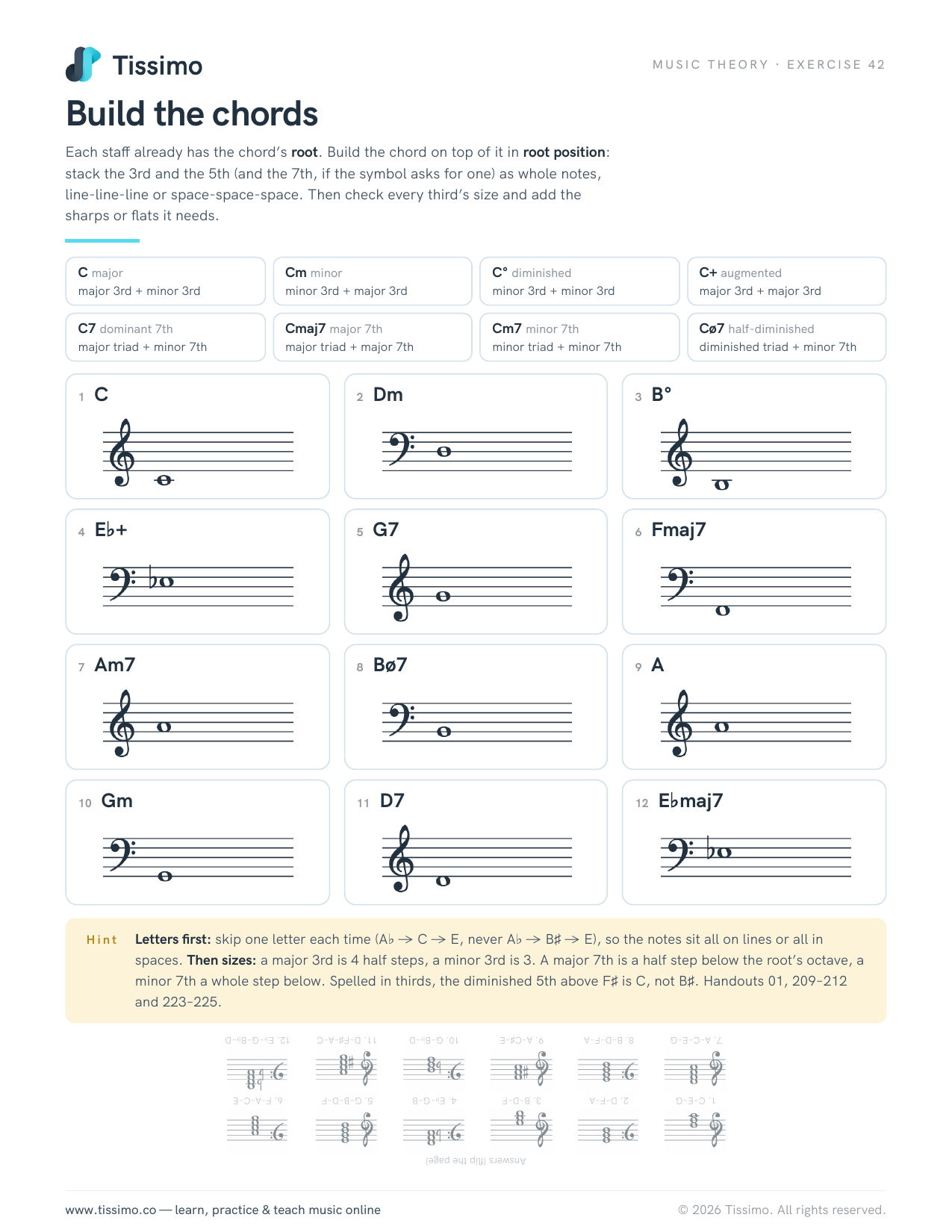 Build the chordsEach staff already has the chord’s root. Build the chord on top of it in root position: stack the 3rd and the 5th (and the 7th, if the symbol asks for one) as whole notes, line-line-line or space-space-space. Then check every third’s size and add the sharps or flats it needs.