Chords & Harmony
Major Seventh Chord
A major seventh chord is a major triad plus a major seventh above the root, such as C–E–G–B (Cmaj7). Its seventh lies a half step below the octave, giving a soft, glowing sound common in jazz and pop.
A major seventh chord is a major triad with a major seventh added above the root. On C it is C–E–G–B, written Cmaj7. Counting half steps from the bottom, it is 4 + 3 + 4. The seventh sits just one half step below the octave, and that gentle rub gives the chord its soft, glowing sound: richer than a plain major triad, but without the urge to move that a dominant seventh chord has.
Symbols
You will see Cmaj7, CM7, CΔ7 or just CΔ; the triangle means "major seventh". In Roman numeral analysis it is usually written I7 or IV7, with the key supplying the quality; some books, and most jazz analysis, write Imaj7 or IΔ7 to make it explicit.
Where it lives in a key
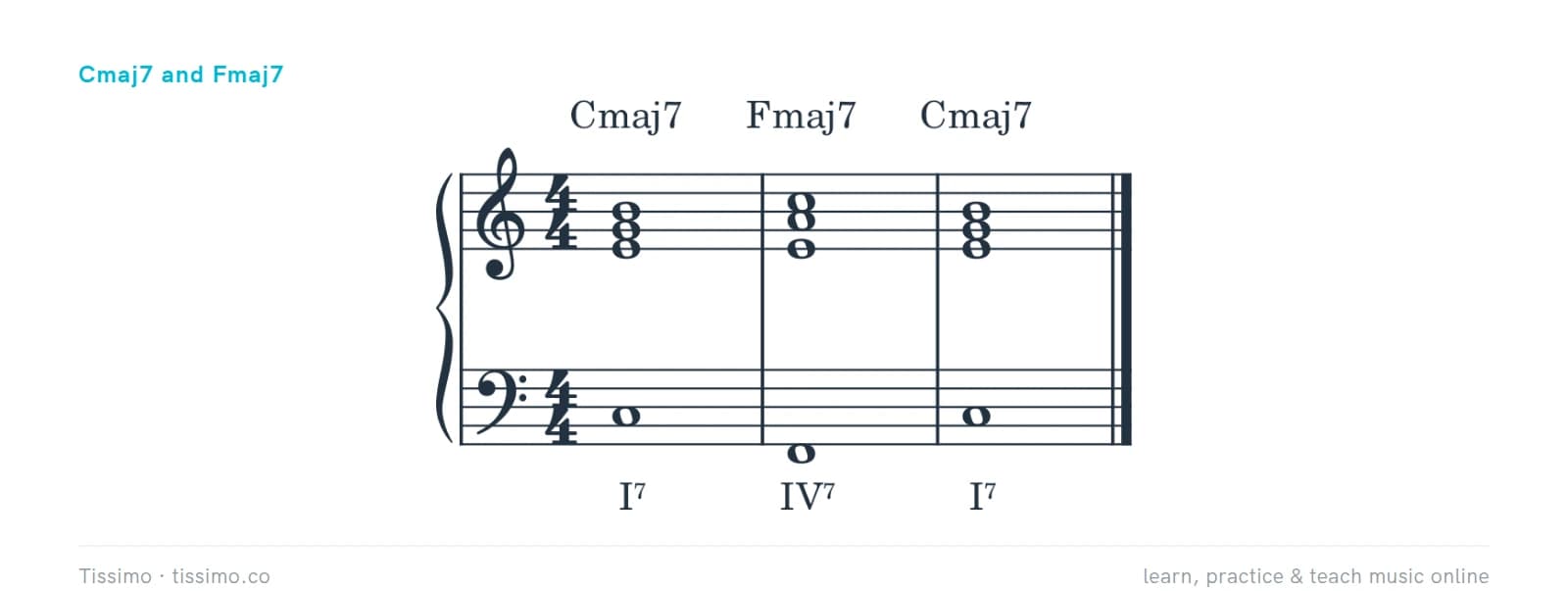
In a major key, the seventh chords on degrees 1 and 4 are major sevenths: Cmaj7 and Fmaj7 in C major. Alternating them makes one of the gentlest two-chord loops there is, because in the right hand only two notes move, each by a step.
In a natural minor key the major sevenths fall on III and VI: in A minor, those are Cmaj7 and Fmaj7 again.
The seventh: B, not B♭
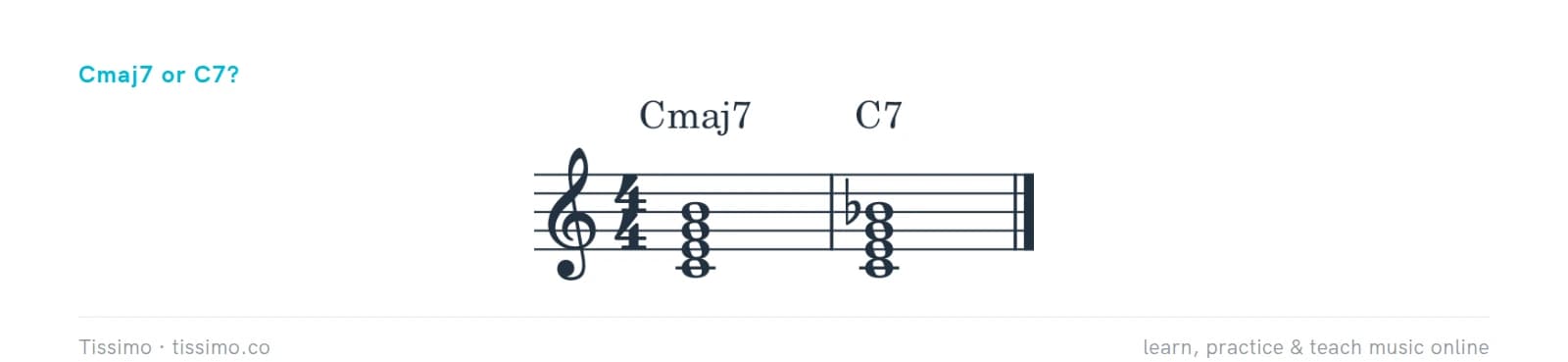
The most common slip is reading C7 as "C with a seventh". C7 is the dominant seventh, with B♭. For B♮ the symbol has to say maj7 (or M7, or Δ). The "maj" belongs to the seventh, not to the triad: a minor triad with a major seventh is written Cm(maj7).
How it is used
In Baroque and Classical music, the seventh of I7 or IV7 is treated like any other dissonance, usually prepared in the previous chord and resolved down by step. In jazz, bossa nova, soul and a great deal of pop it is a stable color, and a song can end on it. When you voice it at the piano, many players avoid putting the root a half step (or a minor ninth) above the seventh, B4 with C5 for example, because that rub sounds harsher than the chord needs. Leaving the root to the bass, as in the examples here, keeps the sound smooth.
Practice with The major 7th and Name the seventh chords.
Common questions
What is the difference between Cmaj7 and C7?
Only the seventh. Cmaj7 has B, a major seventh above C (11 half steps); C7 has B♭, a minor seventh (10 half steps), and is a dominant seventh chord.
What does the triangle mean in a chord symbol?
A triangle (Δ) after the root means major seventh: CΔ and CΔ7 both mean Cmaj7.
Practice it: free worksheets
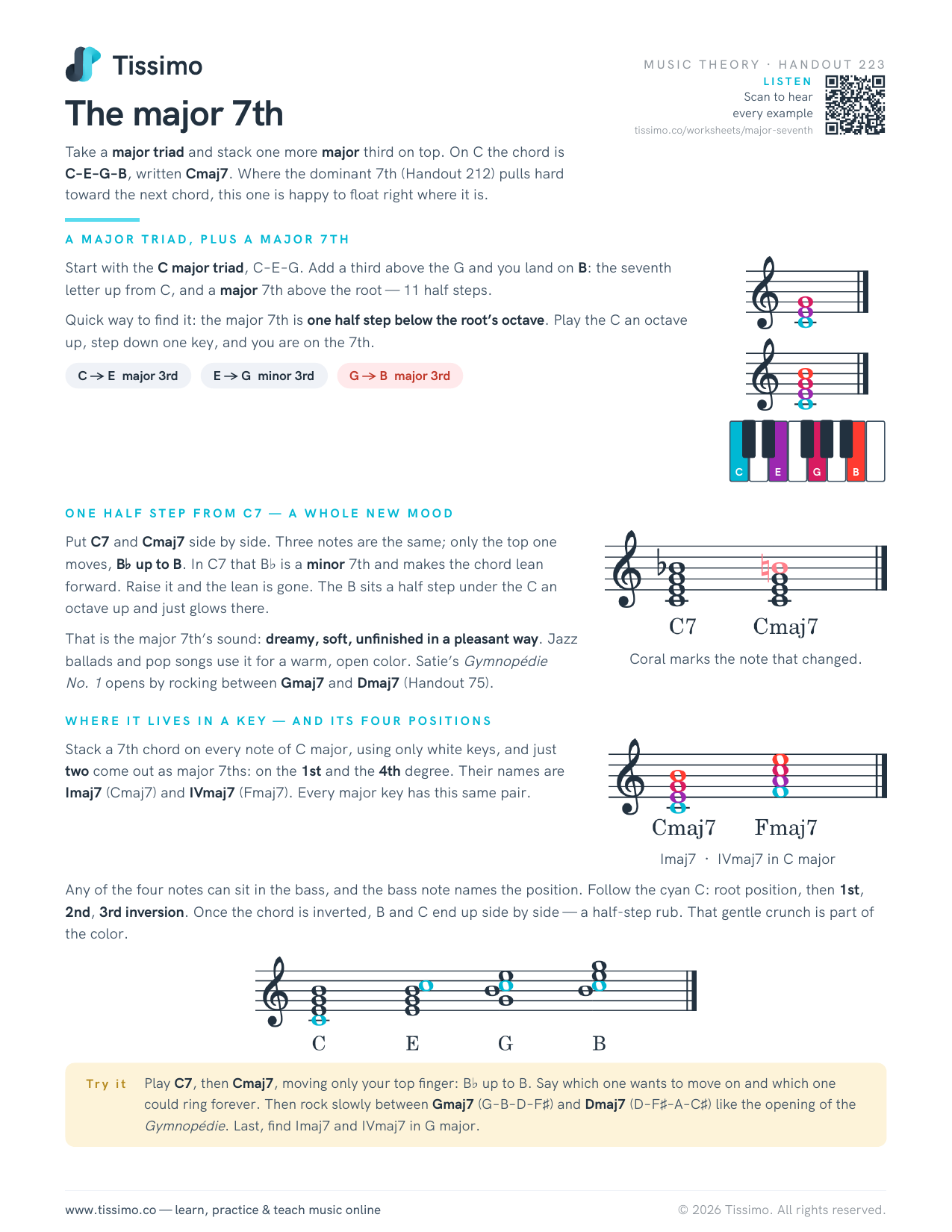 The major 7thTake a major triad and stack one more major third on top. On C the chord is C–E–G–B, written Cmaj7. Where the dominant 7th (Handout 212) pulls hard toward the next chord, this one is happy to float right where it is.
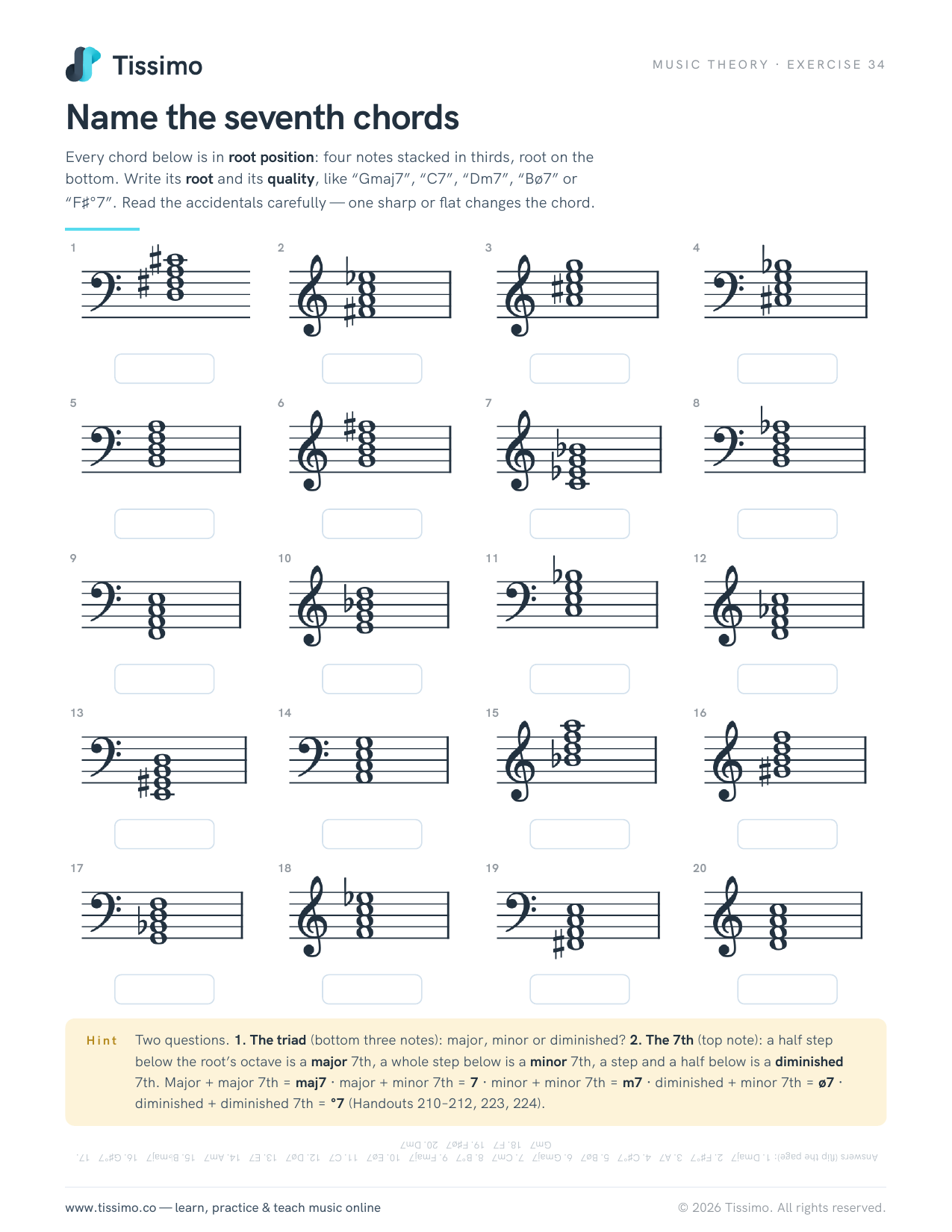 Name the seventh chordsEvery chord below is in root position: four notes stacked in thirds, root on the bottom. Write its root and its quality, like “Gmaj7”, “C7”, “Dm7”, “Bø7” or “F♯°7”. Read the accidentals carefully — one sharp or flat changes the chord.
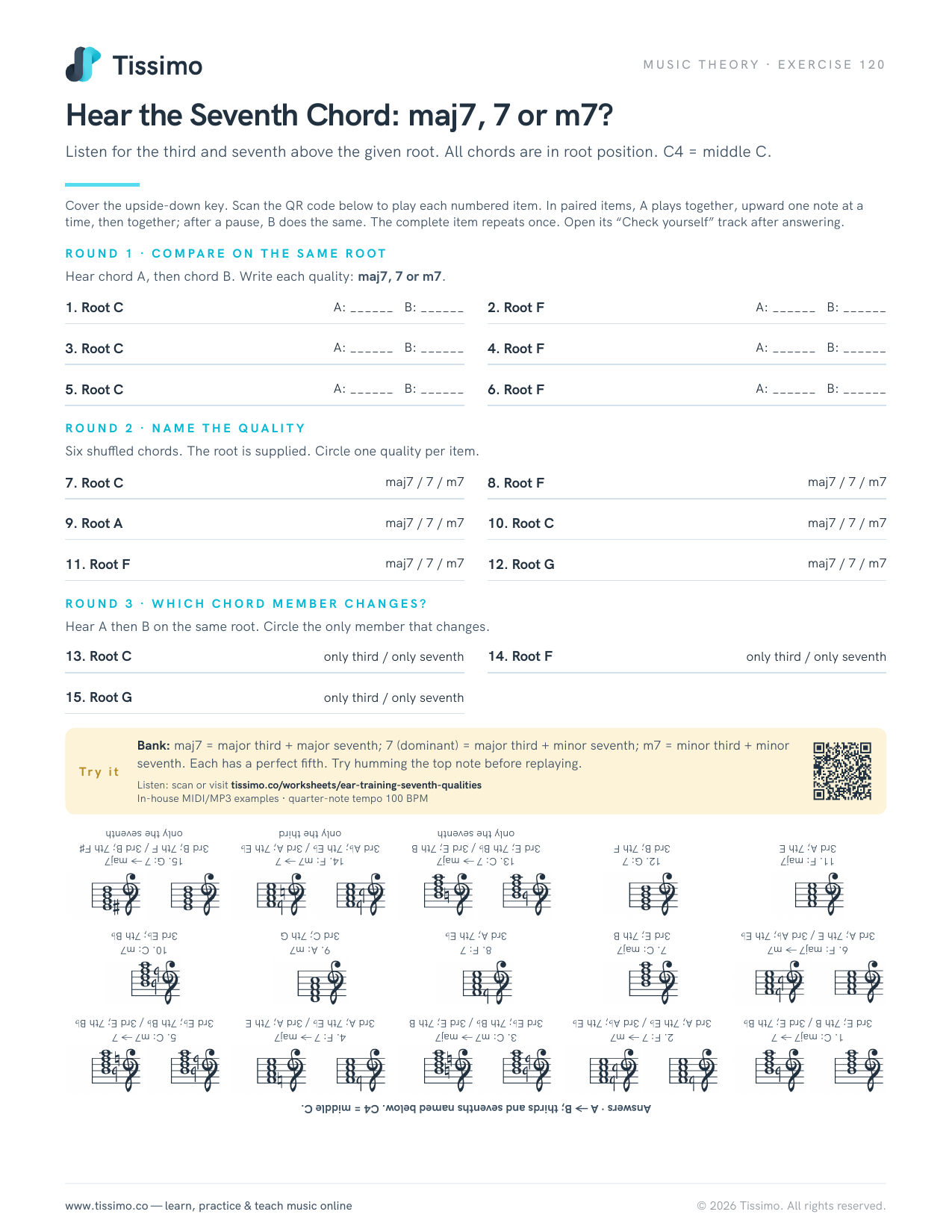 Hear the Seventh Chord: maj7, 7 or m7?Listen for the third and seventh above the given root. All chords are in root position. C4 = middle C.
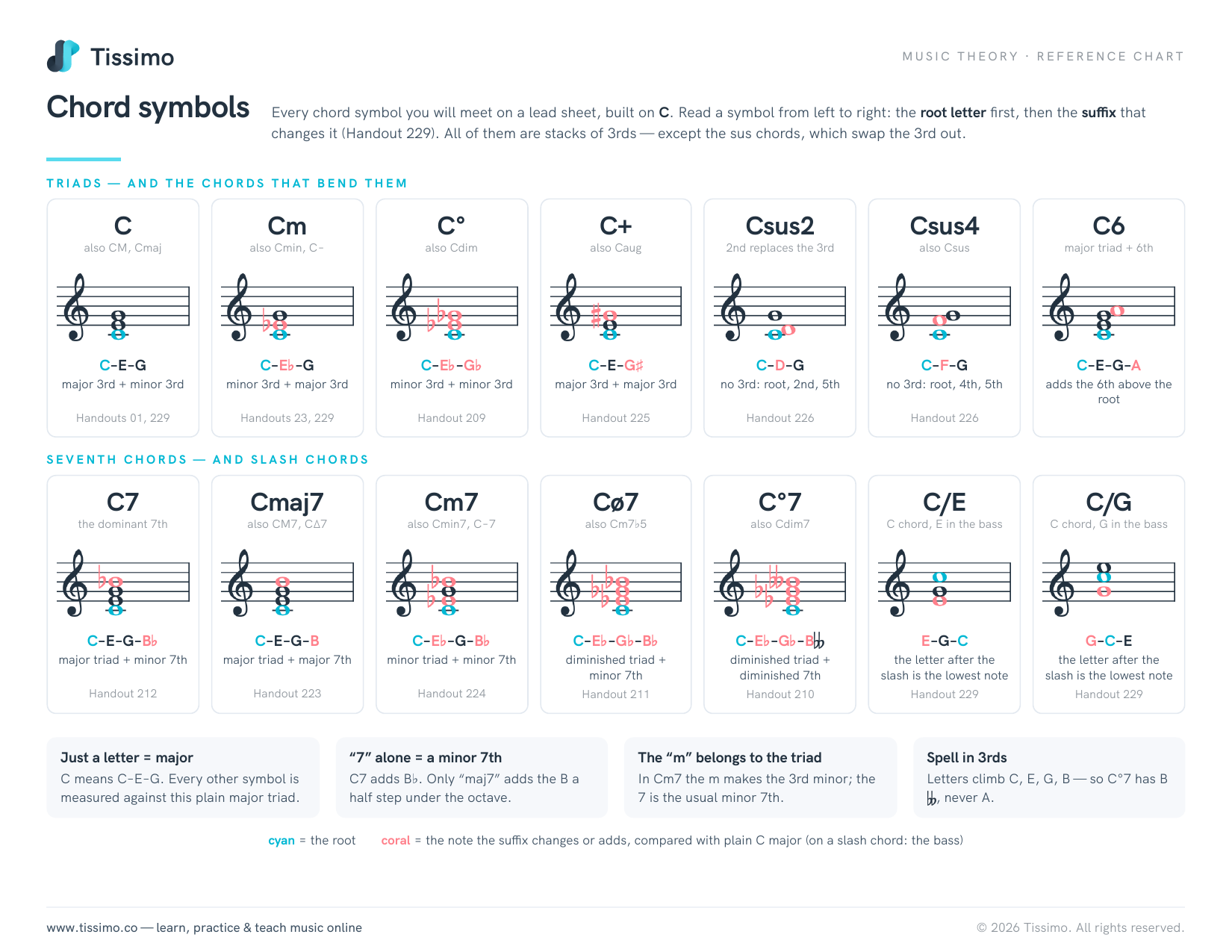 Chord symbolsEvery chord symbol you will meet on a lead sheet, built on C. Read a symbol from left to right: the root letter first, then the suffix that changes it (Handout 229). All of them are stacks of 3rds — except the sus chords, which swap the 3rd out.