Chords & Harmony
Extended Chord (9th, 11th, 13th)
An extended chord is a seventh chord with more thirds stacked on top: the 9th, 11th or 13th. C9, Dm11 and G13 are extended chords, everyday sounds in jazz, soul, gospel and film music.
An extended chord is a seventh chord with more notes stacked above it, still in thirds. After the seventh come the 9th, the 11th and the 13th. On C, stacking thirds gives C–E–G–B♭, then D, F and A. The 13th is as far as the stack goes: the next third up would be C again.
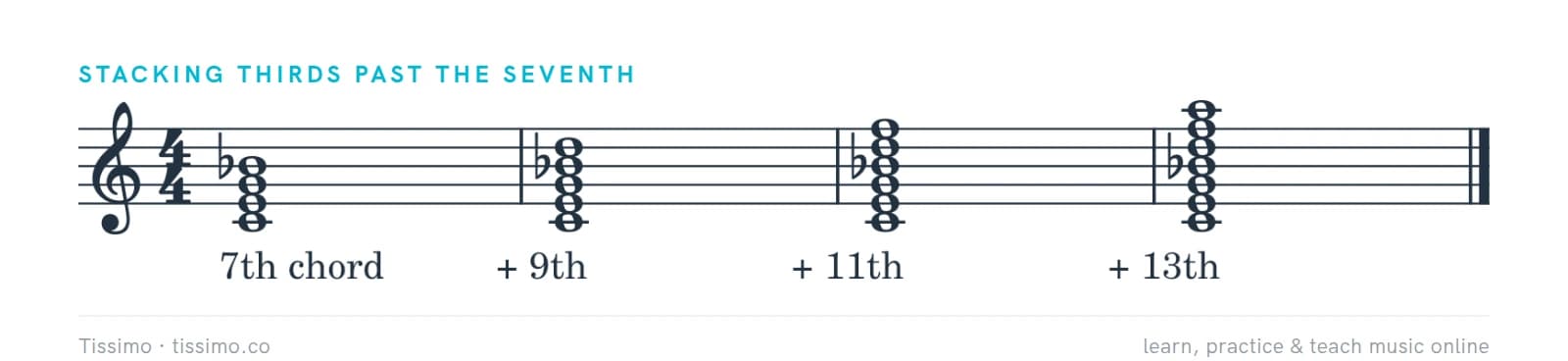
Why 9, 11 and 13?
The extensions are the 2nd, 4th and 6th of the scale, placed an octave higher (see compound interval). Calling D a 9th rather than a 2nd says that it sits on top of a complete seventh chord. A chord with a 2nd or a 6th but no seventh is an added-tone chord instead: Cadd9, C6.
Reading the symbol
The number names the highest extension, and it implies a seventh underneath:
- C9 = C–E–G–B♭–D: a dominant seventh plus the 9th.
- Cmaj9 = C–E–G–B–D: a major seventh plus the 9th.
- Cm9 = C–E♭–G–B♭–D: a minor seventh plus the 9th.
- C13 = a dominant seventh plus the 13th (A), usually with the 9th as well.
- Dm11 = D–F–A–C plus E and G.
Altered extensions such as ♭9, ♯9, ♯11 and ♭13 raise or lower one of these notes, mostly on dominant chords: G7♭9, C7♯11.
Leaving notes out
A complete 13th chord has seven notes, which would sound thick and muddy, so players choose:
- The fifth usually goes first; it adds little color.
- The root can go when a bass player or the left hand already has it.
- On major and dominant chords the natural 11th is usually left out, because it sits a half step (or a minor ninth) above the third: F against E in C13. Minor chords keep it happily, and Dm11 is a favorite sound.
What stays are the notes that define the chord: the third, the seventh and the extension itself. Here is a ii–V–I with an extension on every chord, each voiced in four notes over a bass:
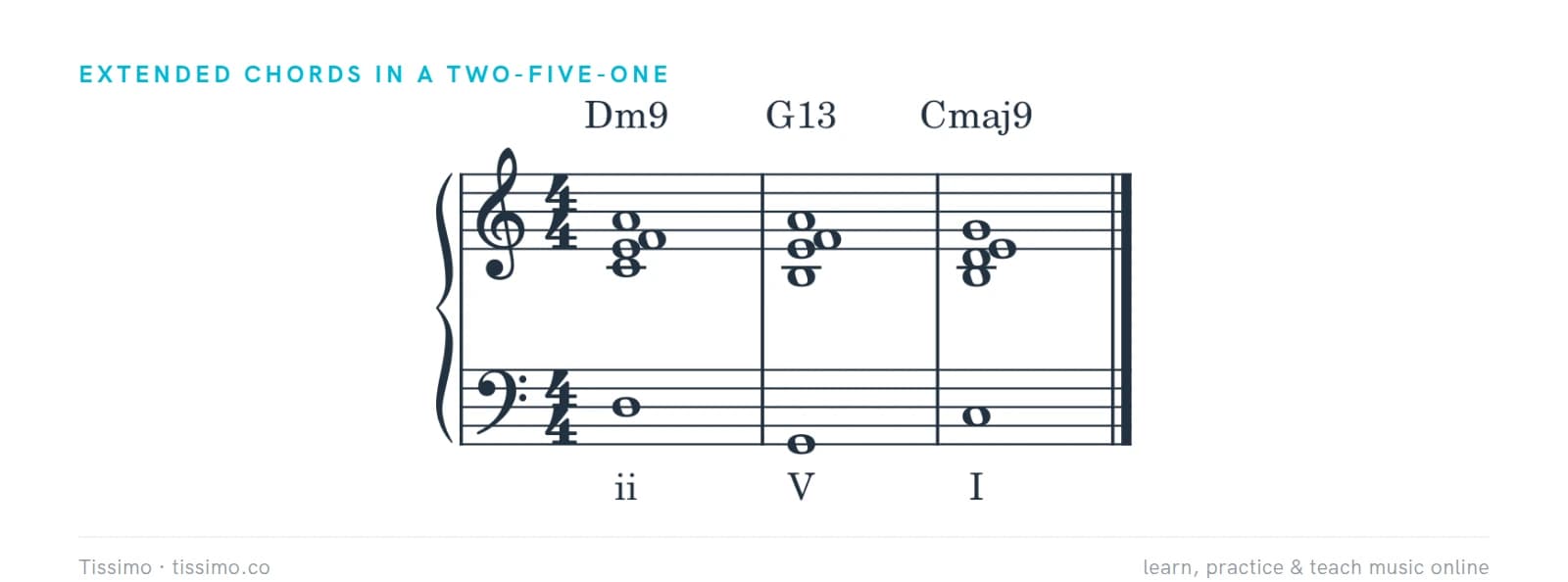
Where you hear them
Extended chords are everyday vocabulary in jazz, soul, R&B, gospel and a great deal of film music. Earlier, composers such as Debussy and Ravel used ninth chords as colors in their own right, sometimes sliding them in parallel. To practice compact voicings at the keyboard, start with Shell Voicings, then try The ii–V–I in Every Key.
Common questions
Why is it called a 9th and not a 2nd?
Because it sits above a complete seventh chord, in the octave above the root. Numbering it 9 tells you the seventh is there too; a chord with a 2nd and no seventh is written add9 or sus2.
Does a C13 chord include every note from C to A?
The full stack would be C–E–G–B♭–D–F–A, but players normally leave out the 11th (F), and often the fifth and the root. A typical C13 voicing keeps E, B♭ and A, with C in the bass and D added if there is room.
Practice it: free worksheets
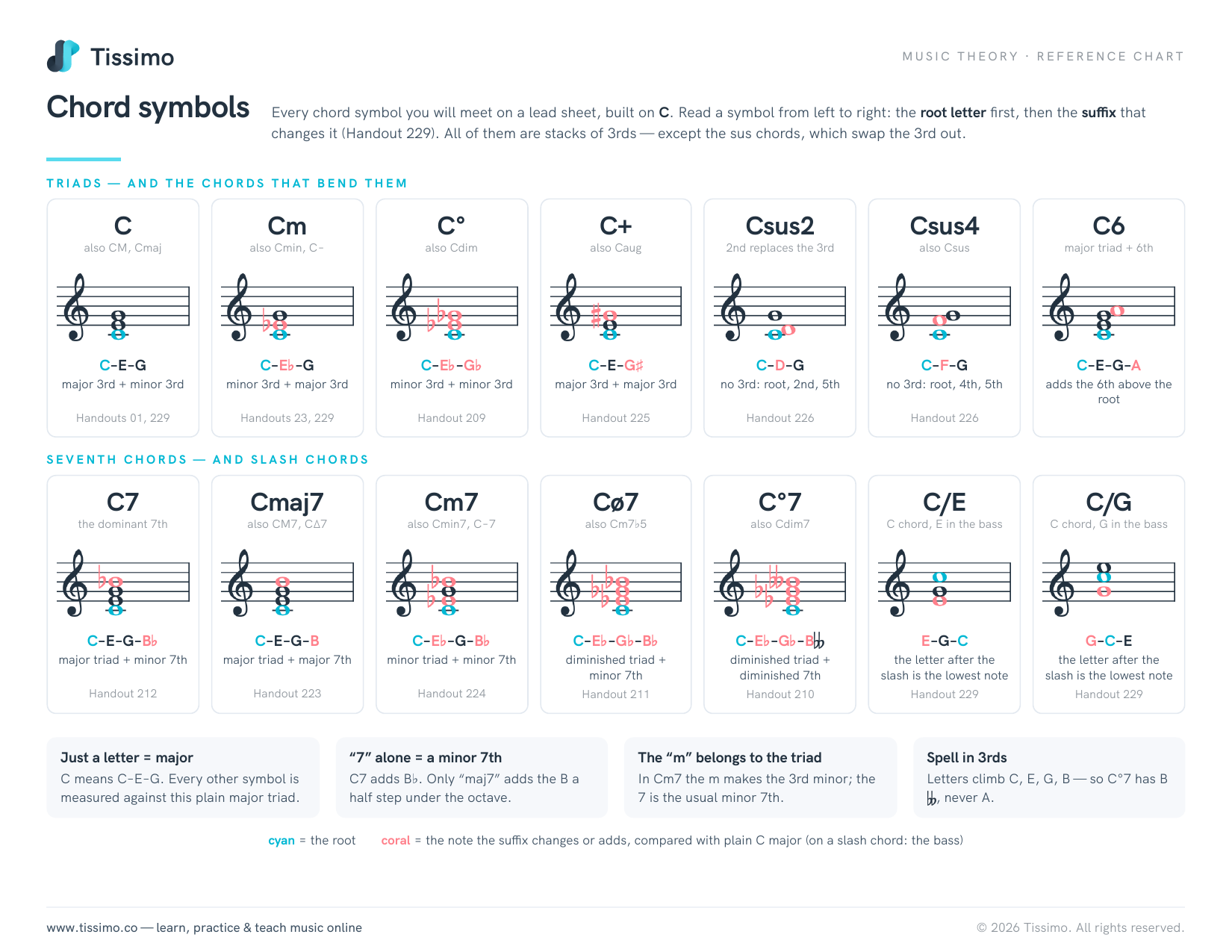 Chord symbolsEvery chord symbol you will meet on a lead sheet, built on C. Read a symbol from left to right: the root letter first, then the suffix that changes it (Handout 229). All of them are stacks of 3rds — except the sus chords, which swap the 3rd out.
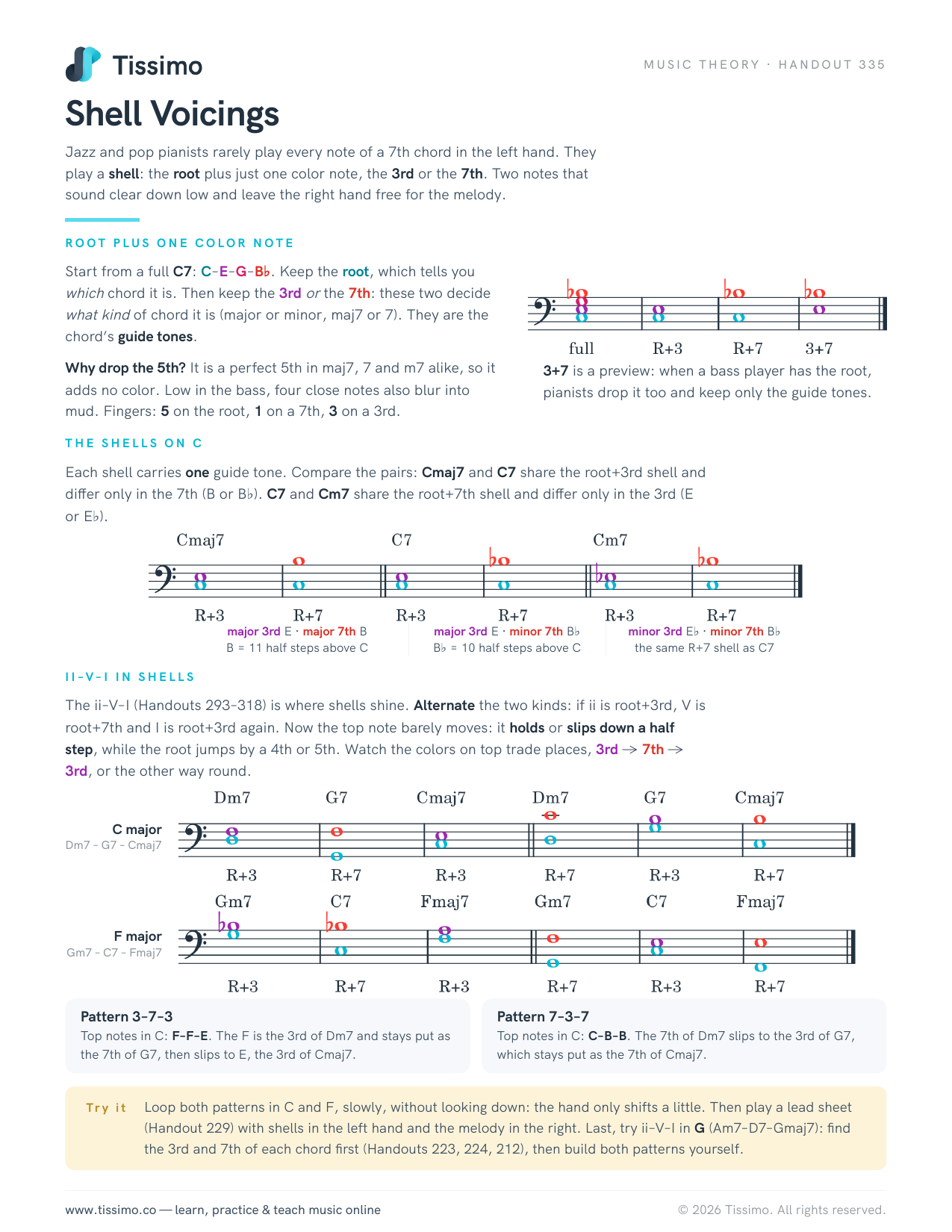 Shell VoicingsJazz and pop pianists rarely play every note of a 7th chord in the left hand. They play a shell: the root plus just one color note, the 3rd or the 7th. Two notes that sound clear down low and leave the right hand free for the melody.
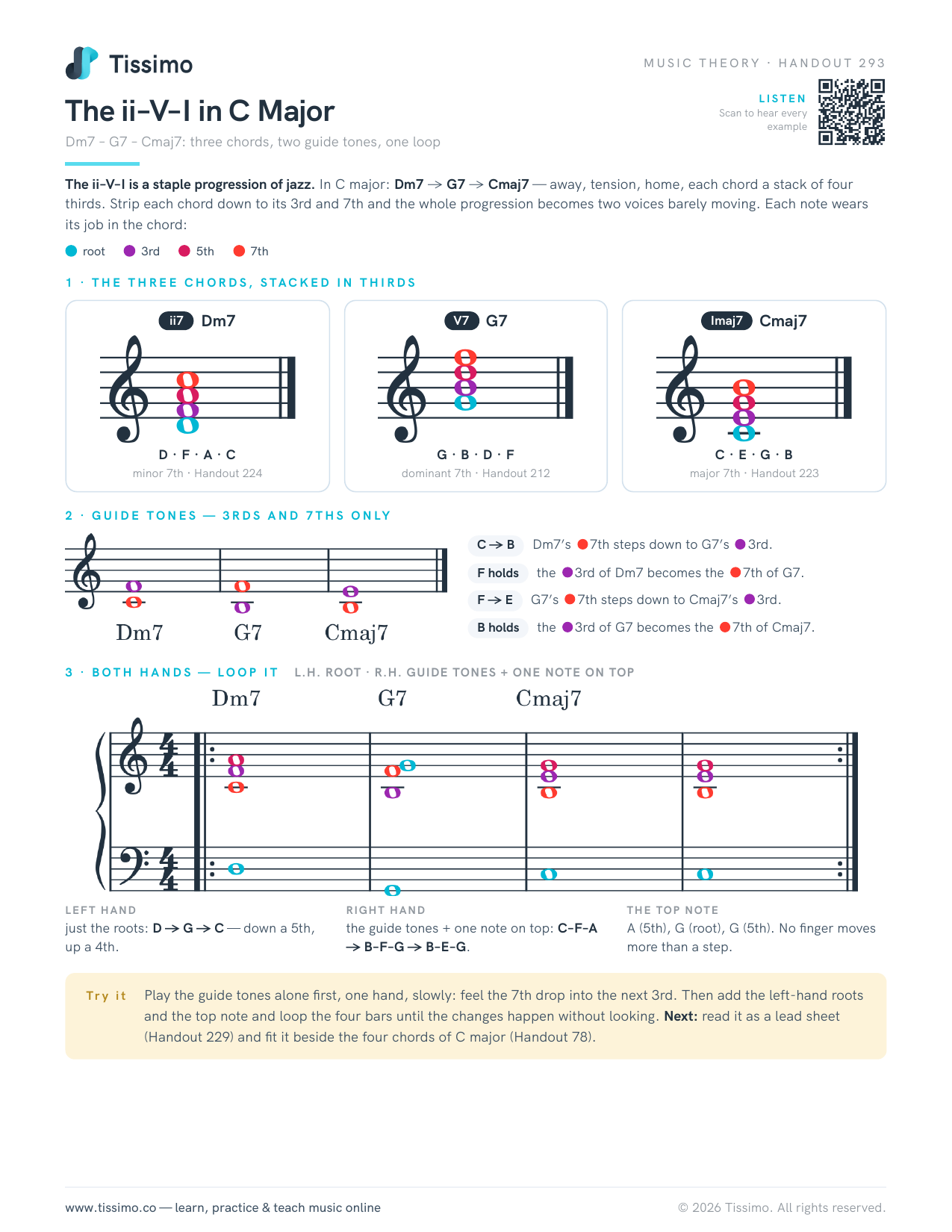 The ii–V–I in Every KeyThe most-played progression in jazz: three chords, two guide tones, one loop, in all 24 keys.