Chords & Harmony
Augmented Triad
An augmented triad is a three-note chord made of two stacked major thirds, such as C–E–G♯. Its outer notes form an augmented fifth, giving a bright but unsettled sound.
An augmented triad is a three-note chord made of two stacked major thirds. On C it is C–E–G♯. Its outer notes are an augmented fifth apart (8 half steps), one half step wider than the perfect fifth of a major chord, and that stretched fifth gives the chord its bright but unresolved, slightly dreamlike sound.
How to build one
Count 4 half steps from the root to the third, then 4 more to the fifth, 8 in all. The fastest route is from a major triad: keep the root and the third, and raise the fifth by a half step. C–E–G becomes C–E–G♯; F–A–C becomes F–A–C♯. Spell the raised fifth on the fifth's own letter (C–E–G♯, not C–E–A♭), so the chord is still a stack of thirds.
Chord symbols write it as C+, Caug or C(♯5). Roman numerals add a plus sign: III+, V+.
Where you find it
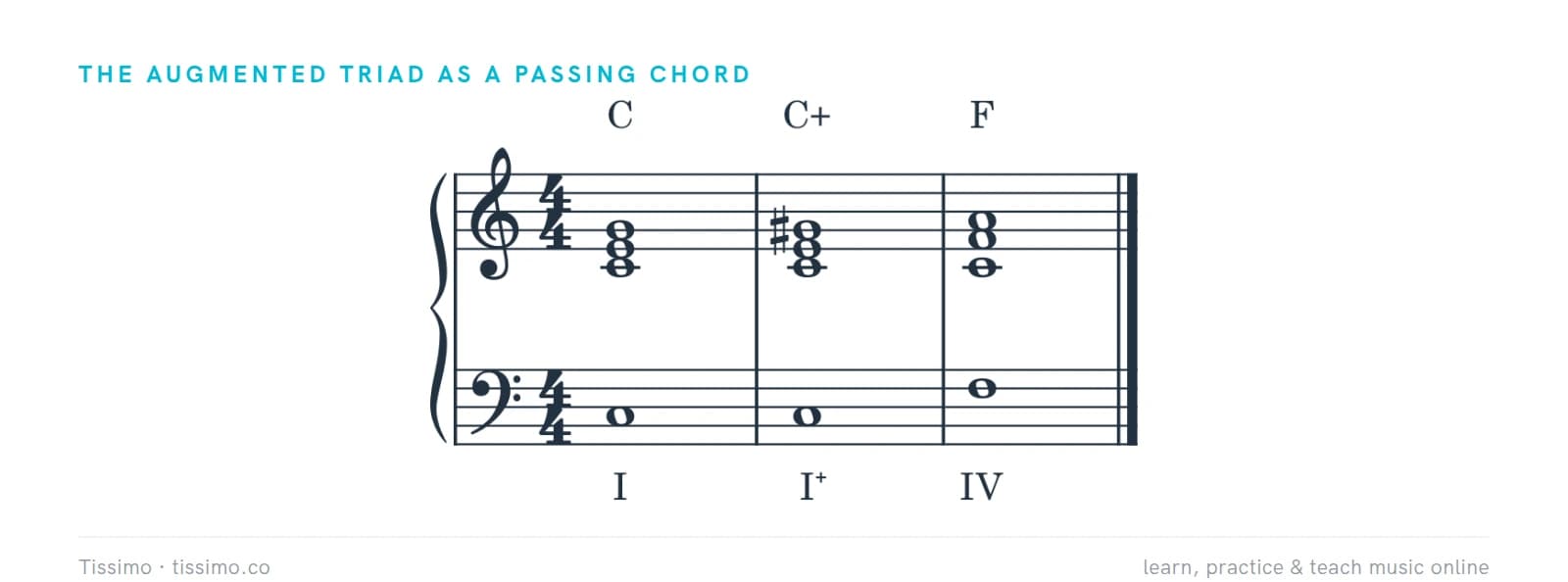
The major scale contains no augmented triad. Harmonic minor does: in A minor, the triad on degree 3 is C–E–G♯ (III+), because the raised seventh, G♯, becomes its fifth. More often, an augmented triad works as a passing chord: one note slides up by half steps while the others hold. In C major, C – C+ – F lets G rise through G♯ to A, the third of F major. A similar line, C – C+ – C6 – C7, climbs G, G♯, A, B♭ over a held C.
A symmetrical chord
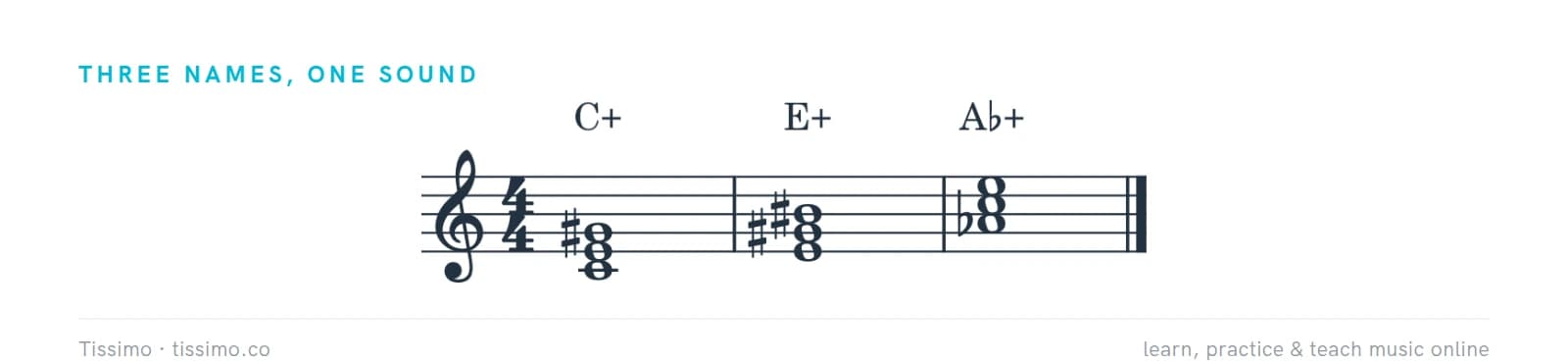
Two major thirds make 8 half steps, and one more major third (4) reaches the octave. So the augmented triad divides the octave into three equal parts, and its sound gives no clear hint of which note is the root. C+, E+ and A♭+ contain the same three pitch classes in twelve-tone equal temperament, though their spellings and voicings can differ. There are just four augmented-triad pitch-class collections in that system, and the whole-tone scale contains two of them.
Practice: The augmented triad and Chord quality review.
Common questions
What is the difference between an augmented and a diminished triad?
An augmented triad stacks two major thirds (4 + 4 half steps) and stretches the fifth; a diminished triad stacks two minor thirds (3 + 3) and shrinks it. Both sound unstable, but in different ways.
How do you write an augmented chord symbol?
With a plus sign or aug after the root: C+ or Caug. Some charts write C(♯5).
Practice it: free worksheets
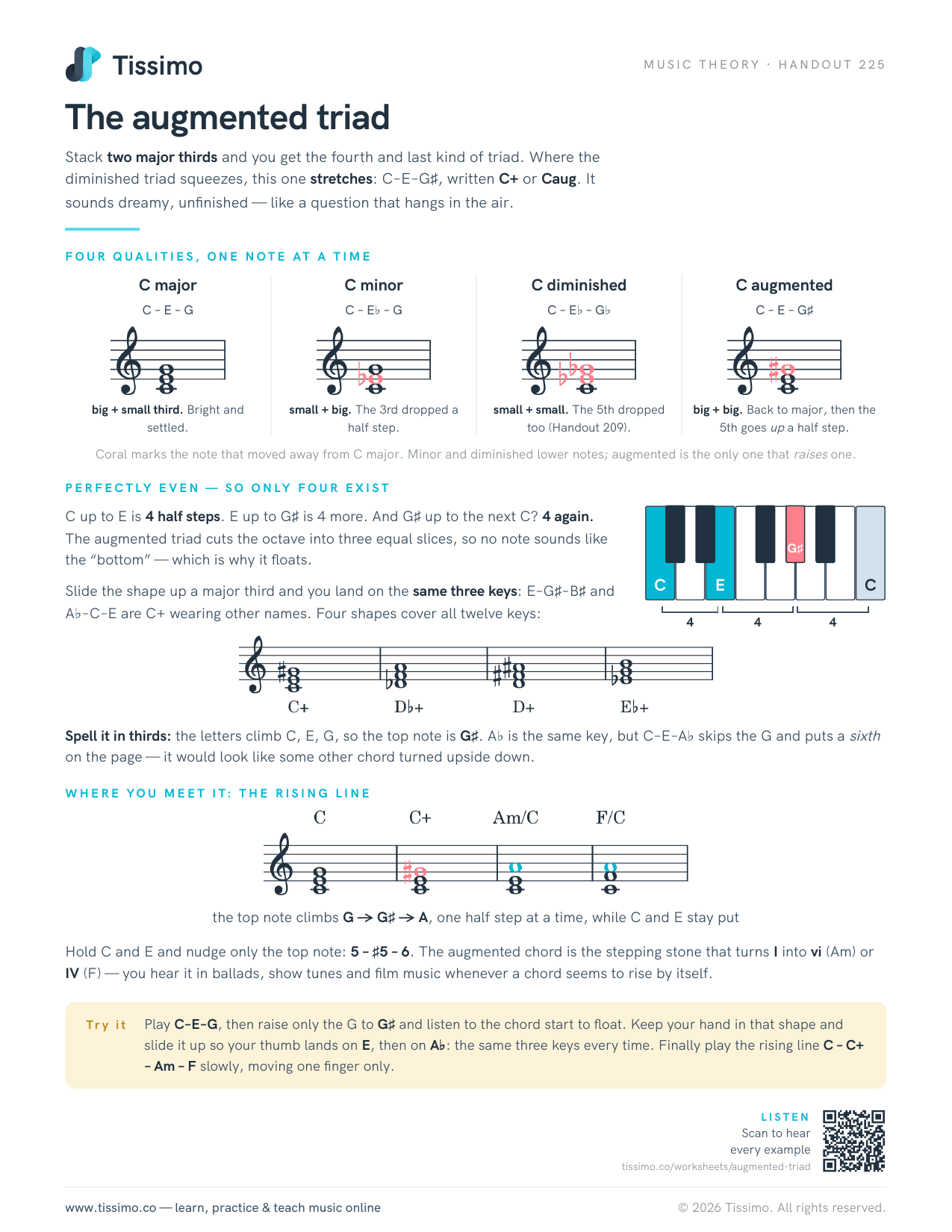 The augmented triadStack two major thirds and you get the fourth and last kind of triad. Where the diminished triad squeezes, this one stretches: C–E–G♯, written C+ or Caug. It sounds dreamy, unfinished — like a question that hangs in the air.
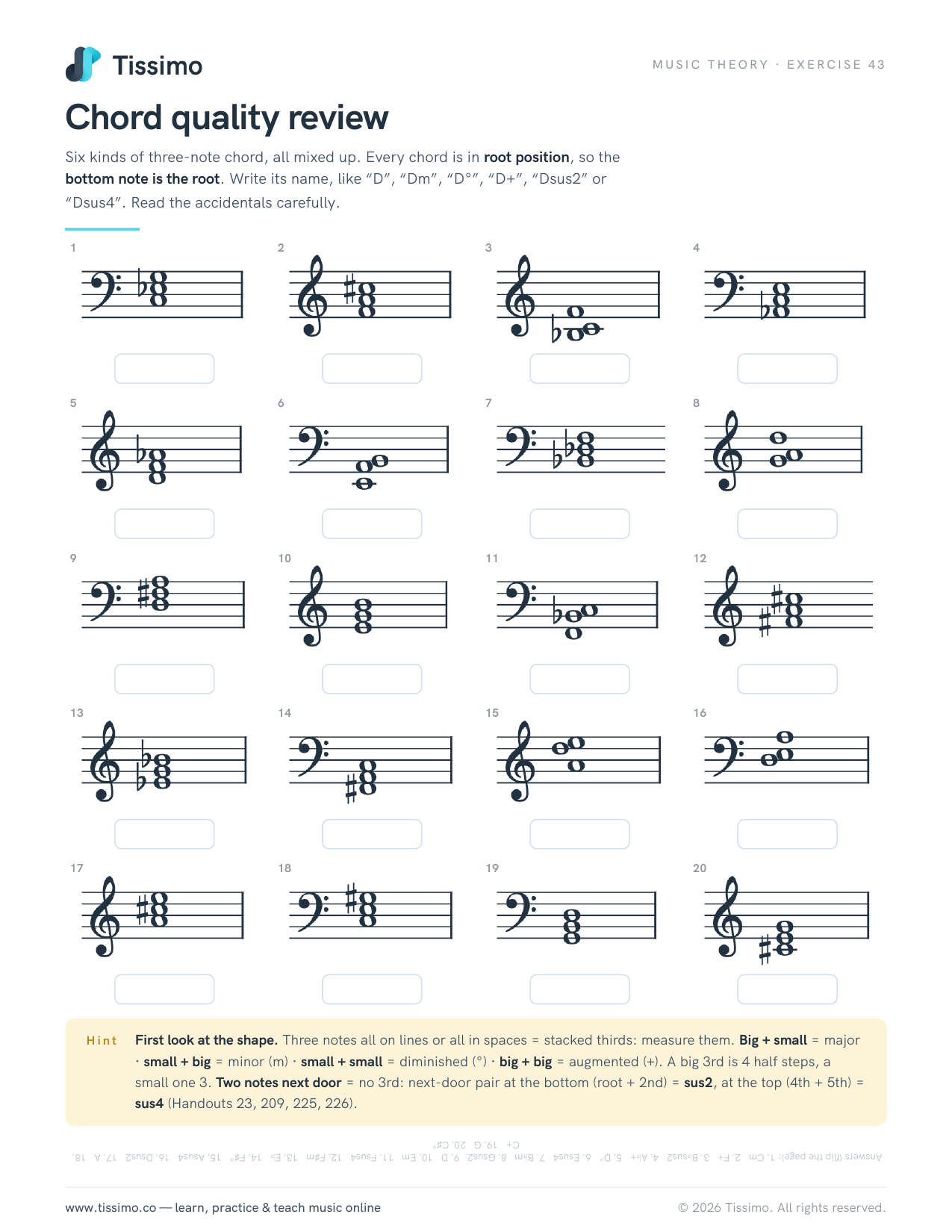 Chord quality reviewSix kinds of three-note chord, all mixed up. Every chord is in root position, so the bottom note is the root. Write its name, like “D”, “Dm”, “D°”, “D+”, “Dsus2” or “Dsus4”. Read the accidentals carefully.
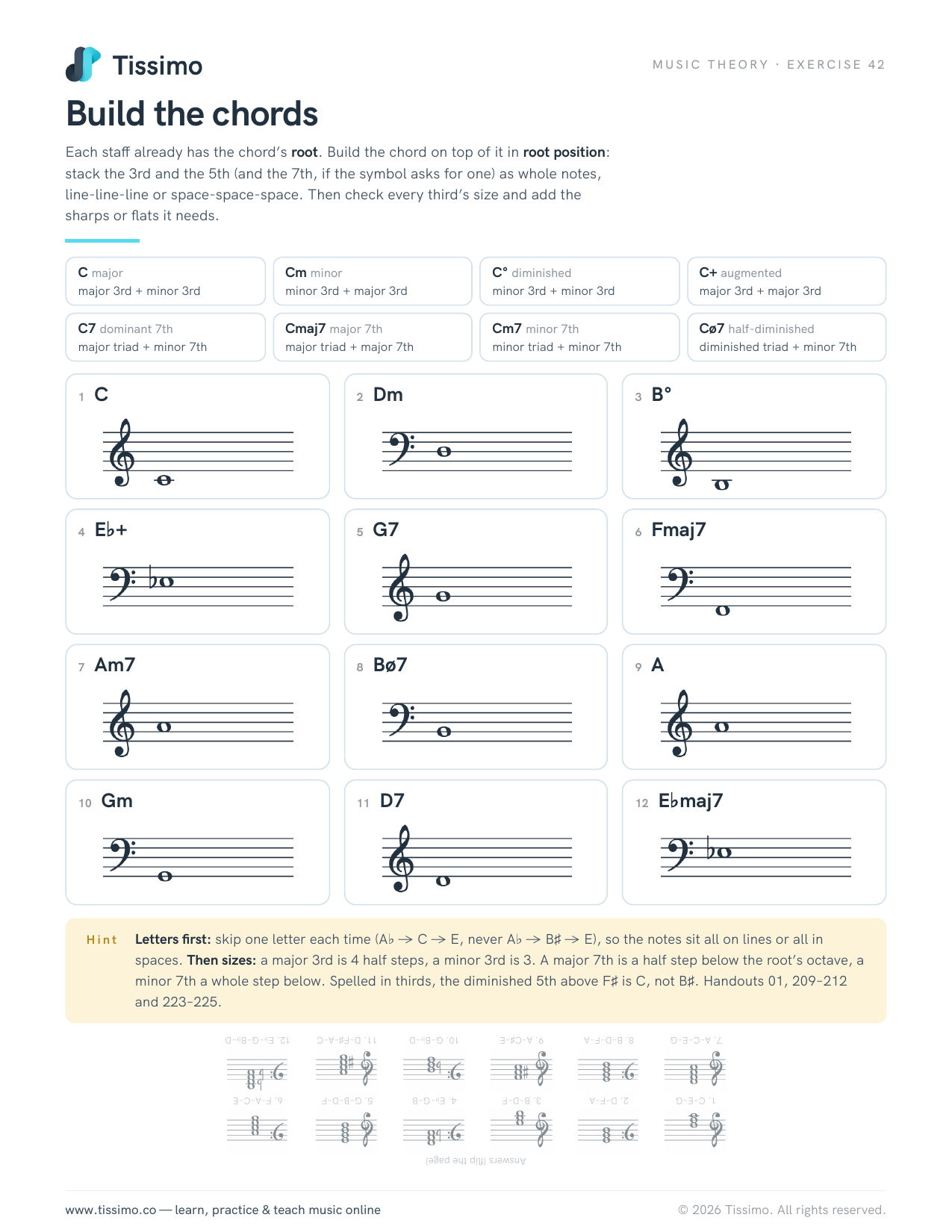 Build the chordsEach staff already has the chord’s root. Build the chord on top of it in root position: stack the 3rd and the 5th (and the 7th, if the symbol asks for one) as whole notes, line-line-line or space-space-space. Then check every third’s size and add the sharps or flats it needs.
 Minor-Key Chords: Natural or Raised Seventh?Natural minor uses the key signature. Harmonic minor raises only degree 7 by a half step: A minor G→G♯; E minor D→D♯; D minor C→C♯. Major: III; minor: i; diminished: ii°; augmented: III+. Use uppercase for major or augmented triads and lowercase for minor or diminished triads. Here VII means the unraised seventh; vii° uses the raised seventh.