Pitch & Intervals
Major Third
Written as M3
A major third (M3) is an interval of four half steps spanning three letter names, such as C–E, F–A or D–F♯. It is the bottom interval of a major chord and sounds bright and stable.
A major third spans three letter names and four half steps: C up to E, F up to A, G up to B, D up to F♯. Abbreviated M3, it measures 400 cents in equal temperament.
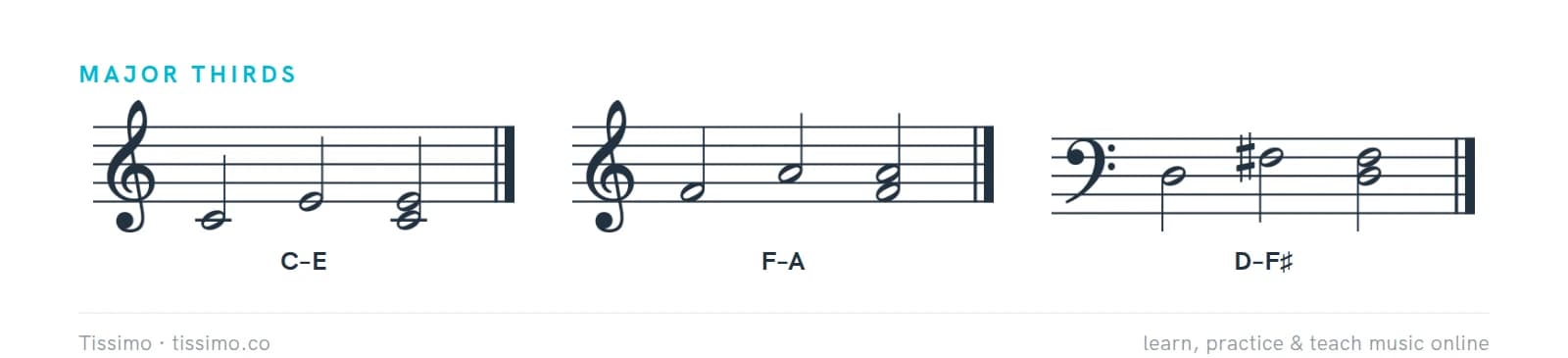
Counting it
C–D–E is three letters, so C–E is a 3rd. Count the half steps from C: C♯ (1), D (2), D♯ (3), E (4). Four half steps make it major; three would make it a minor third.
Among the white keys, only three 3rds are major: C–E, F–A and G–B. They are the bottom intervals of the three primary chords of C major (C, F and G). Every other 3rd needs an accidental to become major: D–F♯, E–G♯, A–C♯, B–D♯.
Major thirds in chords
A major triad is a major third with a minor third on top: C–E–G. The augmented triad stacks two major thirds (C–E–G♯). Add a third major third and you arrive at B♯, the same key as C: three major thirds divide the octave into three equal parts.
How it sounds
The major third is the sound of "major": bright, open and settled. A rising major third opens "When the Saints Go Marching In" (on "Oh when"), and many two-tone doorbells play a falling one. Harmonically it is a consonance (an imperfect consonance in classical theory).
An acoustically pure major third has a frequency ratio of 5:4, about 386 cents. The equal-tempered major third on a piano is about 14 cents wider. Choirs and string quartets tend to tune sustained major thirds narrower than the piano does, closer to the pure ratio (see just intonation).
Inversion and look-alikes
Inverted, a major third becomes a minor sixth: C–E becomes E–C, and 4 + 8 = 12. The same distance spelled with letters four apart forms a diminished fourth. It is rare, but real: in A harmonic minor, G♯ up to C is a diminished fourth.
Practice with Major & minor 2nds and 3rds and Intervals: steps & skips.
Common questions
How many half steps are in a major third?
Four. From C: C♯ (1), D (2), D♯ (3), E (4). A minor third has three.
What is the difference between a major third and a minor third?
Both span three letter names, but a major third is one half step wider: four half steps (C–E) instead of three (C–E♭). That single half step decides whether a triad built on the lower note is major or minor.
Practice it: free worksheets
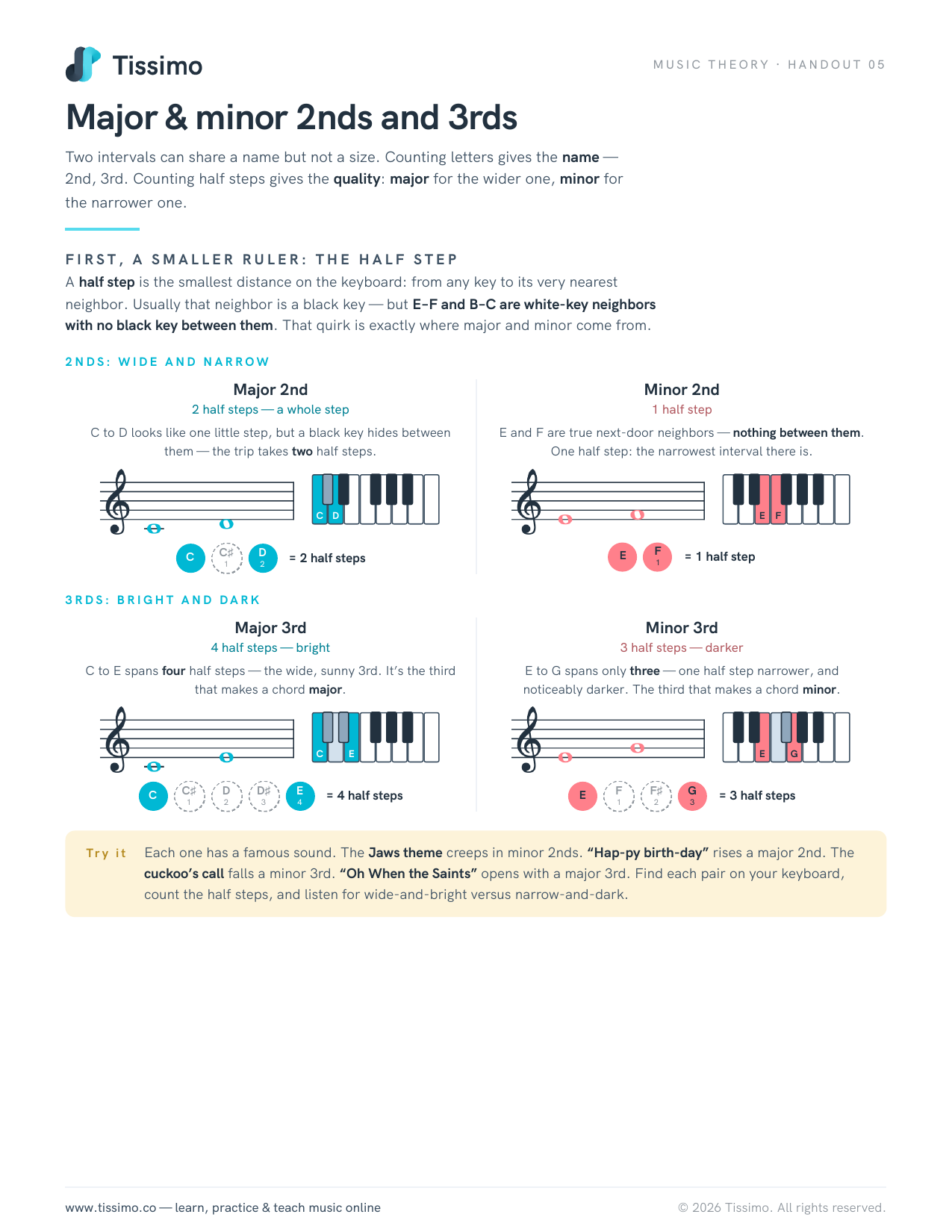 Major & minor 2nds and 3rdsTwo intervals can share a name but not a size. Counting letters gives the name — 2nd, 3rd. Counting half steps gives the quality: major for the wider one, minor for the narrower one.
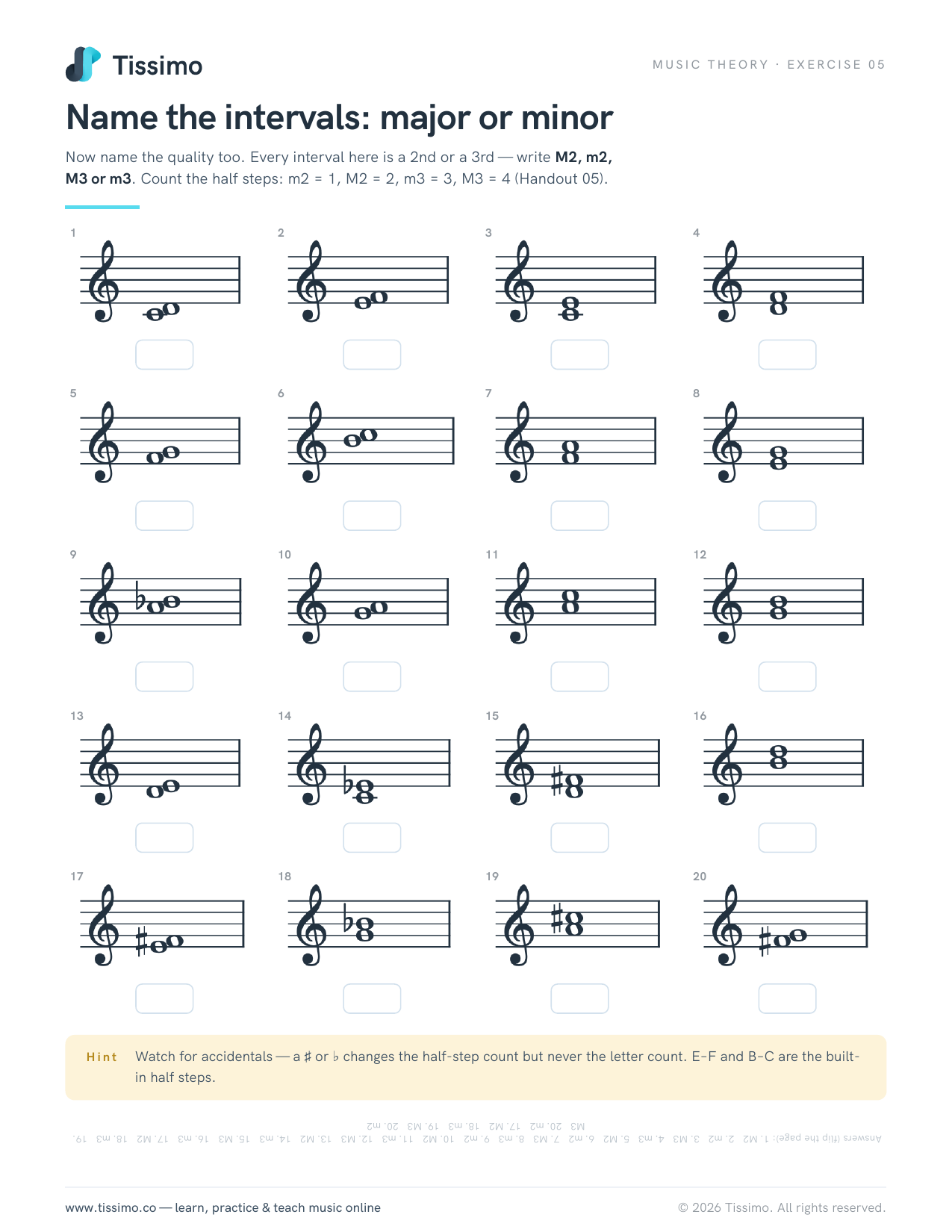 Name the intervals: major or minorNow name the quality too. Every interval here is a 2nd or a 3rd — write M2, m2, M3 or m3. Count the half steps: m2 = 1, M2 = 2, m3 = 3, M3 = 4 (Handout 05). Warm up with Exercise 52.
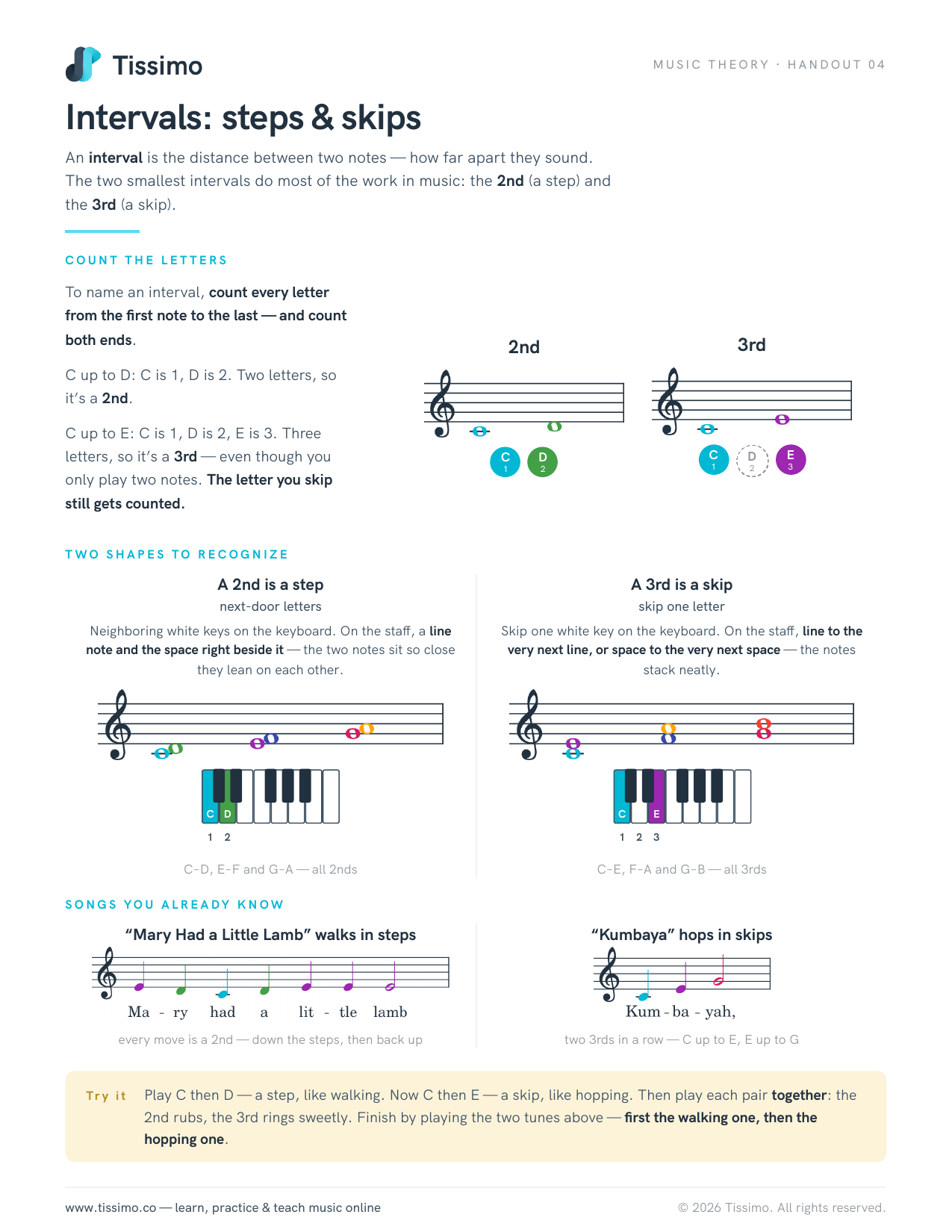 Intervals: steps & skipsAn interval is the distance between two notes — how far apart they sound. Two common melodic movements are the 2nd (a step) and the 3rd (a skip).
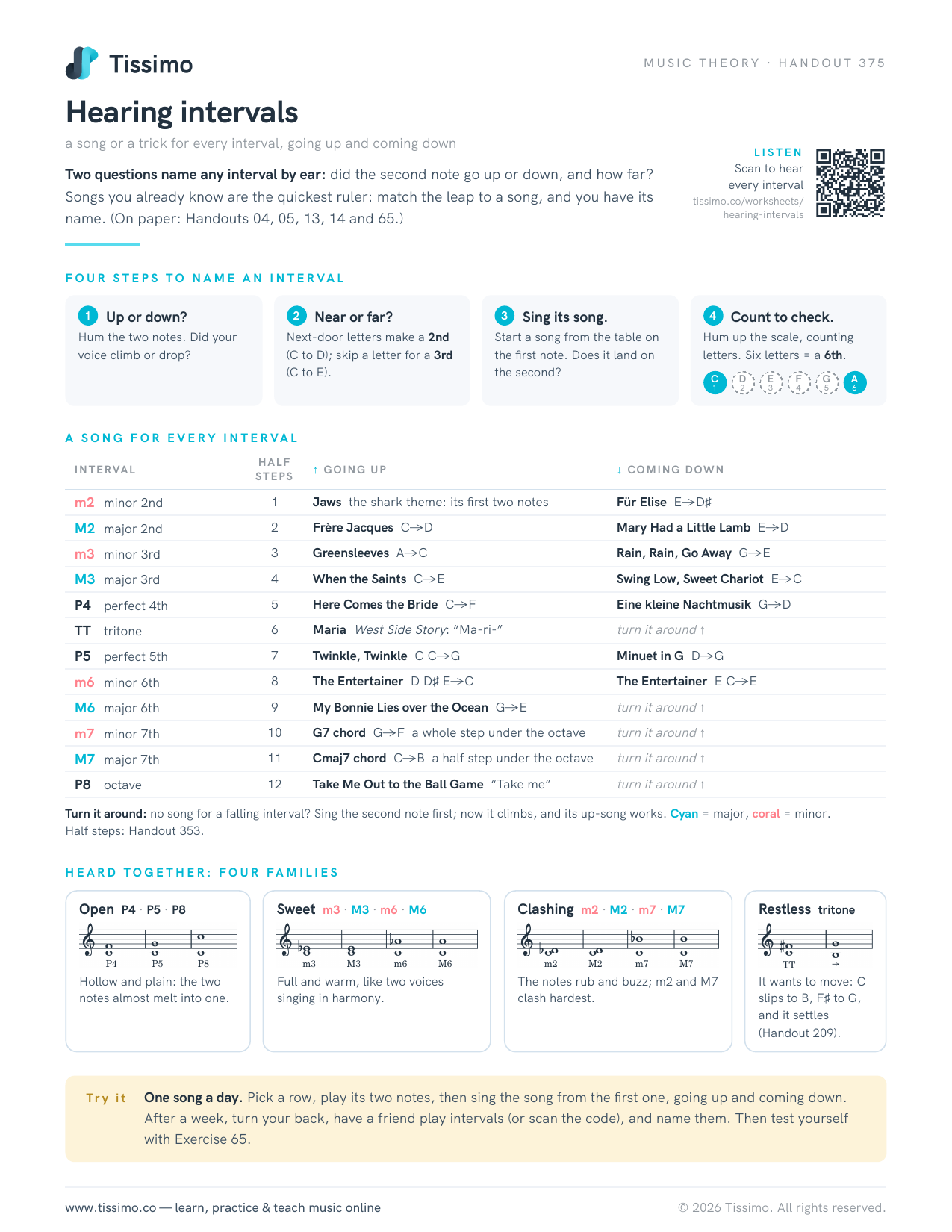 Hearing intervalsa song or a trick for every interval, going up and coming down
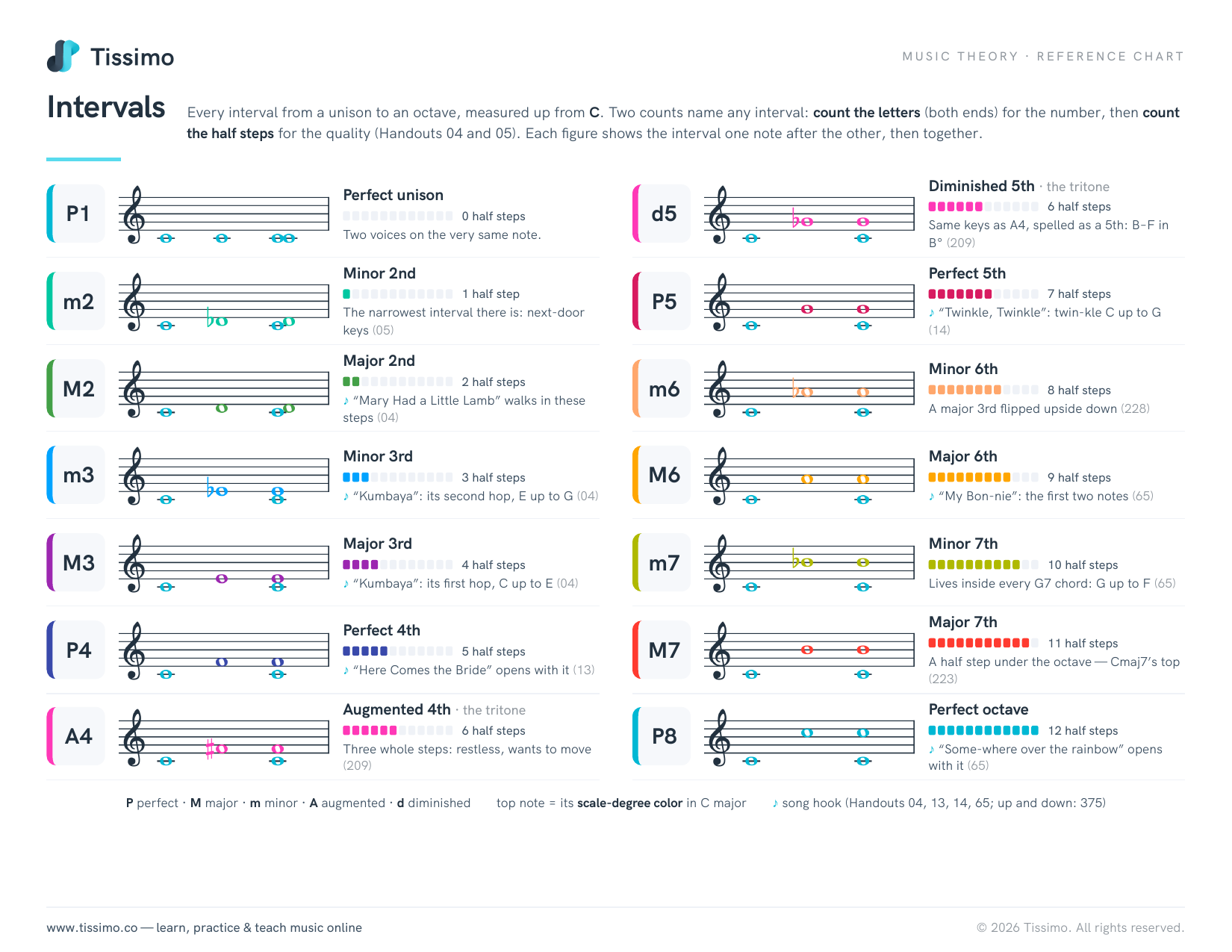 IntervalsEvery interval from a unison to an octave, measured up from C. Two counts name any interval: count the letters (both ends) for the number, then count the half steps for the quality (Handouts 04 and 05). Each figure shows the interval one note after the other, then together.