Sound & Acoustics
Frequency
Frequency is the number of times a sound wave vibrates per second, measured in hertz (Hz). The higher the frequency, the higher the pitch: A4 vibrates 440 times a second, the A above it 880.
Frequency is how many complete vibrations, or cycles, a sound makes in one second. It is measured in hertz (Hz): 1 Hz is one cycle per second. A string that moves back and forth 440 times a second produces a 440 Hz tone, the A above middle C that orchestras tune to (A440).
Frequency and pitch
Frequency is the physical quantity behind pitch: higher frequency, higher pitch. The relationship works by ratios, not by adding. Every time you double the frequency, the pitch rises by an octave.
So the A's on a piano are 27.5, 55, 110, 220, 440, 880 Hz and so on up. Going from 110 to 220 Hz and from 440 to 880 Hz are both one octave, even though the second jump covers four times as many hertz. That is why musicians measure small pitch differences in cents, which are based on ratios, rather than in hertz.
Frequency and intervals
Simple frequency ratios give the basic intervals: 2:1 is an octave, 3:2 a perfect fifth, 4:3 a perfect fourth, 5:4 a major third. A note at 200 Hz and one at 300 Hz form a pure perfect fifth. In equal temperament, the tuning of modern pianos, each half step multiplies the frequency by the twelfth root of 2 (about 1.0595), so most intervals land very slightly off these pure ratios.
Period and wavelength
Two more measurements come with frequency:
- The period is the time one cycle takes: 1 divided by the frequency. At 440 Hz it is about 2.3 milliseconds.
- The wavelength is the distance one cycle covers in the air: the speed of sound (about 343 meters per second at room temperature) divided by the frequency. For A4 that is about 78 centimeters; for the piano's lowest A, at 27.5 Hz, it is over 12 meters.
One note, many frequencies
A musical tone rarely contains just one frequency. A piano's A4 has a fundamental at 440 Hz plus overtones at about 880, 1,320 and 1,760 Hz and higher. The fundamental usually decides the pitch you hear, and the mix of overtones decides the timbre.
See how MIDI note numbers map onto frequencies in MIDI Notes, Octaves and Frequency, and hear what happens when two frequencies almost match in Hear the Pulse Between Two Tones.
Common questions
What is the frequency of middle C?
About 261.63 Hz, when the A above it is tuned to 440 Hz in equal temperament. The C an octave higher is about 523.25 Hz.
Is frequency the same as pitch?
Not quite. Frequency is a measurement in hertz; pitch is how high or low you hear the sound. They track each other closely, but pitch is a perception: you can hear the pitch of a low note on a small speaker that cannot reproduce its fundamental frequency at all.
Practice it: free worksheets
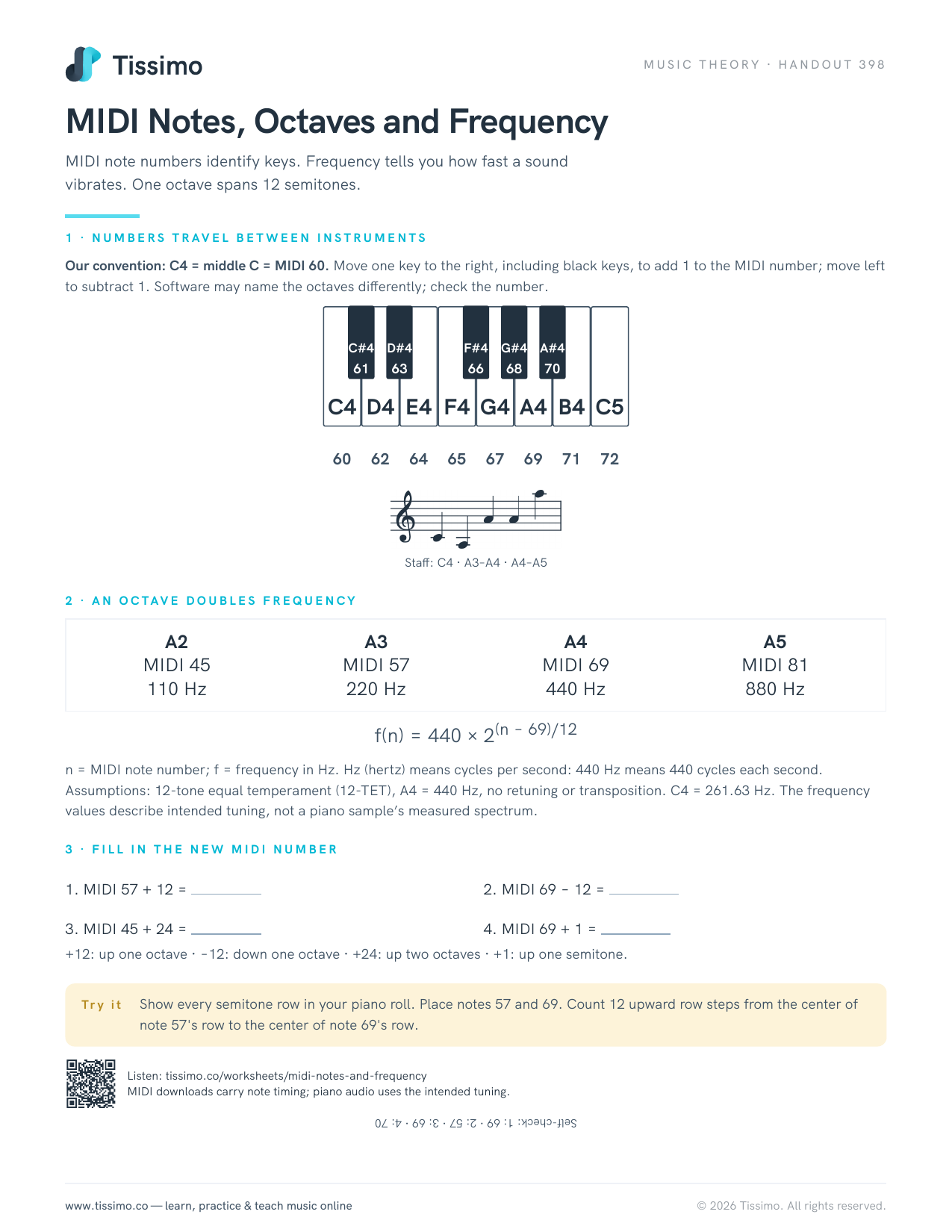 MIDI Notes, Octaves and FrequencyMIDI note numbers identify keys. Frequency tells you how fast a sound vibrates. One octave spans 12 semitones.
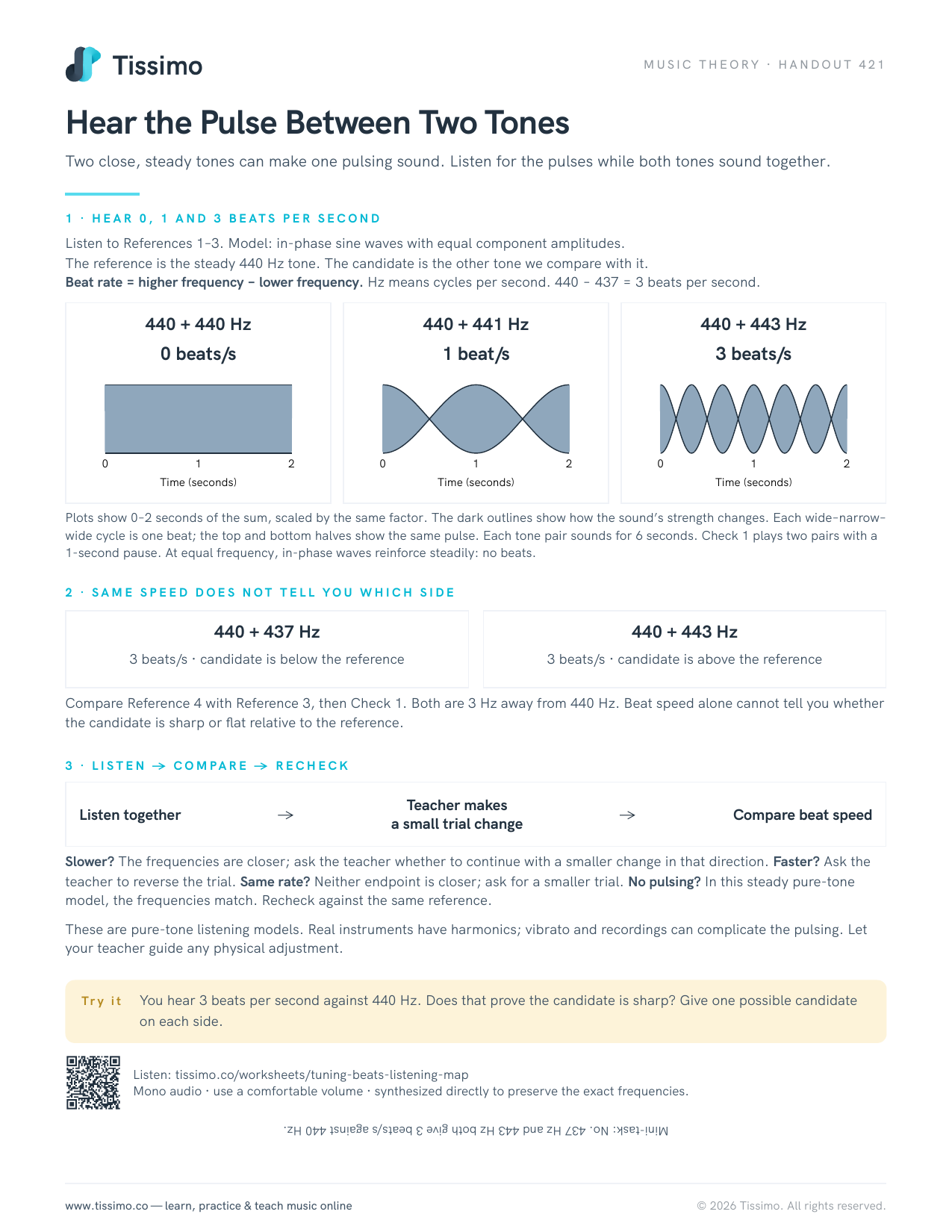 Hear the Pulse Between Two TonesTwo close, steady tones can make one pulsing sound. Listen for the pulses while both tones sound together.
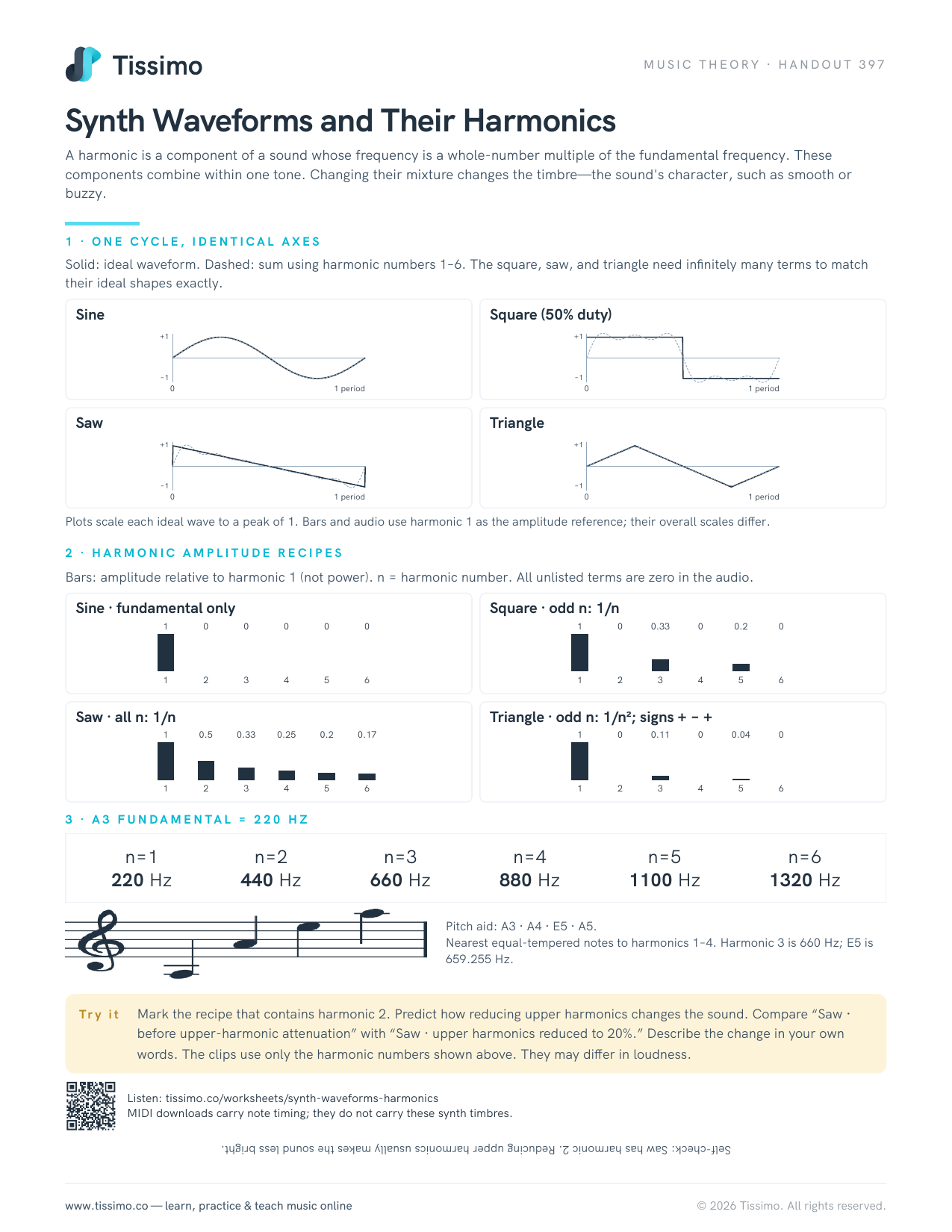 Synth Waveforms and Their HarmonicsA harmonic is a component of a sound whose frequency is a whole-number multiple of the fundamental frequency. These components combine within one tone. Changing their mixture changes the timbre—the sound's character, such as smooth or buzzy.