Sound & Acoustics
Harmonic Series
The harmonic series is the set of frequencies at whole-number multiples of a fundamental: 1, 2, 3, 4 times and so on. Above a low C it gives C, C, G, C, E, G, a flat B♭, C, and continues upward.
When a string or a column of air vibrates, it does not vibrate in just one way. It vibrates as a whole, and at the same time in halves, thirds, quarters and smaller sections. Each way of vibrating adds its own frequency, and those frequencies are whole-number multiples of the lowest one, the fundamental: 1×, 2×, 3×, 4× and so on. That ladder of frequencies is the harmonic series, and each rung is a harmonic.
The series on C
Take C2, a low C on the piano at about 65.4 Hz. Its first 16 harmonics fall close to these notes:
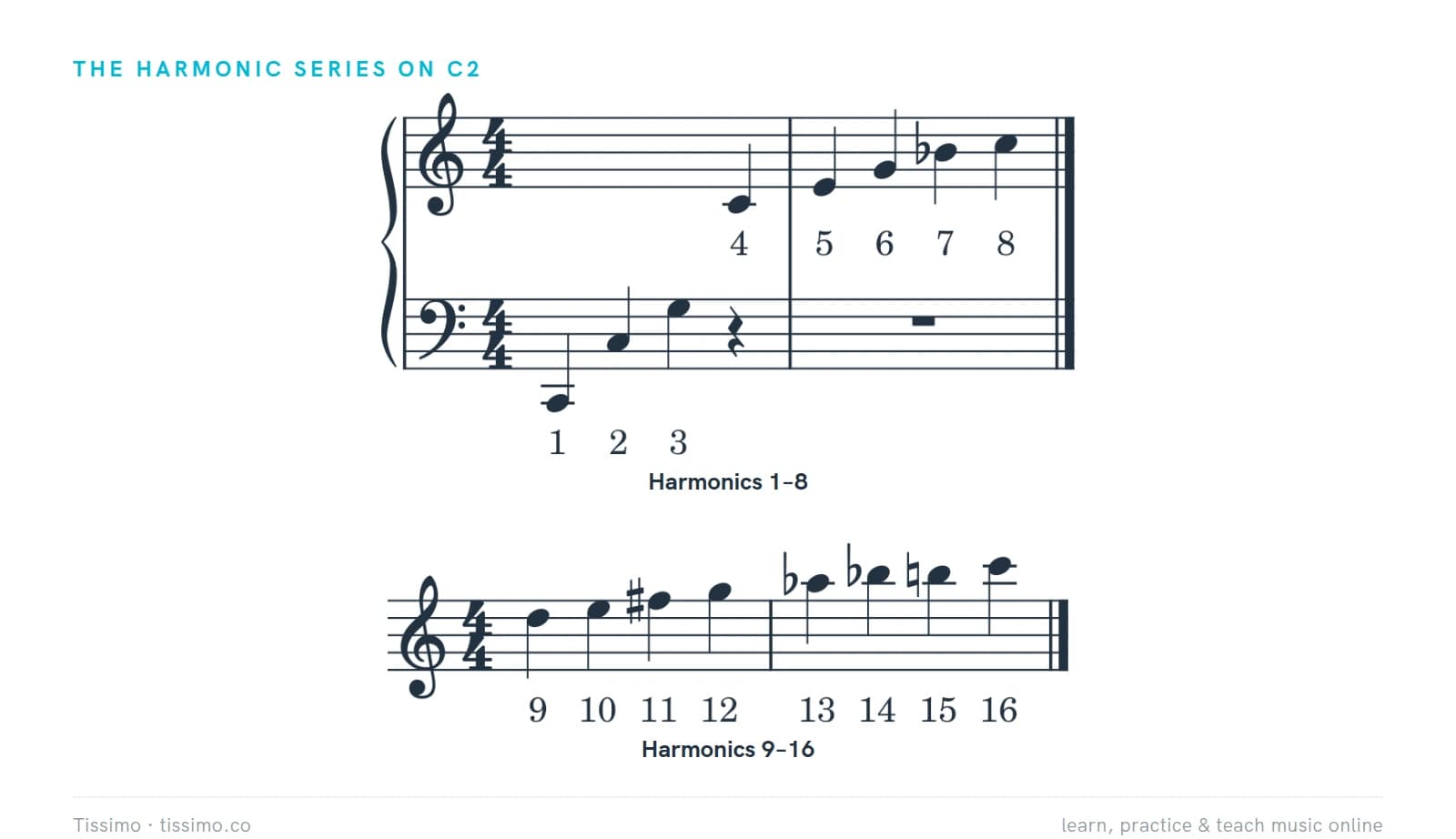
Read the pattern from the bottom. The gaps between neighboring harmonics shrink as you go up: an octave (1 to 2), a perfect fifth (2 to 3), a perfect fourth (3 to 4), a major third (4 to 5), a minor third (5 to 6), then smaller and smaller intervals. Harmonics 4, 5 and 6 spell a major triad, which many theorists connect with how settled a major chord sounds.
The first eight in hertz:
- Harmonic 1: 65.4 Hz (C2)
- Harmonic 2: 130.8 Hz (C3)
- Harmonic 3: 196.2 Hz (G3)
- Harmonic 4: 261.6 Hz (C4, middle C)
- Harmonic 5: 327.0 Hz (E4)
- Harmonic 6: 392.4 Hz (G4)
- Harmonic 7: 457.8 Hz (near B♭4)
- Harmonic 8: 523.3 Hz (C5)
Not quite the piano's notes
The piano is tuned in equal temperament, and the harmonic series is not. The C's (harmonics 2, 4, 8, 16) match exactly, and the G's (3, 6, 12) are only about 2 cents sharp. But harmonic 5 (E) is about 14 cents lower than the piano's E, and harmonics 7 and 14 are about 31 cents lower than its B♭. Harmonic 11 falls almost exactly halfway between F and F♯, and harmonic 13 lies between A♭ and A. The audio of the figure plays the nearest piano keys, so it can only approximate those harmonics.
Where you meet the harmonic series
- In many pitched sounds. Strings, winds and voices often have approximately harmonic spectra. Some pitched percussion has inharmonic partials; a pure sine tone has no higher harmonics. The spectrum helps shape timbre.
- On brass instruments. A bugle has no valves, so all its notes are harmonics of one tube. Valves and slides choose a different tube length, and with it a new series; brass players call these notes partials.
- On string instruments. Touch a string lightly at its halfway point and you stop the fundamental, leaving harmonic 2, an octave higher: a natural harmonic. A touch at a third of the length leaves harmonic 3.
- In tuning. The simple ratios near the bottom of the series (2:1, 3:2, 4:3, 5:4) are the pure intervals of just intonation.
See the series at work in Touch Halfway: The Octave Harmonic, Trombone: One Register, Seven Positions and Synth Waveforms and Their Harmonics.
Common questions
What is the difference between harmonics and overtones?
Harmonics are whole-number multiples of the fundamental; overtones are components above it. In a complete harmonic series, overtone 1 is harmonic 2. Inharmonic overtones do not follow that numbering relationship. See overtone.
Why is the 7th harmonic out of tune?
Its frequency is exactly 7 times the fundamental, a ratio for which equal temperament has no note. It lands about 31 cents below the nearest B♭ on a piano, so it sounds flat against the piano's tuning.
Practice it: free worksheets
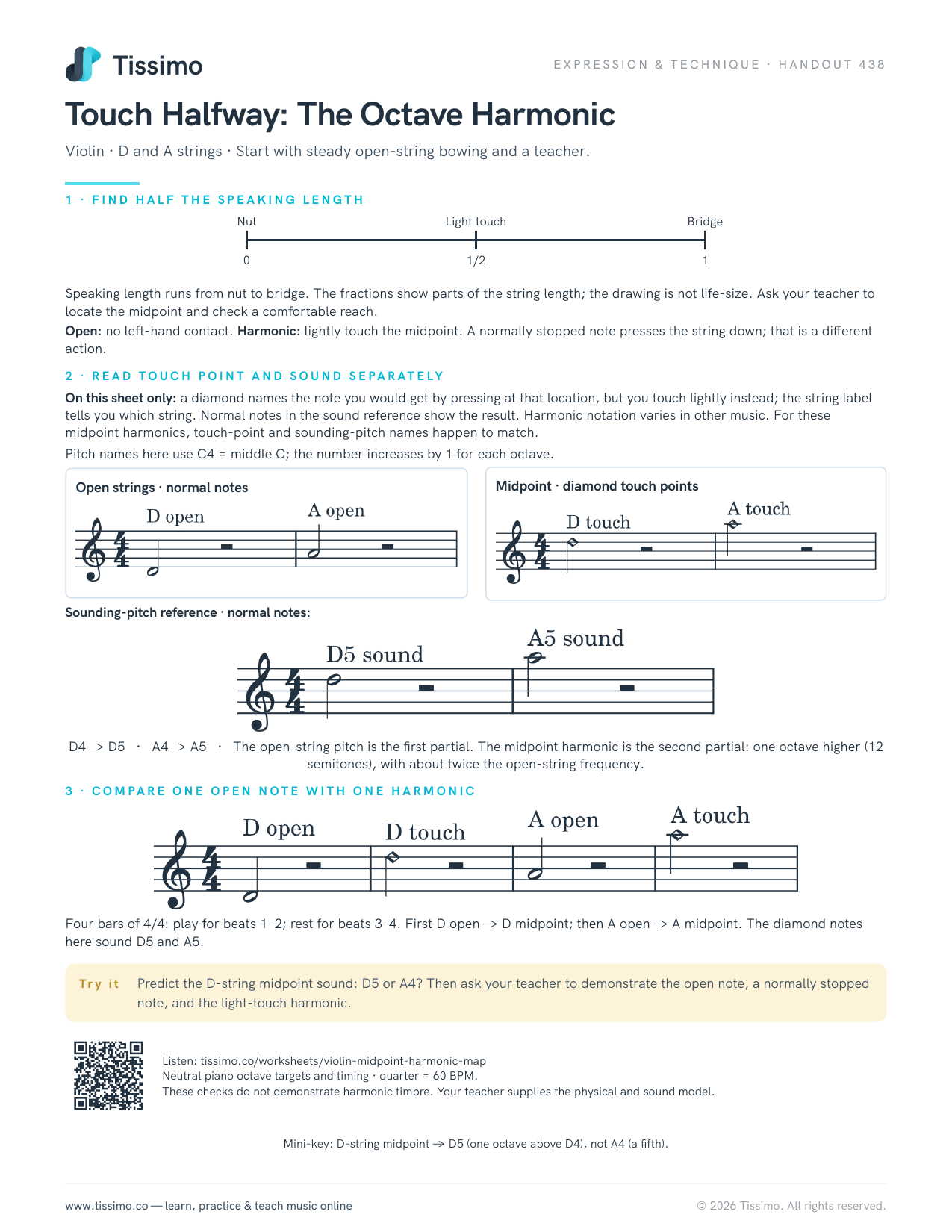 Touch Halfway: The Octave HarmonicViolin · D and A strings · Start with steady open-string bowing and a teacher.
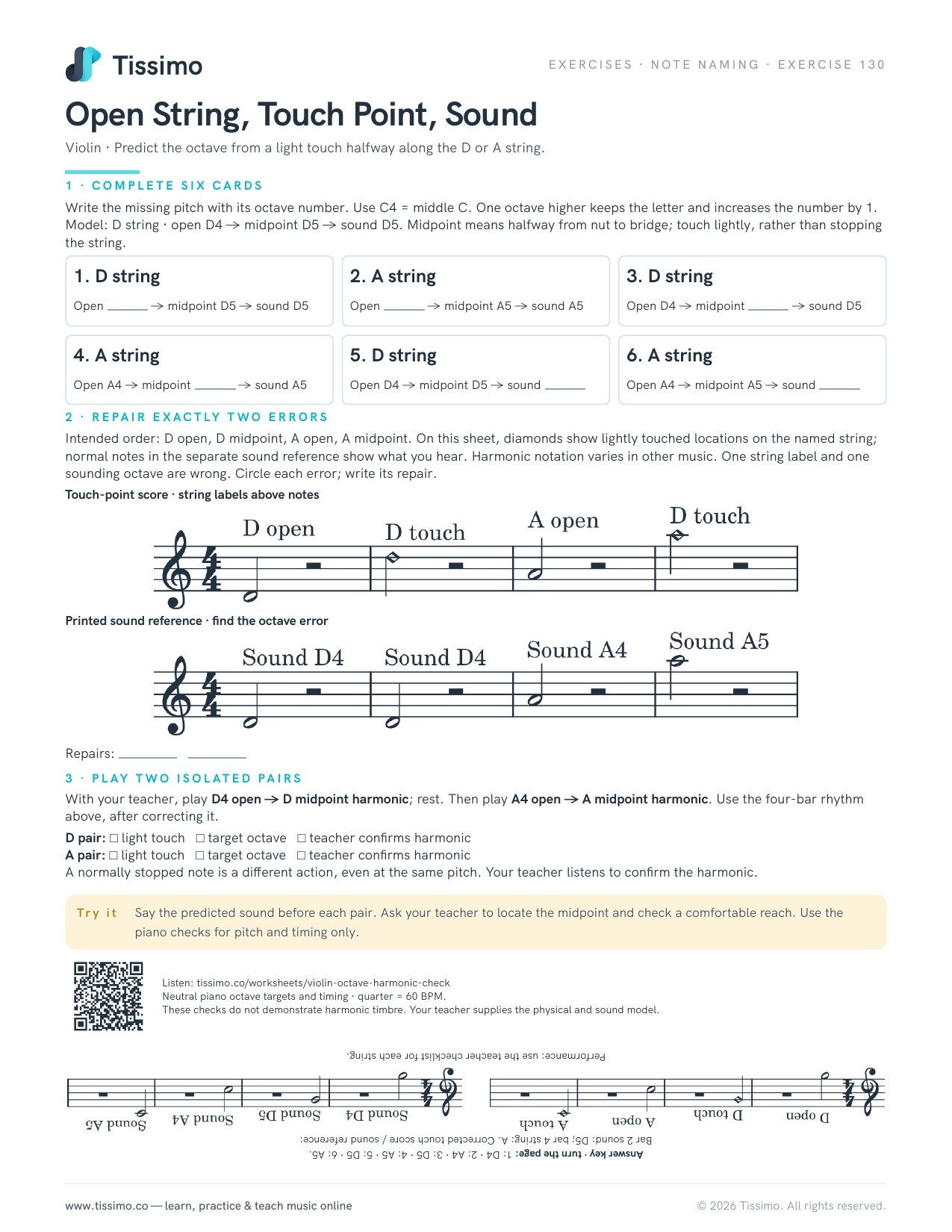 Open String, Touch Point, SoundViolin · Predict the octave from a light touch halfway along the D or A string.
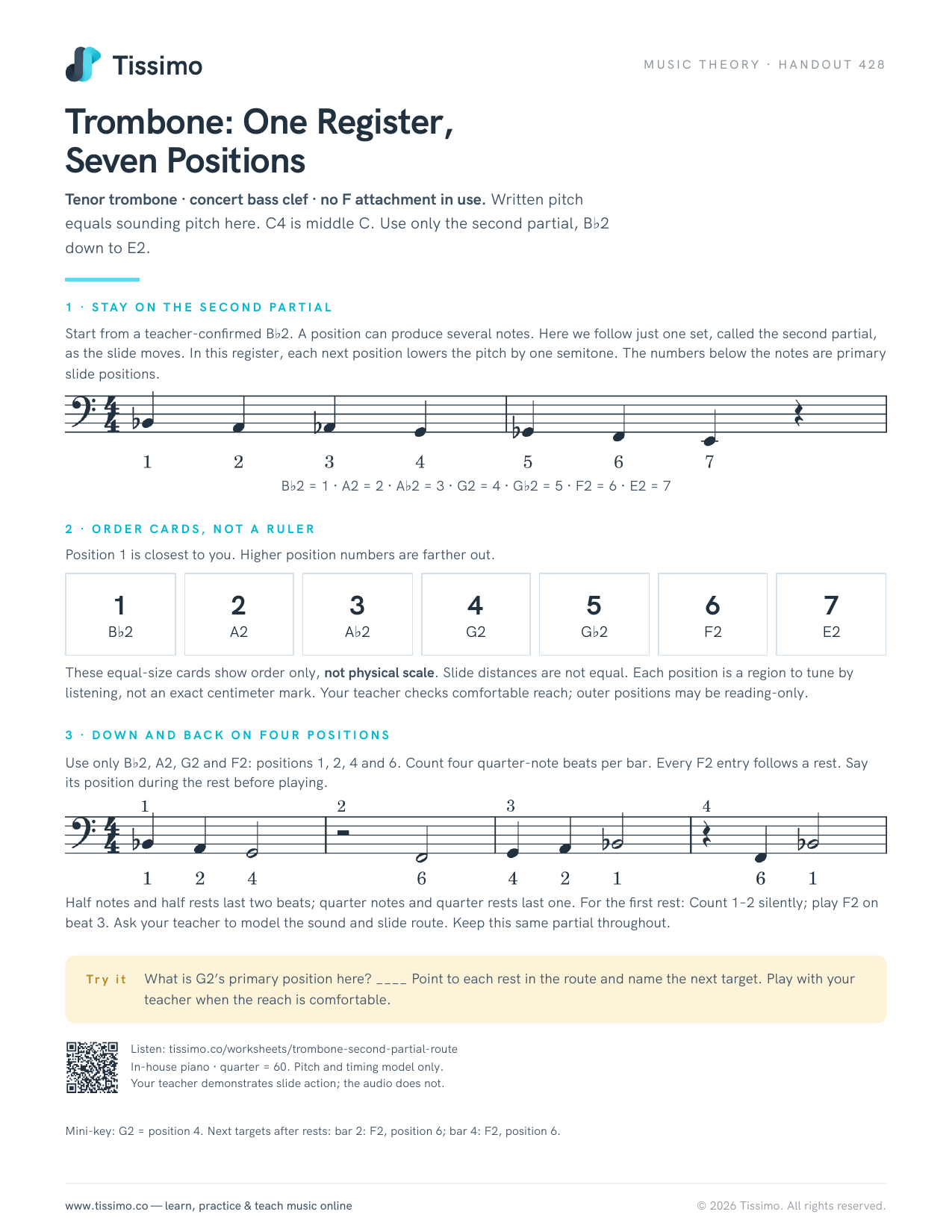 Trombone: One Register, Seven PositionsTenor trombone · concert bass clef · no F attachment in use. Written pitch equals sounding pitch here. C4 is middle C. Use only the second partial, B♭2 down to E2.
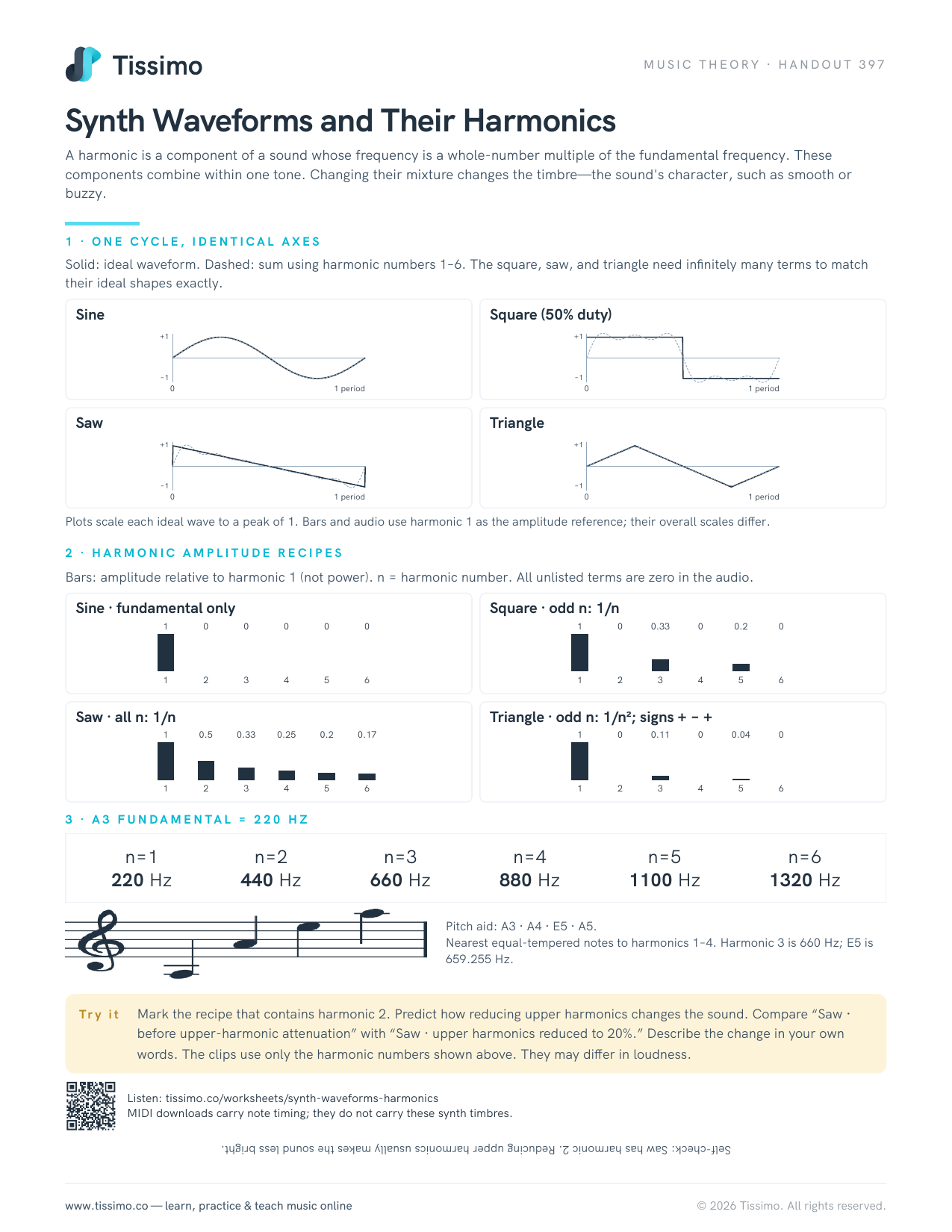 Synth Waveforms and Their HarmonicsA harmonic is a component of a sound whose frequency is a whole-number multiple of the fundamental frequency. These components combine within one tone. Changing their mixture changes the timbre—the sound's character, such as smooth or buzzy.