Sound & Acoustics
Resonance
Resonance is the way an object vibrates strongly when it is pushed at its own natural frequency. Instrument bodies, air columns and your vocal tract use resonance to make sounds louder and give them color.
Everything that can vibrate has one or more natural frequencies: the rates at which it prefers to swing. Push a playground swing once per swing and, even with small pushes, it goes higher and higher; push at a random rhythm and it barely moves. Resonance is the same effect in sound: an object driven at one of its natural frequencies vibrates far more strongly than at any other.
Resonance in instruments
A vibrating string on its own moves very little air and is surprisingly quiet. Instruments use resonance to make it heard:
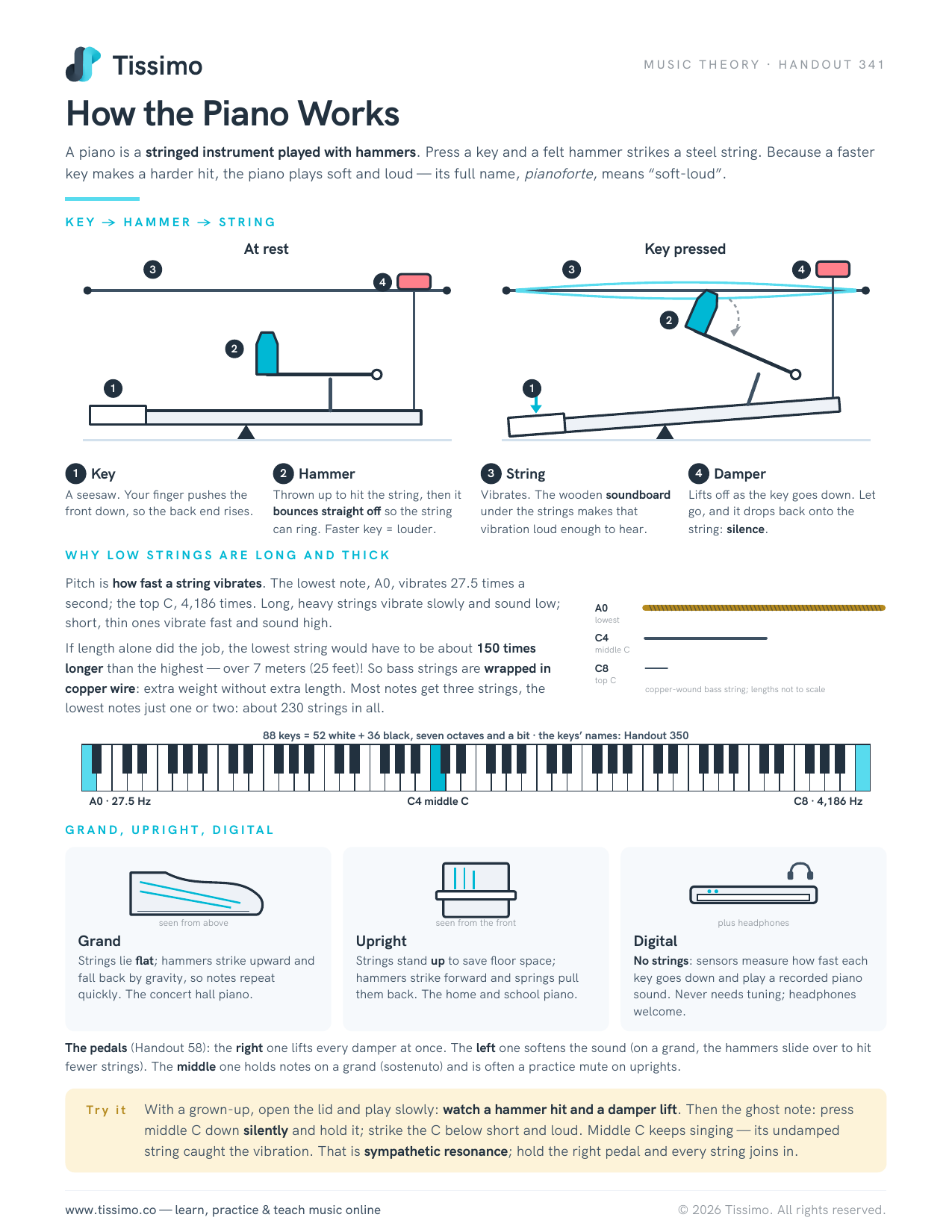
- Soundboards and bodies. A piano's strings pass their vibration through a bridge to a large wooden soundboard; a guitar's or violin's strings drive the top of a hollow body. The wood and the air inside respond strongly in some frequency regions and less in others, which makes the instrument louder and shapes its timbre.
- Air columns. In a flute, clarinet or trumpet, the air inside the tube is the resonator. Its natural frequencies, set by the tube's length and shape, decide which notes the instrument can play. Tone holes and valves change the length of the column, and so its resonances.
- The voice. Your vocal folds produce a buzz full of overtones. Your throat and mouth act as resonators, strengthening certain frequency regions called formants. Changing the shape of your mouth moves them, which is how you sing different vowels on the same pitch.
- Resonator tubes. The metal tubes under the bars of a marimba or vibraphone are tuned to each bar's pitch, making the notes louder and longer.
Sympathetic resonance
Resonance can also let one object set another in motion through the air. Sing a loud note into a piano with the dampers raised and some strings will answer, because their natural frequencies match frequencies in your voice. That case has its own name: sympathetic vibration.
Unwanted resonance
Resonance is not always welcome. A room can boom on certain bass notes because its dimensions match those wavelengths, a snare drum's wires can buzz whenever the bass plays one particular note, and a loose music stand can rattle on a single pitch. In recording, EQ is often used to tame a resonant frequency that sticks out.
Resonance in a teacher's vocabulary
Teachers also use "resonance" loosely for a full, ringing tone, as in "more resonance in your low notes". That usage describes quality, but it rests on the same physics: a tone that makes the instrument's body, or the singer's throat and mouth, respond well.
See how a piano's strings and soundboard work together in How the Piano Works.
Common questions
What is the difference between resonance and sympathetic vibration?
Resonance is the general effect: an object vibrates strongly when driven at one of its natural frequencies. Sympathetic vibration is resonance set off by a separate sound source nearby, such as an undamped piano string answering a sung note.
Why do instruments have hollow bodies?
A string alone moves too little air to be heard well. The hollow body, with its wooden top and the air inside, resonates with the string's vibration, which makes the sound louder and gives the instrument much of its character.