Sound & Acoustics
Sound
Sound is vibration traveling through air, water or a solid as waves of pressure. When those waves reach your ears, you hear them as sound; regular vibrations are heard as musical tones.
Sound is a vibration that travels. A guitar string, a drumhead or your vocal folds move back and forth, push on the air next to them, and set off a chain of tiny pressure changes: squeezed air (compression), then stretched air (rarefaction), again and again. These pressure waves spread out in every direction. When they reach your eardrum, it vibrates in the same pattern, and your inner ear and brain turn that motion into what you hear.
What sound needs
Sound needs something to travel through: air, water, wood, metal. In a vacuum there is nothing to carry the pressure changes, so there is no sound. In air at room temperature (20 °C) sound travels at about 343 meters per second, roughly a kilometer every three seconds. That is why you see lightning before you hear the thunder. Sound moves faster in warmer air, much faster in water, and faster still in solids such as steel.
The properties of a musical sound
Four properties describe most musical sounds, and each has a physical side:
- Pitch: how high or low it is. It follows the frequency, the number of vibrations per second, measured in hertz.
- Loudness: how strong it is. It follows the amplitude, the size of the pressure changes, usually measured in decibels.
- Tone color, or timbre: why a flute and a violin sound different on the same note. It depends on the mix of overtones and on the envelope, how the sound starts, holds and fades.
- Duration: how long it lasts, which is what rhythm organizes.
Musical tones and noise
When a vibration repeats regularly, as a string or an air column does, you hear a definite pitch: a musical tone made of a fundamental and its harmonics. When the vibration is irregular, as with rain, a snare drum or a whispered "shhh", you hear noise. Most instruments make a little of both: the breath in a flute tone, the scrape of a bow, the thump of a piano hammer.
The range of hearing
Young listeners hear roughly from 20 Hz to 20,000 Hz. The upper limit drops gradually with age and with noise damage, so protecting your hearing at loud rehearsals and concerts is worth the trouble. The piano covers a good slice of that range, from 27.5 Hz (its lowest A) to about 4,186 Hz (its top C), and the overtones of its notes reach much higher.
To see how one instrument turns a key press into sound, read How the Piano Works. Synth Waveforms and Their Harmonics shows how a sound's harmonics shape its color.
Common questions
Can sound travel through space?
No. Sound needs a medium such as air, water or a solid to carry its pressure waves. In the near-vacuum of space there is almost nothing to carry them, so even a huge explosion out there would be silent.
How fast does sound travel?
In air at 20 °C, about 343 meters per second (about 1,125 feet per second). It travels a little faster in warmer air, much faster in water, and faster still in solids such as steel.
Practice it: free worksheets
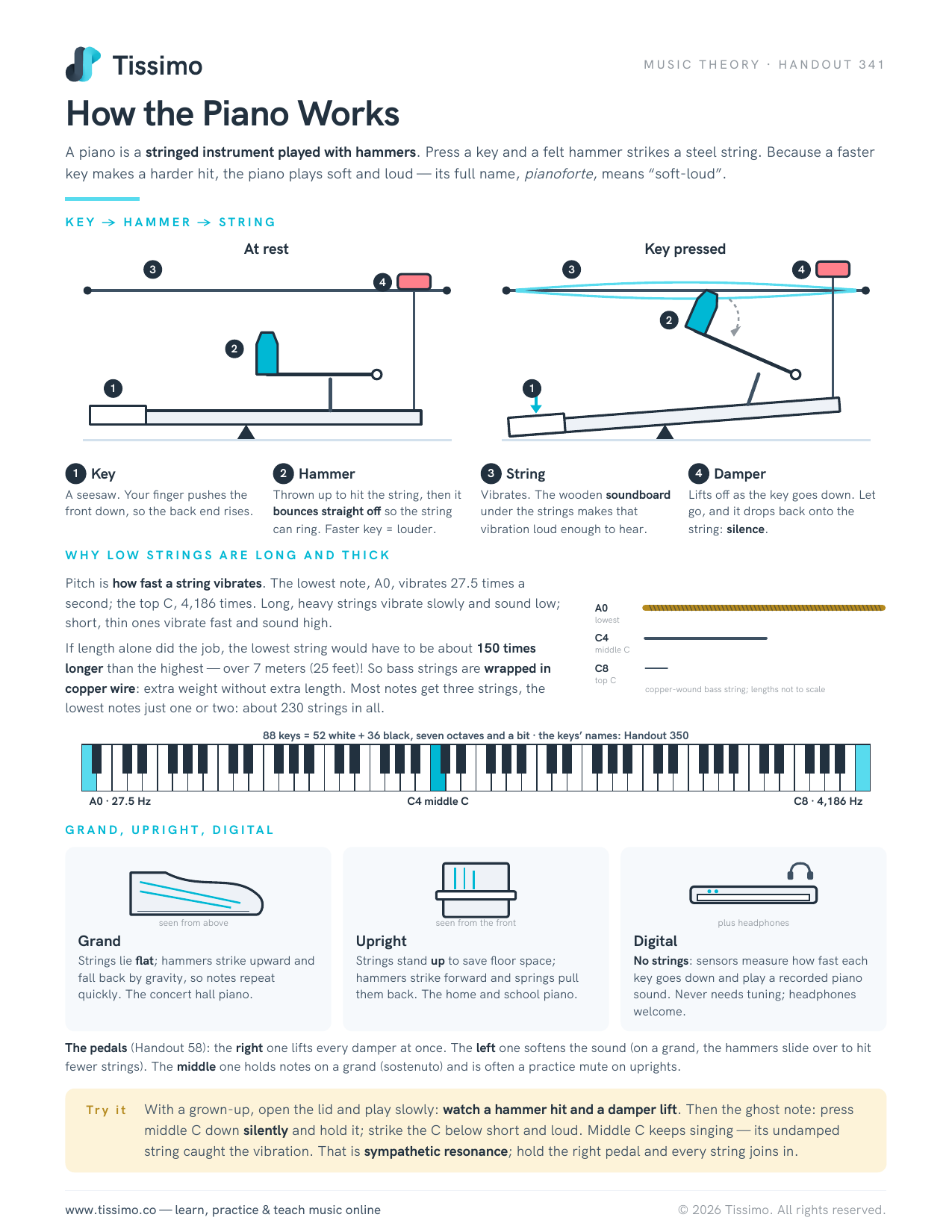 How the Piano WorksA piano is a stringed instrument played with hammers. Press a key and a felt hammer strikes a steel string. Because a faster key makes a harder hit, the piano plays soft and loud — its full name, pianoforte, means “soft-loud”.
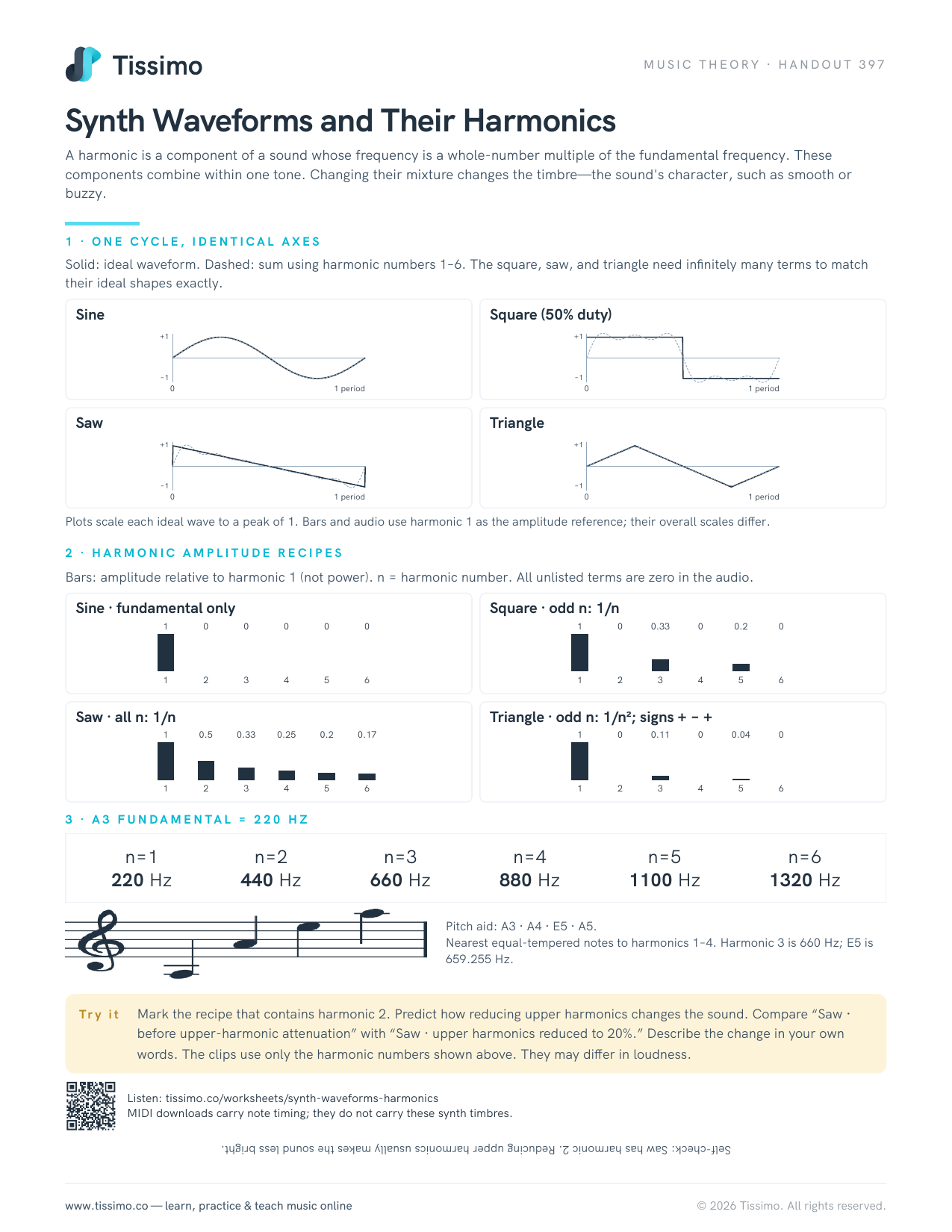 Synth Waveforms and Their HarmonicsA harmonic is a component of a sound whose frequency is a whole-number multiple of the fundamental frequency. These components combine within one tone. Changing their mixture changes the timbre—the sound's character, such as smooth or buzzy.
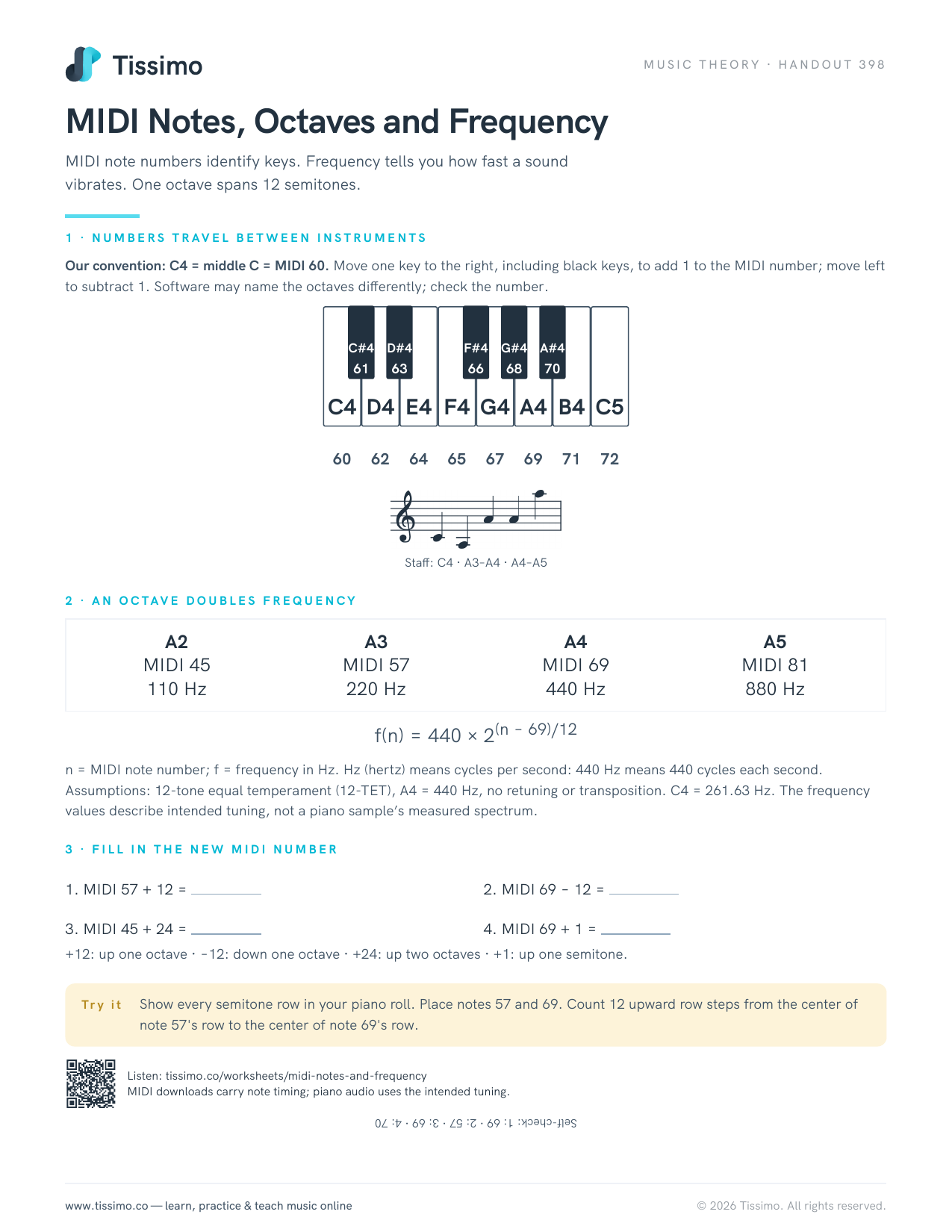 MIDI Notes, Octaves and FrequencyMIDI note numbers identify keys. Frequency tells you how fast a sound vibrates. One octave spans 12 semitones.