Sound & Acoustics
Noise
In acoustics, noise is sound without a regular, repeating vibration, so it has no definite pitch. In recording, noise also means any unwanted sound, such as hiss, hum or room rumble.
"Noise" has two meanings in music, and both are useful.
Noise as a kind of sound
A musical tone comes from a regular vibration: a string or an air column repeating the same motion hundreds of times a second, with a fundamental and overtones neatly spaced above it. That regularity gives it a definite pitch. Noise is the opposite: an irregular vibration whose energy is spread across many frequencies at once, with no repeating pattern. You hear it as a hiss, a rush, a crash or a rustle rather than as a note you could sing back.
Music is full of noise used on purpose:
- Percussion. A snare drum's rattle, a cymbal crash, shakers and brushes are mostly noise, which is why they fit with music in any key.
- Parts of pitched sounds. The breath in a flute tone, the scrape at the start of a bowed note and the thump of a piano hammer are short bursts of noise inside a pitched sound. They matter for timbre: without them, instruments sound oddly artificial.
- Consonants. Singers make noise with every "s", "sh", "f" and "t".
- Electronic music. A synthesizer's noise generator is raw material for hi-hats, snares, wind effects and rising sweeps.
Colors of noise
Engineers name noise by how its energy is spread:
- White noise has equal average power in equal-width frequency bands, such as each 100 Hz band. Because the ear hears by octaves, and each higher octave spans more hertz, white noise sounds bright and hissy.
- Pink noise has equal power in every octave, falling by 3 dB per octave. It sounds more balanced to the ear and is often used to test and tune sound systems.
- Brown noise falls off more steeply still and sounds like a deep rumble.
Noise as unwanted sound
In recording, noise means anything that isn't the music: tape hiss, the hum of mains electricity at 50 or 60 Hz, a computer fan, traffic outside. Engineers talk about the noise floor, the level of background sound in a system, and the signal-to-noise ratio, how far the music rises above it. Good microphone placement, careful gain settings and quiet rooms keep noise down, and noise-reduction tools can remove some of the rest.
Noise as music
In the 20th century, composers began treating noise itself as musical material: Luigi Russolo built noise-making machines in the 1910s, and Pierre Schaeffer composed musique concrète from recorded sounds in the late 1940s. Many electronic and experimental styles continue that tradition.
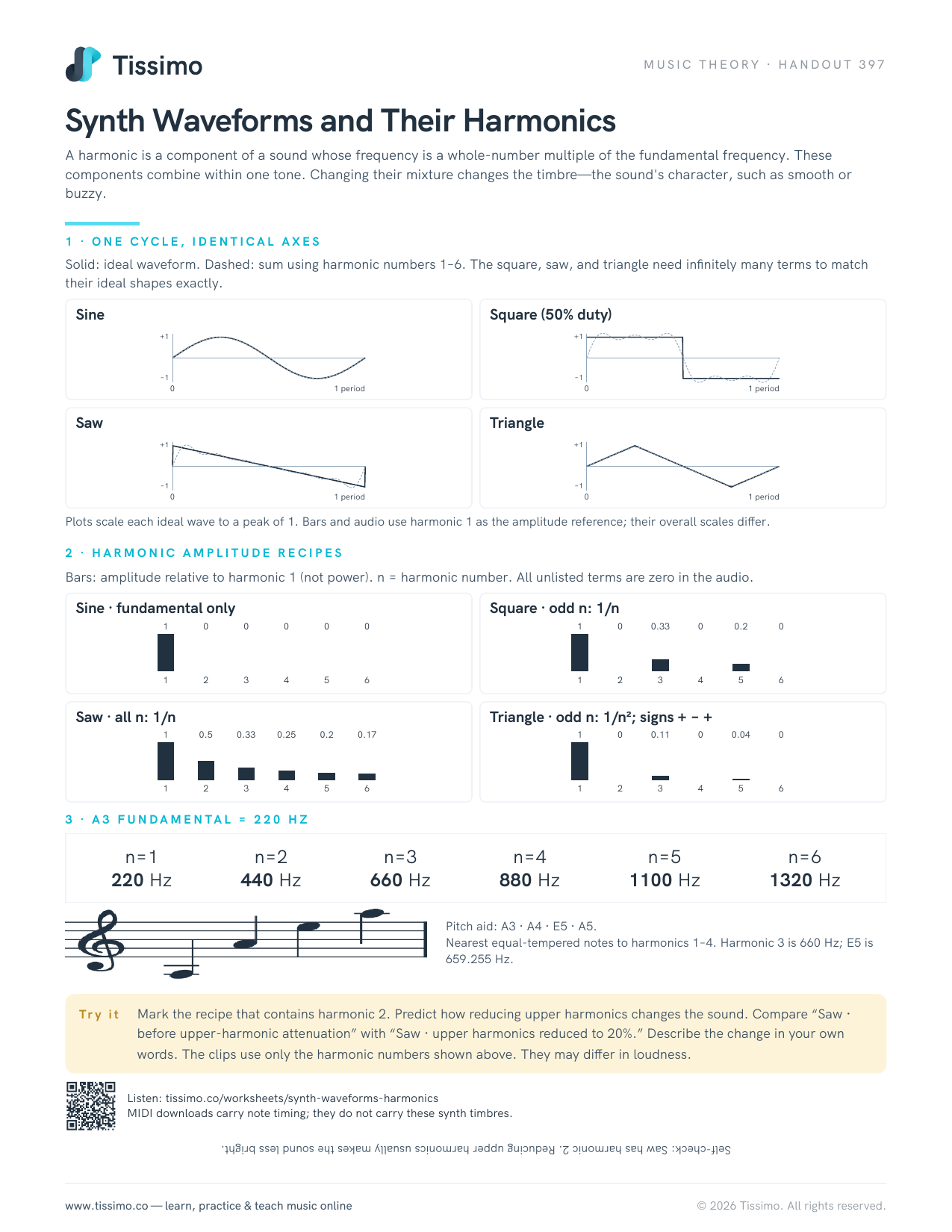
Compare noise with the orderly harmonics of pitched waveforms in Synth Waveforms and Their Harmonics.
Common questions
What is the difference between white noise and pink noise?
White noise has equal average power in equal-width frequency bands, so it sounds bright and hissy. Pink noise has equal energy in every octave, which tilts it toward the low end and makes it sound more even to the ear; it is often used to test speakers and rooms.
Is noise the same as sound?
No. Sound is any vibration you can hear. Noise is a particular kind of sound, one without a regular, repeating pattern and therefore without a clear pitch, or, in everyday and studio use, any sound you don't want.