Sound & Acoustics
Decibel (dB)
Written as dB
A decibel (dB) is a logarithmic unit that compares a sound's level with a reference. Every 10 dB step means ten times the sound intensity, which most listeners hear as roughly twice as loud.
The decibel, written dB, is the unit musicians and engineers use for sound level. It is a tenth of a bel, a unit named after Alexander Graham Bell. A decibel figure is always a comparison: it says how much stronger or weaker a sound is than some reference level.
Why a logarithmic scale
The ear handles an enormous range. A sound loud enough to hurt has about a million times the pressure of the faintest sound you can hear, and about a million million times its intensity. A logarithmic scale squeezes that range into manageable numbers, and it fits hearing better: each 10 dB step sounds like roughly the same jump in loudness, wherever you start.
Three rules of thumb cover most situations:
- +3 dB doubles the power (intensity) of a sound.
- +6 dB doubles its amplitude (sound pressure).
- +10 dB is ten times the intensity, and listeners usually describe it as roughly twice as loud.
So two equally loud trumpets playing together measure about 3 dB more than one, not twice as loud.
Different kinds of decibel
- dB SPL (sound pressure level) measures sound in the air, relative to 20 micropascals, roughly the quietest sound a young ear can detect at 1,000 Hz. Sound level meters often apply A-weighting (dBA), which discounts low and very high frequencies the way the ear does.
- dBFS (decibels relative to full scale) is used in digital audio. 0 dBFS is the maximum sample level in fixed-point formats such as 16- or 24-bit PCM. Floating-point processing can represent levels above it, but those must be reduced before a fixed-point export or output stage that would clip.
- Faders, gain knobs and EQ controls show plain dB: a change relative to where the signal was.
Protecting your hearing
Loud music damages hearing gradually and permanently. The U.S. National Institute for Occupational Safety and Health (NIOSH) recommends limiting exposure to 85 dBA averaged over 8 hours, and halving the time for every 3 dB above that: 88 dBA for 4 hours, 91 dBA for 2 hours, and so on. Rock concerts, brass sections and drum kits in small rooms can exceed those levels, so musicians' earplugs, which lower the level fairly evenly across frequencies, are a good investment.
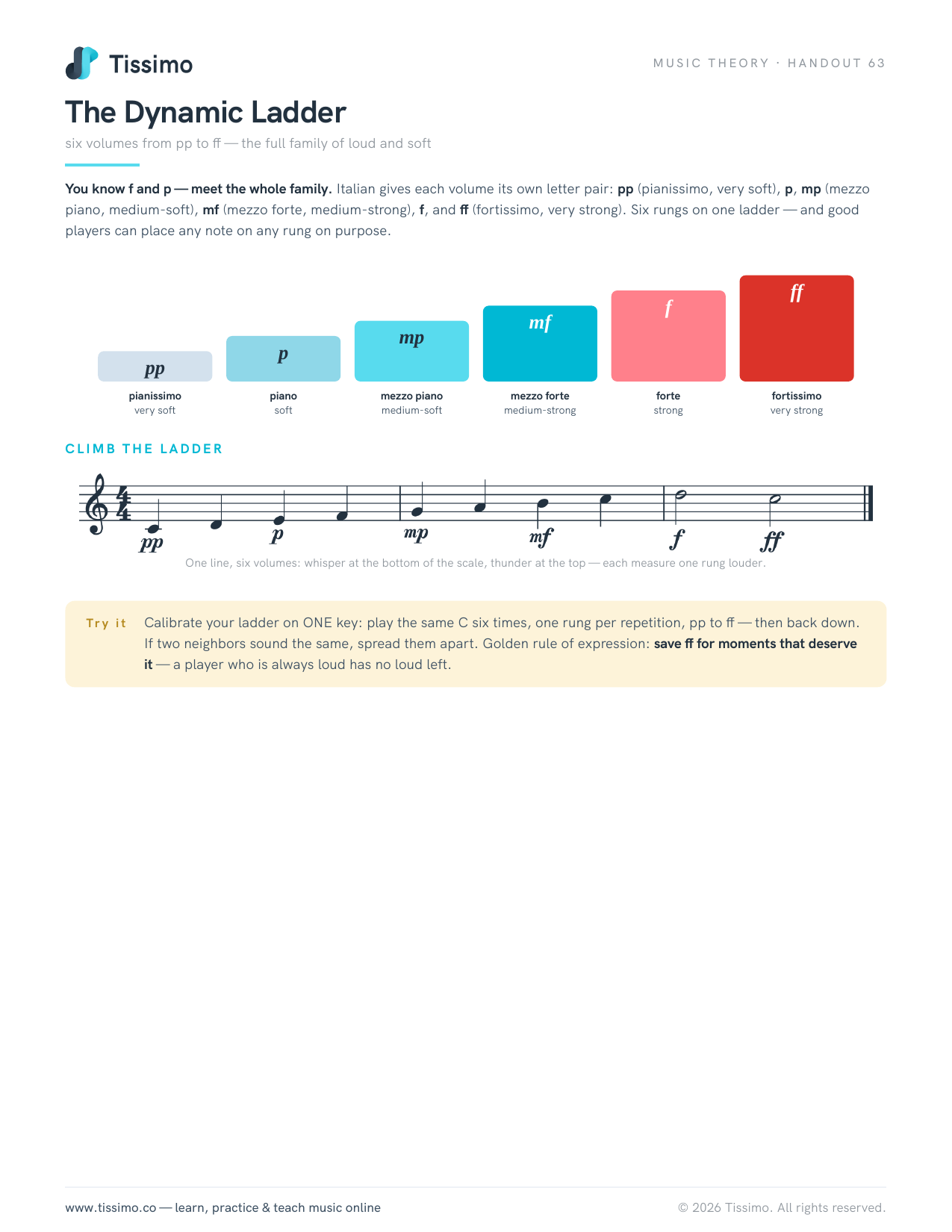
The markings in a score, from pp to ff, are relative rather than fixed decibel values; The Dynamic Ladder shows how they relate to each other.
Common questions
How many decibels is too loud?
NIOSH's occupational recommendation is 85 dBA over 8 hours, halving the duration for every 3 dB increase: 100 dBA reaches that daily dose in 15 minutes. This is not a guarantee of safety. Reduce exposure and use hearing protection in loud settings.
Is 10 dB twice as loud?
Roughly, as most listeners hear it. Physically, +10 dB is ten times the intensity. +3 dB doubles the intensity and +6 dB doubles the sound pressure, but neither sounds twice as loud.