Sound & Acoustics
Timbre
Pronounced TAM-ber
Timbre (TAM-ber) is the tone color of a sound: the quality that lets you tell a flute from a violin when both play the same note at the same loudness.
Timbre is the color or character of a sound. Play the same A, equally loud and equally long, on a piano, a trumpet and a clarinet, and you still know at once which is which. What you are recognizing is timbre. Musicians describe it with words borrowed from the other senses: bright, dark, warm, thin, reedy, breathy, nasal.
What creates timbre
A musical note is not one pure frequency. It contains a fundamental, which usually sets the pitch, plus a family of higher overtones. Several things shape the timbre you hear:
- The overtone recipe: which overtones are present and how strong each one is. A flute's upper overtones are fairly weak, so it sounds pure; an oboe's are strong, so it sounds bright and reedy. The clarinet's low register is unusual: its odd-numbered harmonics are much stronger than the even ones, which gives that register its hollow sound.
- The envelope: how the sound starts, holds and fades. A piano note starts with a sharp attack and dies away; a bowed violin note can swell. Cut the first moment off a recording and many instruments become surprisingly hard to identify.
- Noise and movement: the breath in a flute, the scrape of a bow, the click of a key, and slow changes in pitch and loudness such as vibrato all belong to a sound's identity.
- Resonances: the body of a guitar or the shape of your mouth and throat strengthen some frequency regions. Those strengthened regions, called formants, are what distinguish vowels: "ee" and "ah" sung on the same pitch differ in timbre.
Timbre in practice
Players spend years shaping their timbre: a pianist's touch, a guitarist's choice of where to pluck (near the bridge sounds brighter), a singer's vowels, a brass player's mute. Composers and arrangers choose and combine instruments for their colors, which is the art of orchestration. In electronic music a synthesizer builds timbre directly, starting from simple waveforms and filtering their harmonics.
Timbre, pitch and loudness
Timbre is usually defined as whatever tells two sounds apart when their pitch, loudness and duration are the same. In practice the three interact: most instruments sound brighter when played louder, and their color changes from one register to another.
Hear how waveforms and harmonics change a sound's color in Synth Waveforms and Their Harmonics, and how a harpsichord's stops change it in Harpsichord Stops: Predict the Sound.
Common questions
How do you pronounce timbre?
Most musicians say TAM-ber, rhyming with "amber", close to the French original. It is not usually pronounced like timber, the wood.
What is the difference between timbre and tone?
Tone is used loosely for several things, including the quality of a sound ("she has a lovely tone"). Timbre is the precise word for that quality: the color that separates two sounds of the same pitch and loudness.
Practice it: free worksheets
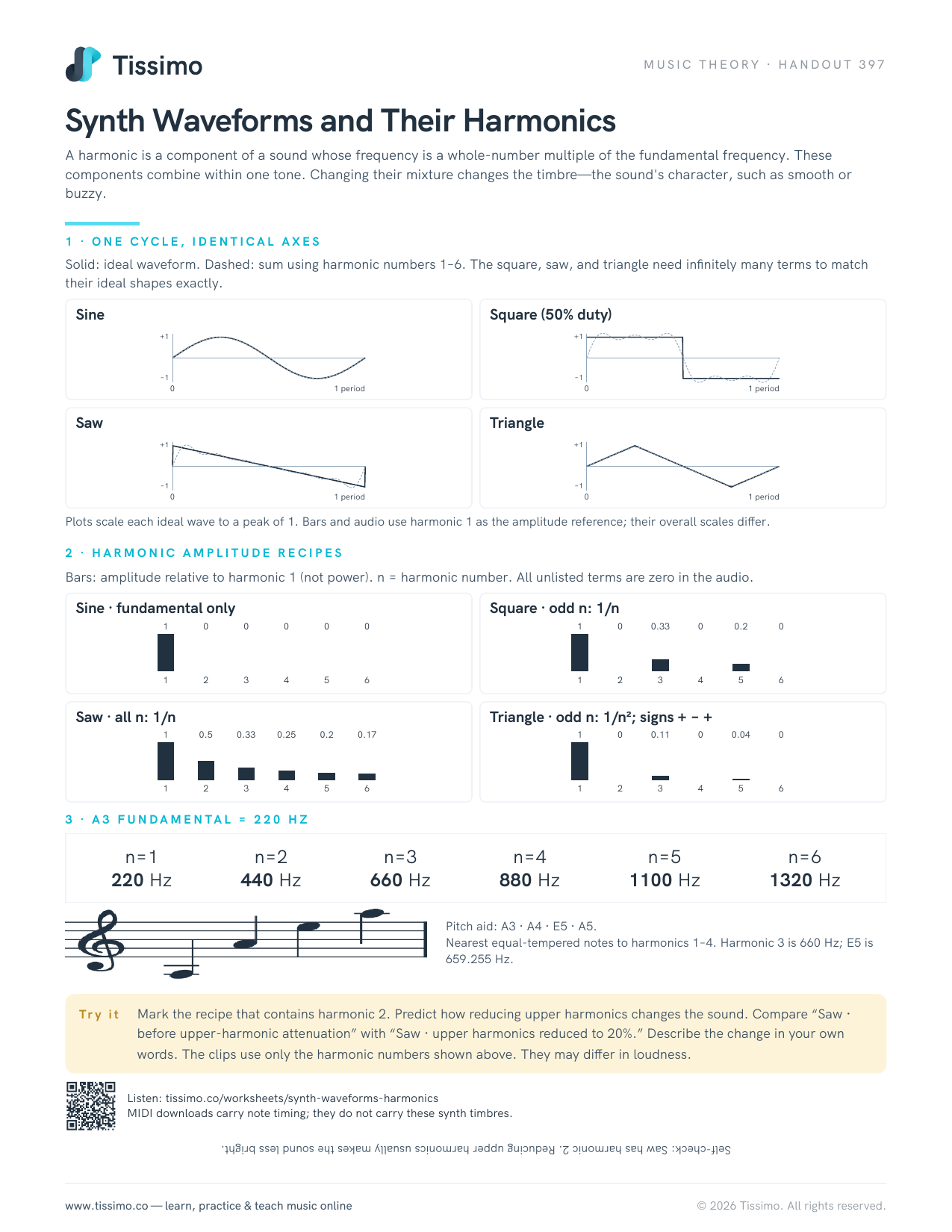 Synth Waveforms and Their HarmonicsA harmonic is a component of a sound whose frequency is a whole-number multiple of the fundamental frequency. These components combine within one tone. Changing their mixture changes the timbre—the sound's character, such as smooth or buzzy.
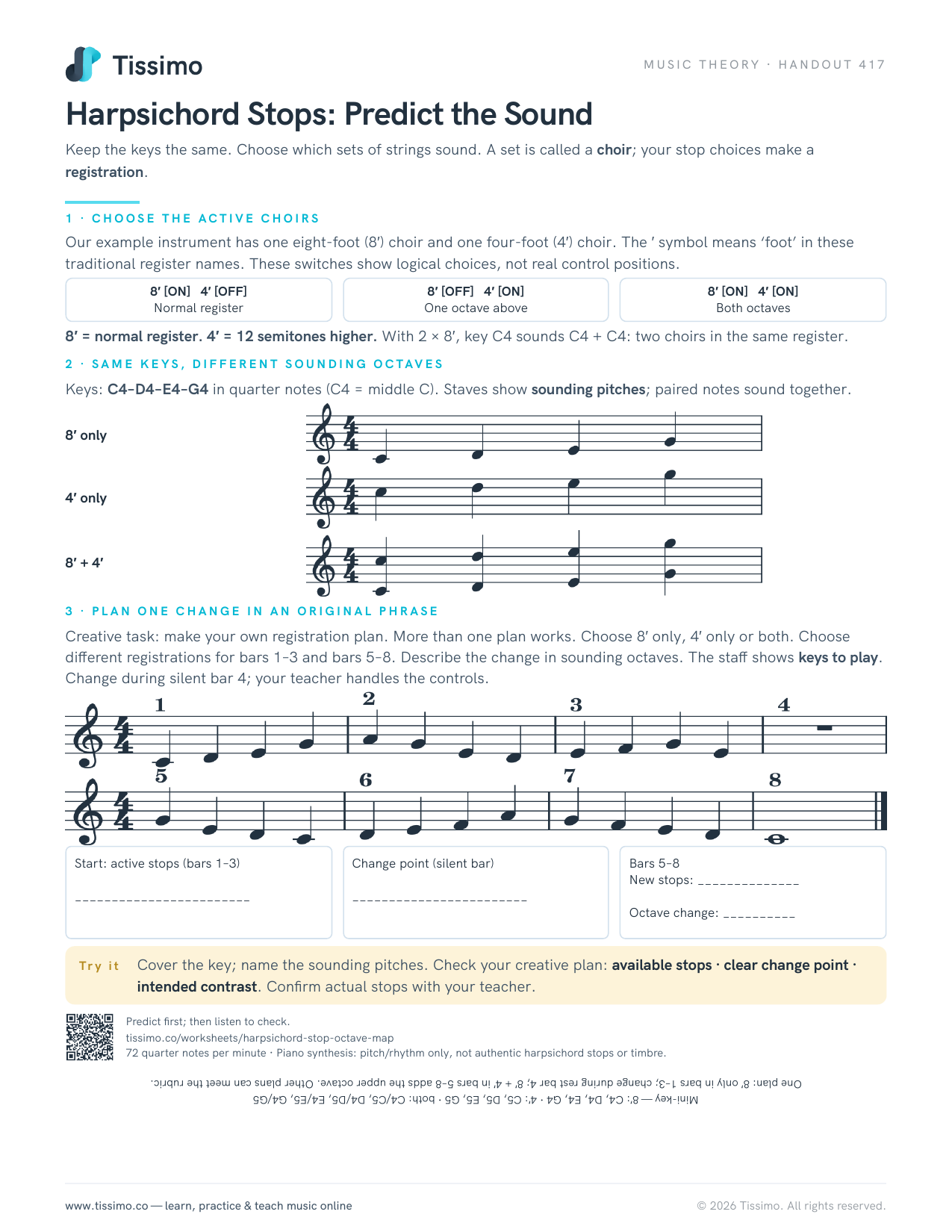 Harpsichord Stops: Predict the SoundKeep the keys the same. Choose which sets of strings sound. A set is called a choir; your stop choices make a registration.