Sound & Acoustics
Envelope (ADSR)
An envelope is the way a sound's loudness, or another quality, changes over time from the moment it starts until it dies away. Synthesizers set it with four controls: attack, decay, sustain and release (ADSR).
Every note has a shape in time. A piano note starts with a sudden strike and then fades; an organ note jumps to full volume and stays there; a bowed violin note can swell in gently. That shape, how the amplitude of a sound rises, holds and falls, is its envelope. It is one of the main ingredients of timbre: much of what tells a piano from a violin happens in the first fraction of a second.
The four stages: ADSR
Synthesizers and samplers describe the envelope with four controls, abbreviated ADSR:
- Attack: the time the sound takes to rise from silence to its peak after the key goes down. Short for a pluck or a drum, long for a pad that fades in.
- Decay: the time it takes to fall from that peak to the sustain level.
- Sustain: the level the sound holds for as long as the key stays down.
- Release: the time it takes to fade to silence after you let go of the key.
The most common confusion: attack, decay and release are times, but sustain is a level. With sustain at zero, the note dies away during the decay even if you keep holding the key; with sustain at maximum, it stays at full volume until you let go.
Acoustic instruments and their envelopes
- Piano and guitar: a fast attack, then a long natural decay. There is no true sustain level, because the string keeps losing energy. The piano's sustain pedal lengthens the release by keeping the dampers off the strings.
- Organ: an almost instant attack, a constant sustain and a quick release.
- Bowed strings, winds and voice: the player shapes the envelope continuously. A crescendo on a held note is a rising envelope that no single ADSR setting can describe.
- Drums and cymbals: a very sharp attack and a decay whose length depends on the instrument and on how it is damped.
Envelopes for more than loudness
In synthesis, an envelope can shape anything that changes over time, not only volume. A filter envelope makes a sound start bright and turn darker, the classic pluck or "wow" of many synth sounds, and a pitch envelope can add a quick drop to the start of an electronic drum hit. In compression and other audio processing, attack and release describe how quickly the processor reacts.
Draw envelopes for different instruments in Draw an ADSR Envelope, and hear how note length shapes a pattern in Arpeggiator Patterns: Order, Rate and Gate.
Common questions
What does ADSR stand for?
Attack, decay, sustain and release, the four stages of a synthesizer envelope. Attack, decay and release are lengths of time; sustain is the level held while the key stays down.
What is the difference between decay and release?
Decay happens while you are still holding the key: the sound falls from its peak to the sustain level. Release begins when you let go: the sound fades from wherever it is to silence.
Practice it: free worksheets
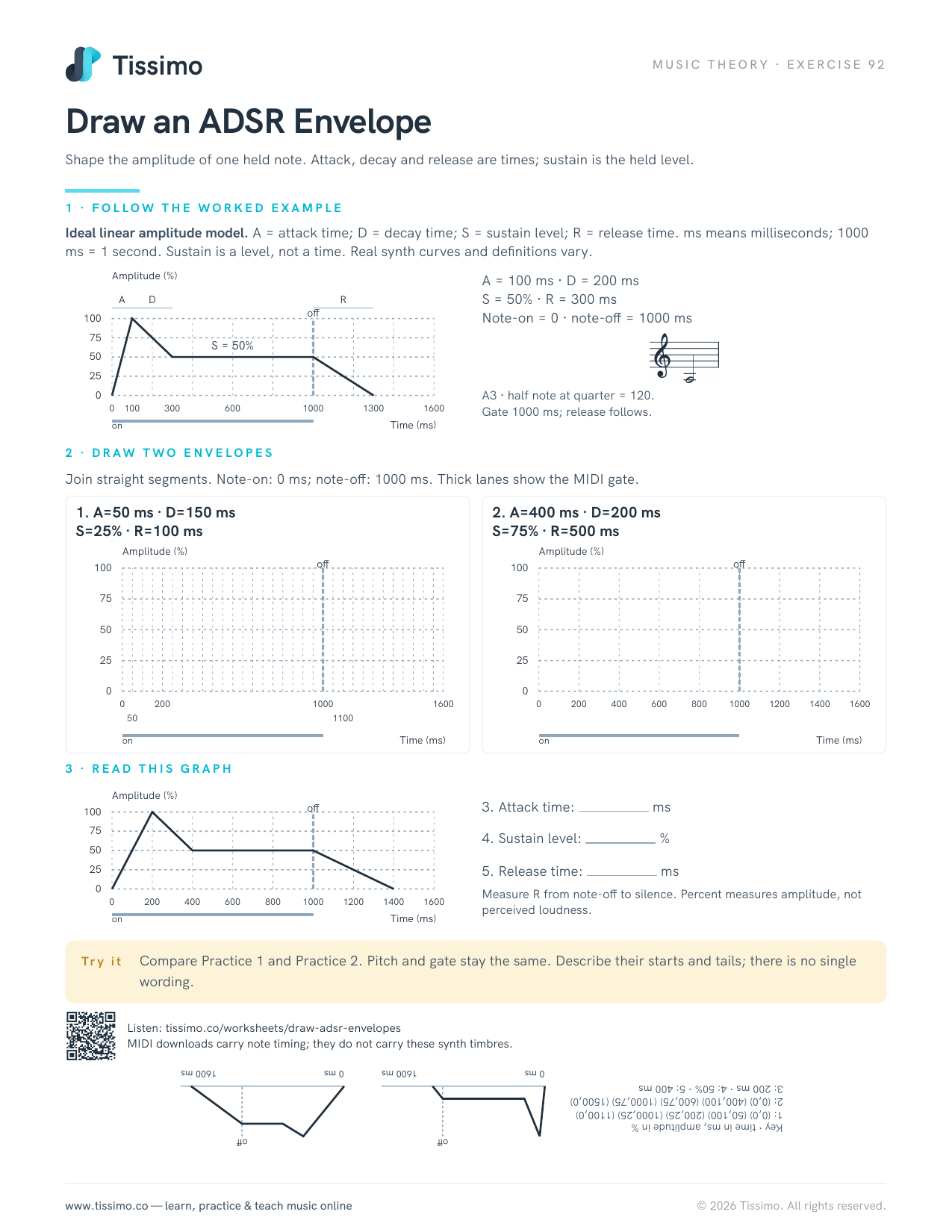 Draw an ADSR EnvelopeShape the amplitude of one held note. Attack, decay and release are times; sustain is the held level.
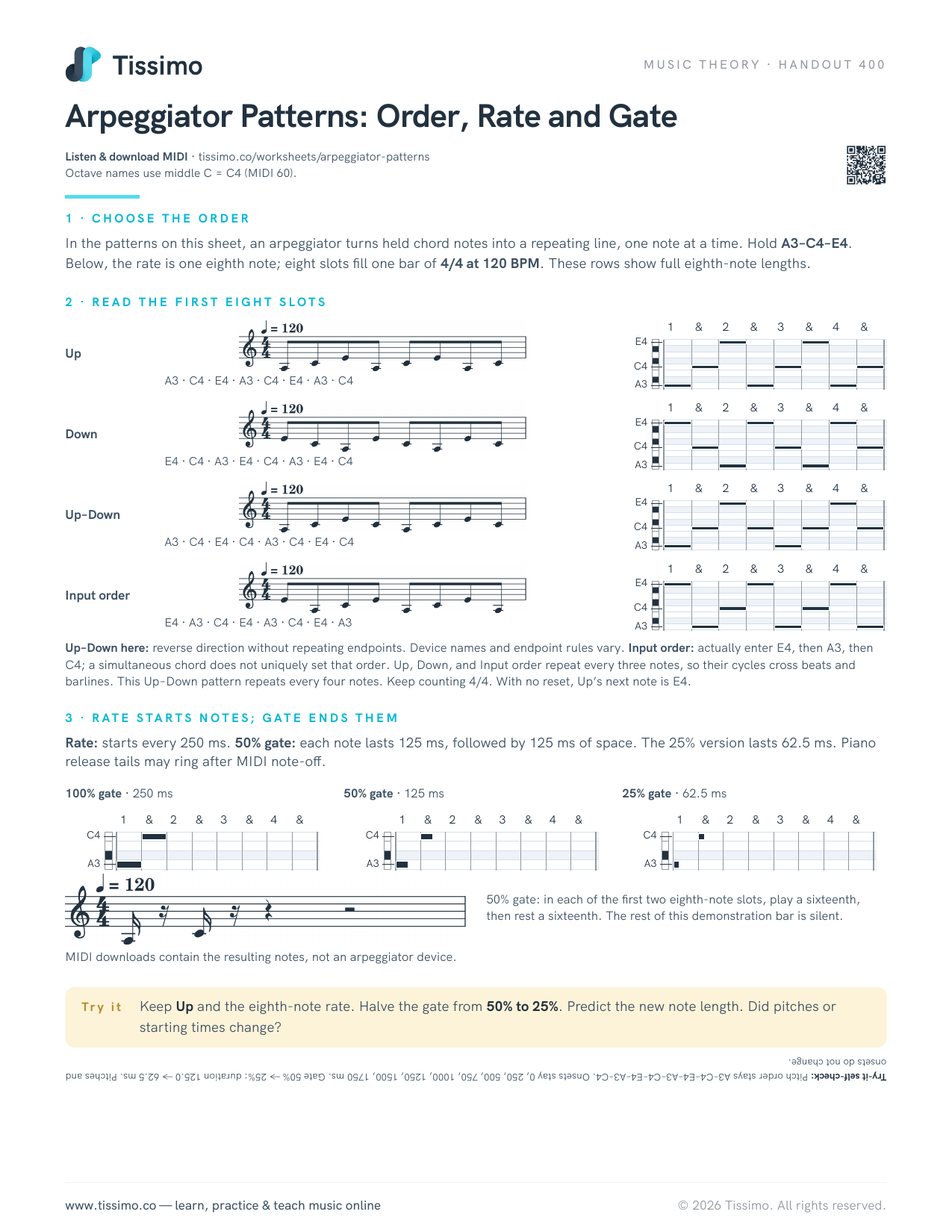 Arpeggiator Patterns: Order, Rate and Gate
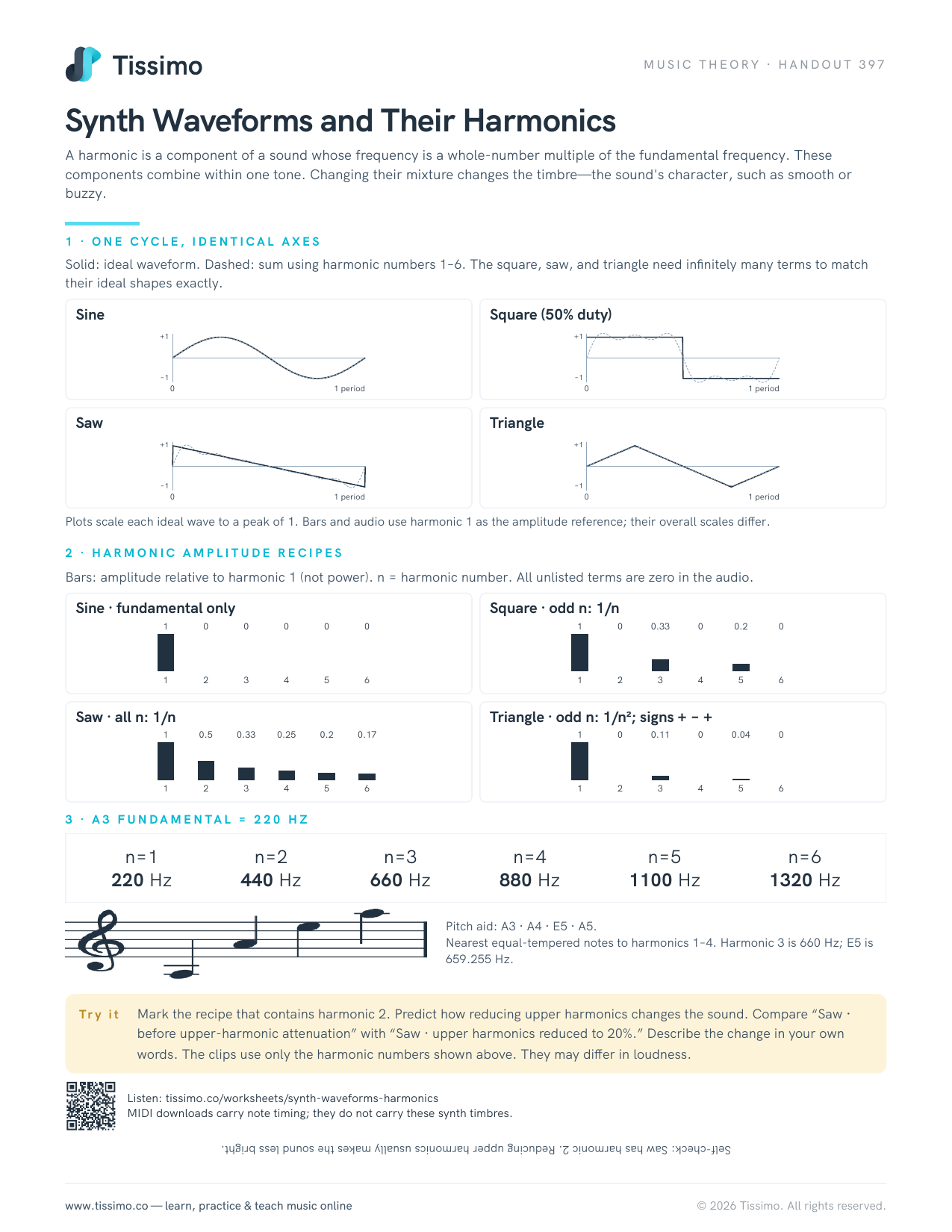 Synth Waveforms and Their HarmonicsA harmonic is a component of a sound whose frequency is a whole-number multiple of the fundamental frequency. These components combine within one tone. Changing their mixture changes the timbre—the sound's character, such as smooth or buzzy.