Instruments & Voices
Synthesizer
A synthesizer is an electronic instrument that creates sound from electrical signals or digital code instead of strings or air. Players shape the sound with oscillators, filters and envelopes, usually from a keyboard.
A synthesizer (synth for short) generates sound electronically. Many begin with one or more oscillators, circuits or software that generate waveforms. Other designs use samples, noise or physical models. The sound can then be shaped into basses, pads, leads and sounds unlike acoustic instruments.
How a synthesizer builds a sound
Many synths follow the same path, often called subtractive synthesis:
- Oscillators make the raw tone. Common waveforms are the sine (pure), triangle (soft), sawtooth (bright and buzzy) and square (hollow). Each has its own mix of overtones, which sets its timbre.
- A filter removes some of those overtones. A low-pass filter cuts the high ones, so lowering its cutoff makes the sound darker.
- An amplifier controlled by an envelope shapes the loudness over time: attack, decay, sustain and release (ADSR). A fast attack and short release sound plucked; a slow attack makes a swelling pad.
- Modulators such as an LFO (low-frequency oscillator) add movement, for example vibrato or a filter that slowly opens and closes.
Other designs work differently. FM synthesis makes rich tones by letting one oscillator rapidly vary the frequency of another, wavetable synths sweep through a series of stored waveforms, and sample-based instruments play back recordings (see sampling).
Hardware and software
Hardware synths may have built-in keyboards or come as modules. They can use analog circuits, digital processing or a mixture of both. Software synths may run inside a DAW or as standalone programs, controlled through MIDI or programmed notes. A synth that plays only one note at a time is monophonic, which suits bass lines and leads; a polyphonic synth can play chords.
Range and notation
A synth has no fixed range. Its keyboard may have anywhere from 25 to 88 keys, and octave buttons shift the whole keyboard up or down. Synth parts are written like other keyboard parts, on a grand staff or a single staff, or as chord symbols on a lead sheet. In the studio they are often entered in a piano roll instead of on paper.
Where you hear it
Synthesizers became commercial instruments in the 1960s, with Robert Moog and Don Buchla among the best-known early designers. Today they are at the center of electronic dance music, hip-hop, pop music and film music, playing bass lines, pads, leads and patterns driven by an arpeggiator or a sequencer.
Tips for beginners
- Learn basic keyboard skills first; they apply to almost any synth you will play.
- Start from a simple preset, change one control at a time (cutoff, attack, release) and listen to what it does.
- Learn one synth well before collecting many. The oscillator, filter and amplifier path is the same on most of them.
Common questions
What is the difference between a synthesizer and a keyboard?
"Keyboard" usually means a home keyboard or digital piano that plays preset sounds. A synthesizer lets you build and edit the sound itself with oscillators, filters and envelopes. Many synths have keys, but some are modules or software with no keyboard at all.
Do I need to learn piano to play the synthesizer?
Not strictly, since many producers program synths with a mouse or a step sequencer. But basic keyboard skills, chords and scales make playing and writing synth parts far easier, which is why many synth players take piano or keyboard lessons.
Practice it: free worksheets
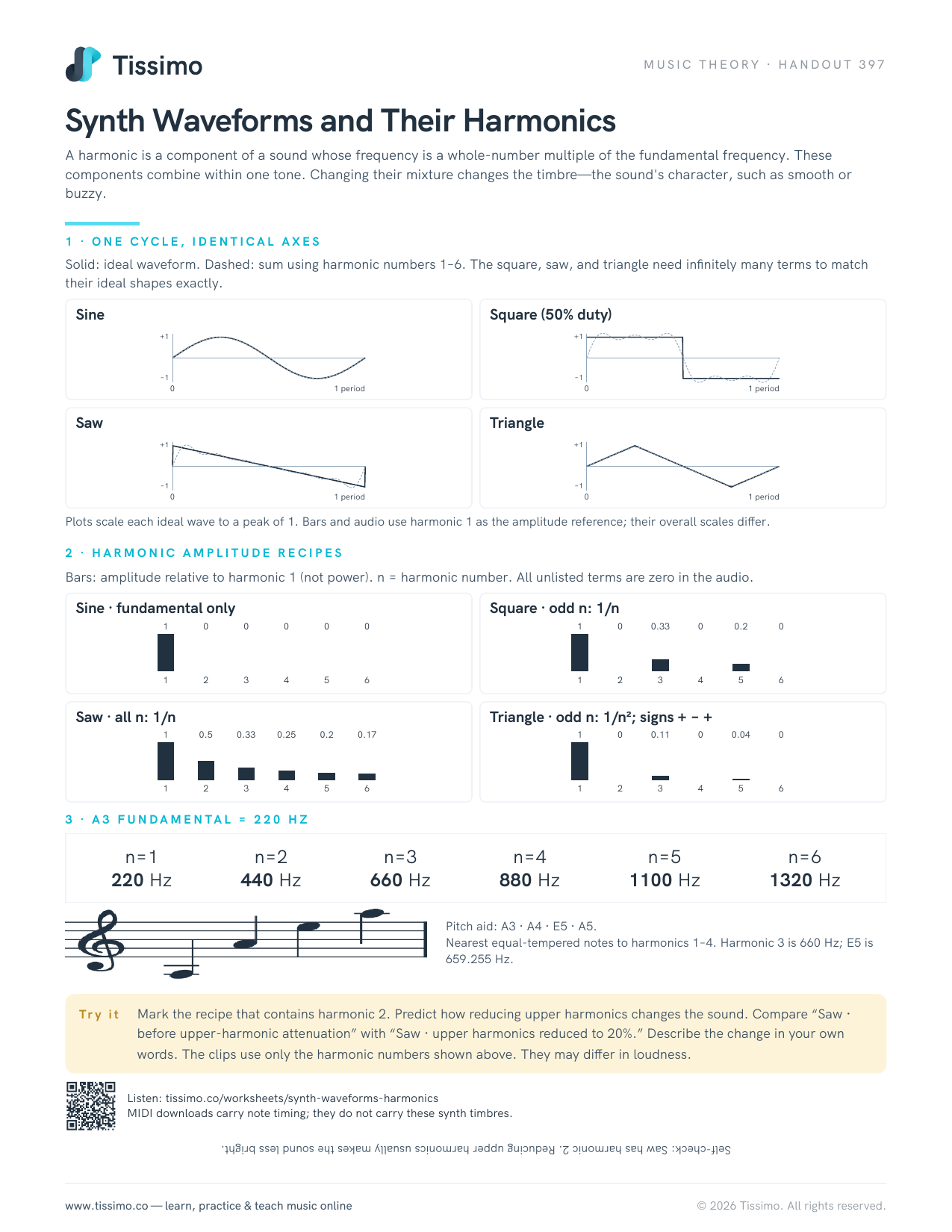 Synth Waveforms and Their HarmonicsA harmonic is a component of a sound whose frequency is a whole-number multiple of the fundamental frequency. These components combine within one tone. Changing their mixture changes the timbre—the sound's character, such as smooth or buzzy.
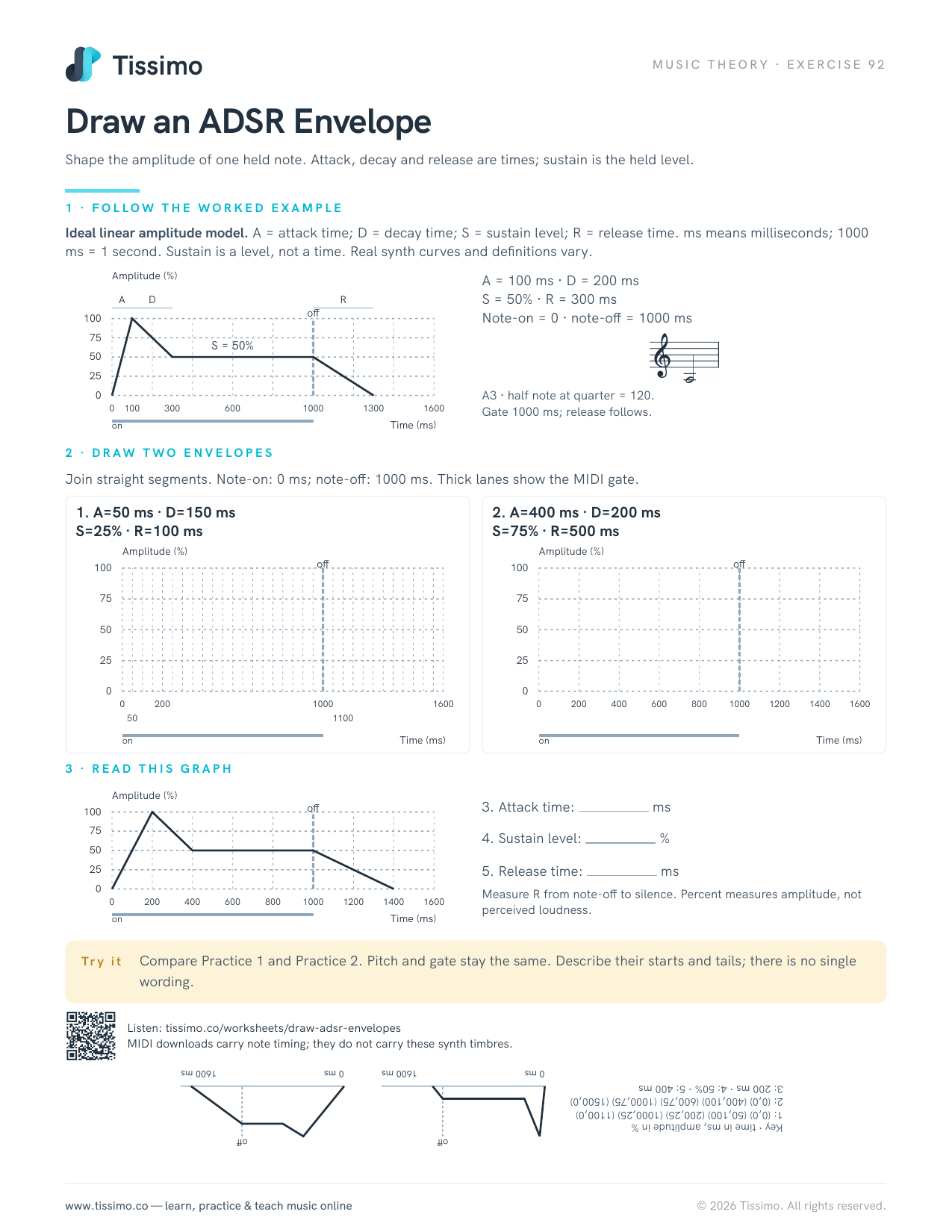 Draw an ADSR EnvelopeShape the amplitude of one held note. Attack, decay and release are times; sustain is the held level.
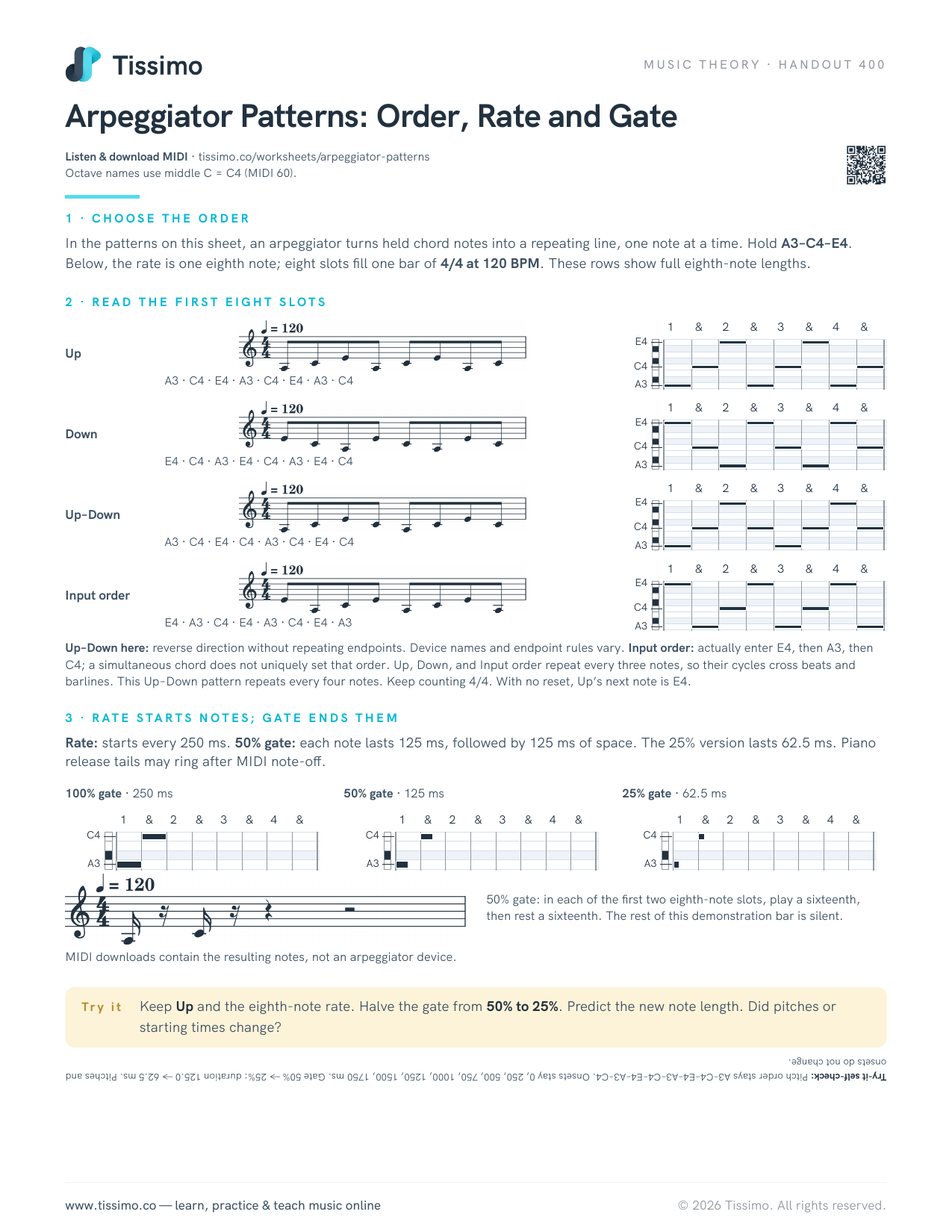 Arpeggiator Patterns: Order, Rate and Gate
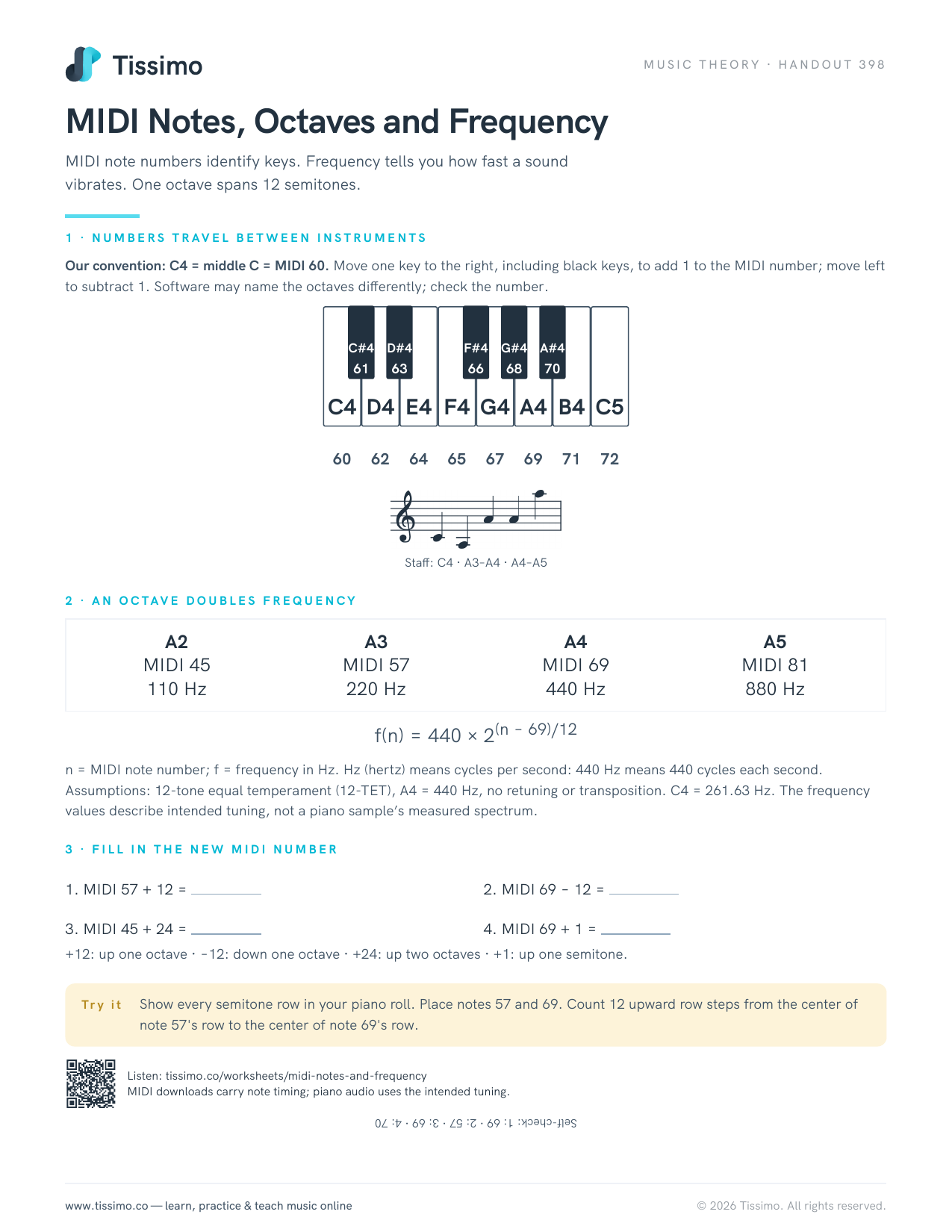 MIDI Notes, Octaves and FrequencyMIDI note numbers identify keys. Frequency tells you how fast a sound vibrates. One octave spans 12 semitones.