Instruments & Voices
Keyboard Instruments
Keyboard instruments are played from a keyboard of white and black keys: the piano, harpsichord, organ, synthesizer, accordion and others. They share one layout but make their sound in very different ways.
A keyboard instrument is any instrument you play by pressing keys laid out in the familiar pattern of white and black. The piano, harpsichord, organ, synthesizer and piano accordion all use it, along with the clavichord, celesta, harmonium, electric piano and digital piano. What they share is the keyboard; what happens after you press a key differs completely from one to the next.
The shared layout
Every octave of a keyboard has seven white keys, named C D E F G A B, and five black keys in a group of two and a group of three. The pattern repeats up and down, so once you can find C (just left of each group of two black keys) you can find every note. Each black key has two names: the one between C and D is both C♯ and D♭.
How they make sound
Keyboards are easiest to group by what the key sets in motion:
- Struck strings: the piano (felt hammers) and the clavichord (small brass blades that press the string and stay on it).
- Plucked strings: the harpsichord and its smaller relatives, the virginal and the spinet.
- Wind: the pipe organ (pipes), and the harmonium and accordion (free metal reeds).
- Struck metal: the celesta, whose hammers strike metal bars for a bell-like sound.
- Electromechanical: electric pianos such as the Rhodes, whose hammers strike metal tines and whose pickups convert the vibration into an electrical signal.
- Electronic: synthesizers, digital pianos and electronic organs.
That variety is why keyboards do not fit neatly into the orchestra's sections. Orchestras usually seat the piano, celesta and harpsichord as a keyboard group, sometimes alongside the percussion.
Touch and expression
How a keyboard responds to your fingers depends on its mechanism. On a piano, a faster key stroke makes a louder note. On a harpsichord or a pipe organ, touch does not change the volume, so players shape music with timing, articulation and their choice of stops. Digital instruments measure how fast you press each key (its velocity) to imitate the piano's response.
How keyboard music is written
Most keyboard music is written on the grand staff: a treble clef staff for the right hand and a bass clef staff for the left, joined by a brace. Organ music adds a third staff for the pedals. The common keyboard instruments play at written pitch, with one notable exception: the celesta sounds an octave higher than written.
Choosing a first keyboard
If your goal is piano, look for an acoustic piano or a digital piano with 88 weighted keys and a sustain pedal. For pop, songwriting and production, a 61-key keyboard or a controller connected to a computer is a flexible start. Skills carry over easily across the family: a pianist can sit down at an organ, harpsichord or synth and play from the first day, then learn what is special about each.
Common questions
Is the accordion a keyboard instrument?
The piano accordion has a piano-style keyboard for the right hand, so it is often counted as one. Its sound comes from free reeds blown by the bellows, though, so it also belongs with the wind instruments, and button accordions have no piano keyboard at all.
Which keyboard instrument should I learn first?
The piano is the usual starting point. Its touch-sensitive keys build control, and its skills carry over to organ, harpsichord, synthesizer and accordion. A digital piano with 88 weighted keys is a good substitute if an acoustic piano is not practical.
Practice it: free worksheets
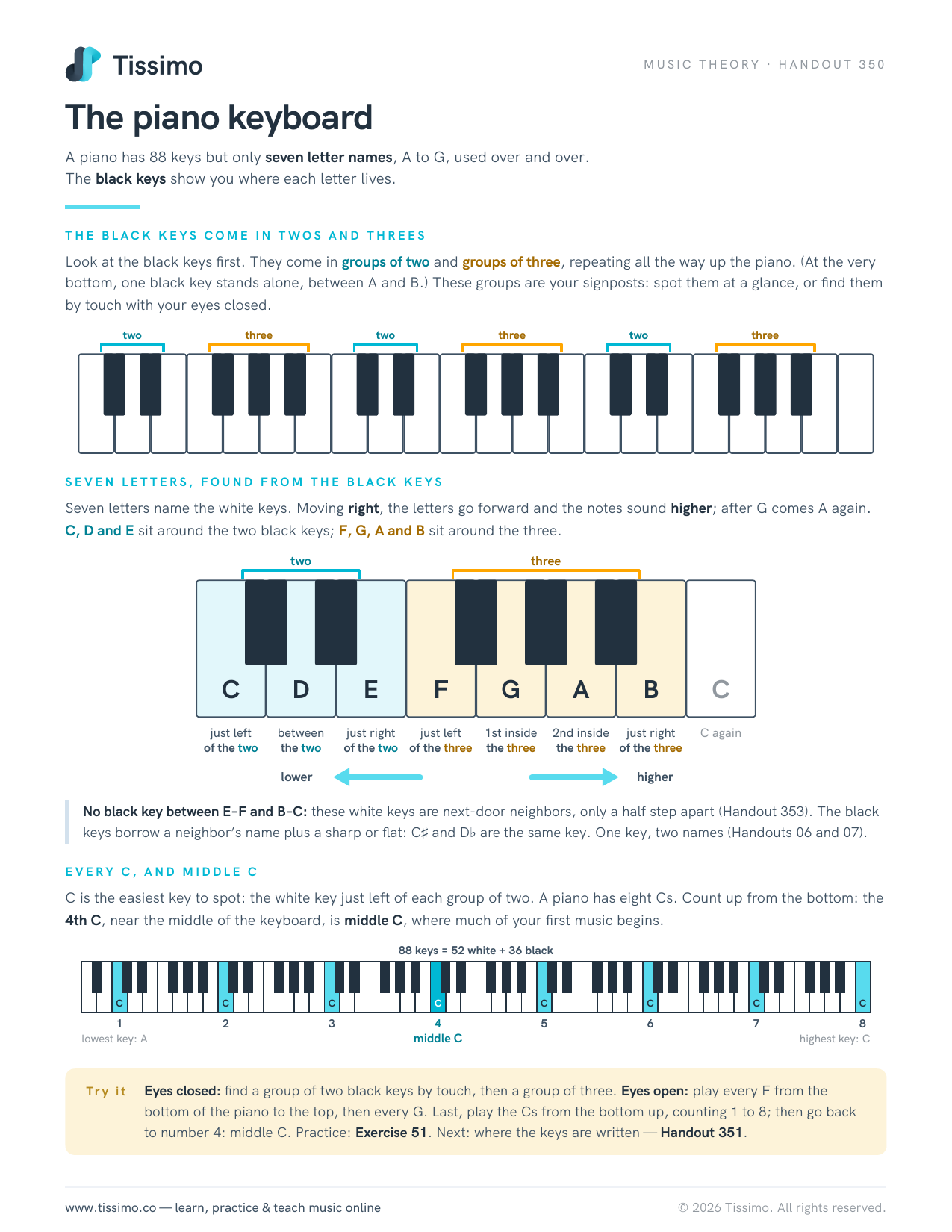 The piano keyboardA piano has 88 keys but only seven letter names, A to G, used over and over. The black keys show you where each letter lives.
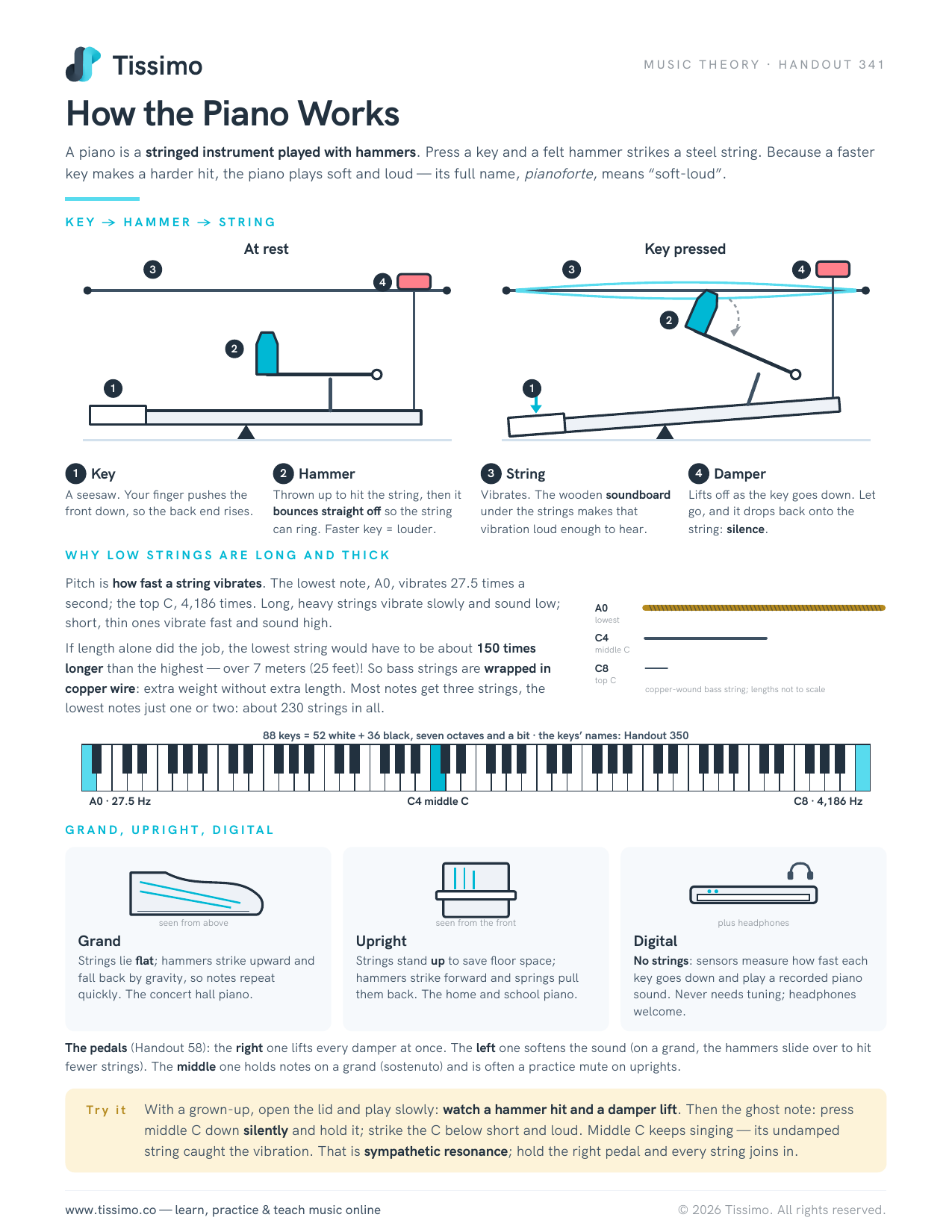 How the Piano WorksA piano is a stringed instrument played with hammers. Press a key and a felt hammer strikes a steel string. Because a faster key makes a harder hit, the piano plays soft and loud — its full name, pianoforte, means “soft-loud”.
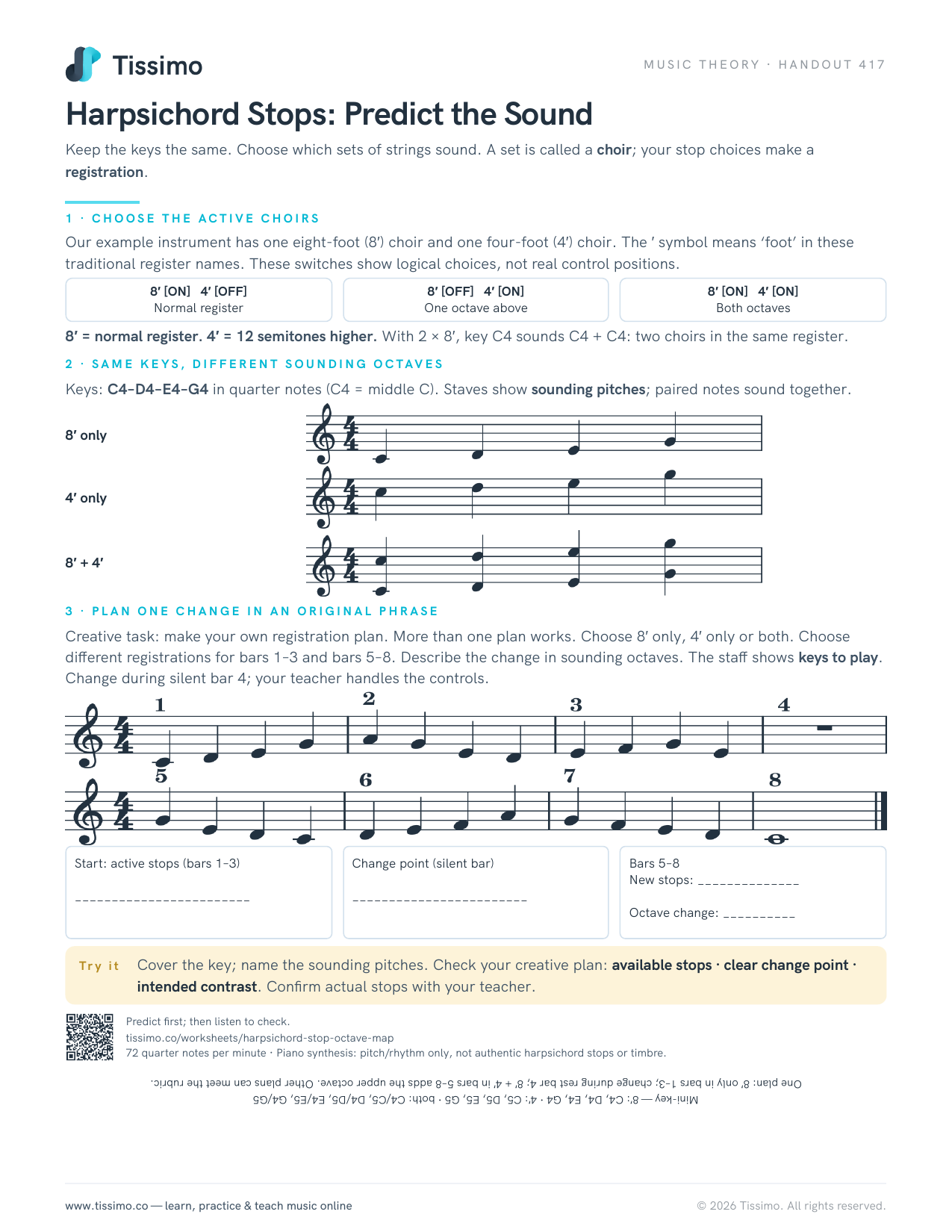 Harpsichord Stops: Predict the SoundKeep the keys the same. Choose which sets of strings sound. A set is called a choir; your stop choices make a registration.
 The Bass Clef & the Grand StaffThe bass staff holds the lower notes, usually played by the left hand. It works just like the treble staff (Handout 351), but its clef names a different line.