Instruments & Voices
Violin
The violin is the smallest and highest bowed string instrument, with four strings tuned G–D–A–E in fifths. It is held under the chin, played with a bow or plucked, and its music is written in treble clef.
The violin is the smallest and highest member of the bowed string family and one of the most important instruments in Western music. It leads the orchestra, plays the top line in the string quartet, and is just as much at home in folk music, where the same instrument is usually called the fiddle.
How a violin makes its sound
The violin's four strings are stretched over a wooden bridge. You draw a bow, a wooden stick strung with horsehair coated in rosin, across the strings. The sticky hair grips a string, pulls it aside until it slips back, and repeats this hundreds of times a second, which keeps the string vibrating. The bridge passes the vibration to the hollow wooden body, which resonates. You can also pluck the strings, which is called pizzicato.
The fingerboard has no frets. You change the pitch by pressing a string with a finger of your left hand, and the exact spot decides whether the note is in tune, so careful listening (intonation) is part of every practice session. Players also use vibrato, a small rocking motion of the finger, to warm the tone.
Tuning and range
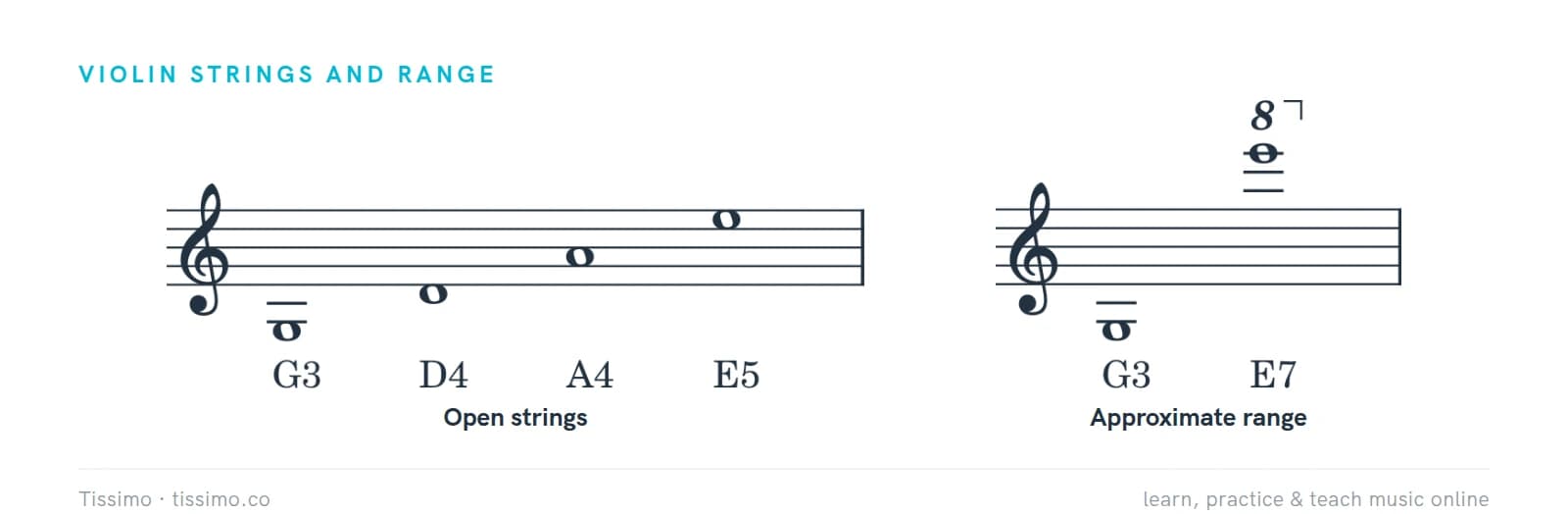
The four strings are tuned a perfect fifth apart: G3, D4, A4 and E5, from lowest to highest. The open G string is the lowest note. Moving the hand up the neck into higher positions extends the range to around E7 in most music, and higher still in advanced solo writing.
How violin music is written
Violin music is written in treble clef at the pitch it sounds. Very high passages use ledger lines or an ottava sign. Bowings are marked above the notes, with a sign like a squared-off n for a down-bow and a V for an up-bow, and slurs show which notes share one bow stroke.
Its role
In the orchestra the violins form the largest section, divided into first violins and second violins. The leader of the first violins, the concertmaster, plays the violin solos and coordinates the section's bowings. Violinists also play solo recitals, concertos and chamber music, and fiddlers play folk music, bluegrass and country music.
Tips for beginners
- Children play smaller violins, from 1/16 size up to full size (4/4). A teacher can measure you for the right one.
- Rosin your bow regularly; without rosin the hair slides over the string and makes almost no sound.
- Keep the bow parallel to the bridge, and let the weight of your arm, not squeezing, make the sound.
- Practice slowly with a tuner or a drone note to train your ear for intonation.
Common questions
What is the difference between a violin and a fiddle?
They are the same instrument. "Fiddle" usually refers to folk, bluegrass and country playing; "violin" to classical music. Some fiddlers set their instruments up a little differently, for example with a slightly flatter bridge, but you can play either style on any violin.
What are the notes of the violin strings?
From lowest to highest: G, D, A, E (G3, D4, A4 and E5), each a perfect fifth apart. The viola has the same G, D and A strings plus a low C instead of the E.
Practice it: free worksheets
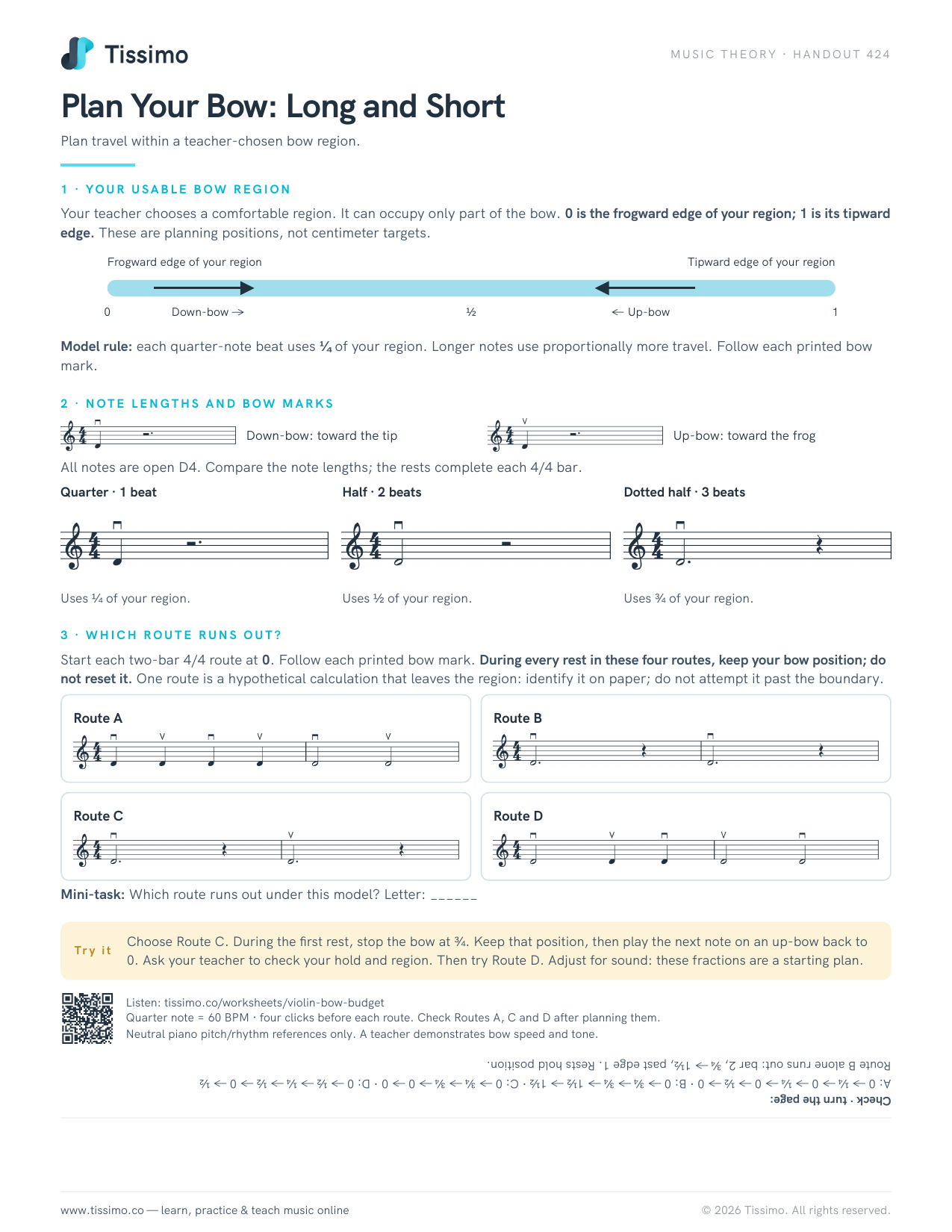 Plan Your Bow: Long and ShortPlan travel within a teacher-chosen bow region.
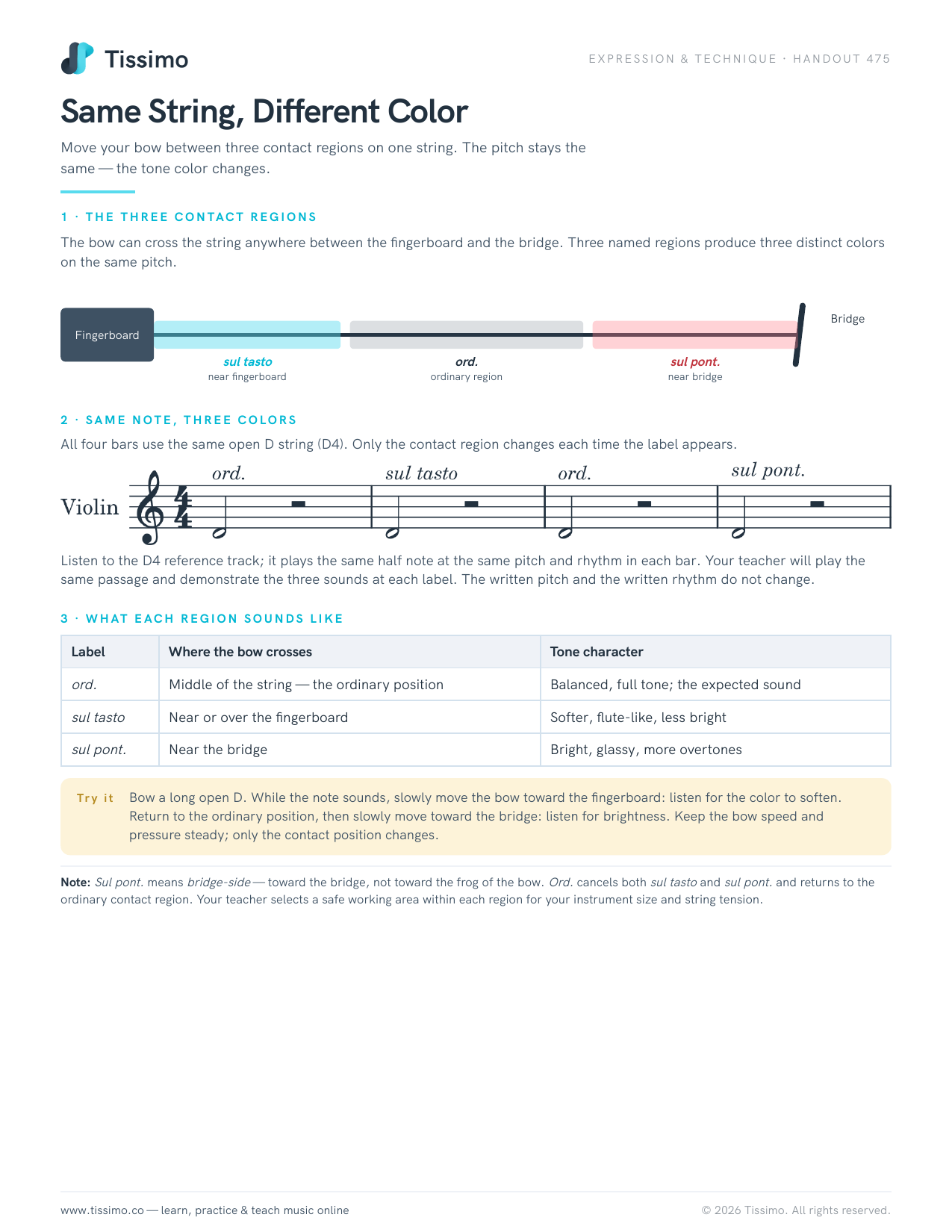 Same String, Different ColorMove your bow between three contact regions on one string. The pitch stays the same — the tone color changes.
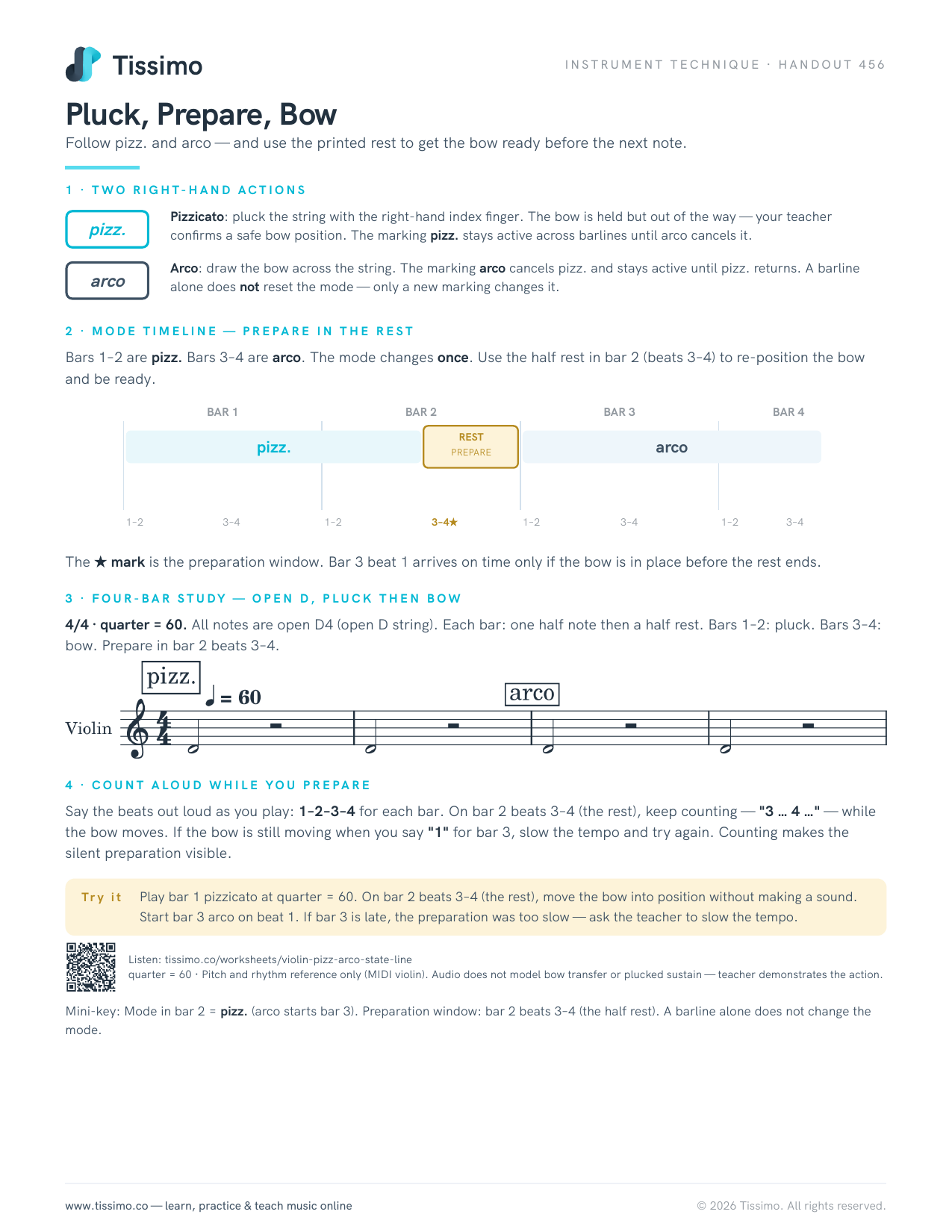 Pluck, Prepare, BowFollow pizz. and arco — and use the printed rest to get the bow ready before the next note.
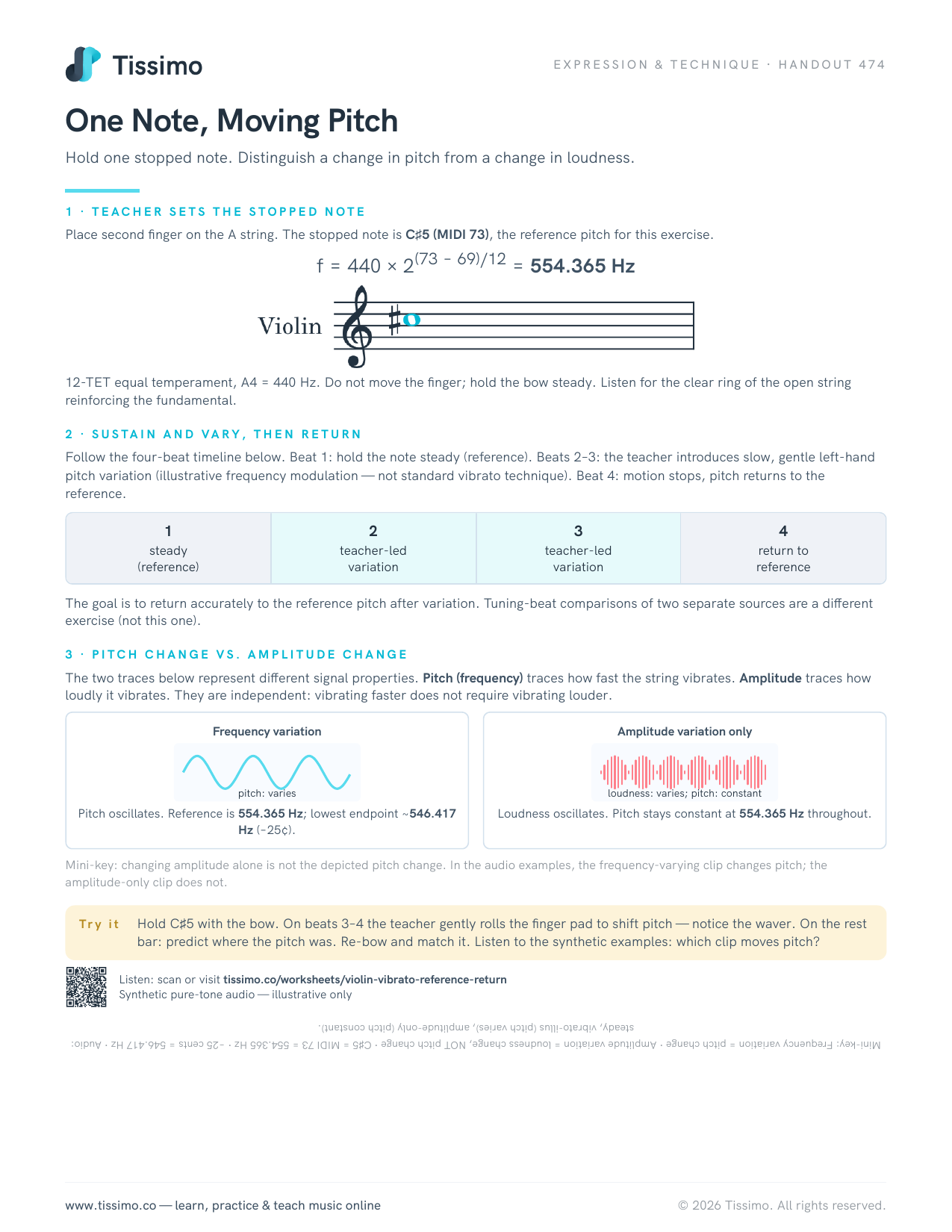 One Note, Moving PitchHold one stopped note. Distinguish a change in pitch from a change in loudness.
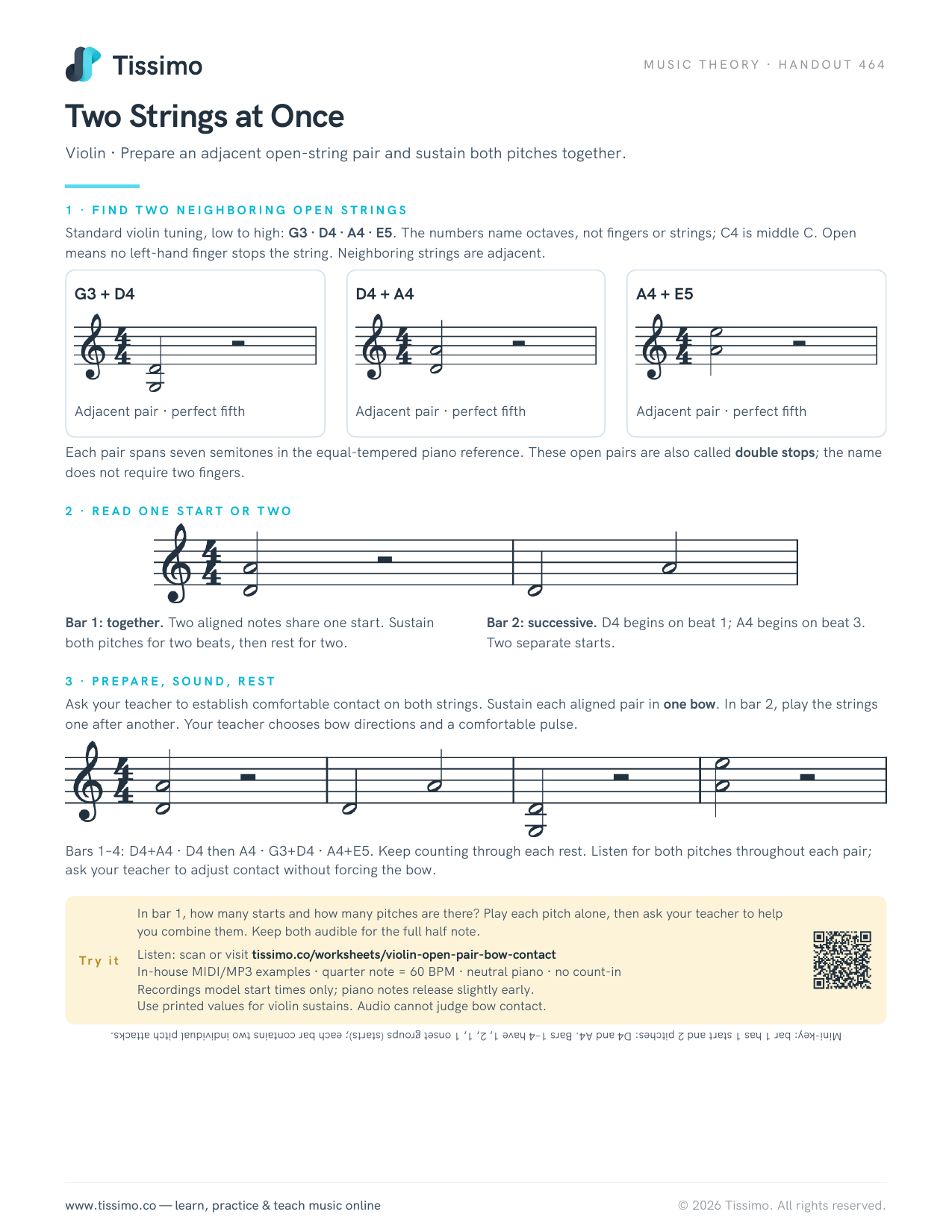 Two Strings at OnceViolin · Prepare an adjacent open-string pair and sustain both pitches together.
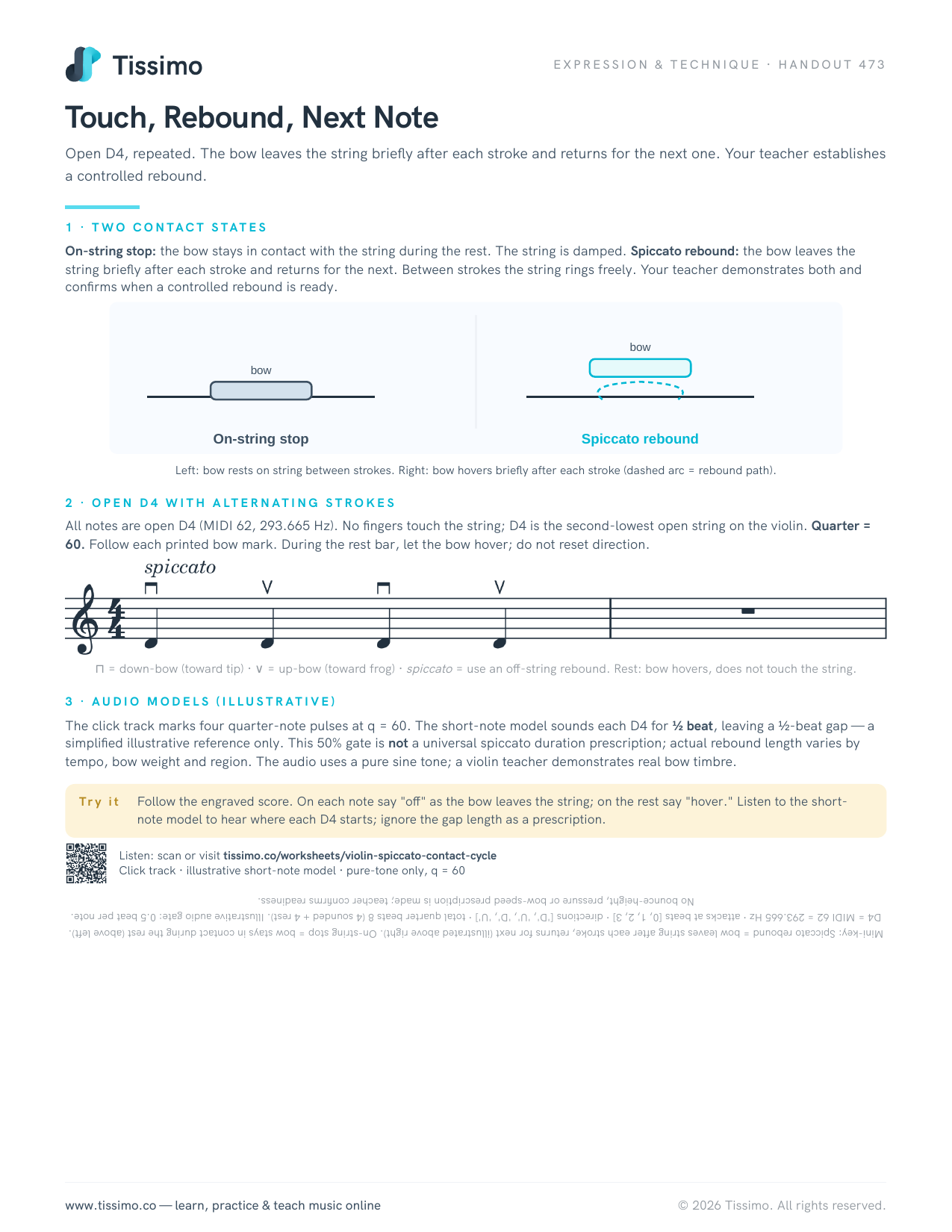 Touch, Rebound, Next NoteOpen D4, repeated. The bow leaves the string briefly after each stroke and returns for the next one. Your teacher establishes a controlled rebound.