Tempo Markings
Vivace
Pronounced vee-VAH-cheh
Vivace is a tempo marking meaning lively and fast. It is usually placed between allegro and presto, roughly 156 to 176 beats per minute on many charts, and it stresses energy and spirit as much as speed.
Vivace means "lively" or "vivacious", and the word is about spirit first. In modern usage it is a fast tempo, usually placed between allegro and presto; many charts give something like 156 to 176 beats per minute, though others place it lower and the ranges disagree. What matters most is that the music sounds alive: crisp rhythms, clear accents, and bounce.
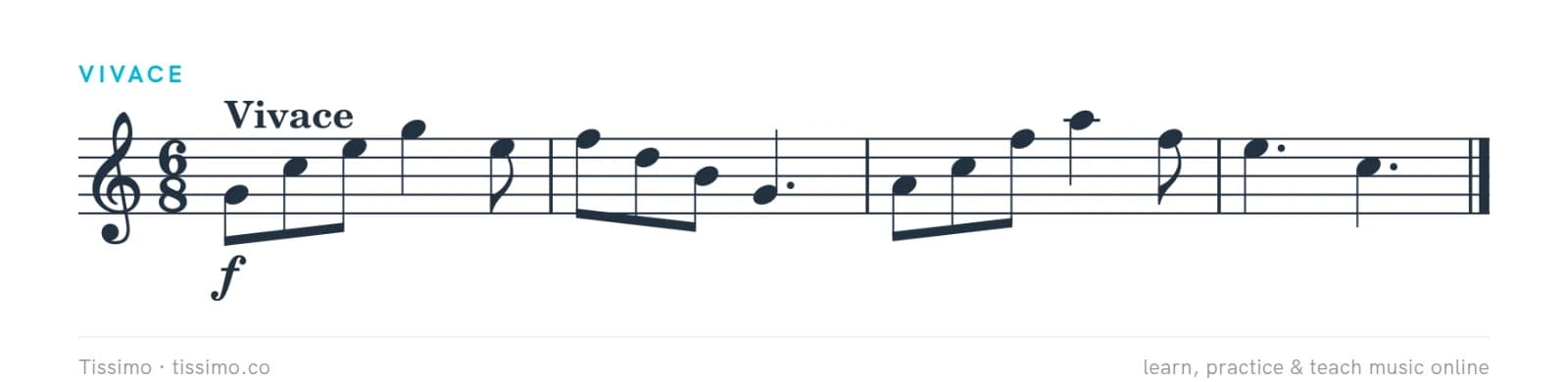
Vivace as a word and as a modifier
On its own, vivace is a tempo. Joined to another tempo word, it adds energy:
- Allegro vivace: fast and lively.
- Molto vivace: very lively. Chopin's Waltz in D-flat, Op. 64 No. 1, the "Minute" Waltz, is marked Molto vivace.
- Vivacissimo: the superlative, extremely lively.
Beethoven's Seventh Symphony opens with a slow introduction, Poco sostenuto, and then breaks into a Vivace in 6/8 driven by a dancing dotted rhythm.
Playing vivace
- Keep notes short and buoyant where the style allows. Lightness sounds faster than weight.
- Feel the beat in larger units: in 6/8, two beats per bar, not six.
- Do not let lively become frantic. If the shortest notes start to blur, take the tempo down a notch.
The Musical terms & signs chart places vivace between Allegro and Presto, and Match the terms: level 3 defines it as lively and quick.
Common questions
Is vivace faster than allegro?
Usually, yes: most modern charts put vivace between allegro and presto. But vivace is mainly about liveliness, so an energetic allegro and a light vivace can end up close in speed.
Practice it: free worksheets
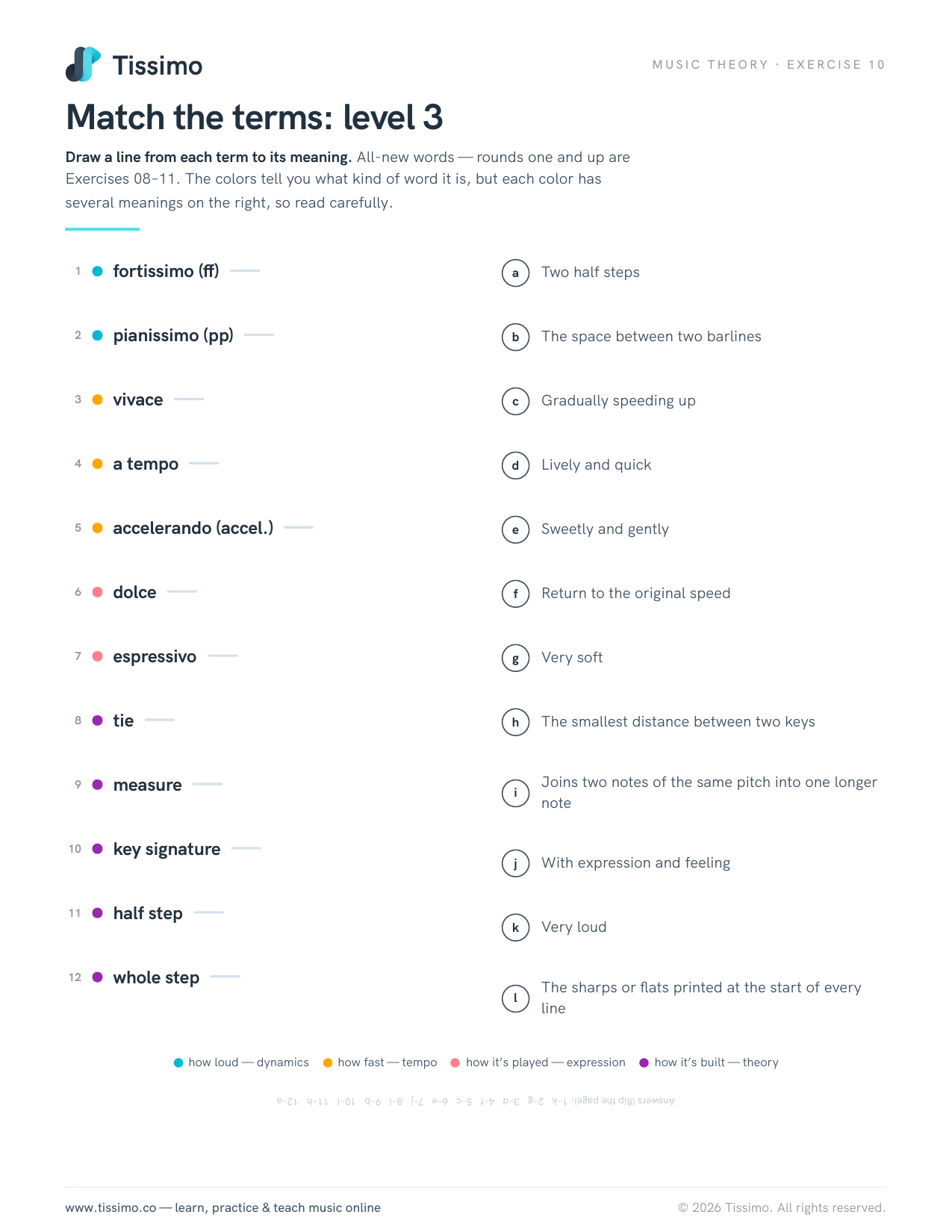 Match the terms: level 3Draw a line from each term to its meaning. All-new words — rounds one and up are Exercises 08–11. The colors tell you what kind of word it is, but each color has several meanings on the right, so read carefully.
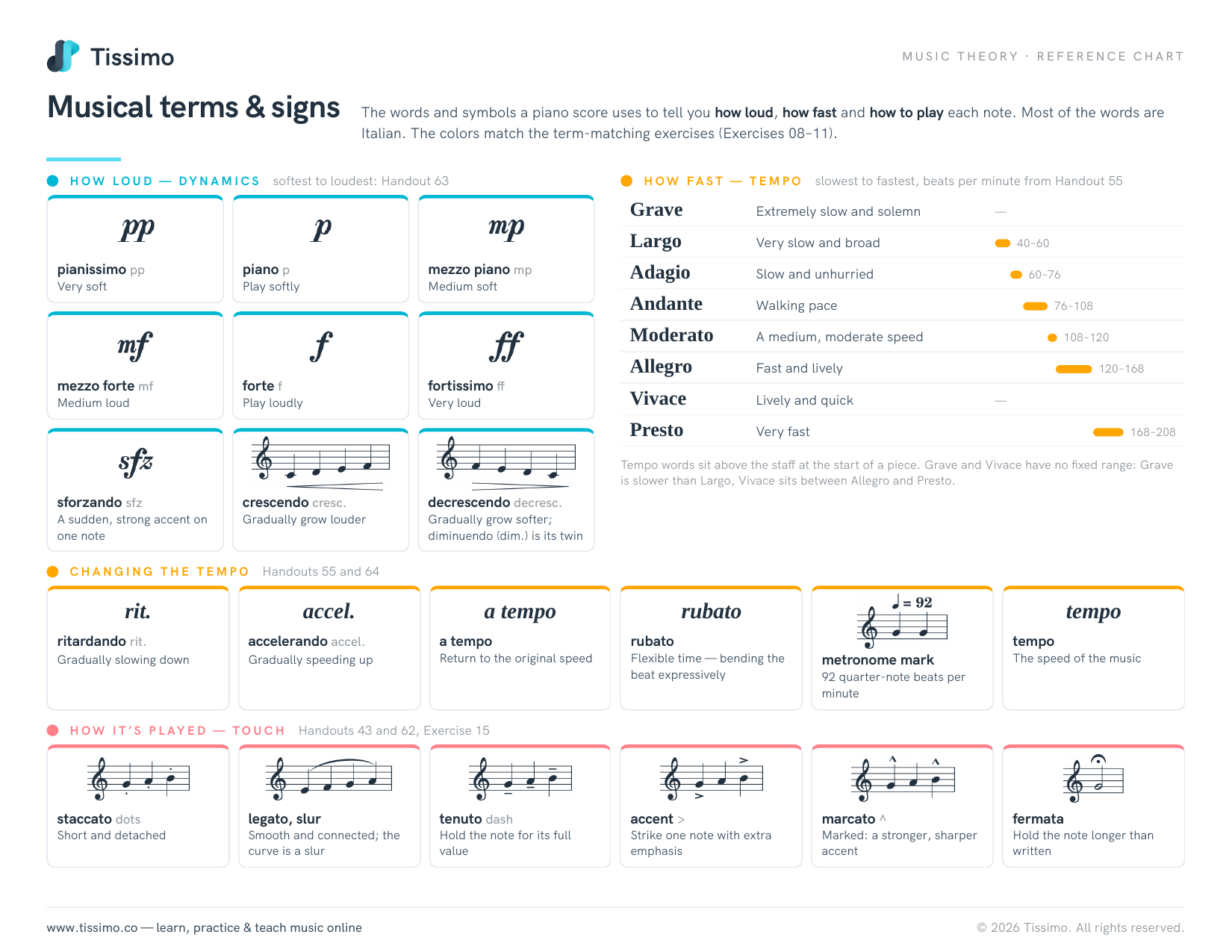 Musical terms & signsThe words and symbols a piano score uses to tell you how loud, how fast and how to play each note. Most of the words are Italian. The colors match the term-matching exercises (Exercises 08–11, 74 and 75).