Tempo Markings
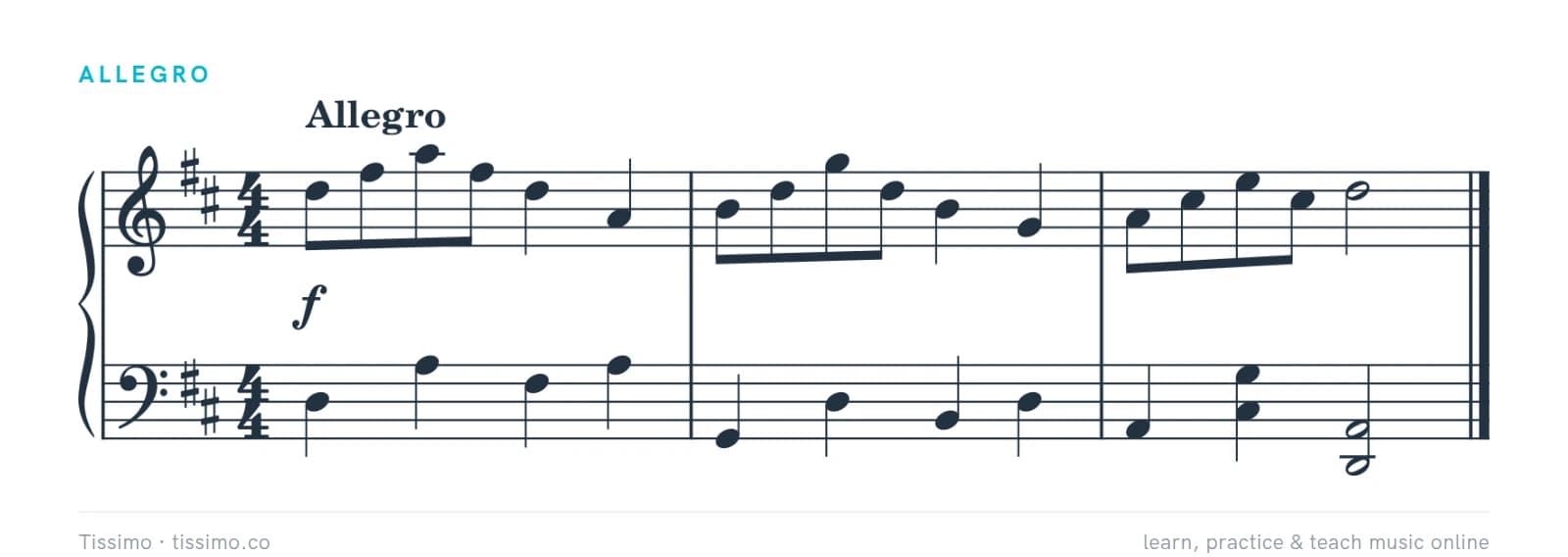
Allegro
Pronounced ah-LEG-roh
Allegro is a tempo marking meaning fast and lively. In Italian it means 'cheerful'. It is the most common fast tempo, often around 120 to 168 beats per minute, and also names the fast movement of a sonata or symphony.
Allegro is the most common fast tempo marking. In everyday Italian it means "cheerful" or "lively", and in music it asks for a quick, bright tempo: faster than moderato and allegretto, slower than vivace and presto. Charts often give roughly 120 to 168 beats per minute, a wide range that leaves plenty of room for the music to decide.
Allegro with other words
Allegro is so common that composers constantly refine it:
- Allegro moderato: moderately fast.
- Allegro ma non troppo: fast, but not too fast. Beethoven's Sixth Symphony opens this way.
- Allegro con brio: fast, with vigor and spirit, as in the first movements of Beethoven's Third and Fifth Symphonies.
- Allegro assai and Allegro molto (or Molto allegro): very fast.
- Allegro scherzando: fast and playful.
Allegro in real music
The first movements of Clementi's Sonatina in C, Op. 36 No. 1, and Mozart's Piano Sonata in C, K. 545, are both marked Allegro; our Clementi Sonatina and Mozart K. 545 studies explore them. Like adagio, the word also works as a noun: "the Allegro" is the fast movement, or a fast section after a slow introduction.
Playing allegro
Fast does not mean frantic. Choose a tempo at which the shortest notes are still even and clear, and at which the music sounds cheerful rather than rushed. Learn the piece well below tempo first, then raise the metronome a few clicks at a time.
Allegro has its own band on the speedometer in Tempo & the Metronome. Practice placing it in Dynamics & Tempo Ladders, match it in Match the terms, and find it in the Music word search.
Common questions
How fast is allegro?
Fast: often given as about 120 to 168 beats per minute. That range is wide on purpose. Pick a speed at which the shortest notes stay clear and the music sounds lively, not rushed.
What does allegro mean literally?
"Cheerful" or "lively". The musical meaning, fast, grew out of that mood, which is why an allegro should sound bright and energetic rather than merely quick.
Practice it: free worksheets
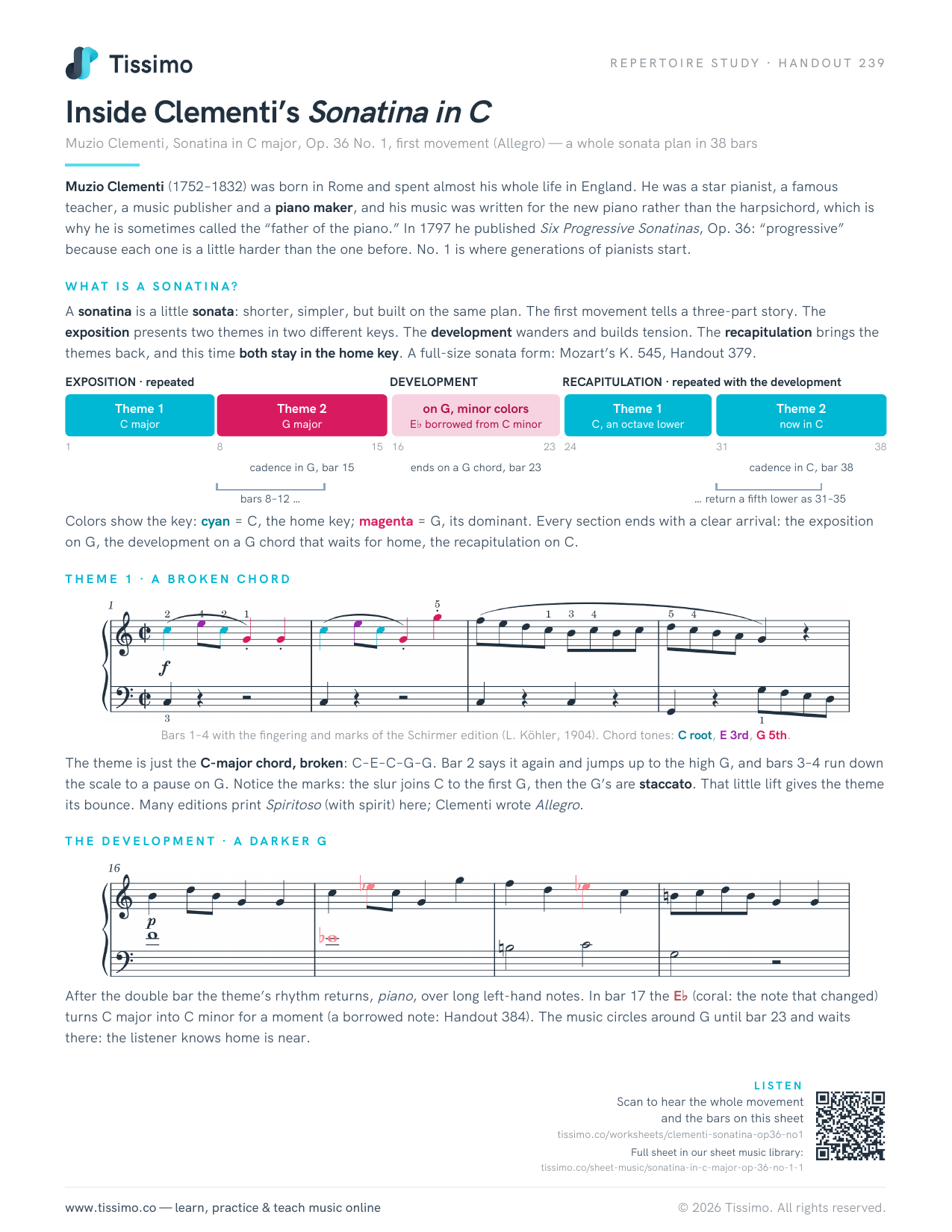 Inside Clementi’s Sonatina in CMuzio Clementi, Sonatina in C major, Op. 36 No. 1, first movement (Allegro) — a whole sonata plan in 38 bars
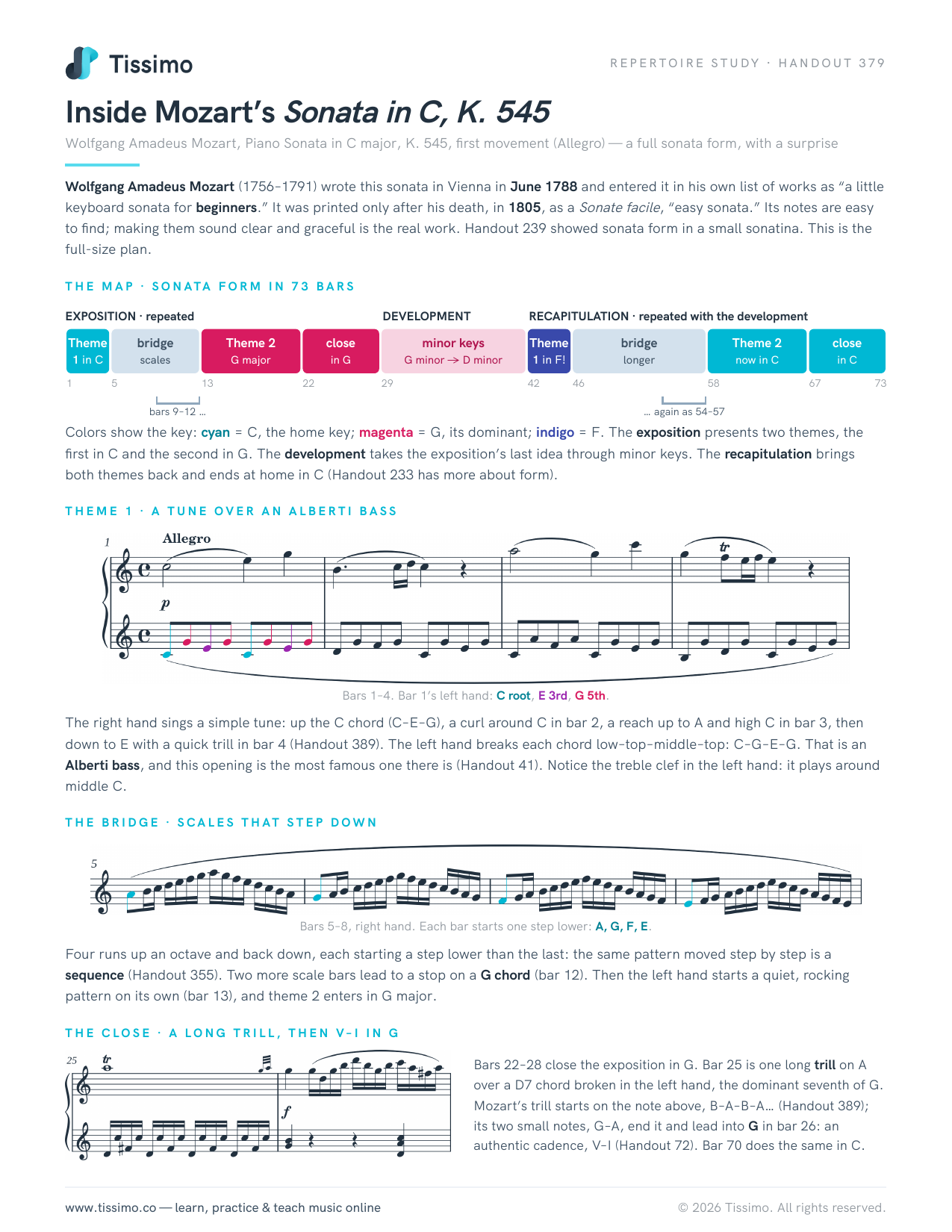 Inside Mozart’s Sonata in C, K. 545Wolfgang Amadeus Mozart, Piano Sonata in C major, K. 545, first movement (Allegro) — a full sonata form, with a surprise
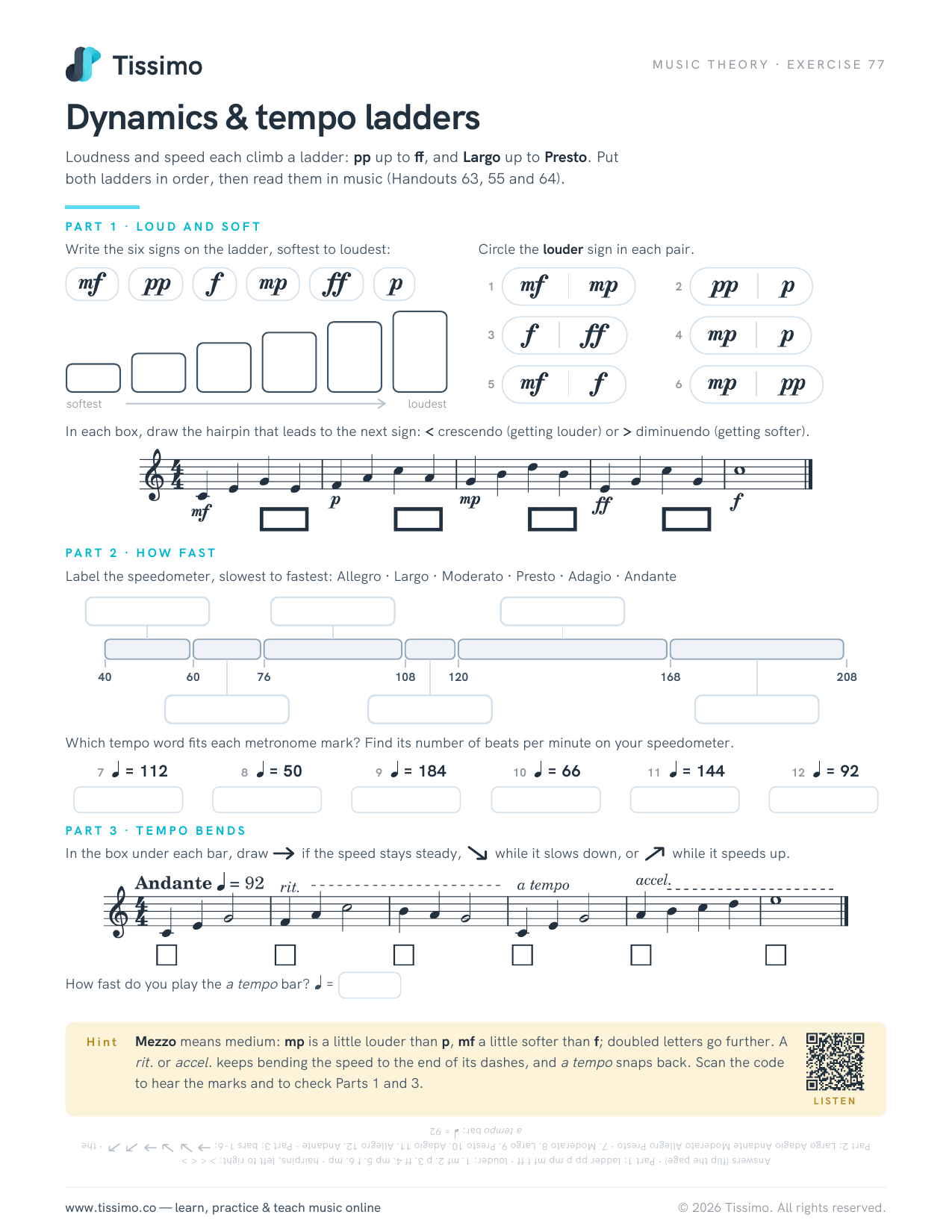 Dynamics & tempo laddersLoudness and speed each climb a ladder: pp up to ff, and Largo up to Presto. Put both ladders in order, then read them in music (Handouts 63, 55 and 64).
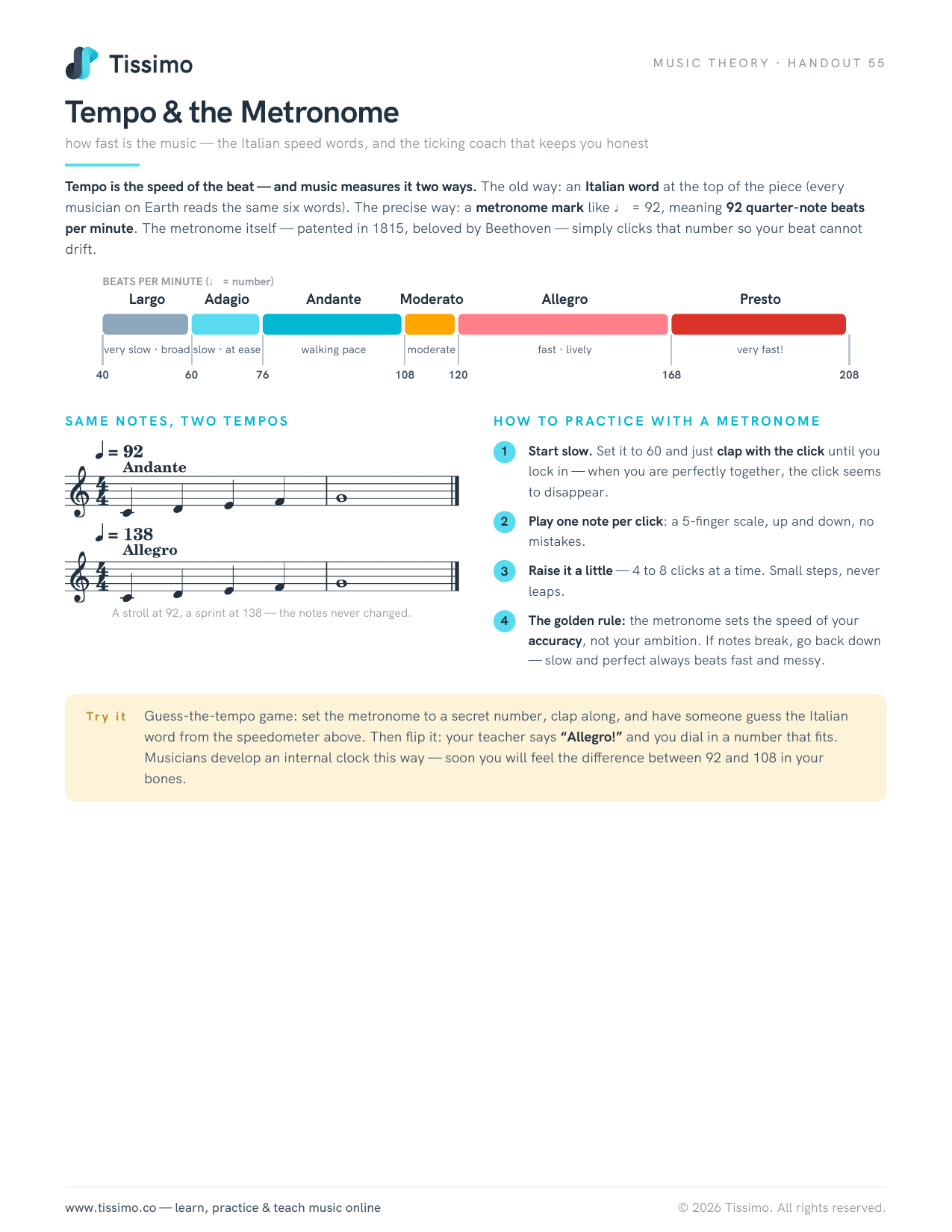 Tempo & the Metronomehow fast is the music — the Italian speed words, and the ticking coach that keeps you honest
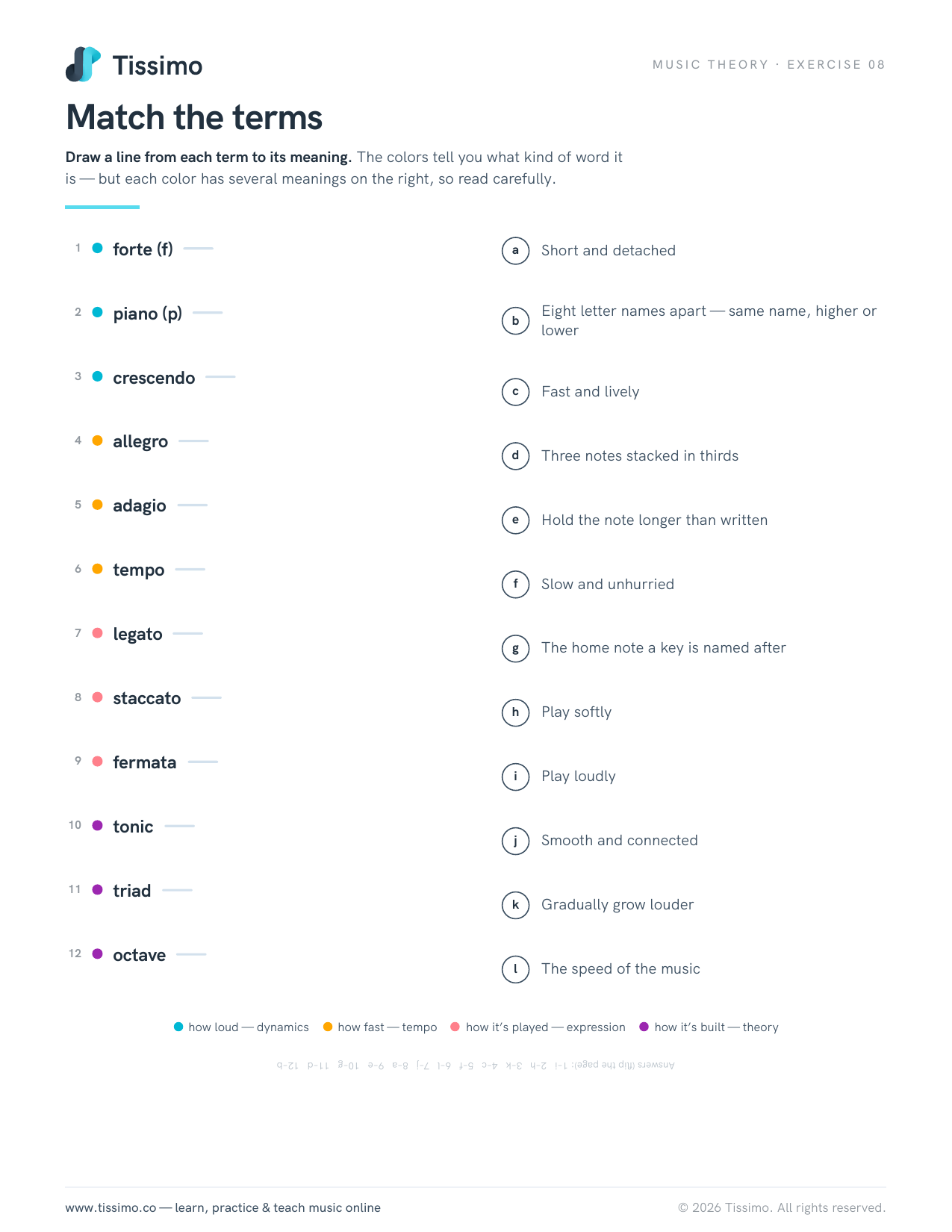 Match the termsDraw a line from each term to its meaning. The colors tell you what kind of word it is — but each color has several meanings on the right, so read carefully.
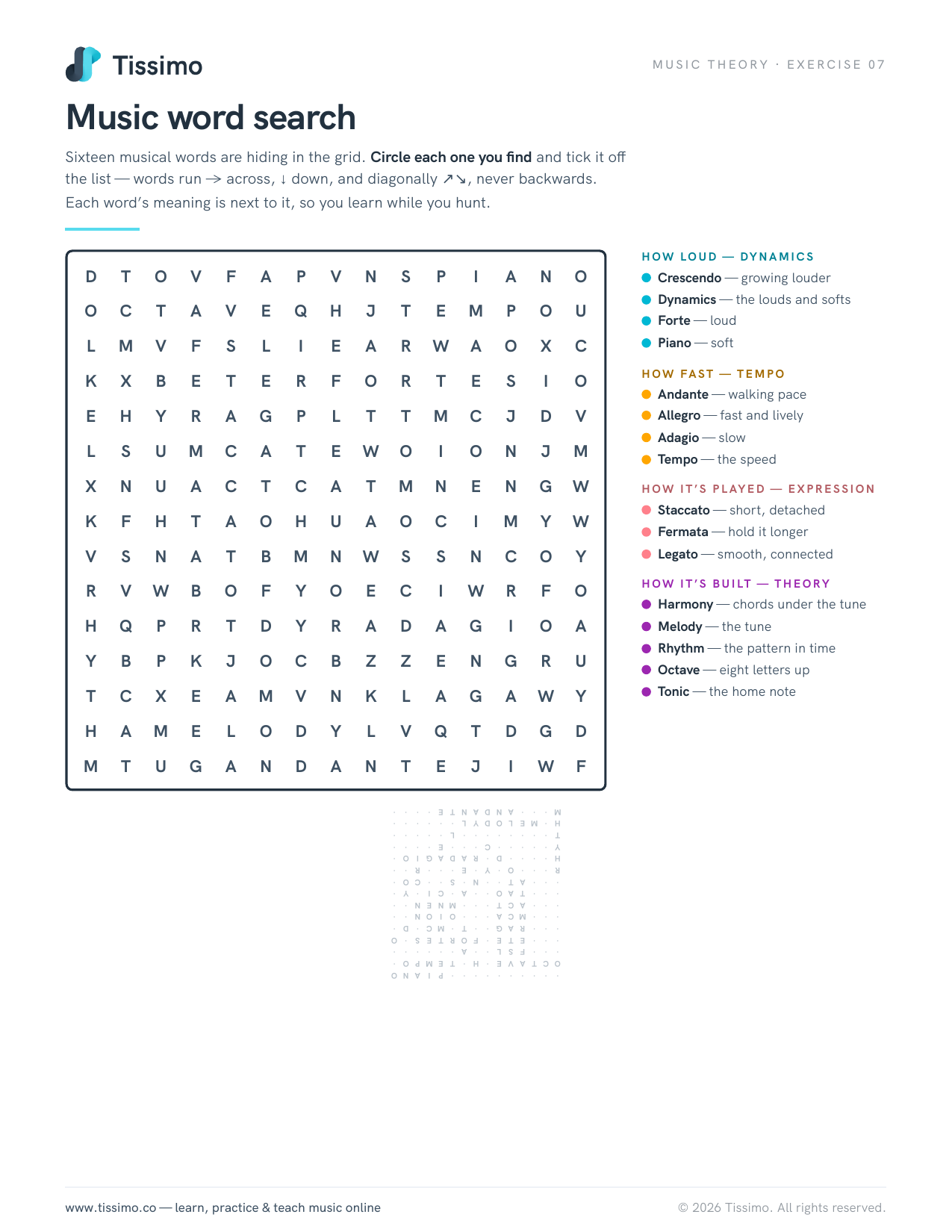 Music word searchSixteen musical words are hiding in the grid. Circle each one you find and tick it off the list — words run → across, ↓ down, and diagonally ↗↘, never backwards. Each word’s meaning is next to it, so you learn while you hunt.